
NOLA Express: An Interview with Darlene Fife

Darlene Fife and Robert Head at the 1969 Love In held in Jackson Square. Photograph by Michael P. Smith ©Historic New Orleans Collection, 2007.0103.1.115.4
July 2026From 1968 - 1974, Darlene Fife and Robert Head published NOLA Express, an underground paper that fought for the end of the Vietnam War and free speech. In this 1990s interview with Fife, she reflects on those turbulent years in the French Quarter.
– by Dennis Formento
If you listen to this story, don’t miss out on the photos below! July 2026: Introduction by Dennis Formento
Darlene Fife and Robert Head published one of the most uncompromising papers of the Vietnam War era: “NOLA Express” first appeared in mimeograph in 1968, like many contemporary literary magazines. “NOLA Express” reached peak circulation in 1970, going to 11,000 readers every two weeks.
Much later, while editing the "surregionalist" magazine, Mesechabe: The Journal of Surregionalism, I contacted Darlene to speak with her for a series of interviews I was doing with people who had had both major and unheralded roles in changing New Orleans through its culture from within.
These included publisher and artist Gypsy Lou Webb, poet, playwright, and Jazz Festival president Tom Dent, poet Lee Meitzen Grue, poet, activist and WWOZ radio DJ John Sinclair, author Kalamu ya Salaam, poet and translator Ahmos zu-Bolton, Karen Rittvo and Sara Beth Wildflower (on late coffee house owner, Robert Borsodi,) et al.

This column is underwritten in part by Karen Hinton & Howard Glaser
After a productive exchange of emails with Darlene, I traveled up to Lewisburg, WV, where they had landed after they left New Orleans). I met with Darlene and Robert (who declined to be interviewed) and turned on the tape recorder. The interview below is the transcript of that tape, edited for length and clarity.
Darlene published her memoir, Portraits From Memory: New Orleans in The Sixties, in December 2000 (Surregional Press). Darlene and Robert moved to West Virginia in 1974 and for the past 49 years Darlene has worked at The Bookstore and Plants, Etc. in Lewisburg, “now the oldest stores in downtown Lewisburg.” Read this July 30, 2026 story about her in The Real WV. And she wrote this essay about the late civil rights attorney, Richard Sobol, for FQJ in 2020.
Robert Head died in February 2025 at the age of 83. Darlene continues to write and travel widely in her woodland home.
Interview with Darlene Fife
DF: Speak about the importance of the underground press and what you wanted to accomplish with NOLA Express, taking off from the peer-oriented mimeo literary magazines. You felt you were mainstream.
Fife: Yes. We felt taking the government was taking us seriously – we were not a fringe group. The mimeo press, great as it was, was people talking to each other. That’s why so many people in mimeo poetry wanted to write for us: they were reaching a much wider audience. We were pleased by our indictment – it showed we were having an effect; the powers-that-be wanted to stop us. This applies not only to NOLA Express but to the way we felt before we started. We had the power to make deep change in American society.
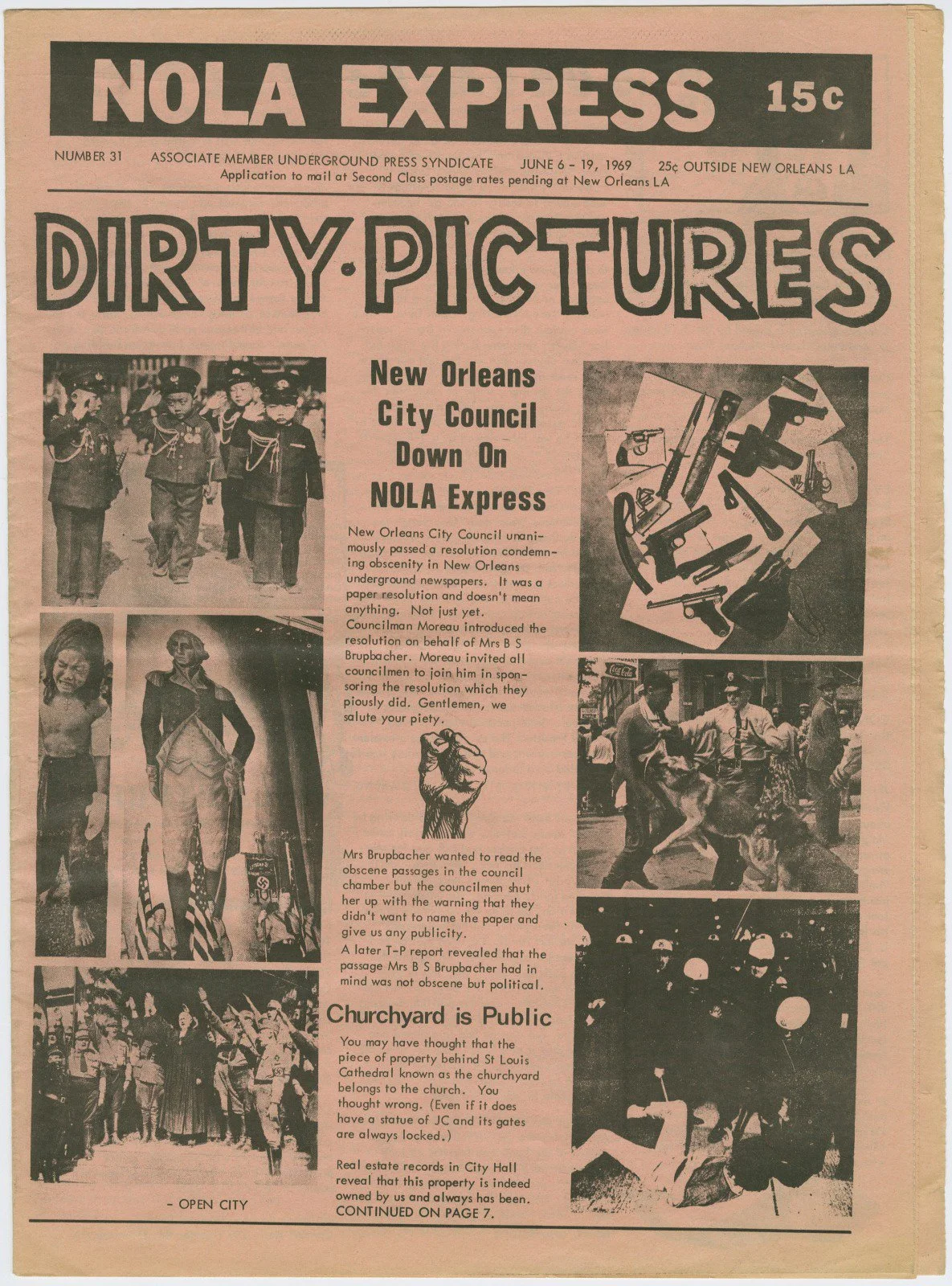
DF: Was there a similar sense of DIY-punk-ethic in NOLA Express? Doing it yourself on a manageable scale out of available material?
Fife: I don’t have that sense of “doing-it-yourself,” although that’s obviously what we were doing. At first it was mimeo machines, what we did with Movement for A Democratic Society [MDS]. How do you make change in American society? You used what you had.
DF: What was your readership at the beginning and in 1970?
Fife: We started NOLA Express in ’68 with a mailing list from the MDS newsletter, over a hundred people. People wanted to end the war. At the high point, we were selling 11,000 copies on the streets plus the subscriptions, which was probably about 500 people.
DF: Did businesses seek you out for advertising or did you beat the streets?
Fife: Both. The large record companies at one point were all advertising in the underground press and would automatically send ads. Mainly, Robert went out on the streets. At various times we had advertising managers. When you are selling 10,000 copies every two weeks, people are anxious to advertise. It’s just getting out there and doing your work.
DF: Some of the undergrounds depended in part upon personal sex ads that created a rift within the publishing collectives.
Fife: We did too, to a degree. Robert and I were the publishers and what we wanted in the paper was in the paper. We did get criticism from women about publishing Bukowski and the sex ads, but they only ran for a brief period. The pornographic movie houses were having the same problems. They were being indicted at the same time as we were, so there was a certain First Amendment bond there.
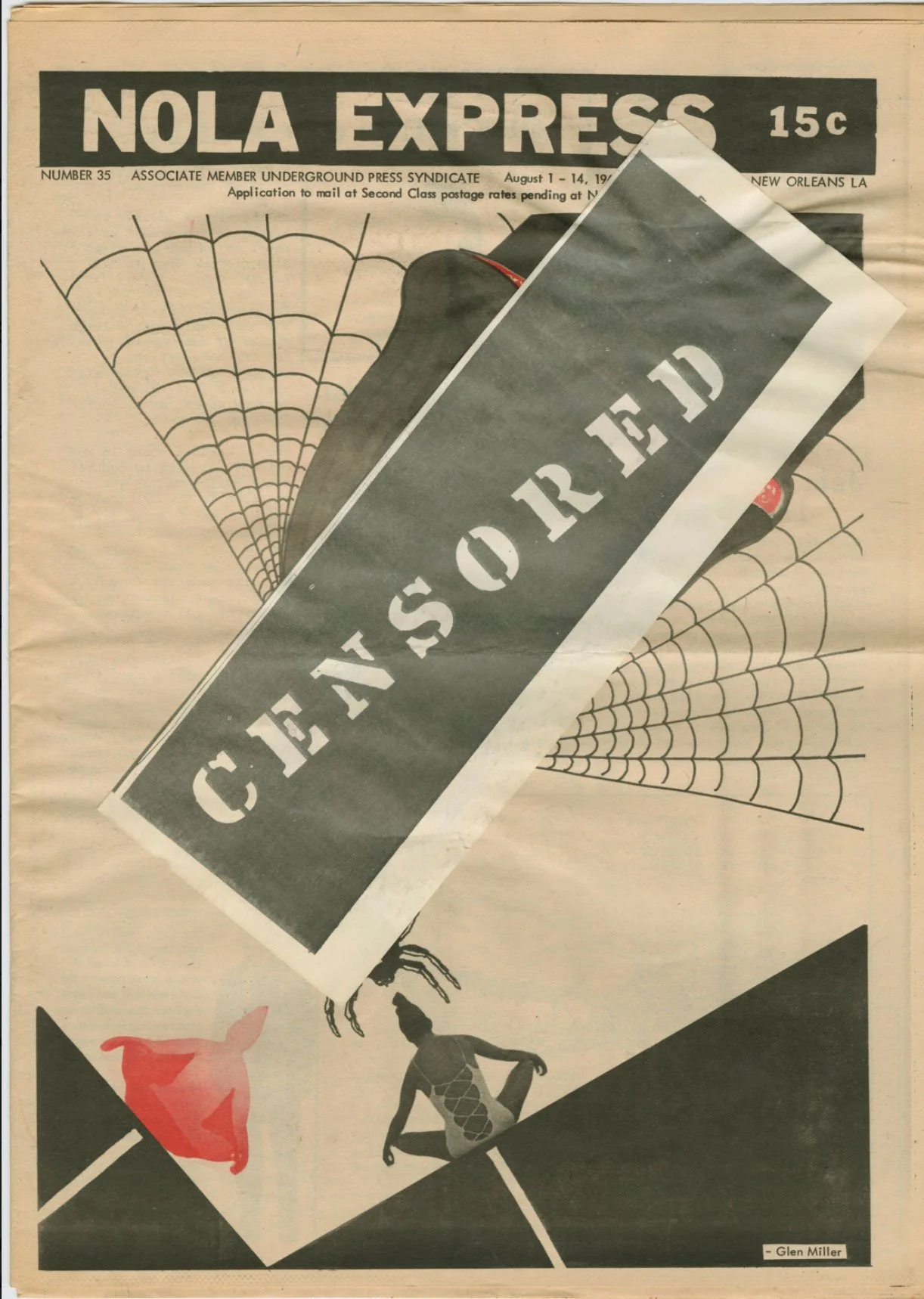
The NOLA Express cover by artist Glenn Miller that helped change obscenity laws. Courtesy Glen Miller
DF: It’s ironic that you were indicted for obscenity when other things you were doing were more important.
Fife: That was the only thing they could think of. Kendall Vick (NOLA Express lawyer) pointed out in Larry Leamer’s Paper Revolutionaries that the cops were arresting vendors on charges of refusal to move on, to get NOLA Express off the streets. And when that didn’t work, when we got the Christenberry injunction, they went around to the Federal offices and said, “What can you do?”
DF: They were harassing the vendors but didn’t come after you and Robert very hard.
Fife: I have never really understood that. There was certainly a possibility of infiltrators busting us on drug charges. At one point somebody who said he was a cop called us on the phone and said that our photographs were being circulated amongst the police department. They were told that under no circumstances to arrest us. I have no idea why.
They would have loved to throw us in jail. The problem is that we had lawyers. Lawyers were very important to the underground press. They knew that immediately we would be out of jail. There was always the issue of whether I was a CIA agent.
DF: Why did they think you were CIA?
Fife: I write about it in my book: “The reasons might be that I was a little older than most, worked as an engineer at Chrysler and just wasn’t like the other folks. At my interview, the city attorney was asking me questions like name, address, and then suddenly said, ‘Are you a CIA agent?’ I was so stunned, I said nothing. Our attorney, Richard Sobol, jumped up and said, ‘Don't answer that.’”
DF: They charged vendors with failure to move on, obstructing sidewalks.
Fife: Just charges to get the paper off the streets. We had a big struggle to get a vending machine into City Hall. It was the usual thing: “You can’t do this.” The Picayune was being sold in City Hall, and eventually, after writing enough letters, we did have a machine there. It wasn’t a driving thing in our lives; it just seemed like a nice place to have a box.

More images from the 1969 Jackson Square Love In. Photograph by Michael P. Smith ©Historic New Orleans Collection, 2007.0103.1.114.1 Love in Jackson Square 1969
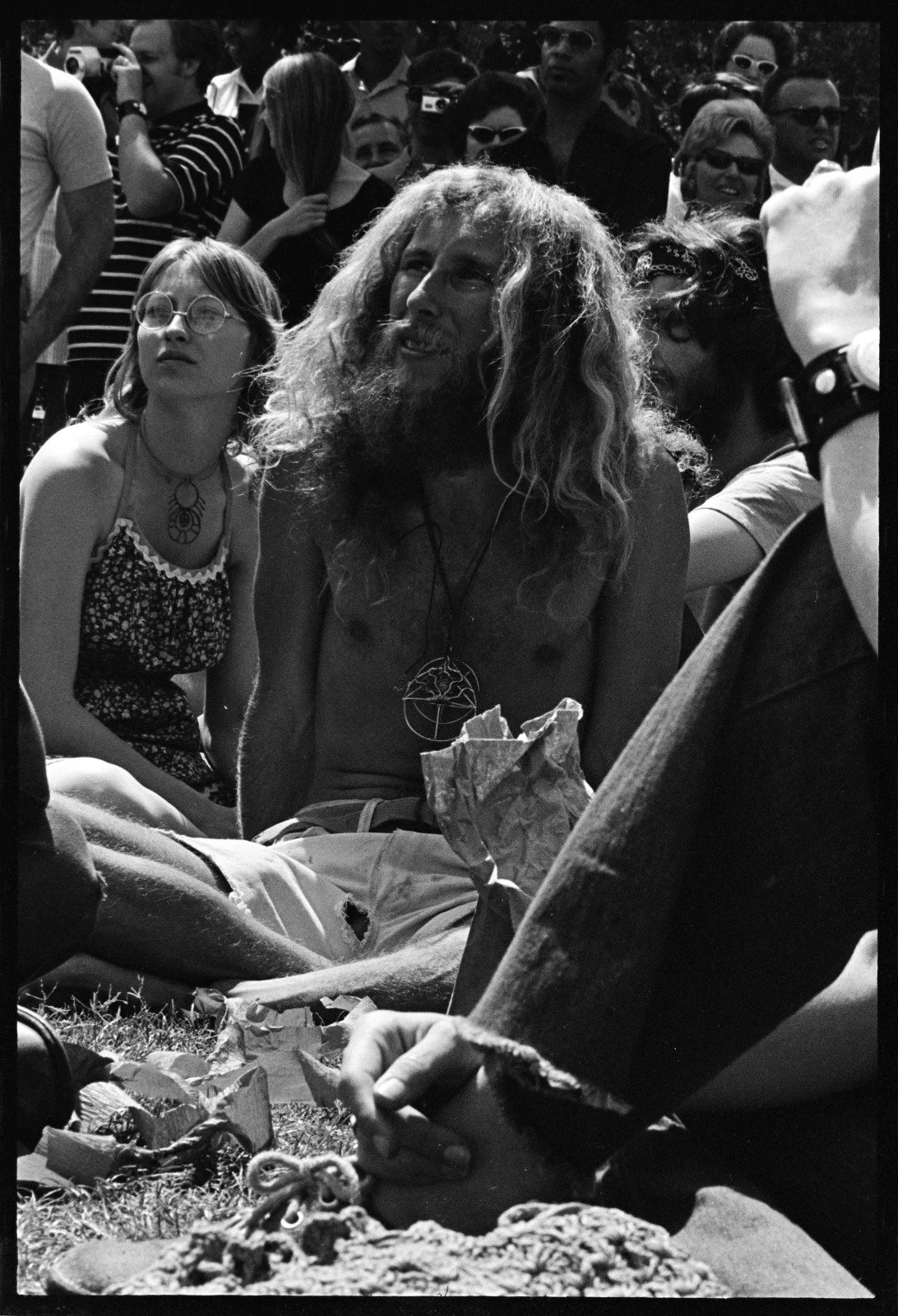
Artist Amzie Adams, a vendor for NOLA Express, at the 1969 Love In in Jackson Square. Photograph by Michael P. Smith ©Historic New Orleans Collection, 2007.0103.1.115.4

Watchful eyes at the Love In. Photograph by Michael P. Smith ©Historic New Orleans Collection, 2007.0103.1.115.9
DF: How did you produce the paper?
Fife: We had a mimeograph. Later, Robert printed it on a press in the ACLU office, 8.5” by 14” format. He knew how to print because he had been working as a printer in the Roosevelt Hotel. We did that for 16 issues.
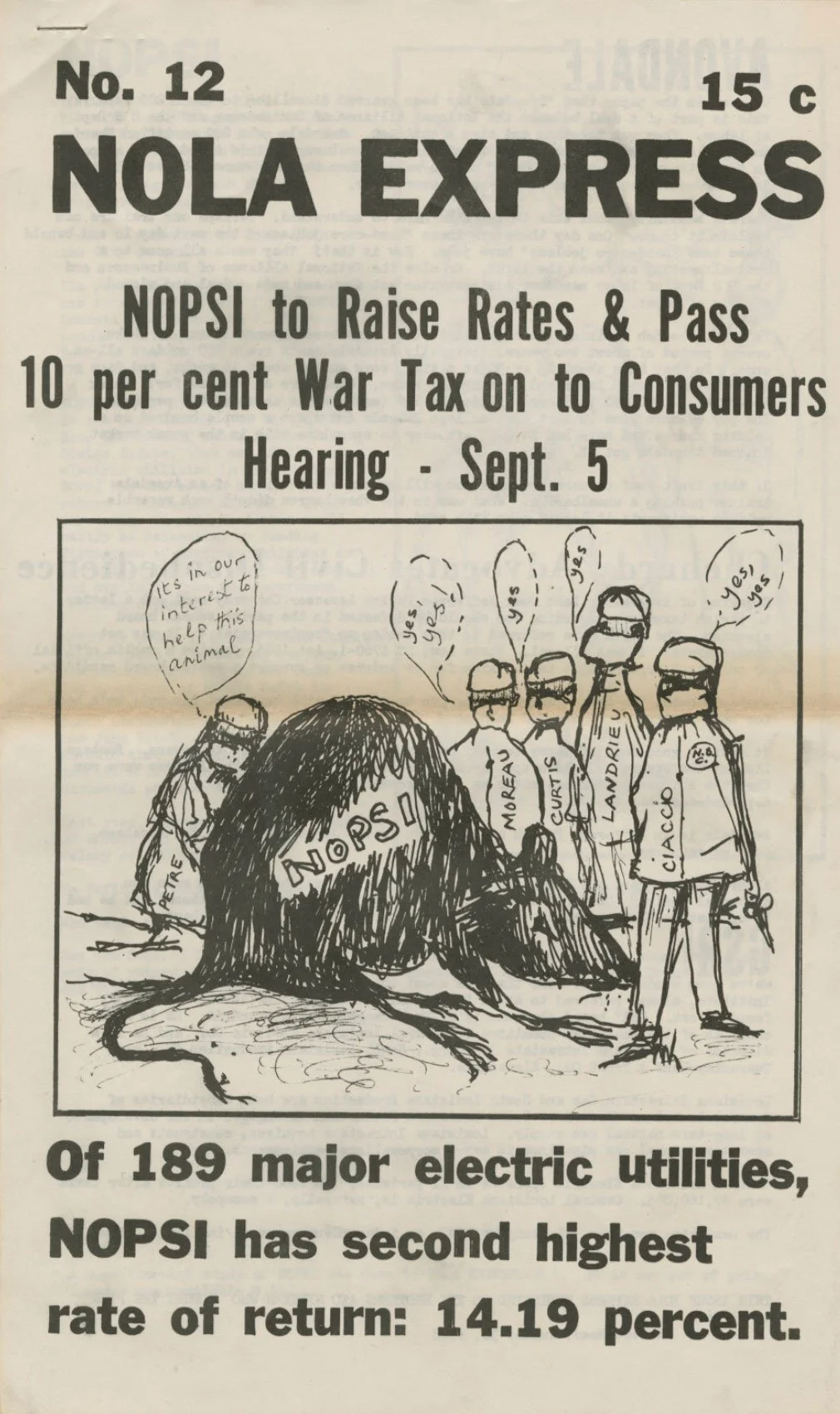
The cover of an early issue of NOLA Express,
He was getting an infection on his fingers from the ink, so we decided to go to a tabloid format and found a printer in Metairie. They printed the rest. When we were using the Vieux Carre Courier offices, we ended up using the IBM Selectric typewriters, and then after we were finished with the Courier, we were doing it on IBM Executives.
You had drawing boards and large sheets with blue lines to help you line it up, Exacto knives and blue pencils. The paper came out on the weekend. It was total exhaustion or parties then, and afterward. The work started again on Monday, people coming by the office or apartment.
I did a great deal of writing, research, right up to a day before the layout work. Robert worked on layout or the cover and centerfold, pacing the floor up to two hours before I had it ready. Then he would do the layout in a hurry.
I did layout for my own stuff. Sometimes he would help with that too. Robert always took it to the printer and it was done the next day. It was a very tight schedule.
DF: Do you feel like you were enmeshed in a large community or with a few dozen people keeping you together? Were you in touch with the eye or the whole hurricane?
Fife: We were part of the French Quarter community. If you ask people who were around in the sixties if they knew us, a great deal of the time the answer would be yes.
DF: You mentioned seeing Noel Rockmore around the Quarter, but getting no sense of recognition from him. On the other hand, you knew Louise and Jon Webb vaguely, but you felt distant from the arts community.
Fife: I’m just speaking of people who considered themselves as living purely in a literary-art world. But there were some great artists in the Quarter we did have contact with. There was in NOLA Express no division between art and politics, and I think that was because Robert and I both happened to be literary people from the start.
We were in contact with McBride from the beginning. He was a ham radio operator, a loner. I don’t remember ever speaking to McBride except that time I went to see his ham radio operation. Robert got the art from him.
Murph Douwouis, an artist from Houma, was very close to “NOLA Express.” Murph was a draft resister, too. That’s how we first got to know him.

Cover of the March 1973 issue of NOLA Express, artwork by Juanita Abbott.
DF: Poet James Nolan said people in The Quorum Club Coffeehouse and the Dream Castle bar were both locals and a lot of southern refugees from their families – young people threatened with institutionalization. They all came to New Orleans. Did you have a feeling of a particular, self-identifying community?
Fife: I felt more like a regular reporter. You were part of the world in which you lived. People responded to you not only from a particular group, but from other places in town.
Lots of people came in from out of town. Ed Clark was from St. Louis. There were people from New York, but there were plenty local people: Walter Collins, Murph Douwouis. Robert himself is from New Orleans.
DF: Do you think you would have been able to carry on beyond January 1974? You mentioned a phone conversation with Charles Bukowski. You said, “Well, perhaps we will publish again.” He said, “It will never be the same.” Did you ever meet Charles Bukowski?
Fife: Never met Bukowski. He was published a great deal in the mimeo papers, and he is also a great writer. Robert wrote him and asked if he would write for us, and he started sending us stories every two weeks, sometimes poetry, but mostly stories. We paid him $25 for each, and that was very important to Bukowski. His stories were being published within two weeks. People wrote letters to the editor, saying how much they hated or how much they loved Bukowski, which we would immediately print. He loved writing back to people who were saying nasty things about him.
DF: Who else was reading it?
Fife: People who were well-known: Charles Plymell, Claude Pelieu, John Bennett, who were part of the mimeo revolution. d.a. levy loved it. Allen Ginsberg— Robert did an interview with him and he hung out with us.
We thought of ourselves as coming to West Virginia and doing some kind of publication. We were literary people and we had been doing it for six years. You can’t envision yourself as being something totally different – that just never happened.
I remember being approached by a lawyer, asking for somebody who wanted to buy NOLA Express. We felt it should end with us. I never could figure out what it was that person thought he was buying. I said, “Tell this person he can start his own newspaper.”
DF: What were your workdays like?
Fife: I don’t think there was a feeling of a workday. We were doing all the things you needed to do – work and go back to the apartment. In the evening, it ended. We spent our nights in bars. I don’t recall what time we got up. It was work all the time – that doesn’t sound right, but it was all part of your life.
I have to have a sense of purpose in doing something. For example, [my book] Portraits from Memory, I couldn’t write it if it was some sort of self-indulgence. I wanted to say what was going on at that time.
I wanted to say that people were serious, say what it was actually like in my world in the ‘60s in New Orleans, so it wouldn’t be forgotten.
I read detective stories. One of them was set in New Orleans. It was like another world. Like what people say about great food, the prostitutes, the way the Quarter looks, the grille work. It was more than that.
I don’t have a sense of bitterness parading around in my heart, but I remember the reporters in New Orleans, how bad they were. They didn’t understand the underground press. You could almost forgive them for that, but they didn’t understand anything about reporting. They had no sense of integrity, they were doing a job, and somehow journalism should be a higher calling.
DF: What coverage was there by the dailies of busting your vendors or the obscenity indictment?
Fife: I don’t remember any coverage by the Times-Picayune and States-Item. The only thing I recall is a smidgen about the nuclear power plant and Robert’s intervention. They were not able to cover that with any seriousness. They certainly couldn’t cover anything else about us, because the intervention was very important to the city, and they didn’t cover that. I remember being interviewed a few times on television, but I didn’t have a television. I don’t know what they did. It must have been about demonstrations.
DF: What about contact with Black media? You had common interest in human rights and getting people out of the draft.
Fife: When Mike Higson was editing the paper [NOLA Express], he made a conscious effort to get news from the Black community. We had contact with the Black Panthers when the police were surrounding their house.
When we went to Christenberry to get the injunction against the police, there was a Black newspaper that tried to get the same injunction, which Christenberry turned down. I remember writing an article about it as an example of racism. He was more sympathetic to us than to the Black paper. Maybe he considered it too revolutionary, maybe he was prejudiced.
DF: Higson was the person the Panthers contacted, who went there when the Panther house was surrounded.
Fife: The way Higson recounted it, he was the only newspaper person there.
DF: Did “NOLA Express” come like an artwork, right out of your sensibility and Robert’s?
Fife: That’s true as long as you don’t think of it in some sort of sentimental way. That would be what I would call self-indulgence, but being against the war was something that came right out of my very being.
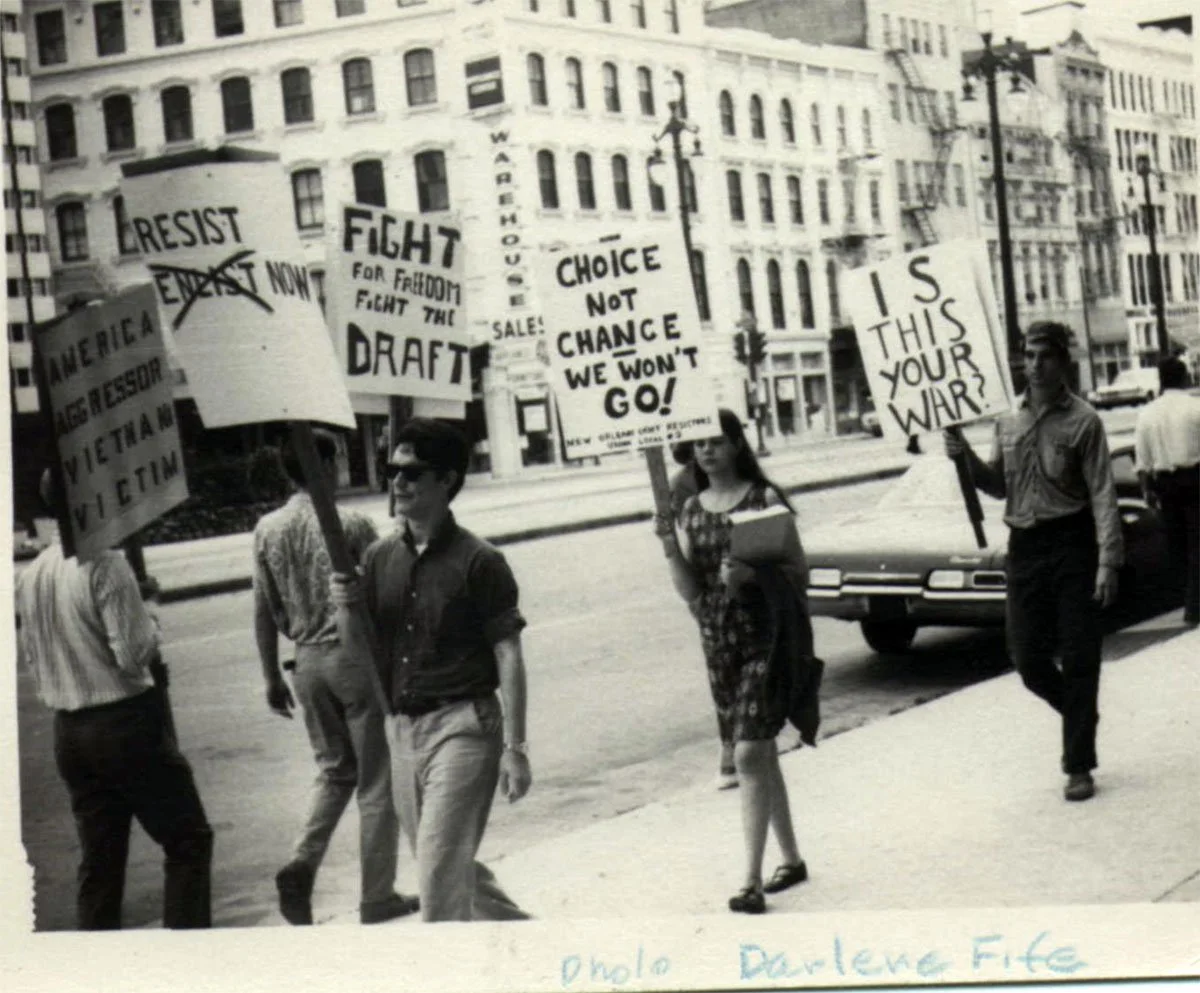
1964 protest against the Vietnam War by Darlene Fife, courtesy of Darlene Fife
DF: Who was the guiding force?
Fife: Robert was the guiding force. I don’t know if he could have done it without my hard work. He was the one with the gift for seeing things that other people did not see, and I did the research.
It was his idea, in ‘66 or ‘67, to get the file cabinet and start making files on heads of this or that corporation in New Orleans in an interlocking directorate. It was his idea, but I’m the one who did it.
DF: Did people help with legwork?
Fife: Sometimes, in later years. Jack Minnis wrote a column every two weeks, Bukowski was writing a story every two weeks, but legwork for a story – people don’t have the tenacity – 99% of the legwork was done by myself.
DF: Had the war not happened, would you have been writing and translating?
Fife: I’ve always had that kind of inclination. Robert has always been a poet and certainly he still is [at the time of this 1990s interview]. But what life would have been like, I have no idea.
DF: In those years between 1964 and 1970 – do you think that things happened so rapidly that they created a fast-paced rhythm that shaped your entire life?
Fife: More in retrospect than when I was actually living it – it’s like this incredible amount was telescoped into this really brief period of time, but living it, I didn’t really have that feeling. It seemed like trying to stop the war in Vietnam was endless – it was going on forever.

Click on the image to order the book.