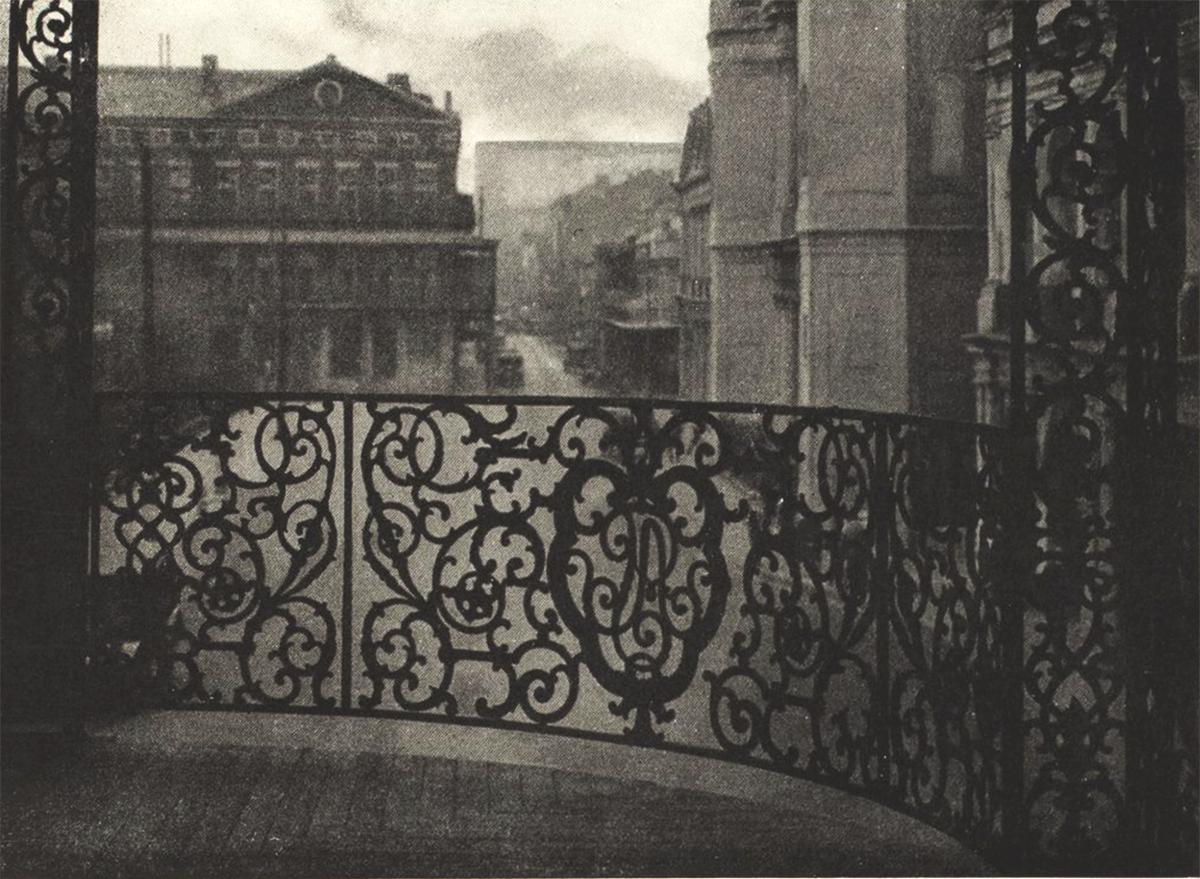
Pontalba buildings by Arnold Genthe, 1920s, one of the images in his 1926 book, Impressions of Old New Orleans
November 2026Fearful that the French Quarter would not survive a 1920s onslaught of demolition, a world-renowned photographer uses his craft as a tool for preservation.
– by Richard Goodman
Exactly 100 years ago, German-American photographer Arnold Genthe published a book of black-and-white photographs called Impressions of Old New Orleans. Most were taken in the French Quarter. He had walked the streets of the Quarter – first in 1920, and then a second time, probably in 1924 – with his hand-held camera, taking scores and scores of photographs, 101 of which would eventually appear in his book.
Genthe (pronounced JEN-tuh or GEN-thuh), a remarkably successful and sought-after studio photographer in New York City, had become entranced with the romantic idea of nineteenth-century New Orleans.
He was spurred on by the writing of George Washington Cable (Old Creole Days,1879), Grace King (New Orleans: The Place and Its People, 1895), who would write the foreword to his book, and, most especially, the work of Lafcadio Hearn, who had lived and worked in New Orleans for many years.

This column is underwritten in part by Vieux Carre Property Owners, Residents and Associates
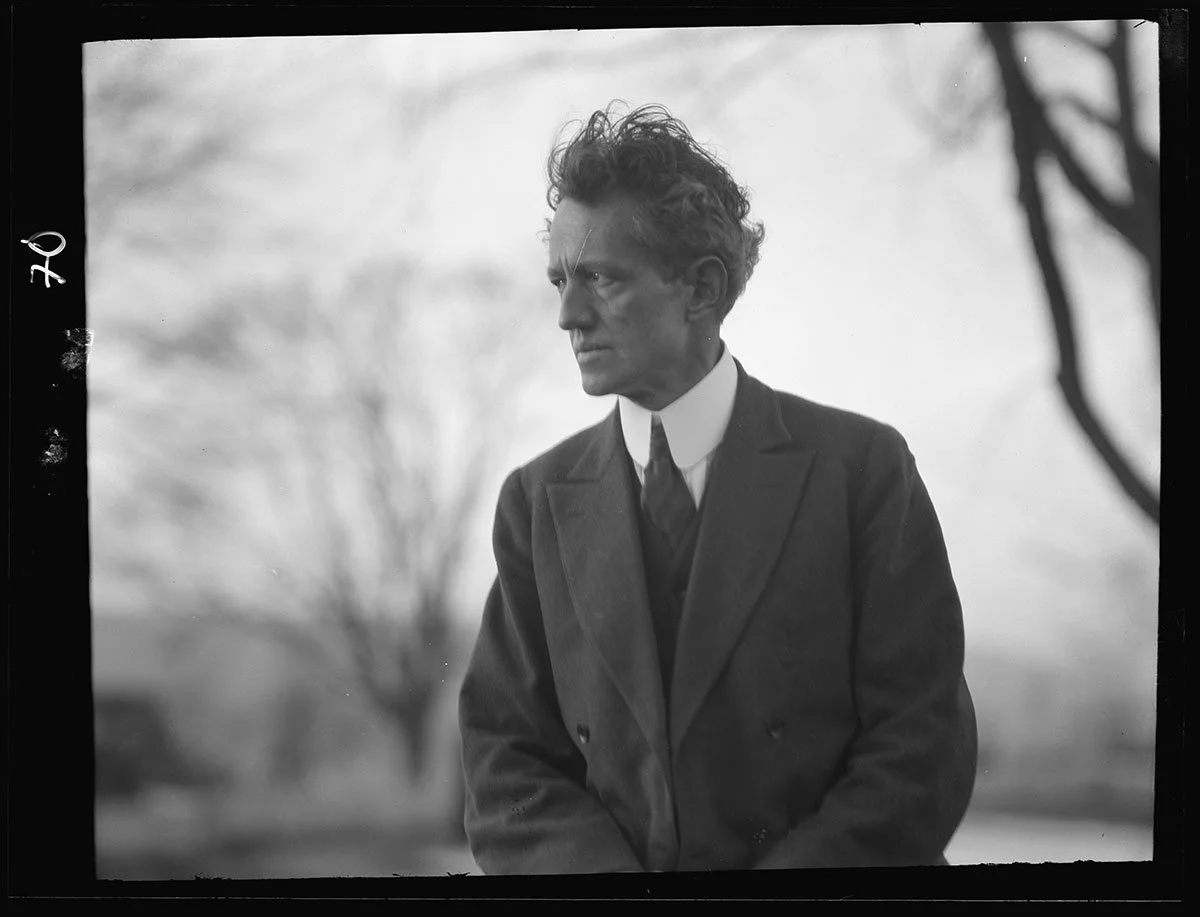
A self-portrait of Genthe, date unknown, Library of Congress, Prints & Photographs Division, Arnold Genthe Collection, 7a09352u
Genthe came to New Orleans with a worried mind. He’d read that the New Orleans he nurtured in his heart, with, as he writes in Impressions of Old New Orleans, “an architectural heritage richer and more varied than has fallen to the lot of any other American city,” was fast disappearing. It was being altered forever, even destroyed, by the vulgar forces of modernity.
He was determined to photograph the city he had read about and imagined so delightfully before it was too late. He also felt that his photographs might inspire people to stand up to those who, as one writer put it, were “beginning to destroy her old glories in the pursuit of her ambition to become that modern atrocity, an up-to-date American city.”
In other words, he thought his work might motivate people.
“It occurred to me,” he wrote, “that such photographs as I had in mind might contribute at least something to the work so eloquently urged.”
That is, to preservation.
Arnold Genthe, then, was not just a photographer, he was an activist.
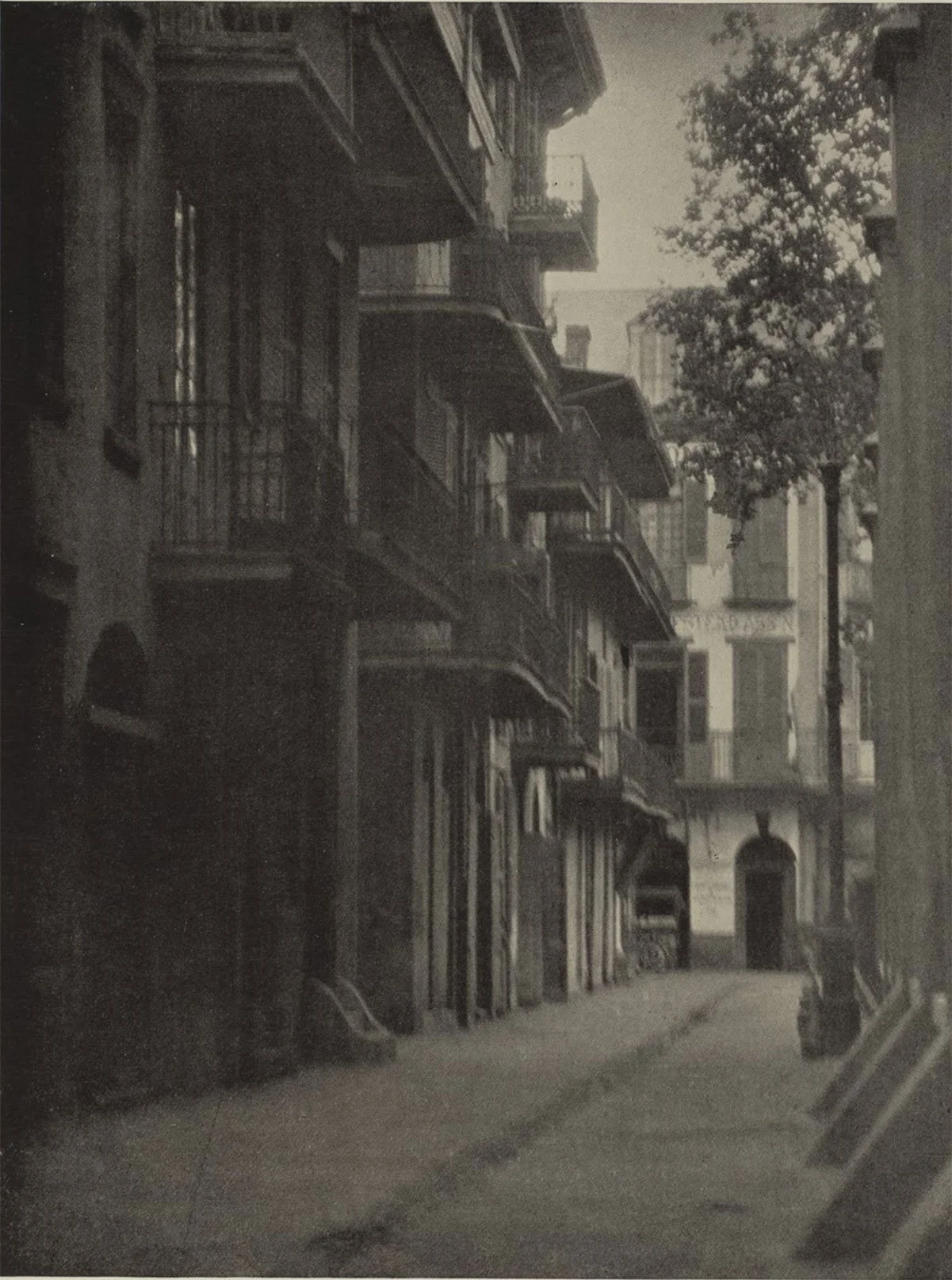
Genthe titled this shot of Pirates Alley “A Street Overhung with Shadowy Balconies” in his book, Impressions of Old New Orleans.
When he arrived, he was disappointed at first. His fears about the city’s drastic changes were confirmed. “The changes wrought by modern American life seemed quite disastrous for my purpose. The old quarter was bustling with the noise and hurry of a modern thriving American city. Vulgar signs and gaudy advertisements disfigured fine old dwellings; nets of telephone wires marred charming vistas, and in the narrow thoroughfares electric cars were a distressing element of modernity.”
So, what did he do in the face of such disappointment?
He created the New Orleans that he had wanted to find. He made the city look like the city of his imagination. He created the city he’d read about in those books.
He took photographs, but he did not include cars (with two hardly discernible exceptions), telephone wires, advertisements, or trolleys. When they appeared in a photograph, he made them disappear; he simply retouched them out or cropped the photograph.
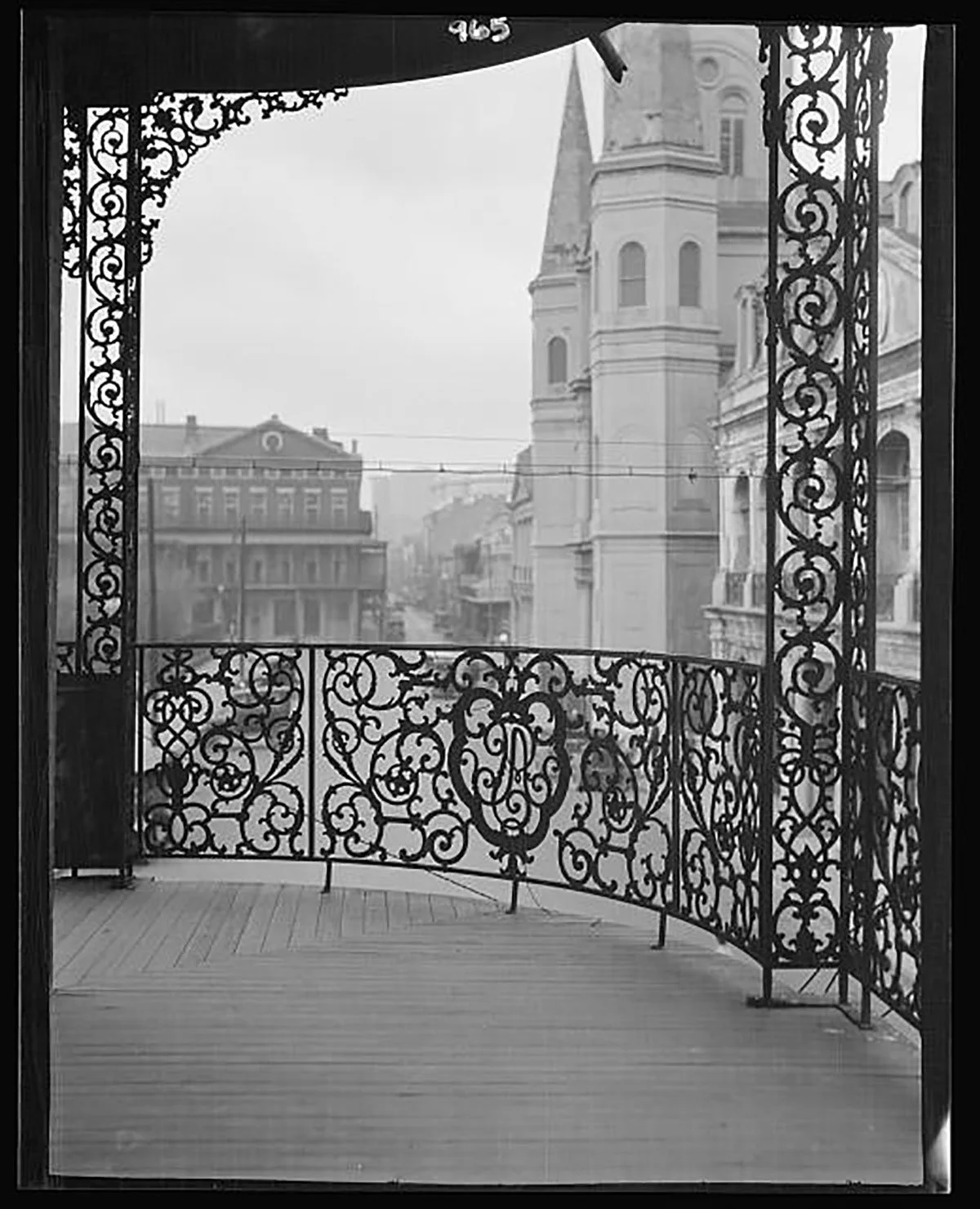
This image of St. Louis Cathedral and Jackson Square from a wrought-iron balcony of the Pontalba Buildings shows the modern wires that Genthe detested. Photographed by Arnold Genthe between 1920 and 1924, Library of Congress, Prints & Photographs Division, Arnold Genthe Collection, 7a03204. This image was not included in Impressions of Old New Orleans.
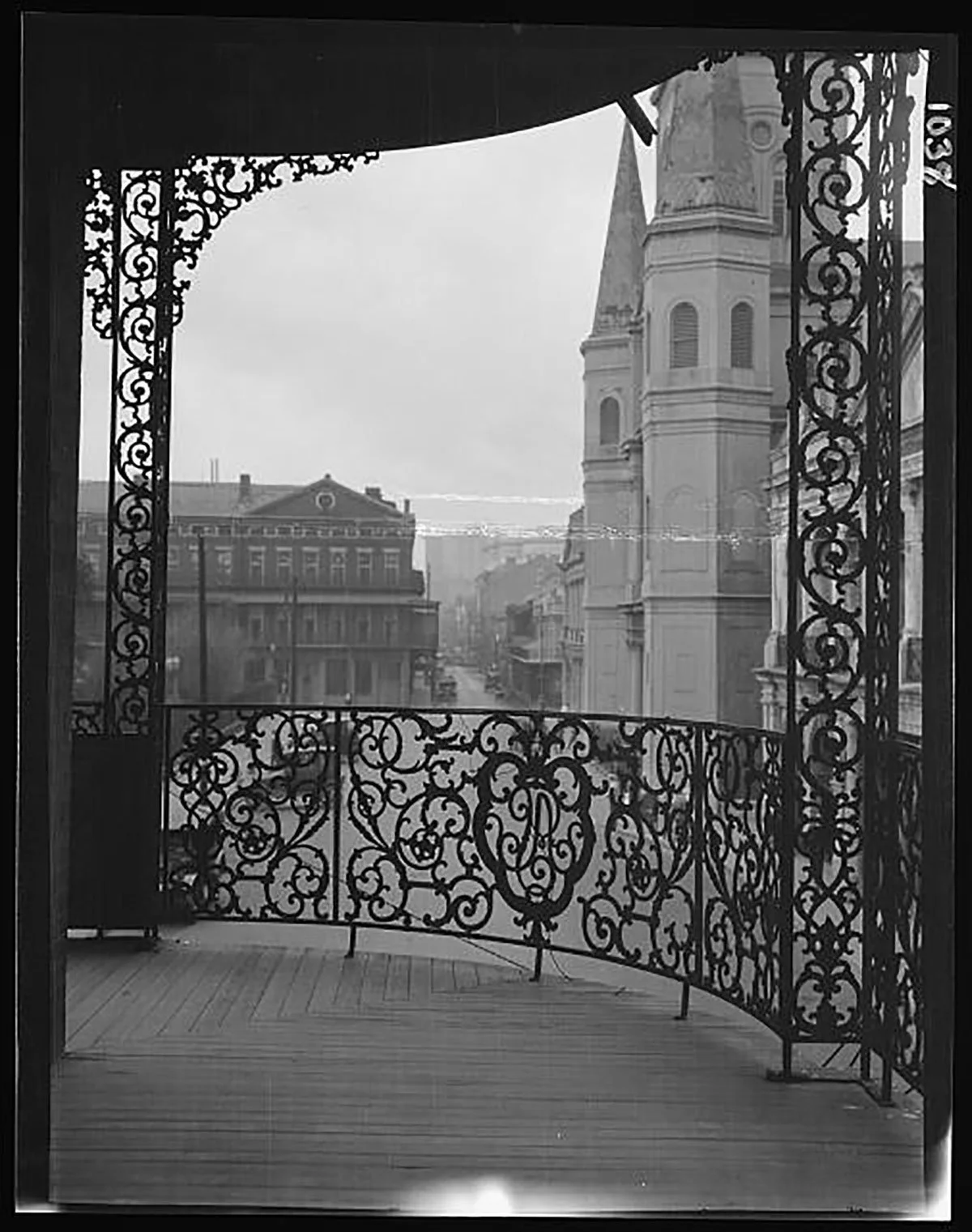
On a separate negative, Genthe apparently tried to remove the wires in the image, perhaps not as successfully as he wanted – this photo was not included in the book. By Arnold Genthe between 1920 and 1924, Library of Congress, Prints & Photographs Division, Arnold Genthe Collection, 7a03204.
Genthe erased modernity from his lens’ eye by another method: he took many of his photographs of interiors, of courtyards, behind walls and doors where you would not encounter a vulgar advertisement or a car. Of the 101 plates in the book, more than half (64) are without people. This has the result of making those places he photographed have a kind of timelessness to them. If you took many of these photographs of courtyards and houses behind walls and told someone they were taken in, say, 1875, they would be hard-pressed to contradict you.
Finally, he took his photographs and made them, in the darkroom, moody, even painterly. There is a dreamy look and feel to them. This was a deliberate artistic choice.
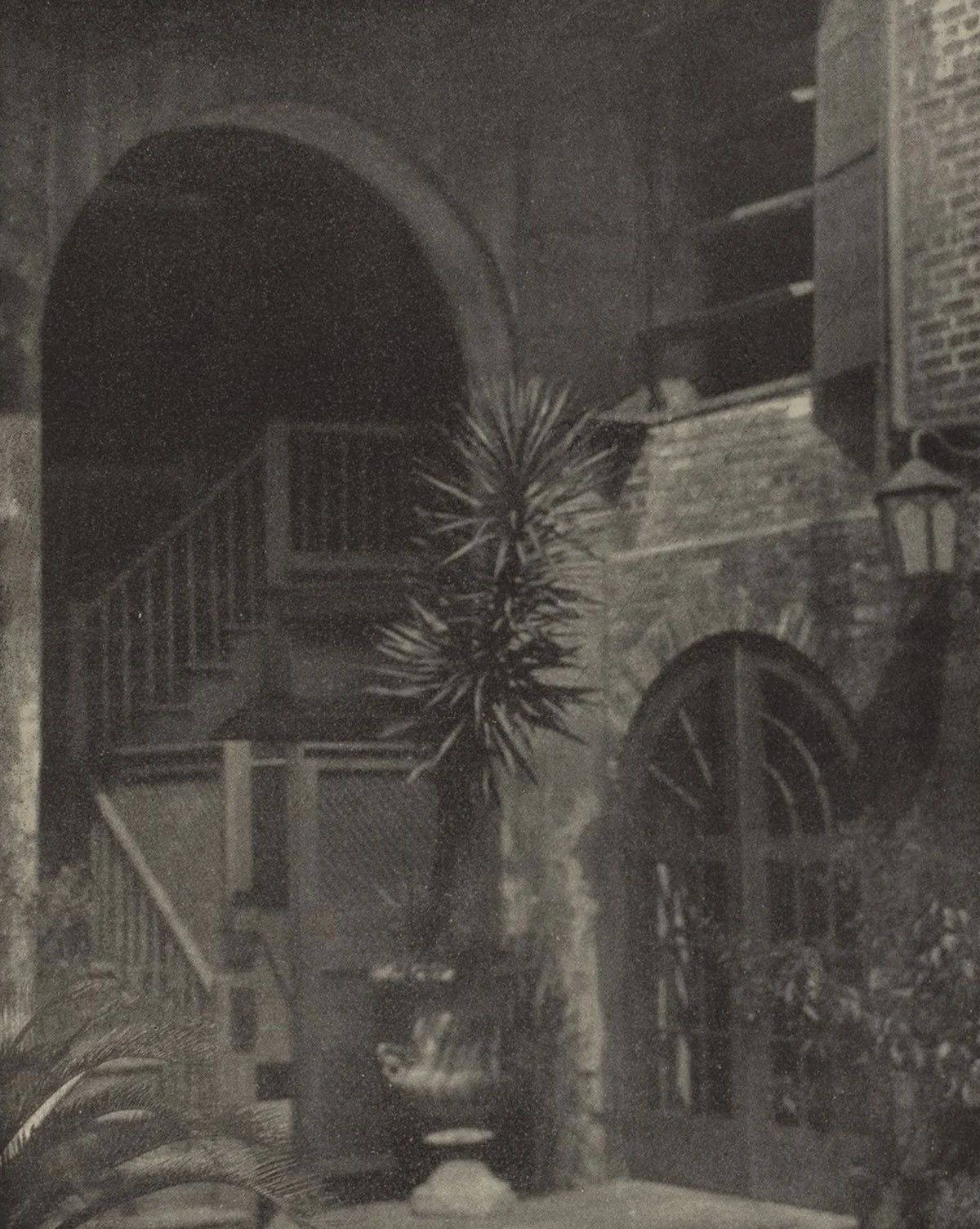
“A Restored Patio (‘Arts and Crafts Building’) by Arnold Genthe in Impressions of Old New Orleans. The building is now home to The Historic New Orleans Collection, 520 Royal Street.
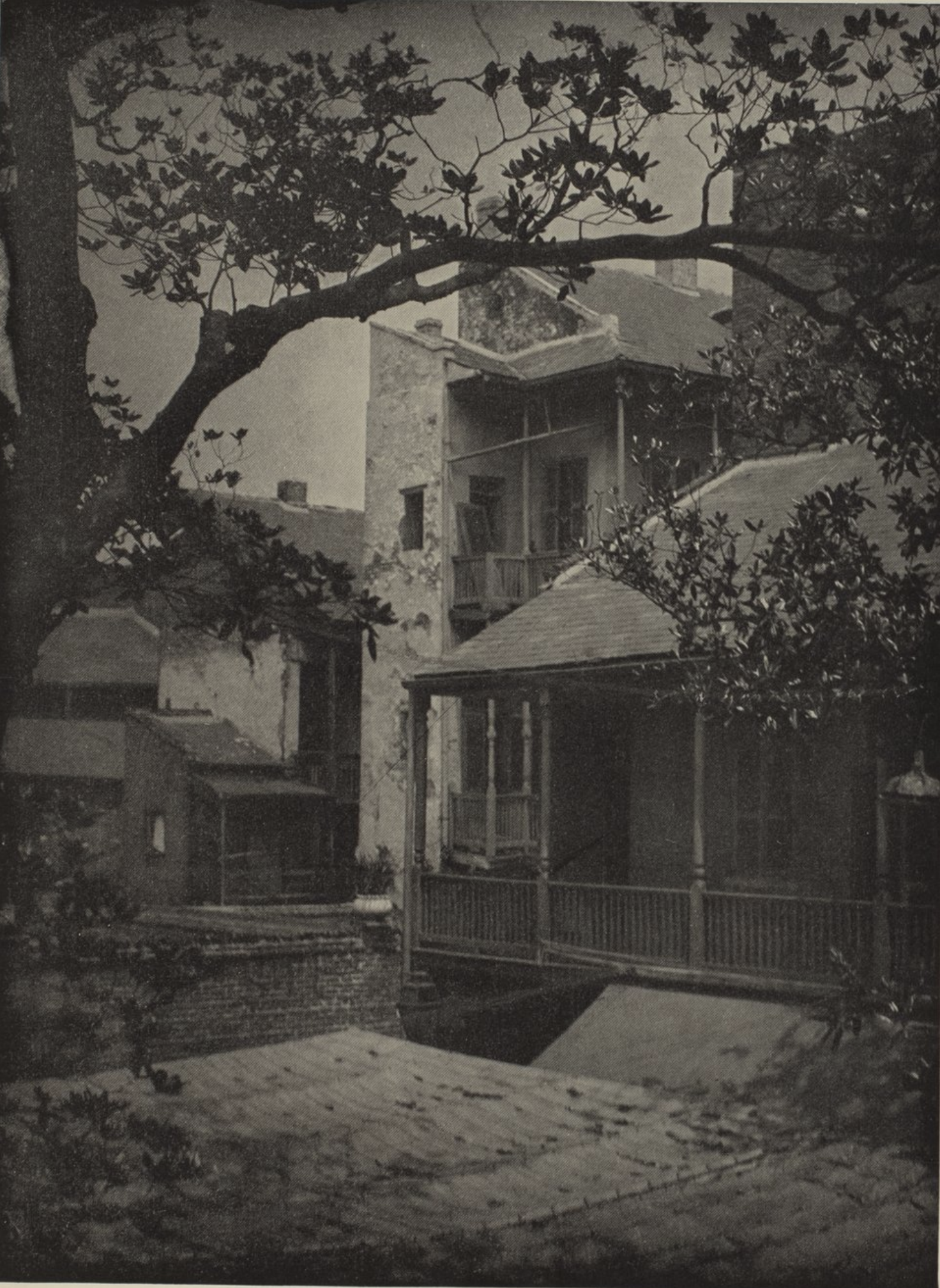
“Slave Quarters and Magnolia (‘Patio Royal’)” by Arnold Genthe in Impressions of Old New Orleans.
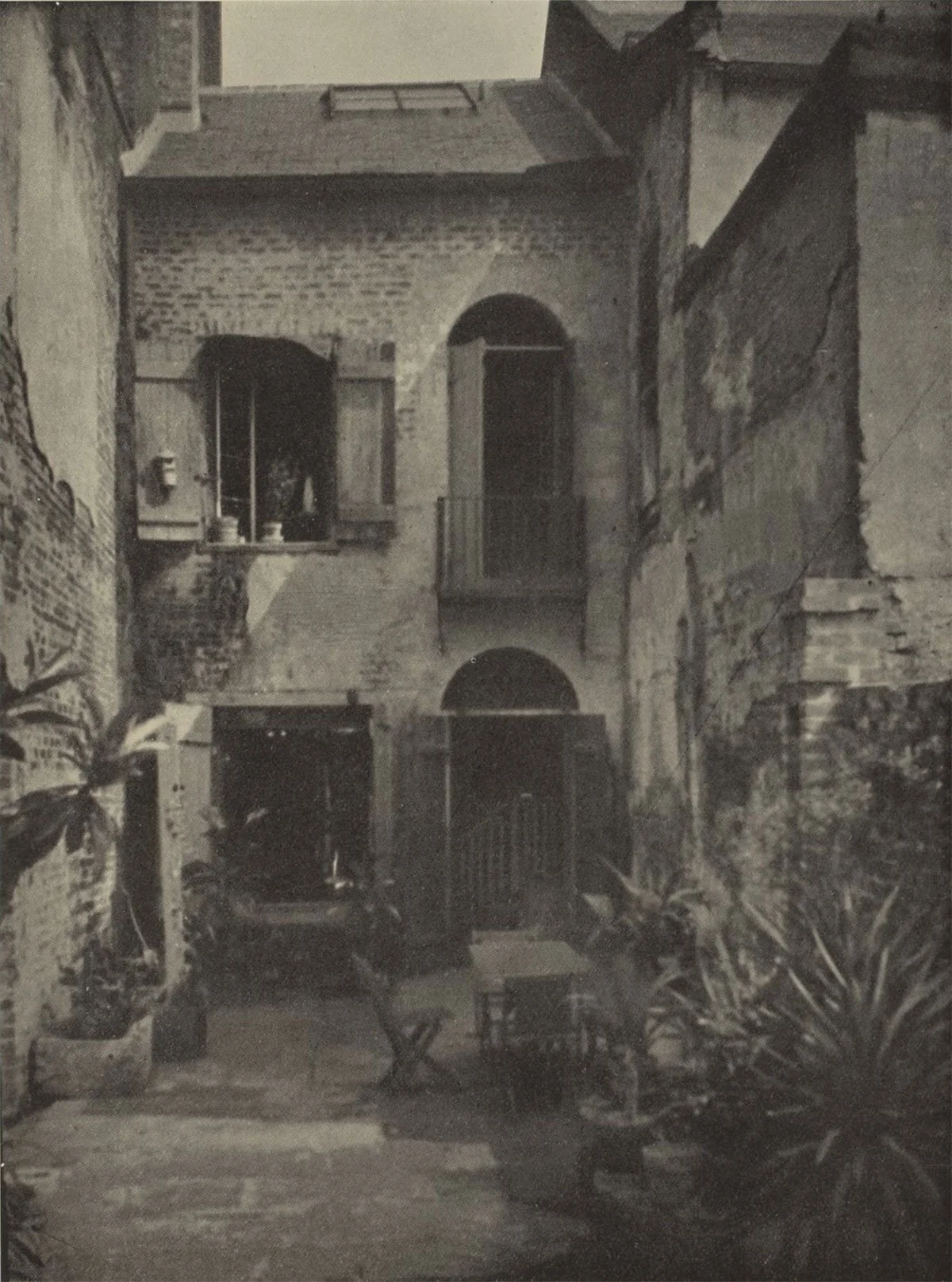
"The 'Green Shutter' Patio by Arnold Genthe in Impressions of Old New Orleans. The Green Shutter was a gathering place for artists and writers in the 1920s. Read more about it in our archived story, “The Heathen Crowd at the Green Shutter.”
Arnold Genthe was part of a movement in photography called Pictorialism. What that means is that photographers embraced the idea that photographs could be – even should be – at the same level of artistic achievement as great paintings. So, for a while at least, some photographers created their landscapes and cityscapes to have an impressionistic sense to them.
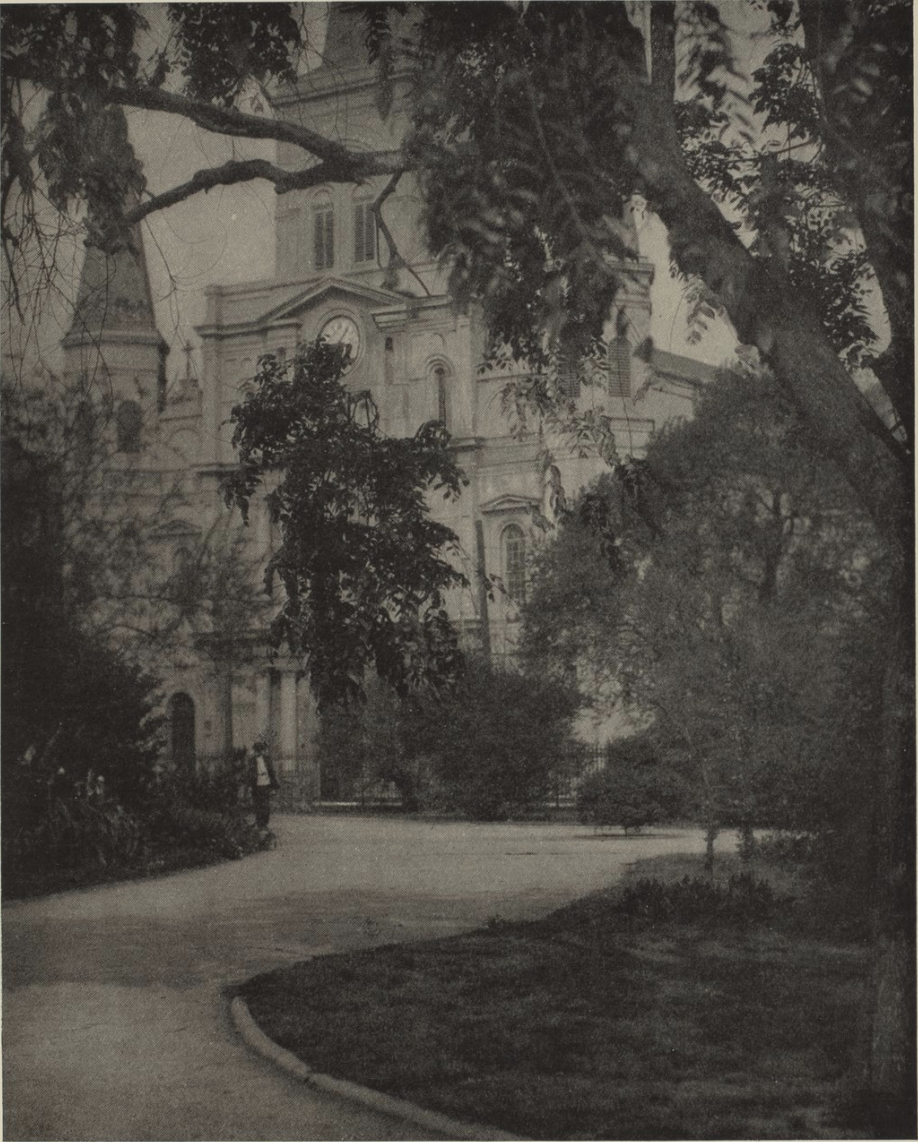
“Jackson Square and the St. Louis Cathedral” by Arnold Genthe, 1920–1924, one of the images in his 1926 book, Impressions of Old New Orleans
The Pictorialists accomplished this in several ways, but one of the main techniques was by a soft focus, sometimes achieved in the darkroom. Genthe’s main inspiration for this, aside from painters, was Alfred Steiglitz.
In his lengthy autobiography, As I Remember (1936), Genthe pays homage to Stieglitz who, “more than to any other man, must be given the credit for the place photography occupies among the graphic arts today.” Both photographers shared a mutual dedication to moody, painterly compositions, to tonal nuance.
In short, their efforts were to make people see that photography was on the same artistic level as painting, and they did that by trying to make their photographs look and feel exactly like paintings. Impressions of Old New Orleans is, by any standard, a Pictorialist book.
The result is a New Orleans with a dreamy, nostalgic feel to it. For the most part, it’s a New Orleans outside of time. It’s the New Orleans – and, really, the French Quarter for the most part – Genthe so strongly believed worth preserving, worth fighting for. To him, this is the essential New Orleans.
Some of the places he photographed you’ll recognize if you’re familiar with the French Quarter: St. Louis Cathedral, the Cabildo and the Historic BK House, for example. But many you probably won’t, especially the interiors, the courtyards behind walls. They have titles like “A Lofty Archway,” “A Palm Courtyard,” “A Humble Courtyard,” “An Old-Time Balcony,” “A Patio Unchanged by Time” and “Climbing Vines.” These could be located anywhere in the French Quarter.
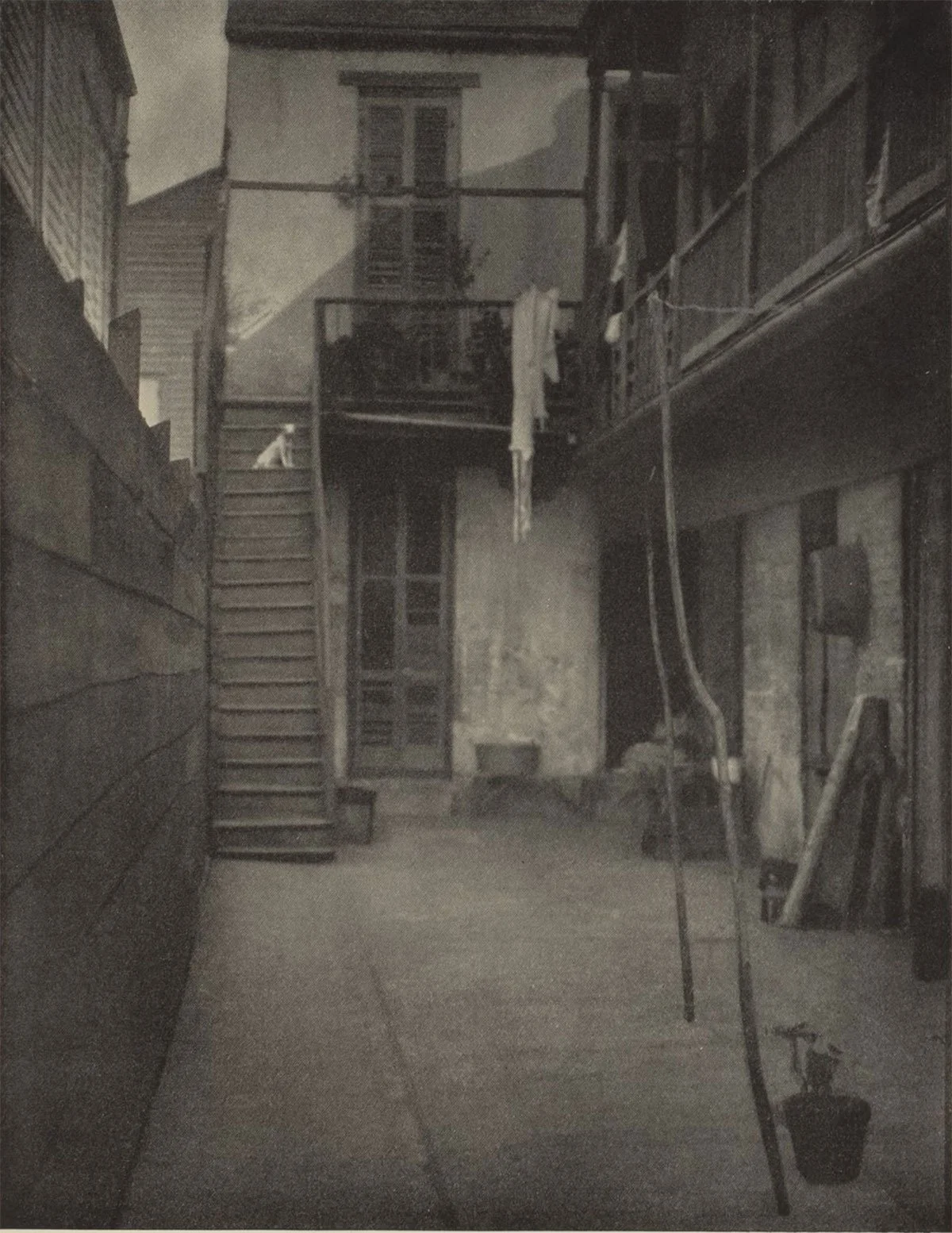
“A Humble Courtyard” by Arnold Genthe in Impressions of Old New Orleans.
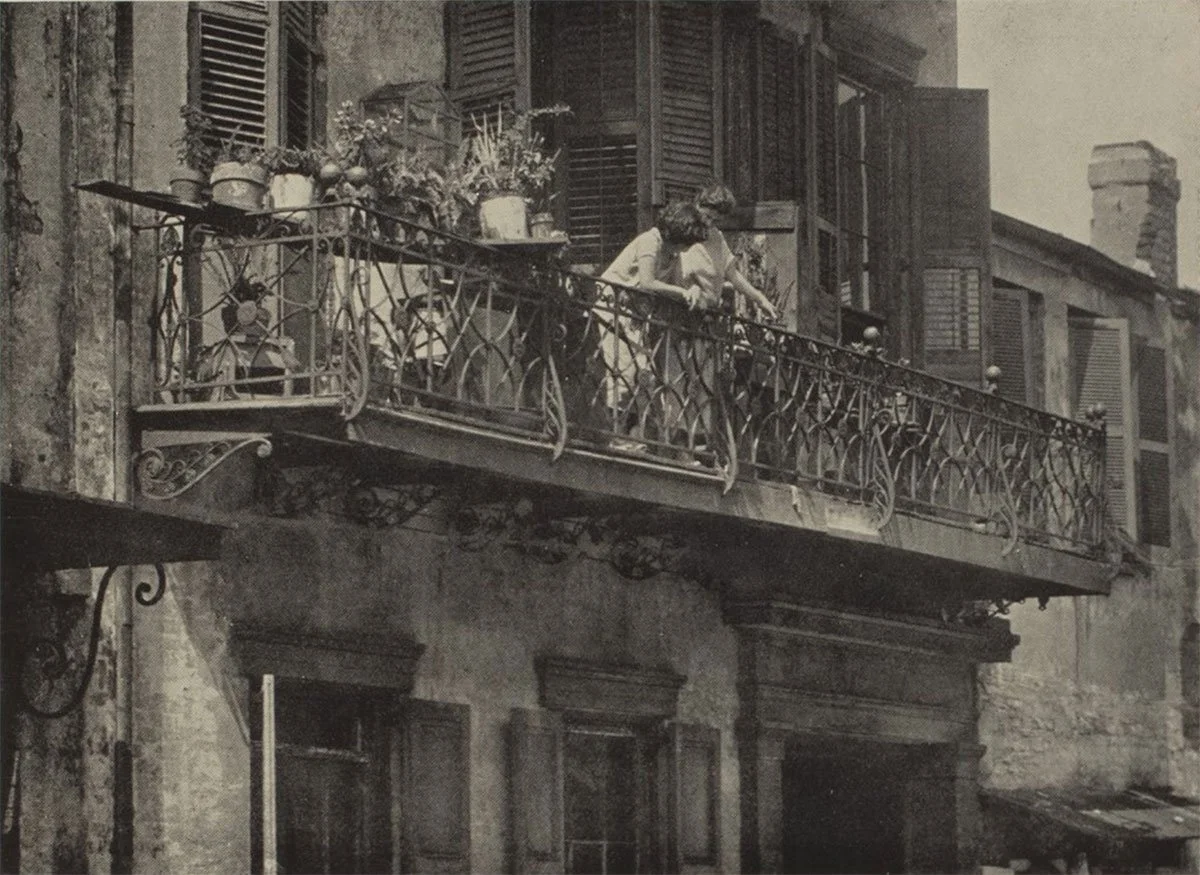
“An Old Time Balcony” by Arnold Genthe in Impressions of Old New Orleans
Genthe was also entranced by iron grillwork on balconies as he was by wooden stairways, windows and shadows. As I say, the purpose of Genthe’s book is clearly not to produce recognizable postcard-like photographs of the French Quarter but rather to give artistic impressions of what he saw. Hence the title of his book.
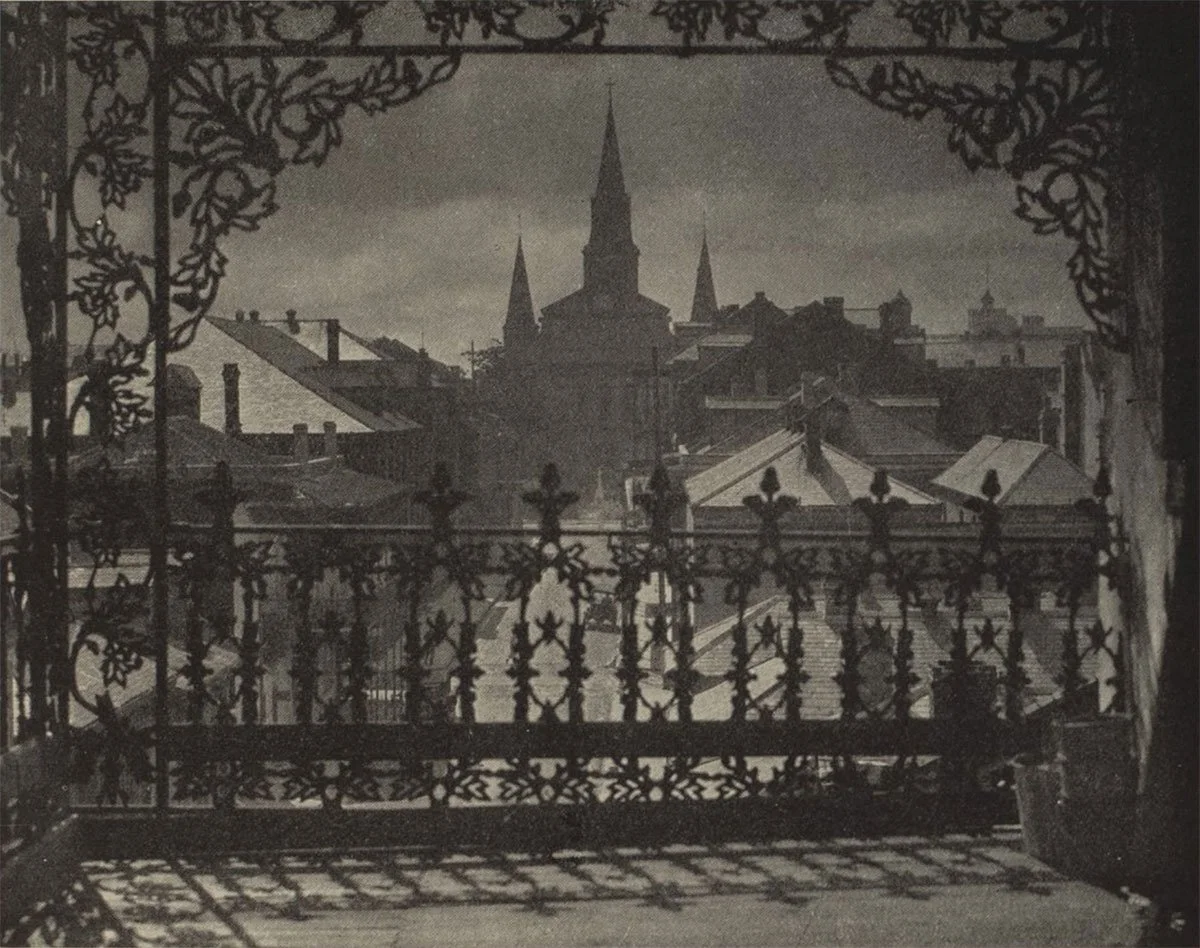
“A Vista Through Iron Lace” by Arnold Genthe in Impressions of Old New Orleans.
In fact, you can compare any photograph in the book with the original negative to see Genthe’s guiding hand, his deliberate artistic choices. When Genthe died in 1942, the Library of Congress acquired more than 16,000 of his negatives, autochromes and lantern slides. You can access most of them – not all have been digitalized – at the LOC site under the “Genthe Collection” . The Library has done a superb job of cataloging the material and providing salient information for anyone interested.
What’s fascinating – to me, at least – is that the original photographs are in all cases sharper, better defined and more detailed than the versions he published in Impressions of Old New Orleans. It seems Genthe did not use a special lens to achieve his effects, but, rather, created his “impressions” in the darkroom.
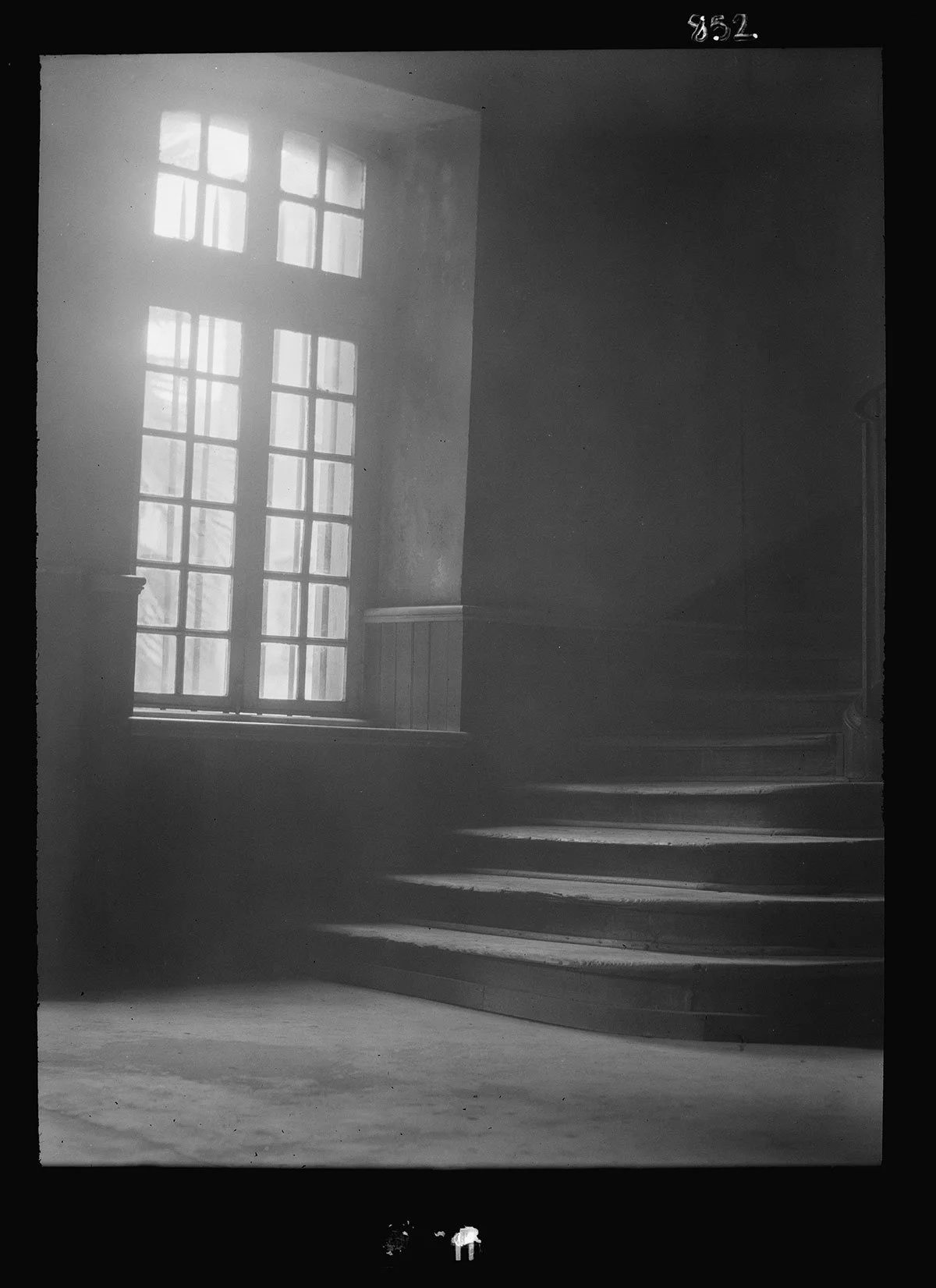
The window and stairway in the Old Ursuline Convent, New Orleans, photographed by Arnold Genthe between 1920 and 1926, Library of Congress, Prints & Photographs Division, Arnold Genthe Collection, 7a03120u
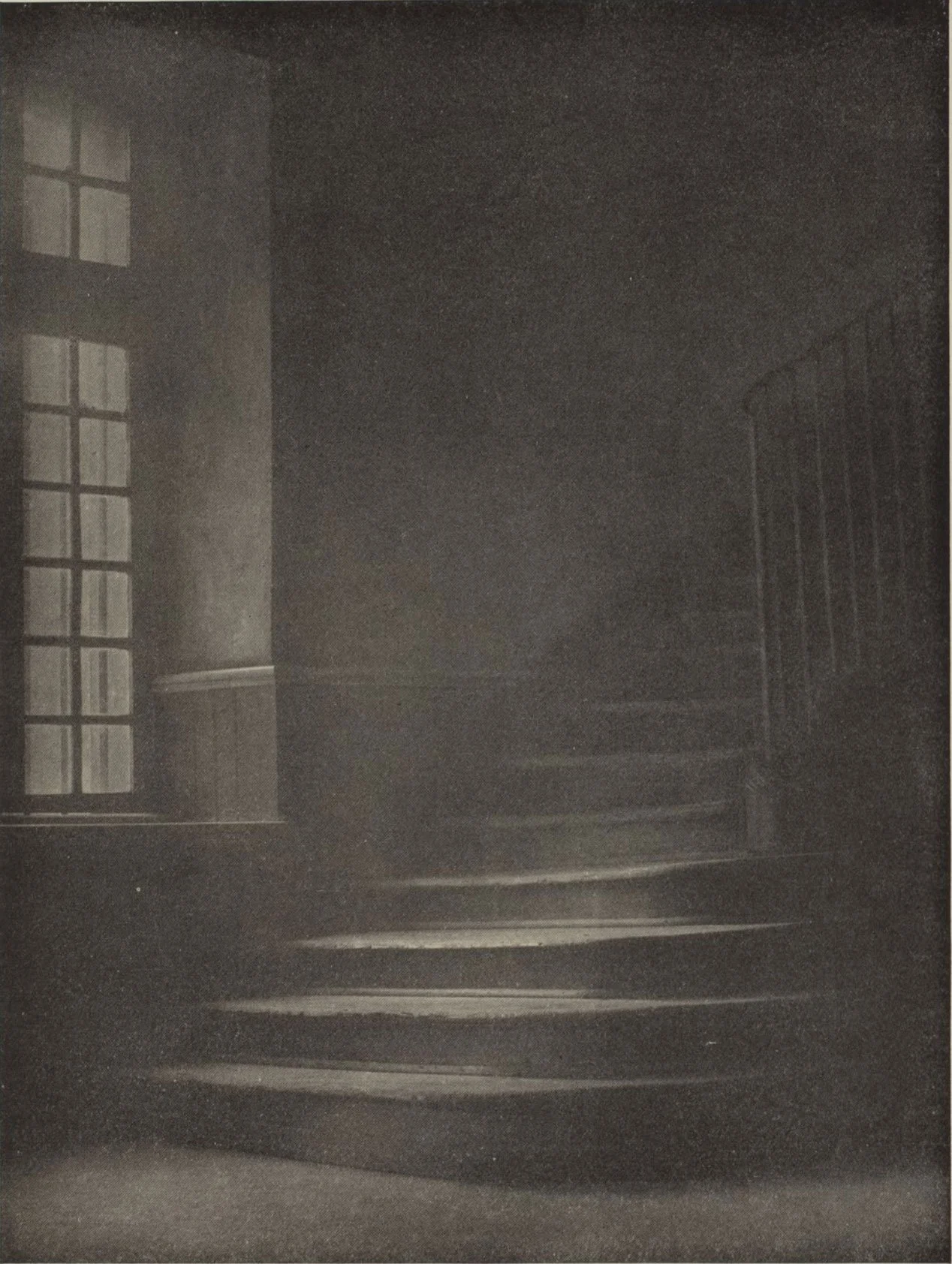
The same view as it appears in Impressions of Old New Orleans.
How? I turned to John H. Lawrence, former head of curatorial collections at the Historical New Orleans Collection and author of the book, Louisiana Lens: Photographs from the Historic New Orleans Collection, who offered this conjecture:
“Since his negatives at LoC [Library of Congress] print clearly, he possibly made a duplicate negative that was heavily retouched or it might be that he slightly changed the focus of the sharp negative when enlarging, though this presumes he did enlarge the negative to print it rather than printing it by contact (directly touching the paper)….The effects in the book could also have been achieved by heavily reworking the printing plate.”
As for Genthe removing all traces of the modernity he loathed, John H. Lawrence pointed me to an example, Genthe’s “Sisters of Charity and Gateway of the Armory” (plate #12 in his book). In the original, two slim telephone wires run across the page. In the printed version, they’re gone. It won’t do to have telephone wires in the French Quarter. Not in the French Quarter Genthe believed in.

Phone wires are faintly visible in this digital image made from Genthe’s original negative. Detail from Sisters of Charity and Gateway to Armory, Library of Congress, Prints & Photographs Division, Arnold Genthe Collection 7a02835

In this screenshot of the same image as it appeared in Impressions of Old New Orleans, the print is much darker and has been retouched to eliminate the phone wires.
The photographer closest in subject matter and spirit to Impressions of Old New Orleans is probably the French photographer Eugène Atget (1857-1927), who took hundreds of pictures of mostly people-less streets and buildings in Paris trying, as he put it, to document “Old Paris.”
Born twelve years earlier than Genthe, Atget also had as his goal the visual preservation of a disappearing city. One difference between the two is that Atget didn’t set out to alter the vistas he captured to conform to an idea he had of Paris. He just presented them. Still, you sense an artistic kinship between the two.
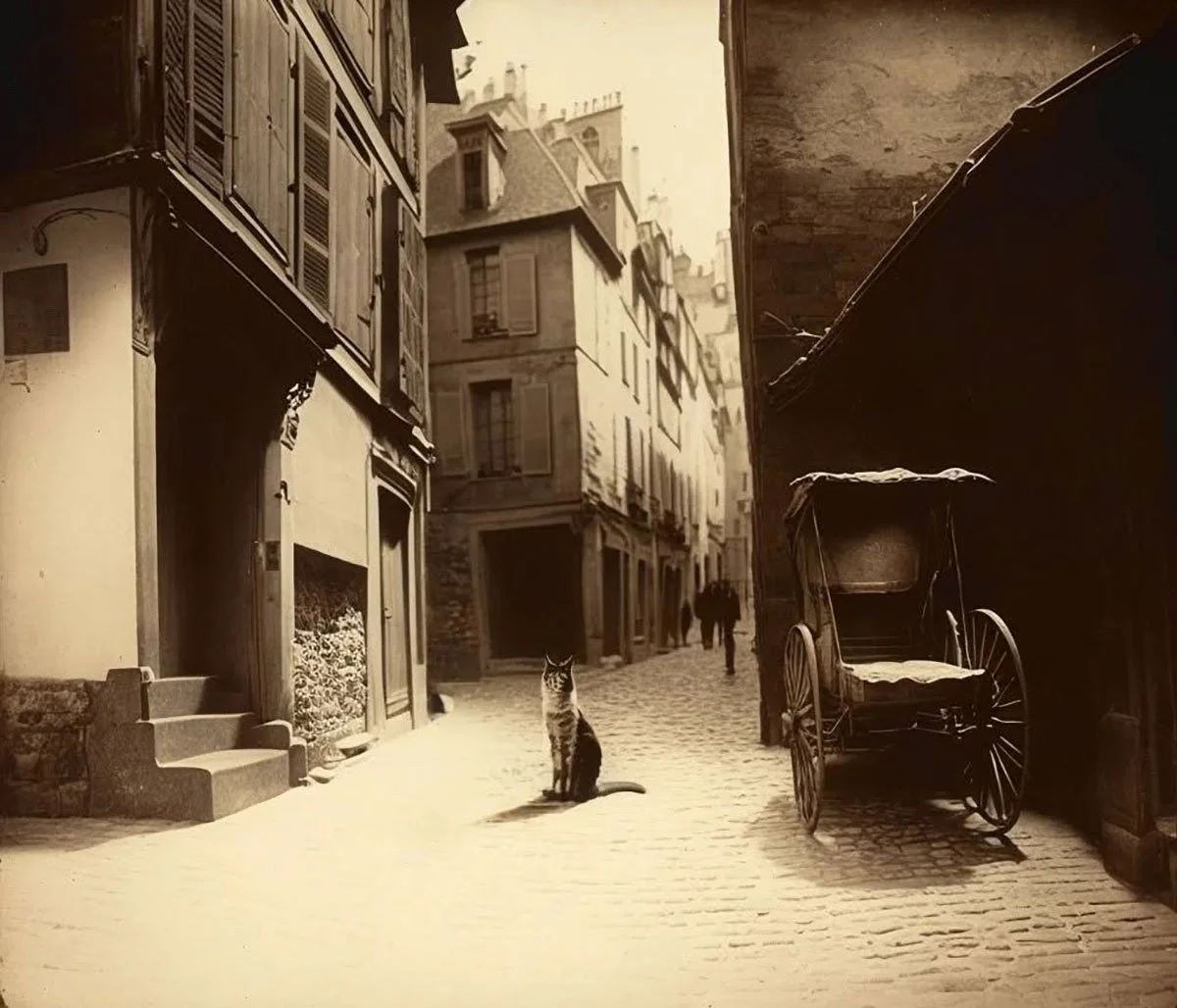
Paris street photo by Eugene Atget, date unknown
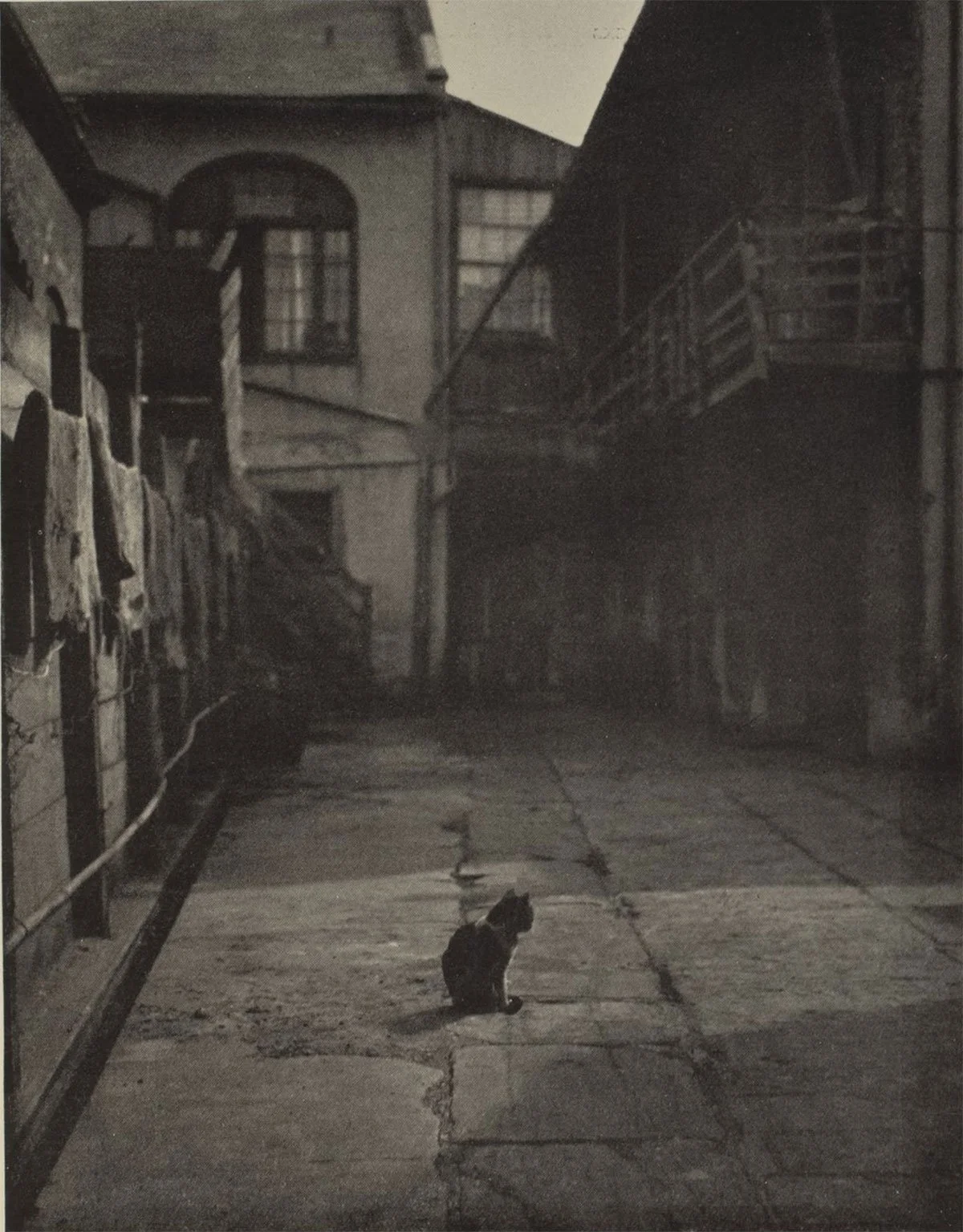
“The Boss of the Fish Dealer’s Court” by Arnold Genthe in Impressions of Old New Orleans.
Who, exactly, was Arnold Genthe, the man who took those photographs?
A man who led a remarkable life. Born in Germany in 1869, raised in an academic family, he studied languages as a college student. He earned a PhD in philology and resigned himself to be, like his father, an academic. Fate intervened in the form of a job offer tutoring a wealthy German couple’s son in San Francisco. So, at the age of 26, Genthe left Germany for New York and made his way to San Francisco, arriving in 1895.
A charmed life was waiting there for him.
From all accounts, Genthe himself was a charming man, handsome, full of vigor and good humor. He made friends easily. He discovered, in San Francisco, a Bohemian world that included the writers Jack London and Ambrose Bierce and other writers, dancers and painters, a world that fit him like a glove.
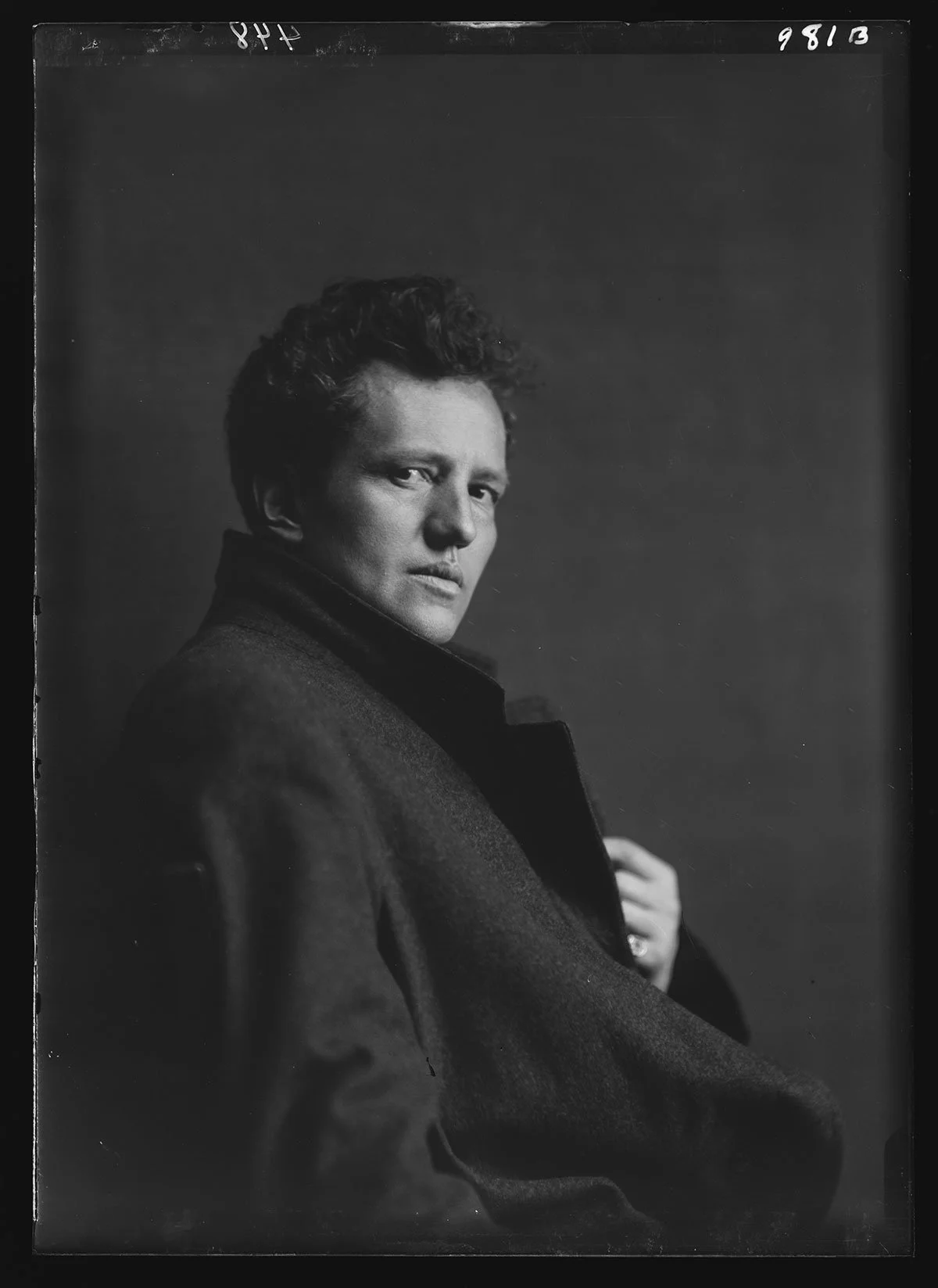
A self-portrait of Genthe, date unknown, Library of Congress, Prints & Photographs Division, Arnold Genthe Collection
When his employers returned to Germany, inconveniently taking their son, his pupil, with them, Genthe looked around for something to do. He picked up a camera. “I had acquired the rudiments of a camera,” he writes in As I Remember. “Now I set about to buy one.” He bought a Kodak 3A Special, a camera small enough that he could hold it by hand. He opened a studio.
Almost immediately, it flourished. He was drawn to San Francisco’s Chinatown, where he photographed, sometimes surreptitiously, its citizens. His circle of friends widened.
Then a curve. The famous San Francisco earthquake of 1906 destroyed much of the city, including Genthe’s studio. He lost all his equipment and work. He immediately got himself another camera and set about documenting the earthquake’s damage. You may have seen one of those photographs, “Looking Down Sacramento Street, San Francisco,” without knowing that Genthe took it.
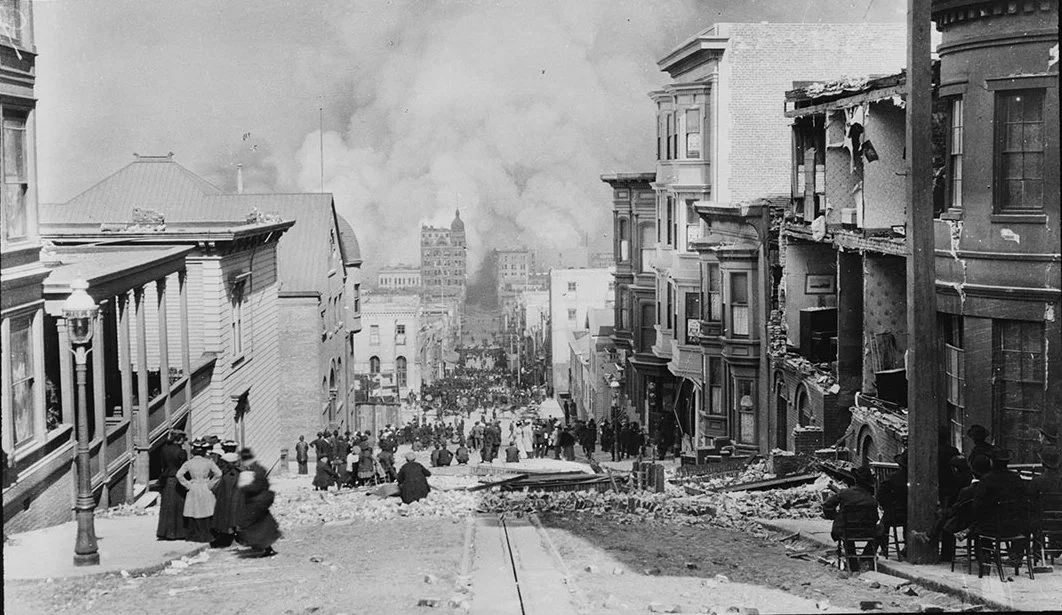
The 1906 San Francisco earthquake and fire, photographed by Arnold Genthe on Sacramento Street, April 1906, Library of Congress, Prints & Photographs Division, Arnold Genthe Collection.
He promptly opened a new studio. But, in 1911, wanting more access to publishing opportunities, he moved to New York City where he opened a studio on East 49th Street. He then proceeded to have a thirty-year career that, as John H. Lawrence put it, “would have been the envy of any studio photographer.”
He photographed everyone who was anyone. We can be skeptical when we hear that expression, but in Genthe’s case, it was true.
The list of his subjects, many of whom became friends and companions, is about as illustrious as you can imagine: Isadora Duncan, Arturo Toscannini, Anna Pavlova, John Barrymore, Greta Garbo before she became the Greta Garbo, Edna St. Vincent Millay, Eva La Gallienne, Katharine Cornell, Ruth St. Denis—not to mention presidents Theodore Roosevelt and Woodrow Wilson and the iconically wealthy John D. Rockefeller Sr. and J.P. Morgan.
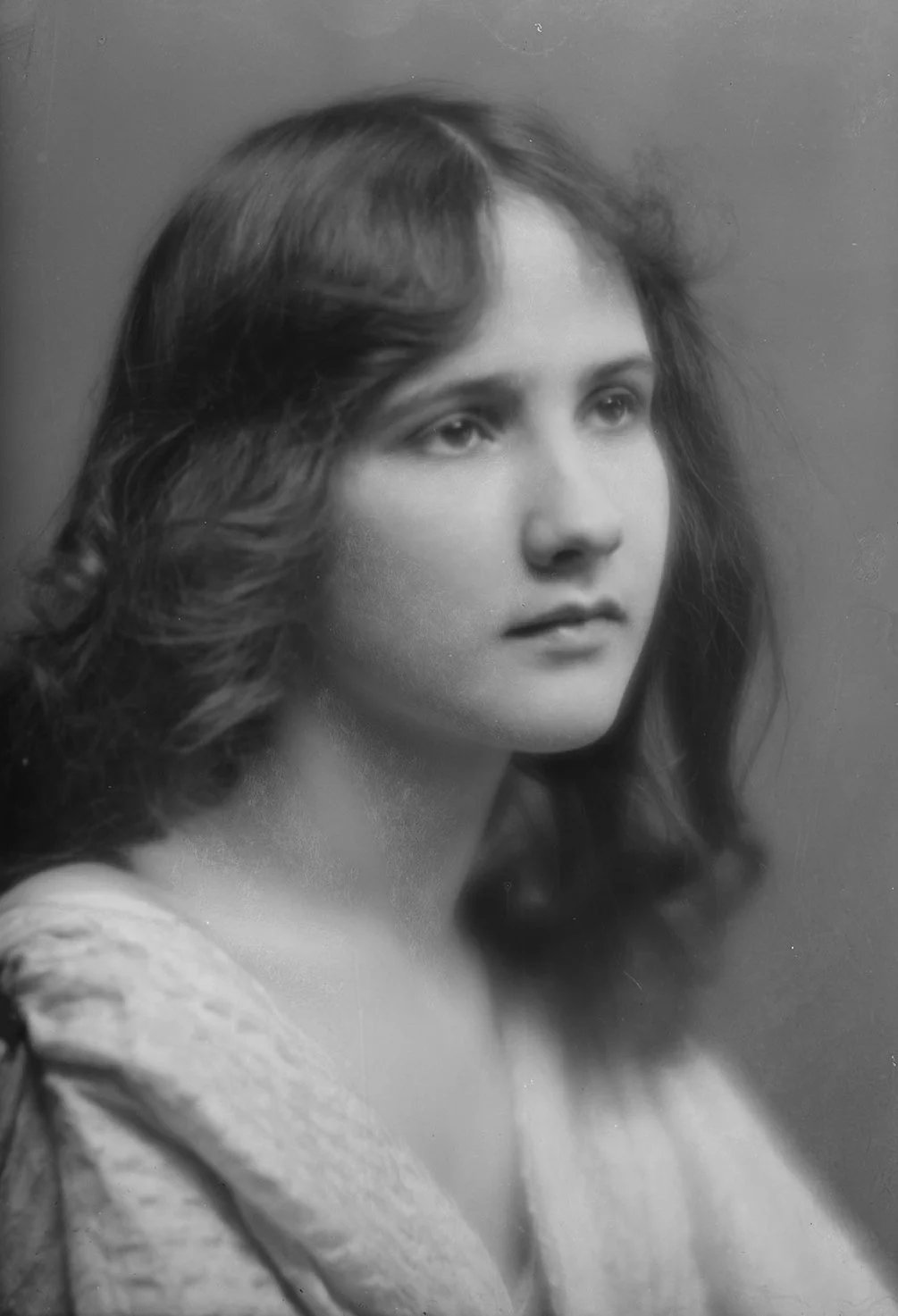
A portrait of an Isadora Duncan dancer, photographed by Arnold Genthe between 1915 and 1923, Library of Congress, Prints & Photographs Division, Arnold Genthe Collection, 7a14252
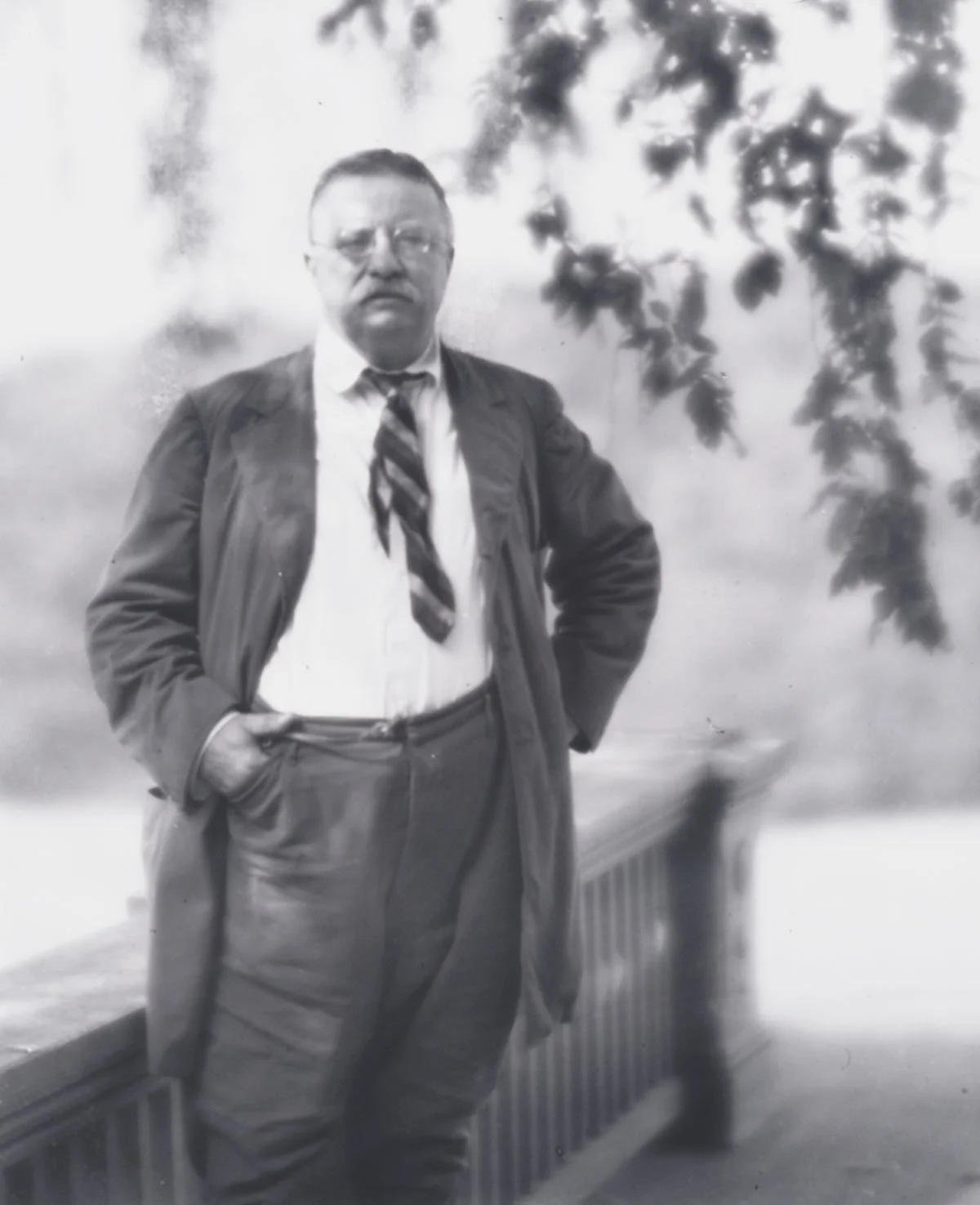
A portrait of President Theodore Roosevelt, photographed by Arnold Genthe on September 8, 1916, Library of Congress, Prints & Photographs Division, Arnold Genthe Collection, 7a15179
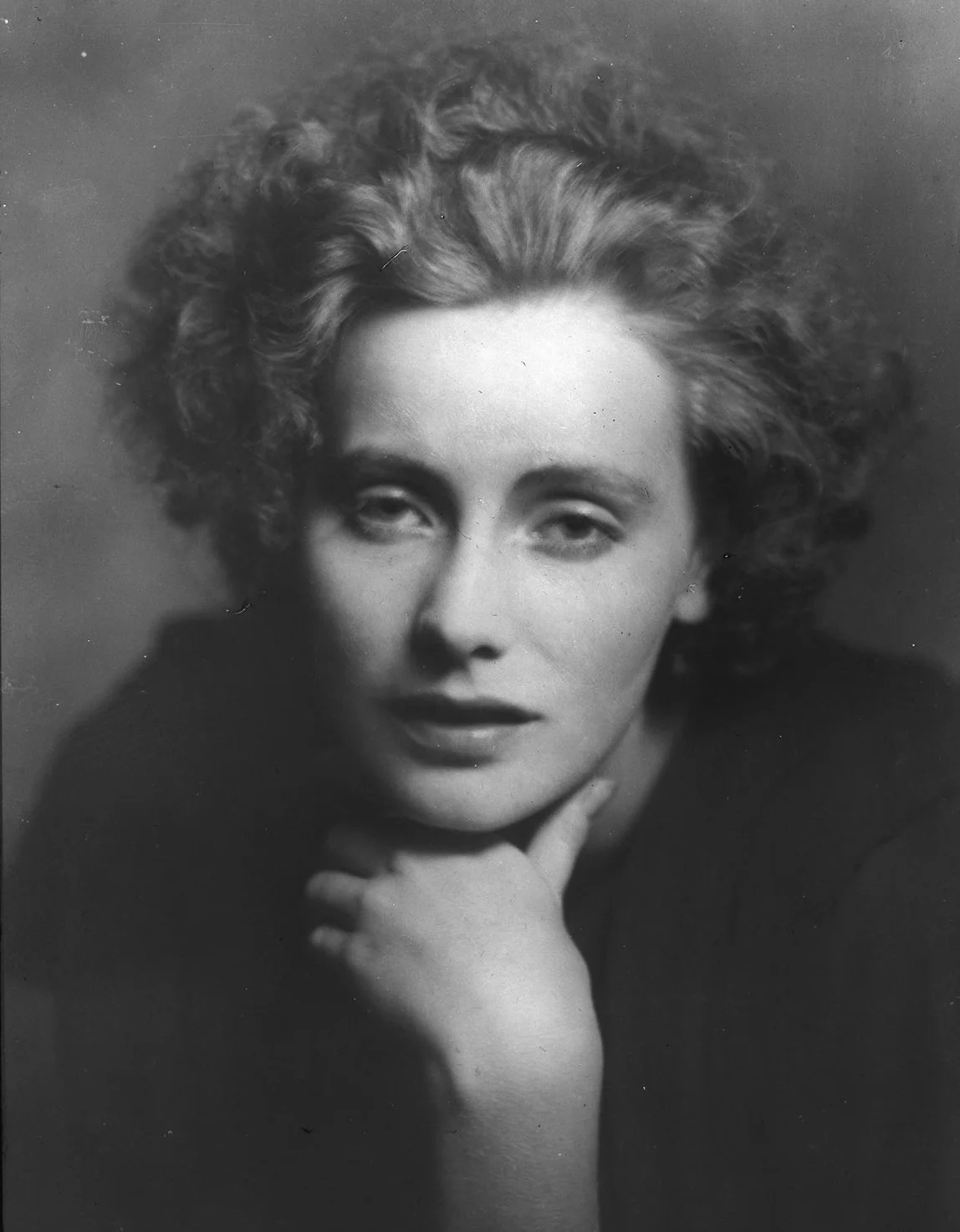
A portrait of Swedish actress Greta Garbo, photographed by Arnold Genthe in July 1925, Library of Congress, Prints & Photographs Division, Arnold Genthe Collection, 7a10224
He died in 1942. The last line of As I Remember is, “I daresay I have had as much out of life as is coming to any man.”
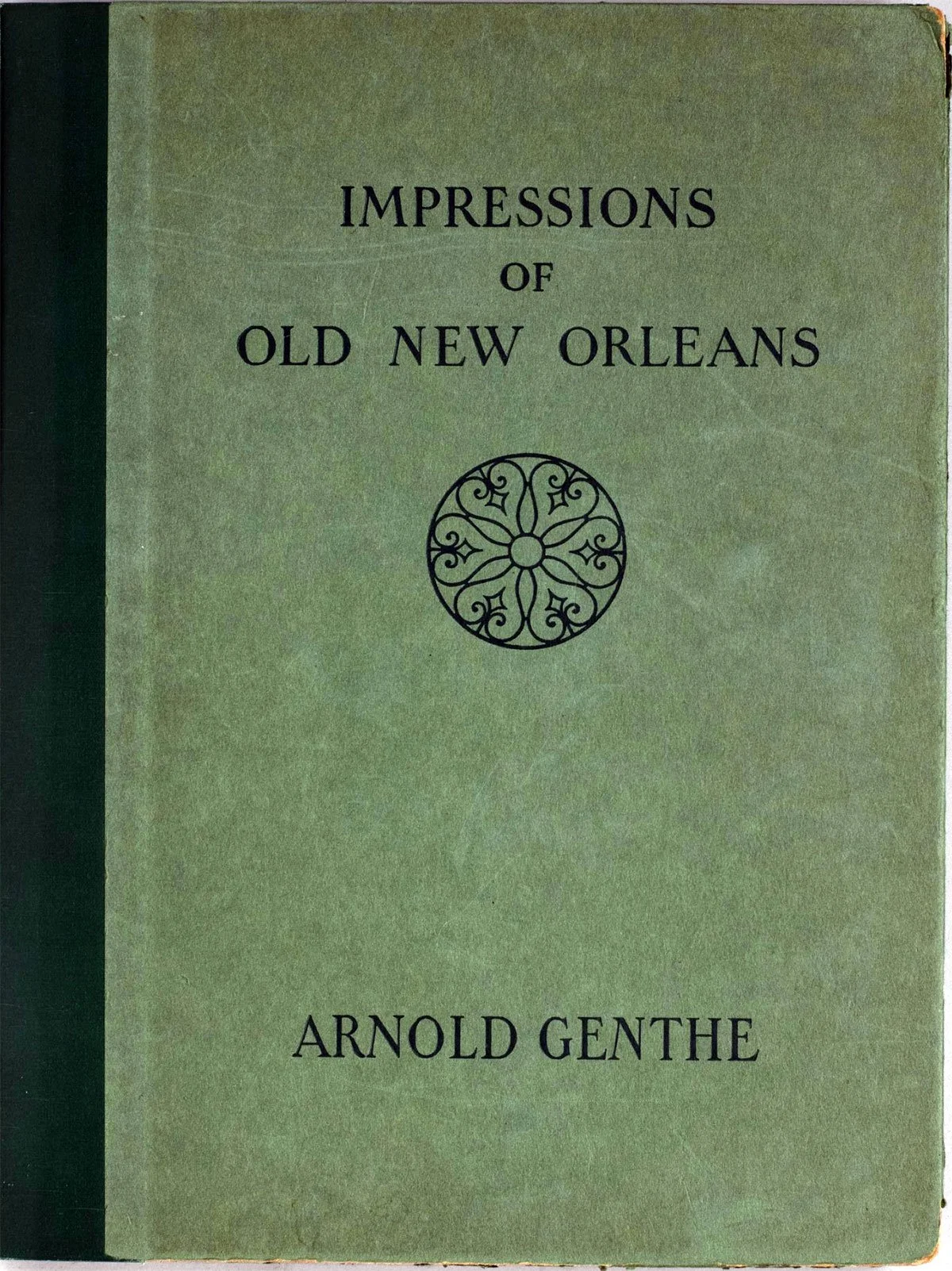
Fortunately, the entire book has been digitalized by the University of California, Berkeley Digital Collections. Click on the cover to access the PDF on their website.
This is the man who came in search of the New Orleans of his imagined memory and, at the times when he didn’t find it, created it.
It’s hard to say what, if any, influence Genthe’s Impressions of Old New Orleans had on his effort to help preserve the city’s heritage and uniqueness as he hoped it would. The book received a favorable pre-publication mention from the New York Times in 1926 and a recognition of the city’s plight as Genthe saw it:
“The charm and spirit of old New Orleans has been caught by the famous photographer Arnold Genthe in a book of photographic studies with the title ‘Impressions of Old New Orleans.’ It contains hundreds of pictures of places and characters, all distinctive of the old city that is rapidly vanishing before the new.”
In the end, though, it’s difficult to say what effect Genthe’s book had on changing people’s minds about what he perceived as the declining and alarming state of New Orleans and, particularly, the French Quarter.
But it may be no coincidence that the Vieux Carré Commission was created in 1925 at the time Genthe was taking his photographs – especially when we consider that one of the moving forces behind the Commission’s creation was Grace King, who was a close friend and to whom the book is dedicated.
Regardless of its influence, Arnold Genthe’s book is an honest and dedicated effort, made with all the skill and artistry he could summon. As John H. Lawrence put it so well, Arnold Genthe’s Impressions of Old New Orleans is an admirable result of “his singularity of purpose.”
And that, in the end, is maybe all we can do. To take on our beliefs and causes with passion and with a singularity of purpose.
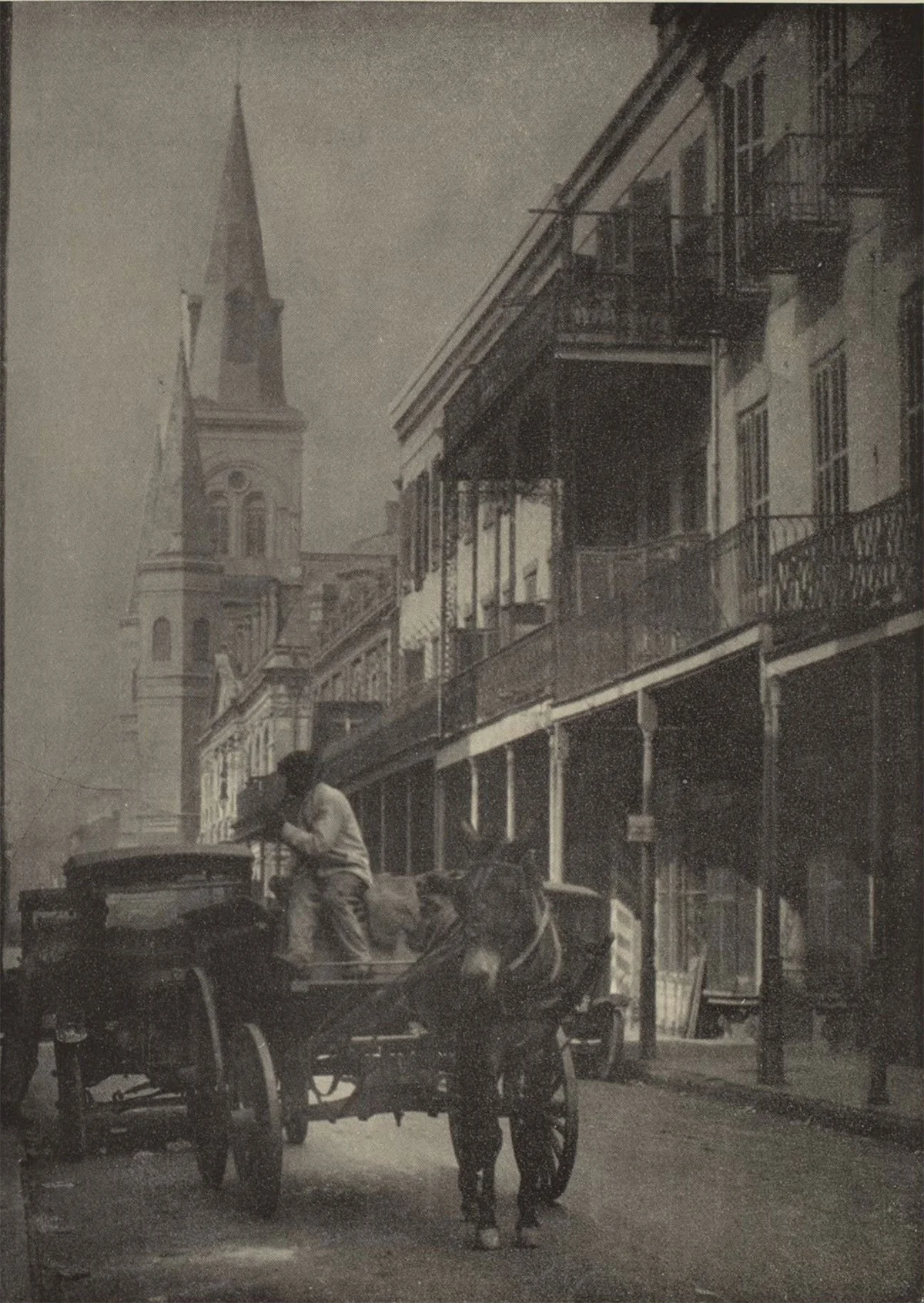
The 800 block of Chartres Street where the office of French Quarter Journal is located, is the first image in Impressions of Old New Orleans.
