The Lost New Orleans Jazz Festivals: Untold Stories
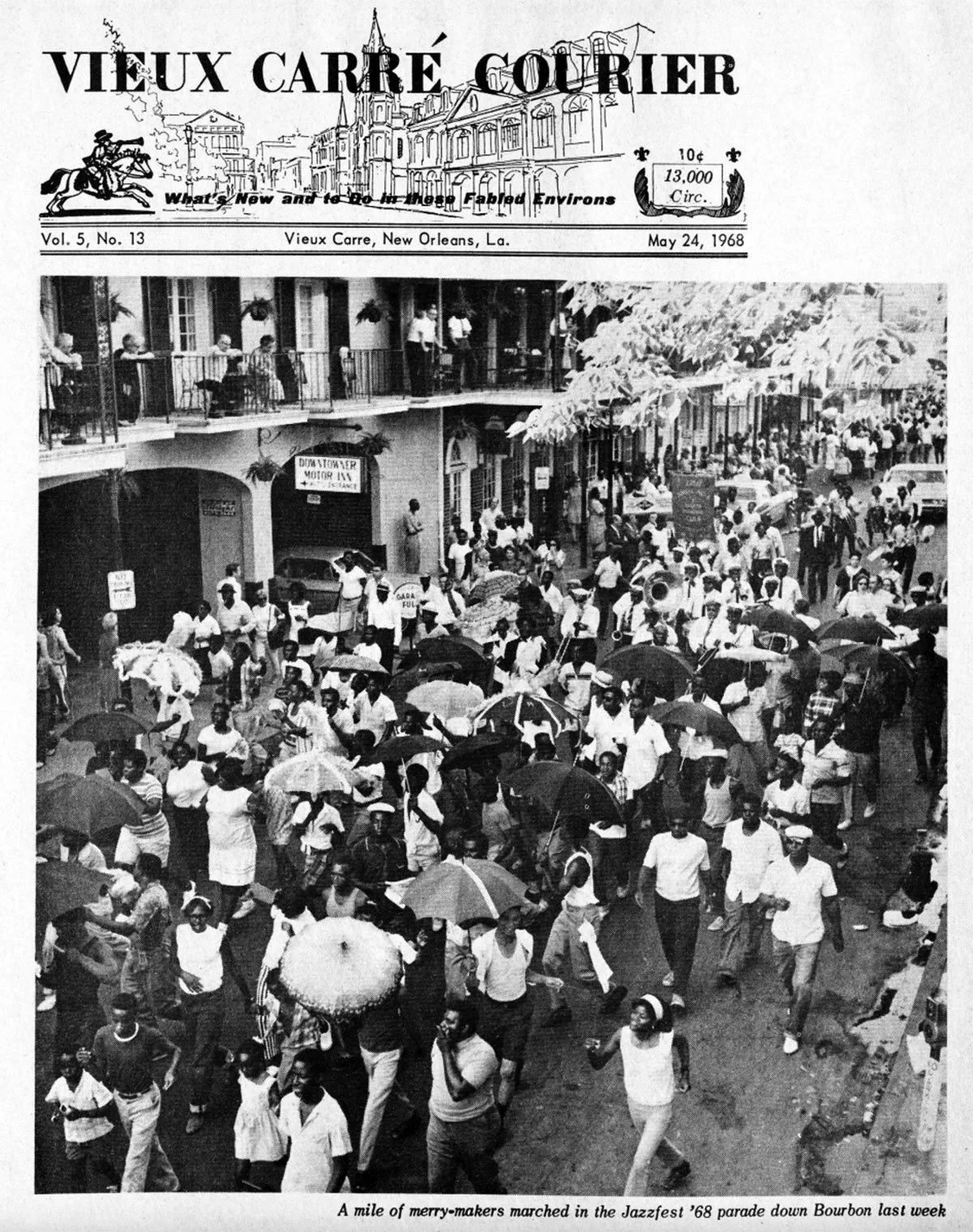
The front page of the May 24, 1968 Vieux Carré Courier was devoted to the 1968 Jazz Festival, which included “the world’s longest second line.” Courtesy HNOC and with permission of Steve May
May 2026The venerable New Orleans Jazz & Heritage Festival was inspired by two earlier fests - one in 1965 and a much larger event in 1968 – yet, the timing couldn’t have been worse for either. Peek behind the curtain for the backstories.
– by Bethany Ewald Bultman

This column is underwritten in part by Lucy Burnett
The sold-out crowd of 5000 people leapt to their feet, roaring as the Onward Brass Band, led by grand marshal Danny Barker – “strutting and puffing on an enormous cigar” marched through the Municipal Auditorium toward the stage.
John S. Wilson tantalized New York Times readers with his account of the 1968 New Orleans Jazz Fest kick-off – a full two years before the birth of the world-renowned New Orleans Jazz & Heritage Festival.
But this often overlooked 1968 festival was actually the city's second jazz festival. Three years before, two unlikely local jazz musicians had hatched and hosted the audacious 1965 International Jazz Festival.
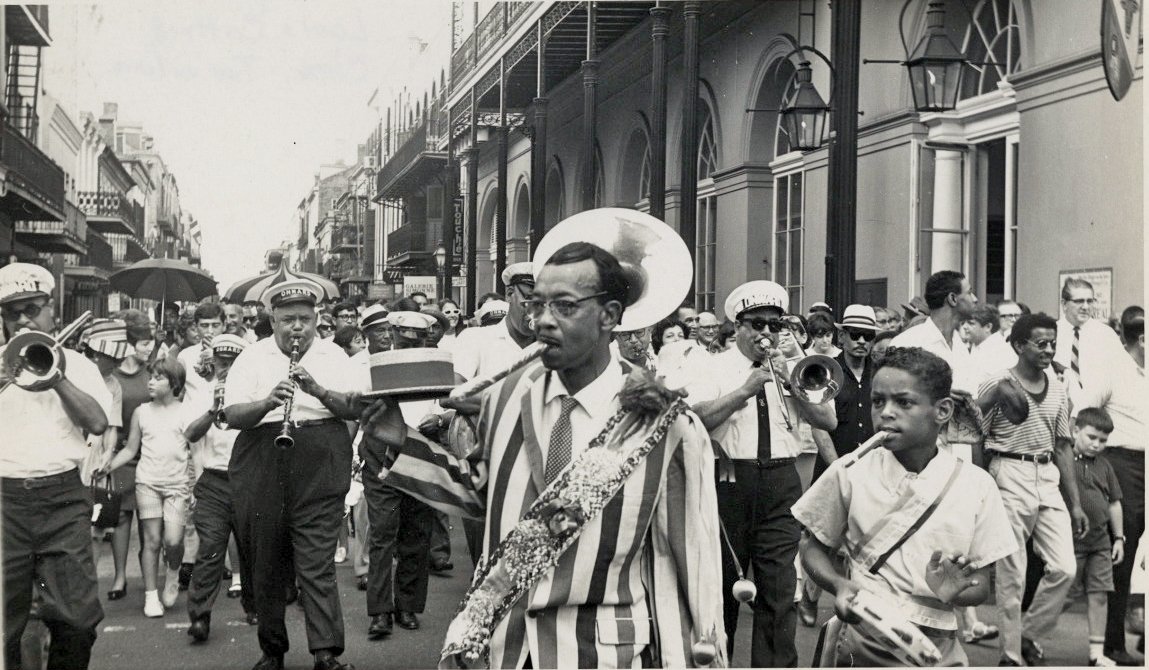
Danny Barker leading the Onward Brass Band on June 30, 1968, outside of the Royal Orleans, Photographer unknown. With permission from The William Russell Jazz Collection at the Historic New Orleans Collection. Gift of the Clarisse Claiborne Grima Fund, ACC no. 92-48 L.331.2451
And working behind the scenes to bring both of these vanguard events to life? Musician and raconteur Danny Barker.
“It took New Orleans, the cradle of jazz, fifty years to finally stage a jazz festival. It may take a while more to learn to rock the cradle.” Carroll P. Trosclair, The States Item, May 21, 1968.
Danny Barker, grandson of Isidore Barbarin, one of the founders of Onward Brass Band, understood the good, the bad, the sass, and glory of New Orleans jazz. In fact, he was the unsung hero of both festivals.
In May 1965, after 30 years as a New York-based musician with moderate success – but still scrabbling financially – the 56-year-old Danny Barker returned to New Orleans, as he told an interviewer, “to go down with the ship.” To some in his hometown, he and his wife, Blue Lu Barker, were talented celebrities. To others, the couple represented a cautionary tale about how the “Big Time” can chew you up and spit you out.
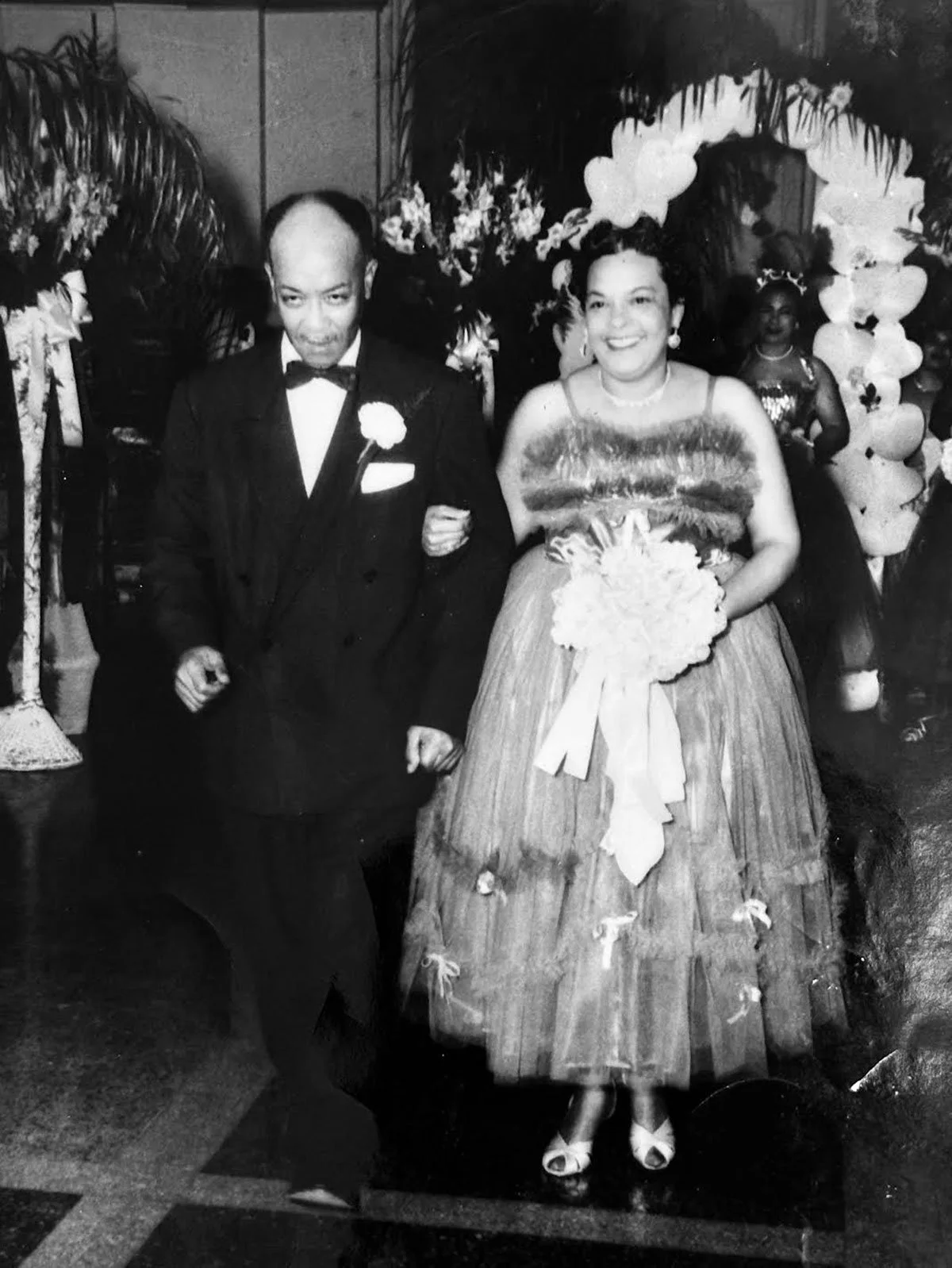
Danny and Blue Lu Barker at a Mardi Gras Ball in mid 1960's. With gratitude to Batou Chandler, from the David and Patricia Chandler Archives
Danny Barker as grand marshal of the Onward Brass Band in this Smithsonian Production filmed in late 1968.With more than 100 cousins in New Orleans, the Barkers planned to grow successful second careers from their hometown roots. To accomplish this, Danny had two goals. One was to qualify for his first driver’s license, so they had transportation to gigs. The other was to help raise the pay scale for musicians performing both locally and on tour.
Barker hit the local ground running that May. He immediately joined forces with Dean A. Andrews, Jr., the colorful self-styled beatnik, Dixieland clarinet player and Carlos Marcello’s immigration attorney. Dean and Barker established an LLC to produce the city’s first-ever International Jazz Festival. Their dream was to create a show with a stellar line-up that they could also take on the road – and one that would pay local musicians decently.
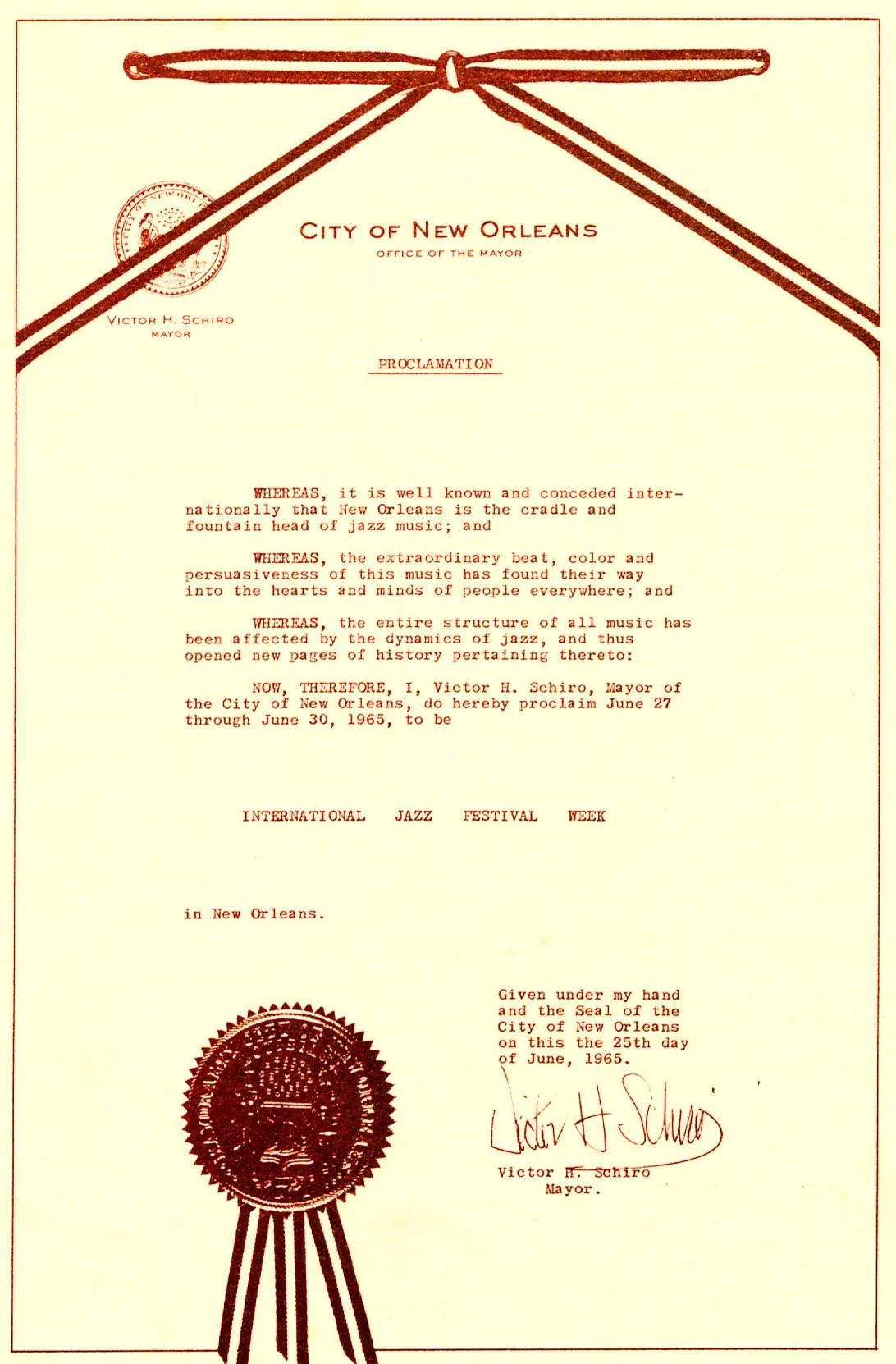
The city issued.an official proclamation naming the wee from June 27 - June 30, 1965, International Jazz Fest Week. Courtesy of the Williams Research Center at the Historic New Orleans Collection
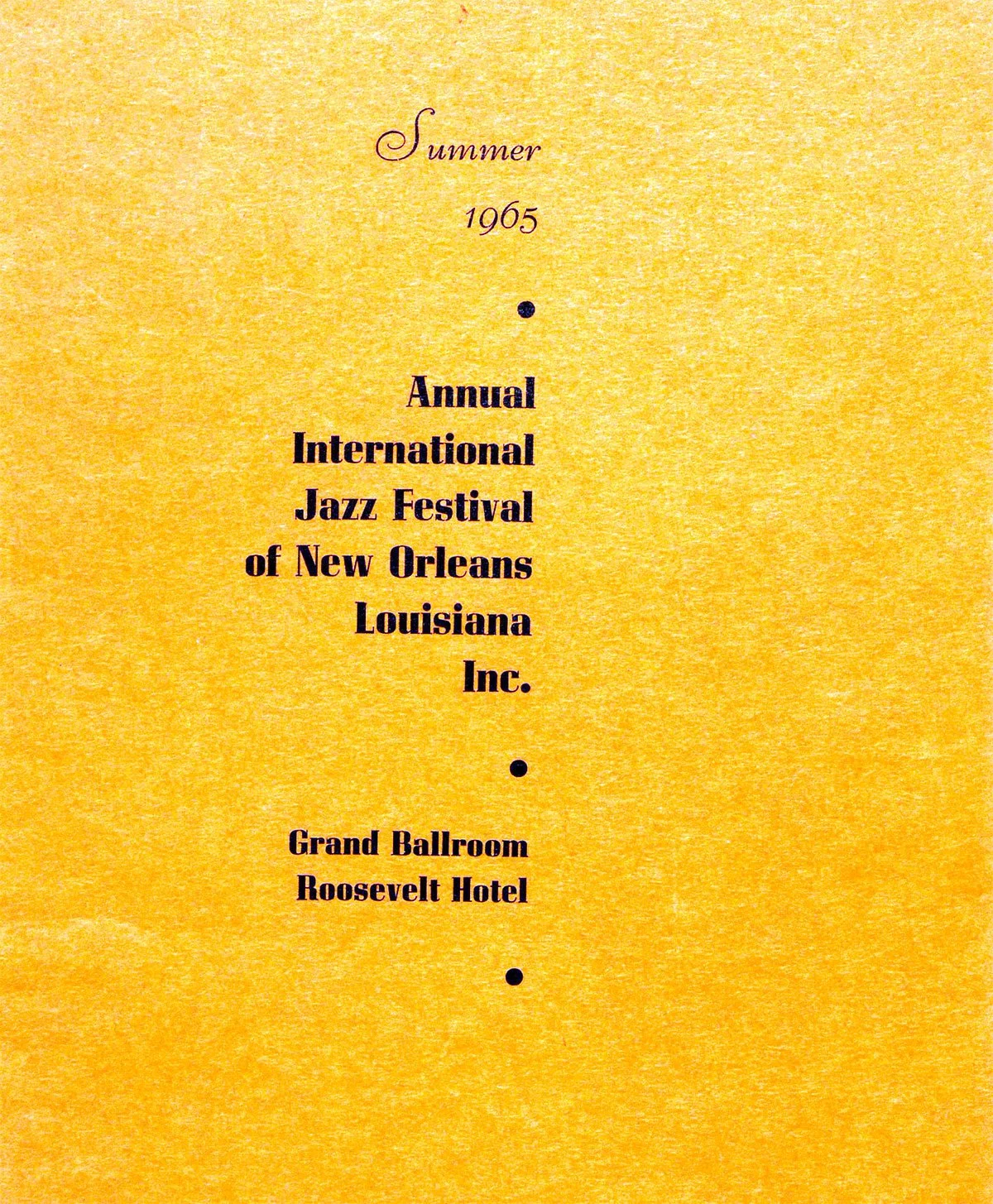
Click on cover image to access the full program in PDF format, with the official proclamation. Courtesy of the Williams Research Center at the Historic New Orleans Collection
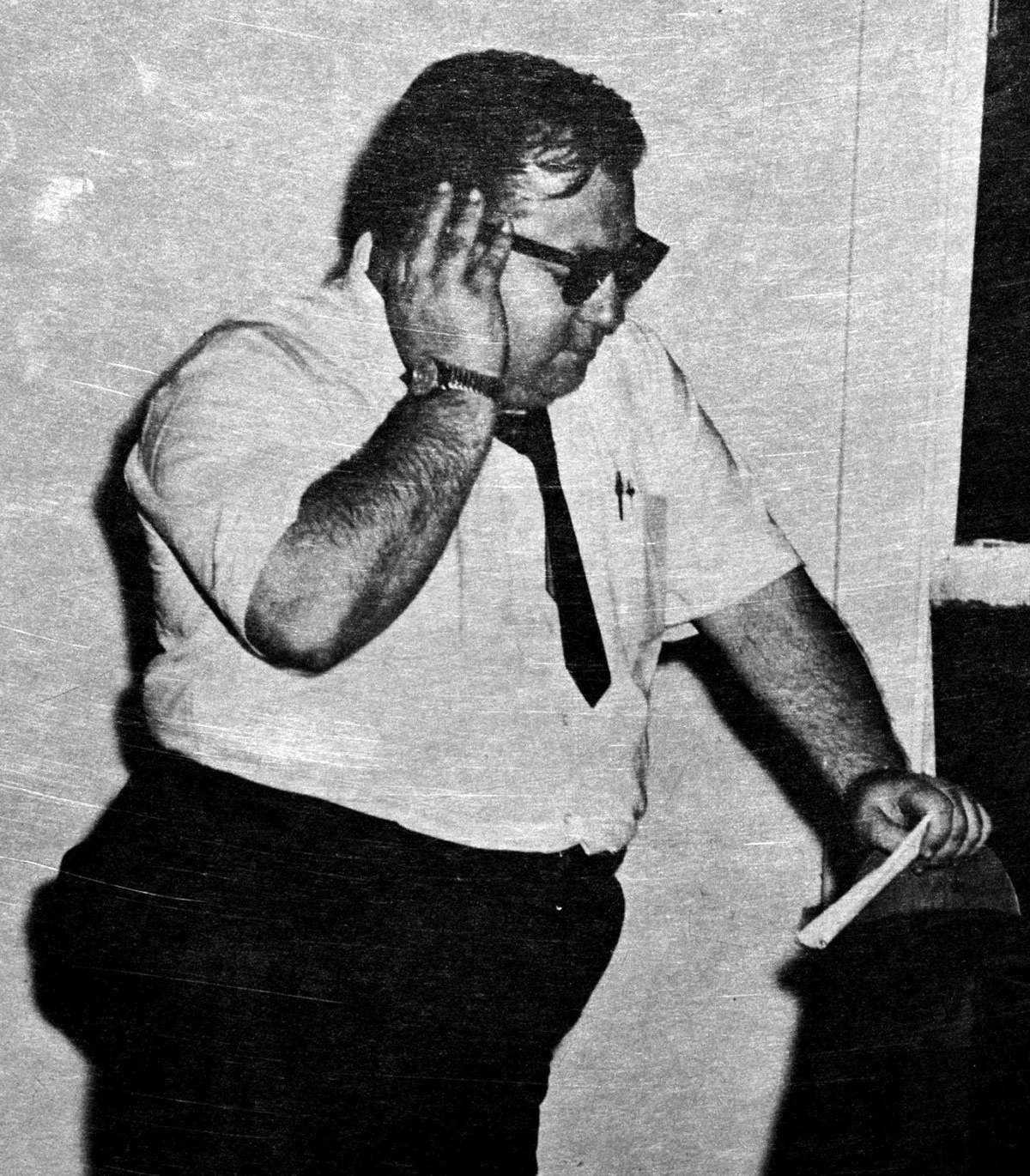
A photo of Dean Andrews from the official program of the 1965 festival.
Within a month, Andrews and Barker welcomed elegantly attired jazz festers to the ballroom at the Roosevelt Hotel. Earlier that year, the then-segregated hotel had been involved in a national football scandal: Black AFC football players in town for the All-Star game, had been the victims of blatant racism, including being prohibited from using the hotel’s main elevators. In January 1965, the players voted to boycott New Orleans.
According to Danny Barker, Dean Andrews sold the hotel on the idea that hosting an integrated jazz festival in the Roosevelt’s Blue Room to undo some of the PR damage from five months before.
There were three nights of performances, from 7pm - 2am, with Andrews as MC and ringmaster. Unfortunately, few people attended. A smattering of tourists wandered in, as well as some members of the Jazz Club. Barker later said that there were more musicians in the audience than paying customers.
Dean and Barker had learned a hard lesson: Few locals would pay to hear jazz – which many considered a free natural resource. As assistant curator of the New Orleans Jazz Museum, Barker began to position himself to be indispensable to the Jazz Club, conspiring to give New Orleanians “an attitude adjustment.” He remained convinced that an internationally famous jazz festival could be a year-round boon to local musicians.
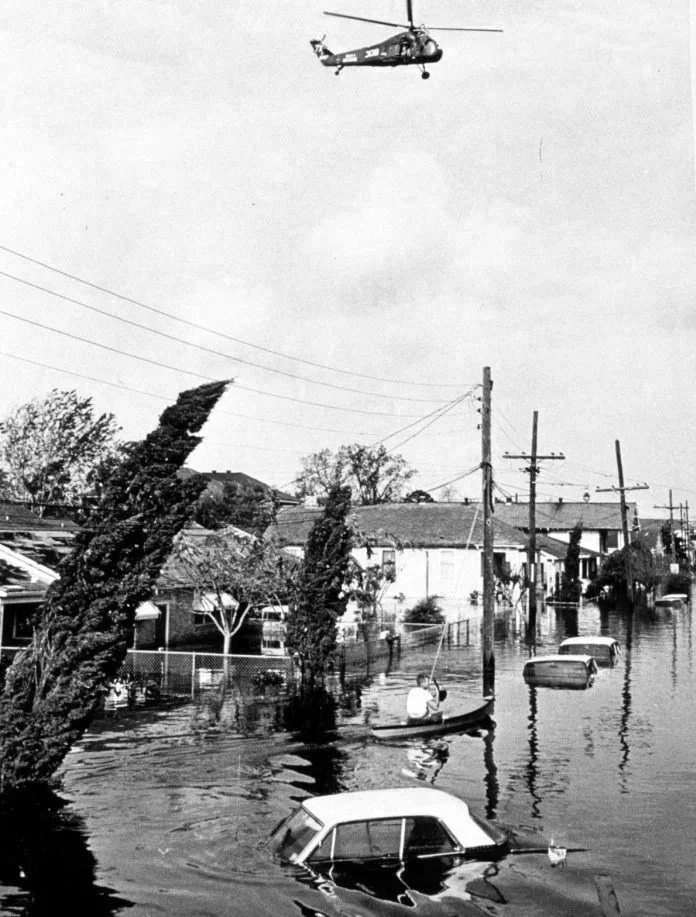
The 9th Ward after Betsy, 1965, NOAA photo
Then in September, Mother Nature paid a call, washing away housing and community for many cultural workers. Louisiana Senator Russell Long wrote that "aside from the Great Lakes, the biggest lake in America is Lake Pontchartrain. It is now drained dry. Hurricane Betsy picked it up and put it inside New Orleans and Jefferson Parish and the Third Congressional District."
During "Billion Dollar Betsy,” gimcrack levees in the Lower Nine and St. Bernard failed. 164,000 homes became uninhabitable. The social fabric of many tight-knit African American neighborhoods was broken. After Mayor Victor Schiro issued the statement, “Don’t believe any rumors, unless you hear them from me,” his leadership became a punchline.
Yet, somehow, six weeks later, the New Orleans Jazz Club and Barker’s efforts to bring back Jazz King Louis Armstrong for a triumphant Halloween 1965 return came off like clockwork. His benefit performance for the Jazz Club that night attracted international press, giving New Orleans renewed recognition as the birthplace of jazz.
“A living art is not preserved, it is practiced.” - Charles Suhor, Jazz in New Orleans: The Postwar Years Through 1970 (Scarecrow Press, 2001).
By 1968, just three years after Armstrong’s triumphant visit, the city – and the country itself – had changed drastically. The philosophy “if it bleeds, it leads,” dominated national news headlines.
The Vietnam War’s TET Offensive (January-September 1968) was foremost on American minds. A quarter of a million young men were drafted that year. With nearly 17,000 deaths, 1968 was the bloodiest year of the unpopular war in Southeast Asia.
And New Orleans had been making sensational national headlines again: On March 1, 1967, respected New Orleans businessman Clay Shaw had been arrested by the local District Attorney for the 1963 assassination in Dallas of President John F. Kennedy.
At that point, 90% of American households contained televisions and none of them could get enough of the astonishing and salacious tale: D.A. Jim Garrison claimed that the tall, courtly Shaw had led a group of sadistic homosexual thrill killers to assassinate Kennedy.
Garrison’s prosecution of Shaw - the only person ever brought to trial on charges pertaining to the assassination – lasted two endless, headline-grabbing years before Shaw was declared innocent by a jury - in less than one hour.
Unfortunately for Danny Barker’s jazz fest production aspirations, his partner, Dean A. Andrews, Jr., had been caught up in Garrison’s vindictive agenda early on. Andrews was arrested on March 16, 1967 on three counts of perjury. He had claimed under oath that a sinister figure named Clay Bertrand [a supposed alias for Clay Shaw] had hired him to represent Lee Harvey Oswald. Later, he admitted that he’d invented Clay Bertrand.
Later that year, Andrews was sentenced by a grand jury to serve three concurrent 18-month sentences.
“Jazz Fest ’68 points out that New Orleans is the birthplace of jazz and will illustrate jazz in all its traditional and progressive states of evolution.” Co-Music Coordinator, Al Belletto to the Louisiana Weekly, May 11, 1968.
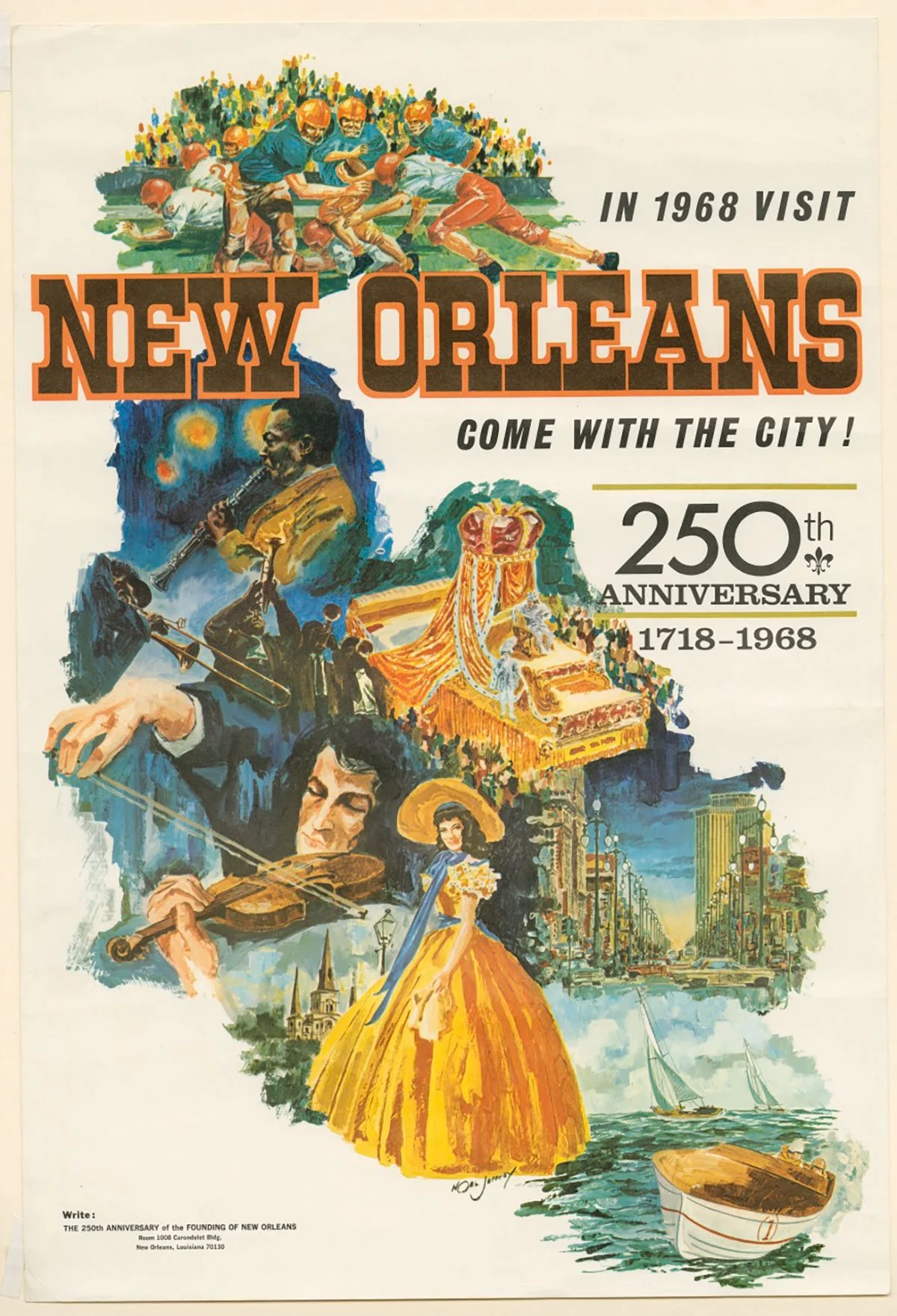
If Noel Robert Jeffrey’s official poster for New Orleans’ 250th birthday (1718-1968) is any indication, the city was dominated by football and a lady in a yellow hoop skirt, with a Mardi Gras float , the International Trade Mart and musicians representing economic forces – and a open row boat should visitors need a hasty maritime escape. Artist: Noel Robert Jeffrey c. 1967 with permission of the Historic New Orleans Collection. 1974.25.8.227.
Yet, amid 1968’s national socio-political turmoil, New Orleans was celebrating its 250th anniversary. Its civil-rights-era tourist industry needed a defibrillator to attract conventions to the city. And the city’s official anniversary poster proved the white leadership was sadly out of step with the times, promoting the city’s antebellum glory.
Barker and his compatriots at the Jazz Club spotted an opening and began floating the idea of an International Jazz Festival. Since 1954, New Orleans’ jazz icons had traveled up to the outdoor jazz festival in Newport, Rhode Island to entertain the East Coast elite.
New Orleans jazz advocates like Barker argued that the time had come for hometown artists to plant their flag on jazz’s evolutionary map, bringing fans to see them in the birthplace of the genre.
Unfortunately, Boston-based George Wein, the creative force behind the successful Newport festival, continued to turn down New Orleans’ overtures to produce a festival. Beginning in 1962, local white male civic leaders rolled out the red carpet for him in hopes of monetizing jazz. Wein, whose wife Joyce was an African American scientist, would not be allowed to stay with her in a New Orleans hotel under Louisiana’s Jim Crow laws.
As Wein noted in his 2003 autobiography, Myself Among Others: A Life in Music, “Here were a group of prominent Louisiana figures valiantly trying to find a way around the laws that they themselves had helped to create and enforce,” he observed.
Wein wisely deduced, “In a culture steeped in white supremacy, racism becomes a personal thing.” He knew it would take time until these leaders internalized racism as immoral – both in their “souls and pocketbooks.”
It would be 1970 before Wein took the helm and began the New Orleans Jazz & Heritage Festival. So in the absence of a professional producer, Durel Black – the local Chair of the Chamber of Commerce’s Jazz and Music Therapy Committee – and the New Orleans Jazz Club, spearheaded the mission to produce a festival for the city’s birthday year.
Working with City Hall, Black created a committee to oversee the festival. By securing jazz greats from afar like Dave Brubeck, Duke Ellington, Woody Herman, and Ramsey Lewis, the local producers aspired to get New Orleanians to pay to hear jazz alongside the tourists.
This committee relied on two local musicians to assist, Danny Barker and Al Belletto. The two New Orleans-born jazz legends possessed impressive credentials and contacts, and proved to be nimble strategists.
Al Belletto, a college-educated grandson of Sicilian immigrants, was recognized by musicians for his commitment to equitable treatment and compensation for both Black and white performers. As the national music director of the Playboy Clubs, he integrated the band in the New Orleans Club despite Louisiana’s laws to the contrary.
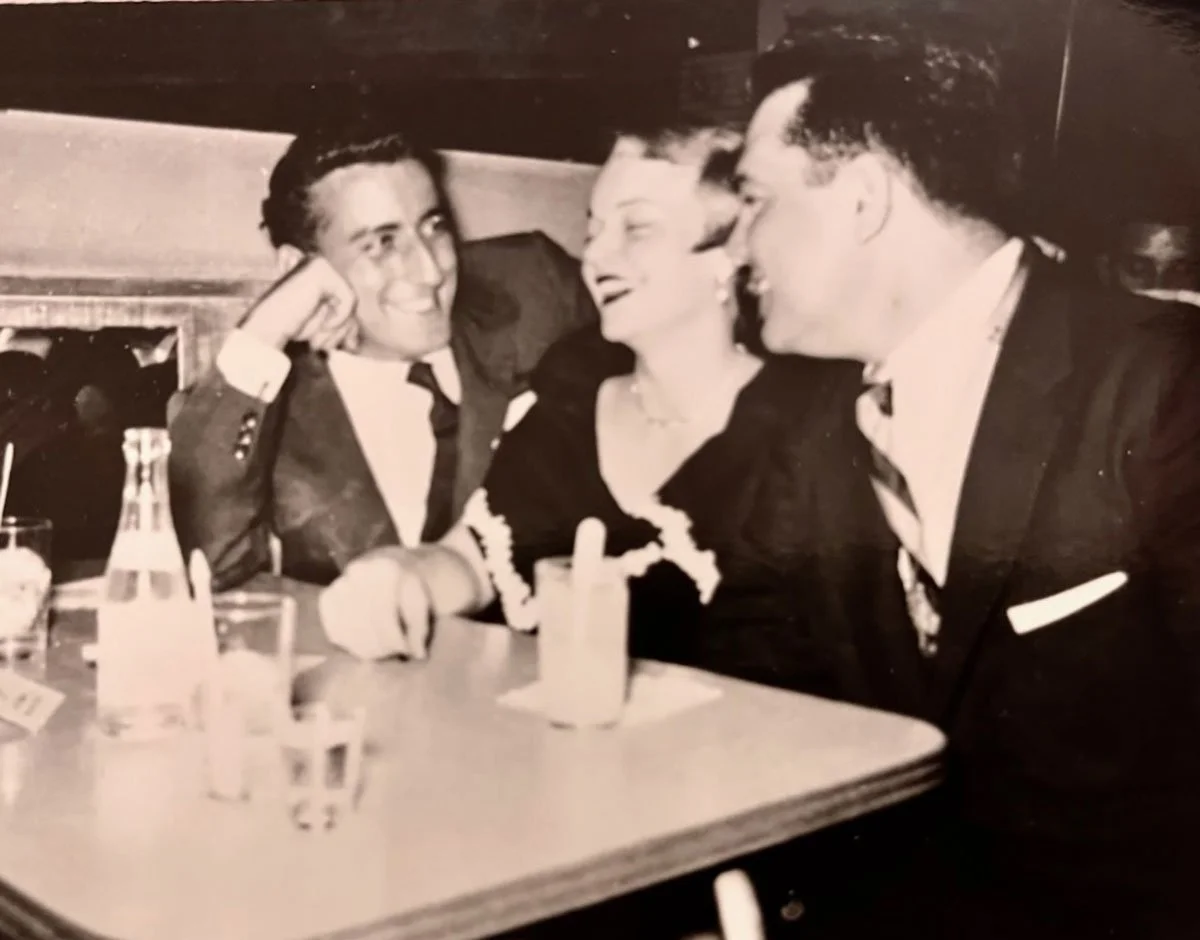
Tony Bennett (l) with Al Belletto. Al Belletto was beloved by musicians and comedians all over the country in his role as the talent coordinator of the national Playboy Clubs. With appreciation to Brad Belletto, from the Al Belletto Archives
The festival planners came to lean on Barker to coordinate talent, resolve a myriad of inevitable kerfuffles, host the jazz education session for children, grand marshal the Onward Brass Band, babysit foreign press, serve as Dixieland’s air traffic controller and kiss the rings of the bigwigs who sought to reap the prestige. And perform.
In their roles, Barker and Belletto observed that New Orleans jazz legends were treated like royalty in the outposts of Dixieland in England, Europe and Japan. There was concern as to how these jazz fans would react when they witnessed how Jim Crow treated cherished Black musicians, prohibiting them from using “White Only” restrooms and water fountains.
They also had to navigate the local unions. In 1968, the New Orleans jazz scene was governed by two unions: the Musicians Local 496 for Blacks led by Louis A. Cottrell, Jr., and the all-white Local 174, led by David Winstein. The two unions were determined to preserve their own hierarchy and authority and did not merge until 1971. White European-born jazz musicians like Lars Edegran, Clive Wilson and Orange Kellin were required to join the Negro Musicians Union if they wished to perform with Black artists.
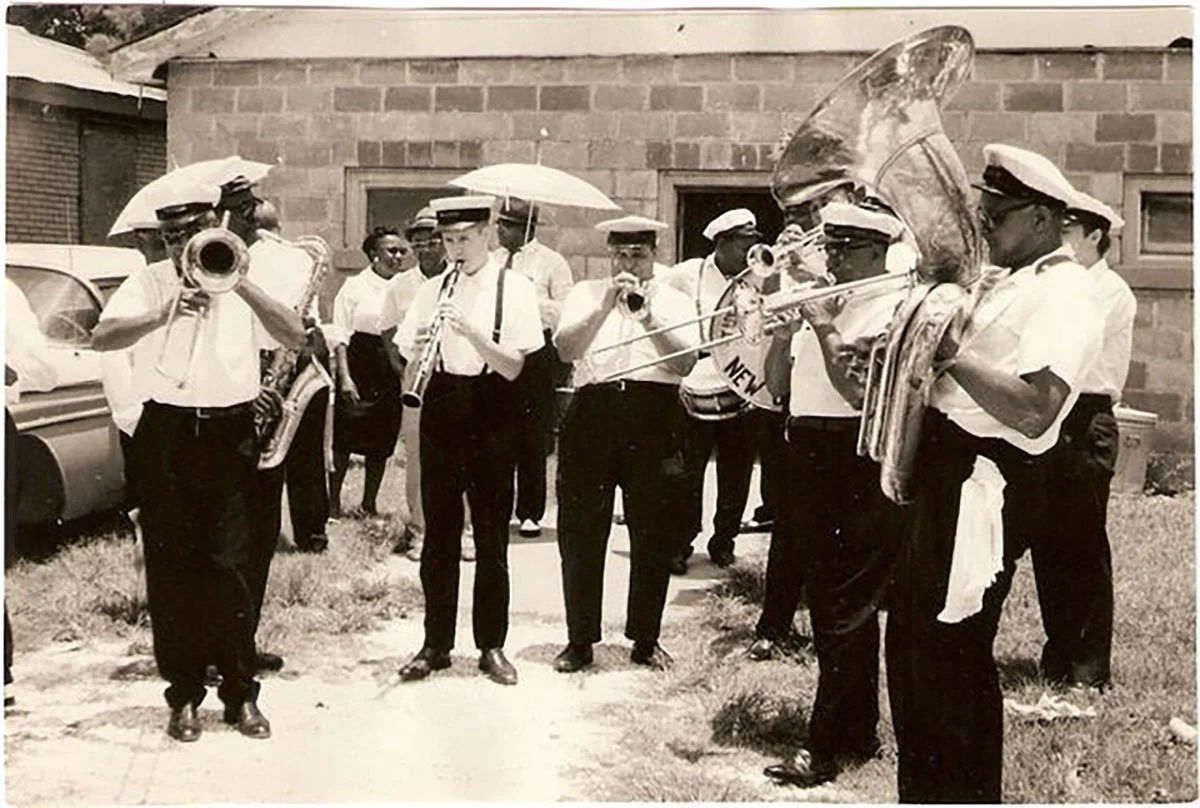
European-born musicians like Lars Edegran (clarinet) joined the union for Black perfomers. With appreciation to the Lars Edegran Archive
“Jazz was the gift of the Negro to suffering humanity and its value, I think, has been greatly underestimated.” Excerpt from Archbishop Philip M. Hannan’s homily at the standing room only mass for the dearly departed jazz icons at 3 pm on Sunday, May 12, 1968. (The Times-Picayune, Monday, May 13, 1968)
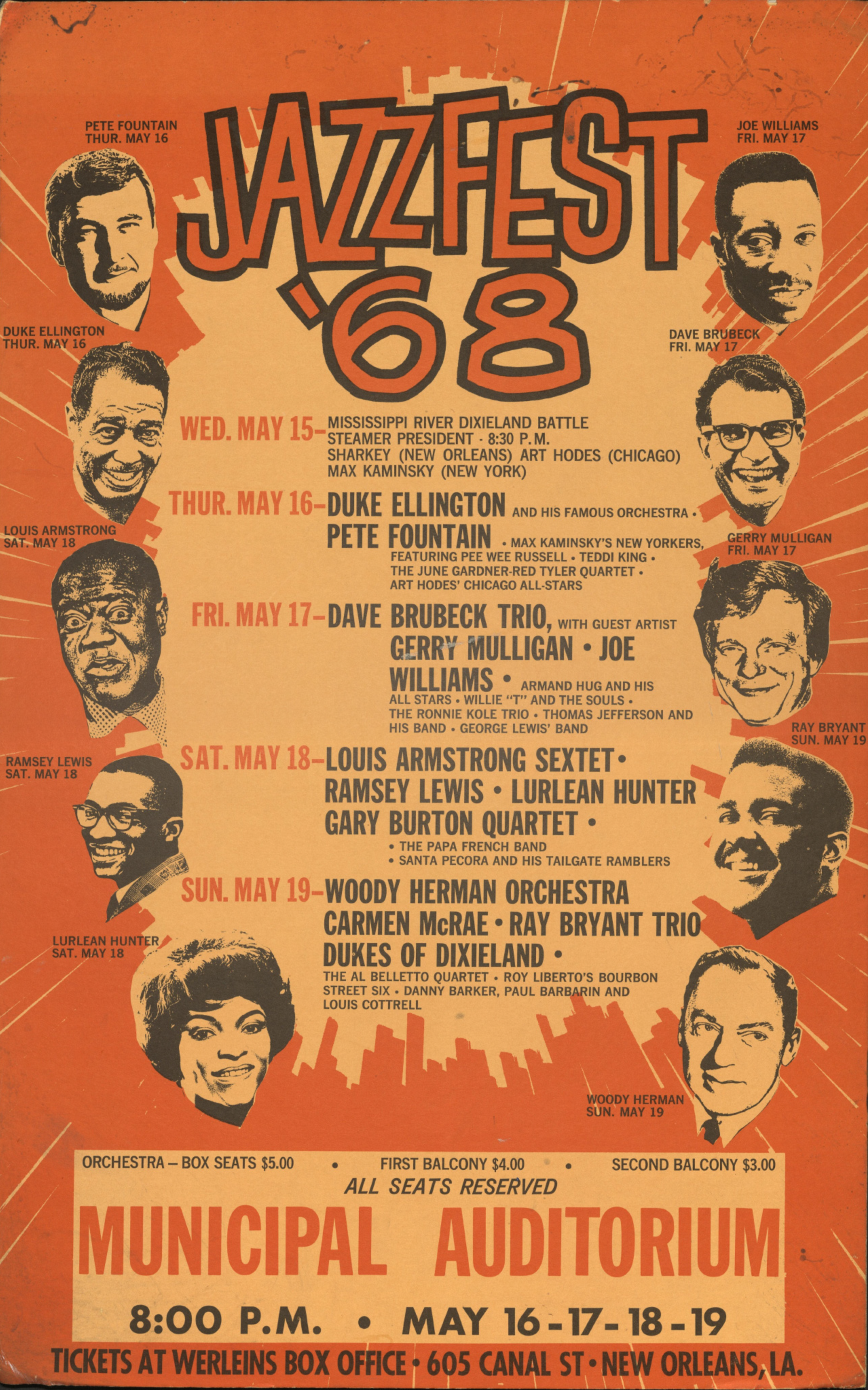
The stellar line up appeared on local fliers tacked up on telephone poles and advertisements in all the local papers. With permission from Tulane University Special Collections.
Only six weeks before the festival, Dr. Martin Luther King, Jr., the 39-year-old civil rights leader, was assassinated at the Lorraine Motel in Memphis. Dr. King’s murder unleashed deep-seated rage as 100 American cities erupted in flames during “The Holy Week Uprising of 1968” (April 4-11).
A short, silent video of the 1968 Jazz Mass, courtesy the New Orleans Jazz MuseumIn 1968, the city had a 67% African American population, shaped by centuries of complex class and race dynamics, more rigid than a wrought iron fence. Ironically, while New Orleans was celebrating its 250th anniversary with a festival to support jazz – an art form born to upend injustice – the city’s public swimming pools remained closed to prevent race mixing.
But the New Orleans festival proceeded on schedule, beginning with a special mass in St. Louis Cathedral on Sunday, May 12. Archbishop Philip Hannan conducted the service as a tribute to New Orleans’ jazz ancestors. Several choirs sang in honor of lost musicians, but certainly, King’s assassination must have been foremost in everyone's minds.
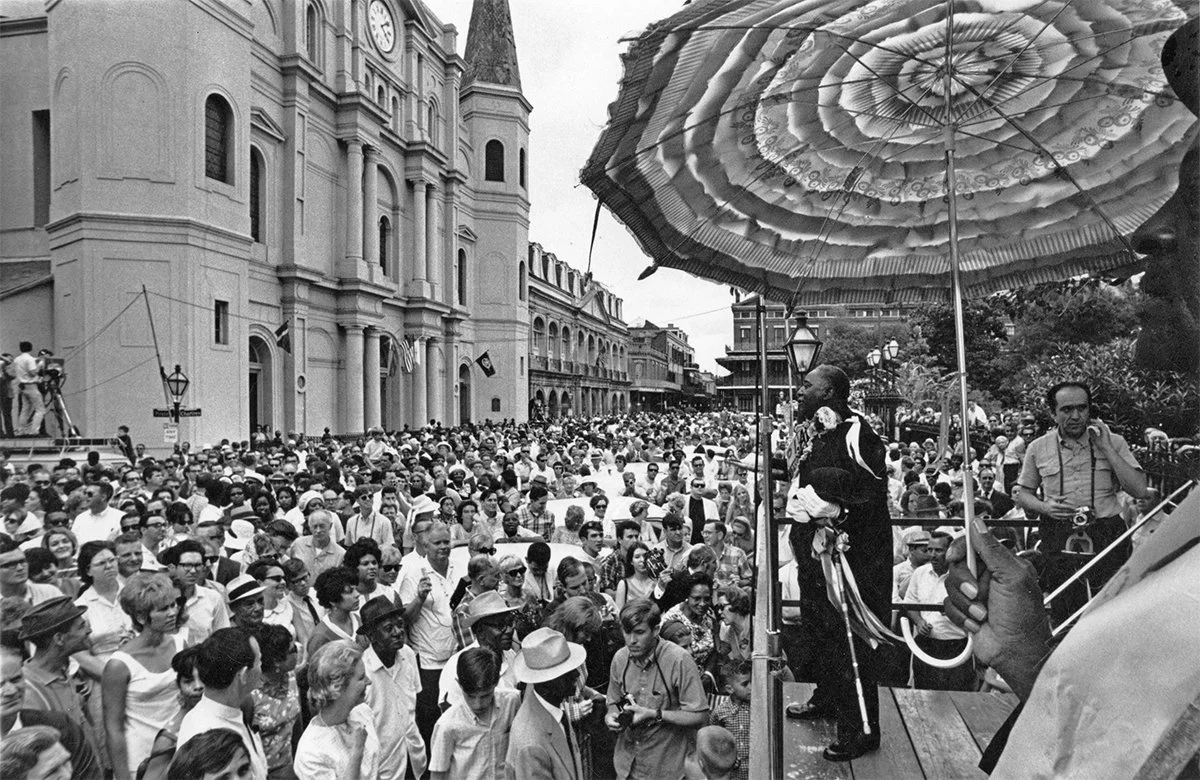
The 1968 International Jazz Festival opened with a special mass, followed by a second line parade. Photo courtesy The New Orleans Jazz Museum Archives
“A musician could be playing in London or Tunis, in Paris, in Germany. But no matter where (jazz) is played, you gotta hear it starting way behind you. There’s the drum beating from Congo Square and there’s the song starting in the field over the trees.” Sidney Bechet, Treat it Gentle: An Autobiography, Da Capo, 1978.
At 6pm on Wednesday, under the sprawling oaks of Congo Square (then named Beauregard Square), the longest second line in American history provided the soundtrack to New Orleans’ 250th birthday.
Dejan’s Olympia Brass Band carried forth the ancient spirit that cradled jazz’s myths and melodies. That first evening of the International Jazz Festival, 11 bands danced their way to the Mississippi River, where a Battle of the Bands would be hosted aboard the SS President.
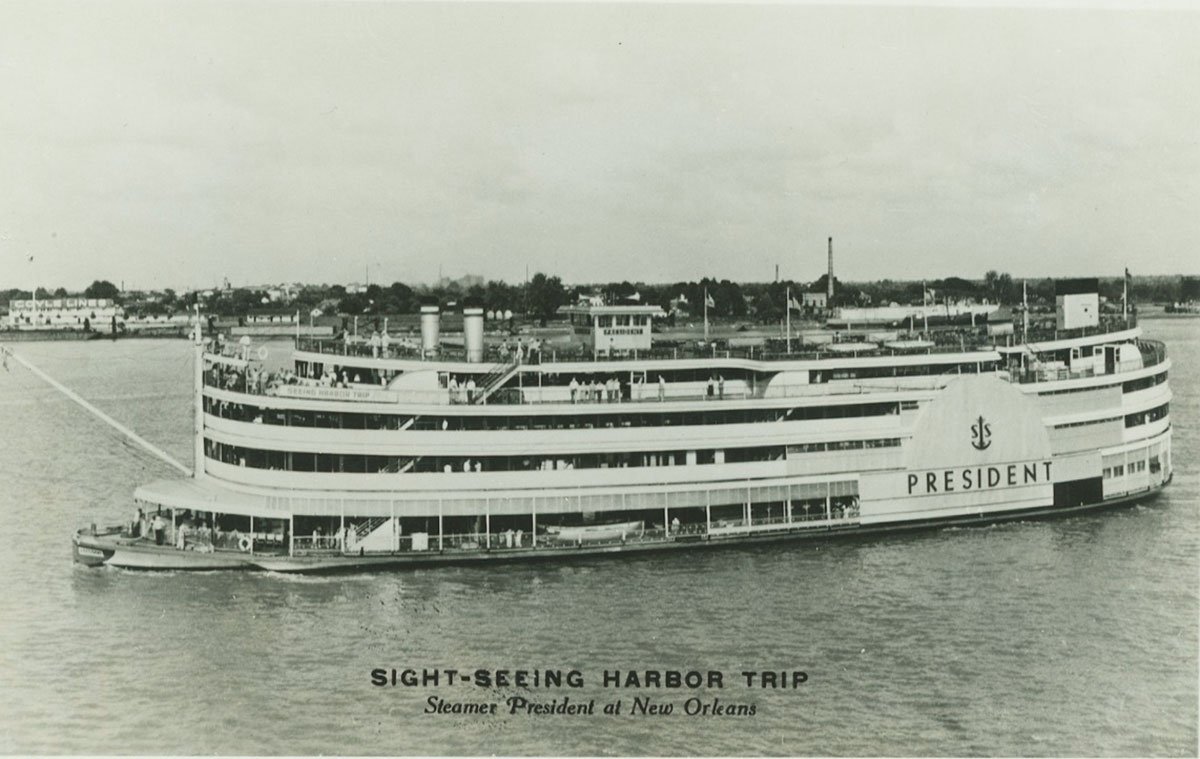
On the fest’s first night, May 15, 1968, ,Captain Verne Streckfus was at the helm as 2400 jazz fans (tickets $3.50 ) crammed aboard the SS. President for Mississippi River Dixieland Battle of the Bands between Sharkey Bonano from New Orleans, Art Hodes from Chicago and Max Kaminsky from New York. The vessel, headquartered in New Orleans circa 1940-80) had been featured in Elvis Presley’s 1958 film, King Creole. Sergio Leone renamed her SS New Orleans in his 1973 Western, My Name is Nobody. With permission of the Historic New Orleans Collection, Gift of Beverly A. Harber, 2014.01.88.5.
Popular British writer, Stanley Dance, captured the festival highlights for the Jazz Journal. His words magically transported his British readers to the birthplace of jazz.
“The heat came up like steam from a leaky radiator,” Dance wrote.
“Milton Batiste, a powerful younger trumpeter, would point his horn toward the sky and let it rip, reminiscent of how Buddy Bolden used to blow for the kids across the river in Algiers,” wrote Dance.
Dance heaped praise upon the New Orleans Police Department Band as “seven clarinets wailed away on The Saints with considerable skill.” He noted they were accompanied by police cavalry in crash helmets “in case the nags got riled up by the hot jazz.”
He also noted that should his kinsmen visiting New Orleans in 1968 feel homesick, a bright red double-decker London bus was parked adjacent to Jackson Square.
But at least one other writer demonstrated the cultural schism between New Orleans Dixieland fans and the visiting jazz sophisticates. For example, John S. Wilson, the same New York Times reviewer who praised Danny Barker as the grand marshal, took Louis Armstrong to task. Wilson complained about Armstrong’s selection of popular songs like “Blueberry Hill” and "Hello Dolly!" before delivering his final scathing opinion of one song…
“…a dreary bit of sentimental claptrap, ‘What a Wonderful World,' which Armstrong is plugging assiduously.”
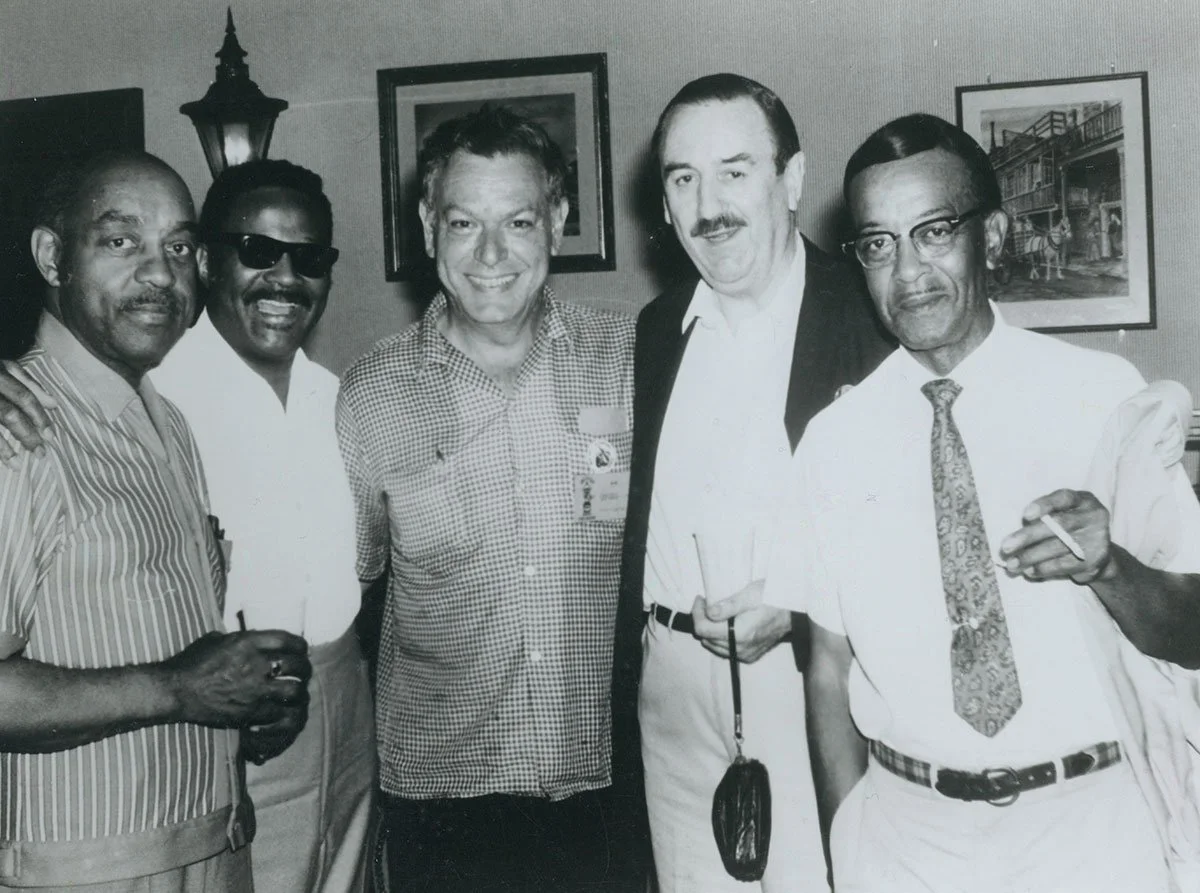
As the music co-producer of the 1968 International Jazz Fest, Danny Barker put all of his skills to use. Pictured : Benny Carter, Clark Terry, Floyd Levin, Stanley Dance and Danny Barker. One of the best accounts of the 1968 Festival was written by Dance. Stanley Frank Dance (born in England, 1910), wrote a monthly column for Jazz Journal (1948-1999) was a passionate advocate of New Orleans jazz who righteously opposed Bebop. With permission from the New Orleans Jazz Museum Archives.
“Each master, each sideman, offered up his life’s work in a carpet of sound that amounted to a monument, a benediction to the fathers of Jazz in New Orleans around the turn of the century.” M. Gene Mearns, (UPI), “New Orleans’ First Jazzfest is rated success by Backers,” Sunday Advocate, Baton Rouge, May 19, 1968
The four nights of festival concerts were held in the air-conditioned comfort of the 5,000-seat, Art Deco-style Municipal Auditorium, which had opened in 1930. The New Orleans institution was the home of the circus, Mardi Gras balls and boxing matches. The Duke and Duchess of Windsor had made history there when, incredibly, they bowed to Carnival royalty (February 21, 1950). Elvis, the King of Rock n Roll, gyrated there in May 1955.
So the auditorium provided a fitting home for this first International Jazz Festival – one conceived by the Jazz Club for New Orleans’ jazz immortals to take their victory lap for the art form they birthed.
Each day of the festival, a traditional brass band led a second line from Jackson Square to the auditorium. To festival attendees unaccustomed to coastal humidity, the comfort of the chilly auditorium settled jazz fans in their seats by the time the brass band made its way to the stage.
The festival’s MC, Willis Conover, was also the co-producer of the festival. An Irish jazz purist based in Washington, D.C., Conover had 30,000 fan club members worldwide. As the international voice of jazz for more than 40 years, he broadcast a two-hour show six nights a week on Voice of America. It reached 30 million listeners worldwide.
“WHAT A NIGHT!” Conover shouted at the opening, then went on to tell the jubilant, sold-out audience that more than 18 of the local performers were over seventy years old.
To Al Belletto and Danny Barker, these statistics were noteworthy for several reasons. The first was that they were living to soak up long-awaited praise in New Orleans before they themselves became ancestors. The second was that they re-united with those fellow jazz musicians who’d crossed color lines in the early days to defy Jim Crow.
And lastly, it illustrated the vulnerability of New Orleans-style jazz. While many young foreign-born musicians were wild about trad jazz, up-and-coming local musicians favored R&B and pop.
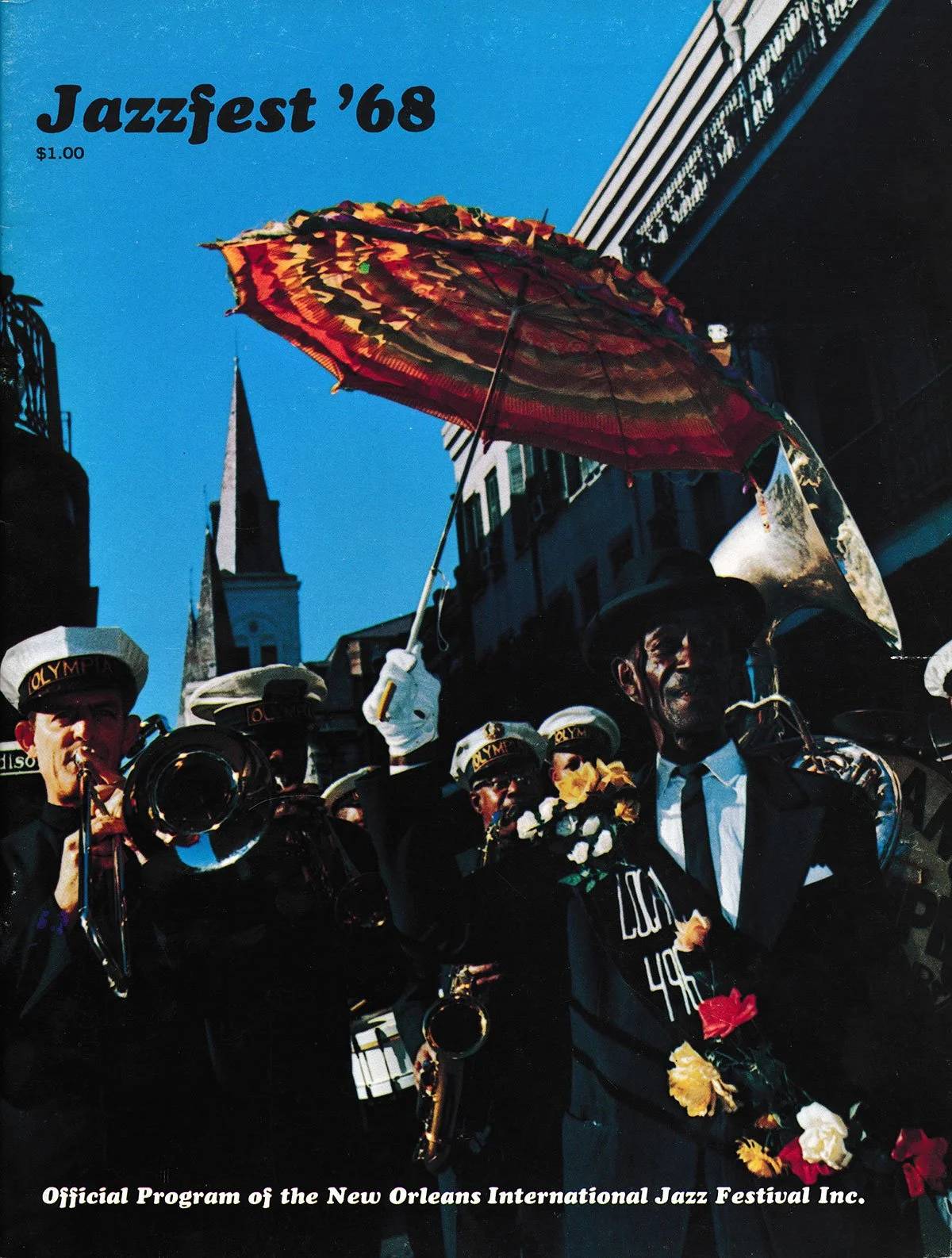
The first full copy of the official program writer Bethany Bultman located in her research for this piece is in the Brubeck Collection. They kindly digitized it for this article and gave FQJ permission to link to it – you may access it by clicking on the cover image. It’s sad to note that Danny Barker was not credited in the program for his work in helping produce it.
The young members of the Barry Martyn Jazz Band from England were a case in point. Slated to perform, they joined the hundreds of foreign fans who came to breathe the same swampy air as their jazz idols. The quest to experience authentic jazz had brought them across the Atlantic and led them to make the 1,300-mile trip from New York, all six – and their gear! – crammed into a rented station wagon.
Driving into the French Quarter on May 15, the six-member band heard the distant beat of their first second line. Thrilled beyond measure, they parked their rented blue Dodge station wagon in the 700 block of Dauphine – tightly packed with their passports, travelers’ checks. instruments and suitcases. They locked the car and raced toward the beat.
Accustomed to hearing New Orleans’ jazz on records, the young Brits were dazzled by the amplified sound as brass and drum. Hemmed in by the French Quarter buildings, the astonishing music ricocheted off brick and wrought iron.
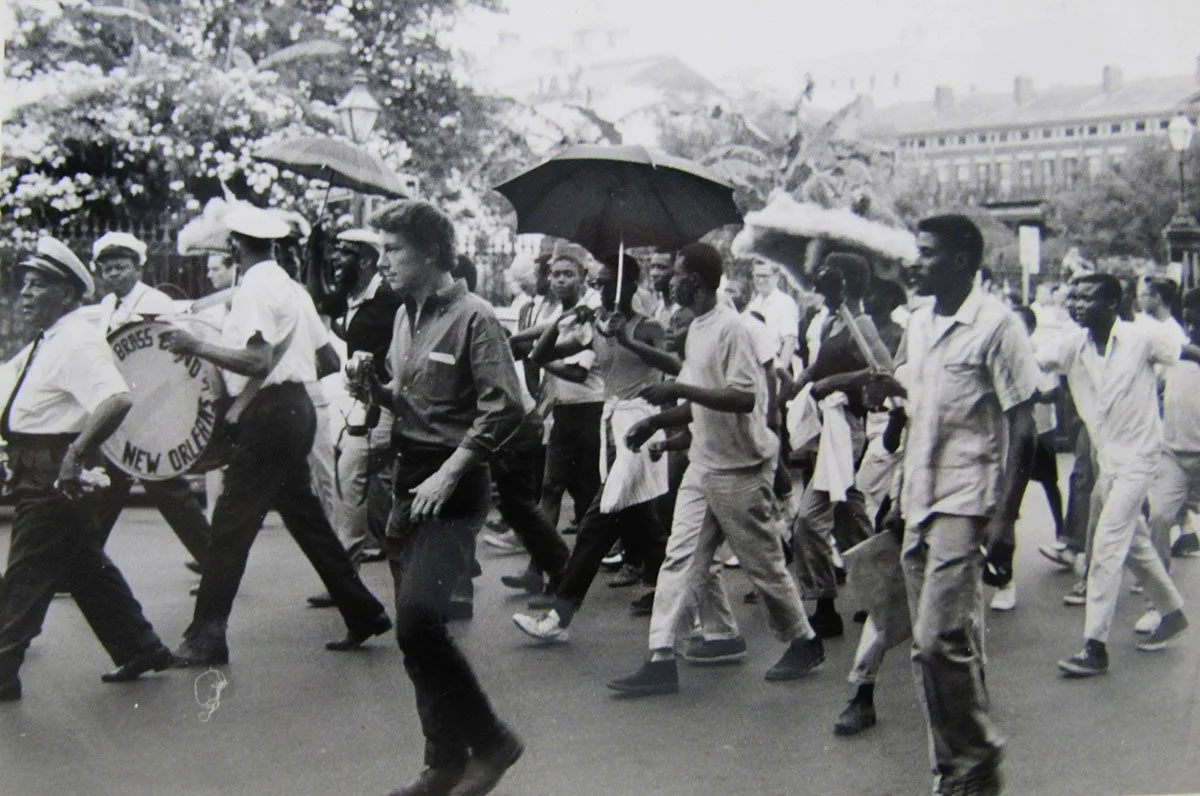
On Wednesday afternoon, March 15, 1968, after a 1500 mile car trip from New York, Brian Turnock and his five British bandmates, parked their rented station wagon in the 700 block of Burgundy to join in with the Young Tuxedos second line. With gratitude to the Brian Turnock Archive.
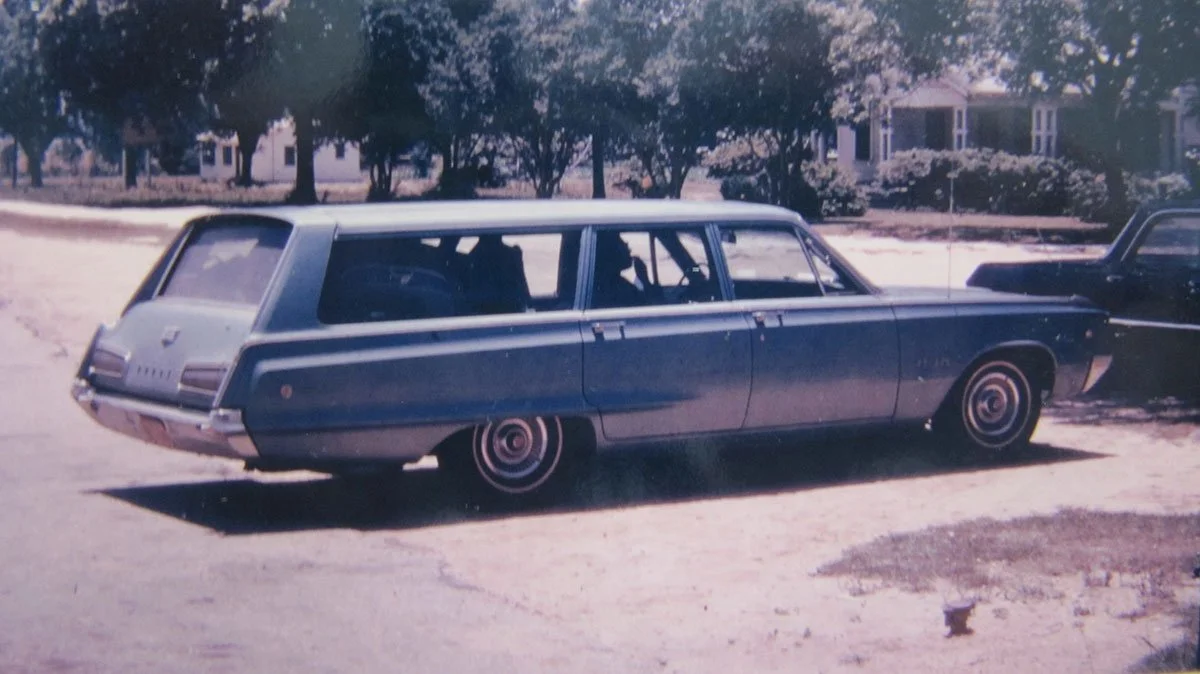
As the six British musicians basked in the glory of their first authentic New Orleans second line on Wednesday, May 16,, 1968, a thief broke into the side vent of their rented station wagon and stole Barry Martyn's snare drum, the musicians' clothes, passports, and travelers checks. With gratitude to the Brian Turnock Archive.
But while the Martyn band was chasing the second line, a thief was jimmying the side window of their Avis rental car. According to the police report, they lost their travelers' checks, passports, clothes – and Martyn’s snare drum.
Yet the theft didn’t mar their experience.
New Orleans alto saxophonist and band leader, Harold “Duke” Dejan threw a party and invited the Brits. Peter Dyer, trombonist in Martyn’s band, recounted his experience for the British Jazz Times.
“They [Dejan and his girlfriend, Ms. Fox] really laid on a feast – gumbo, fried chicken, spaghetti and lots of booze.” New Orleans musicians, including some of their idols, were playing for kicks.
Harold Dejan also arranged several private gigs for them to help make back their stolen money, so the young British musicians played often over the euphoric five days.
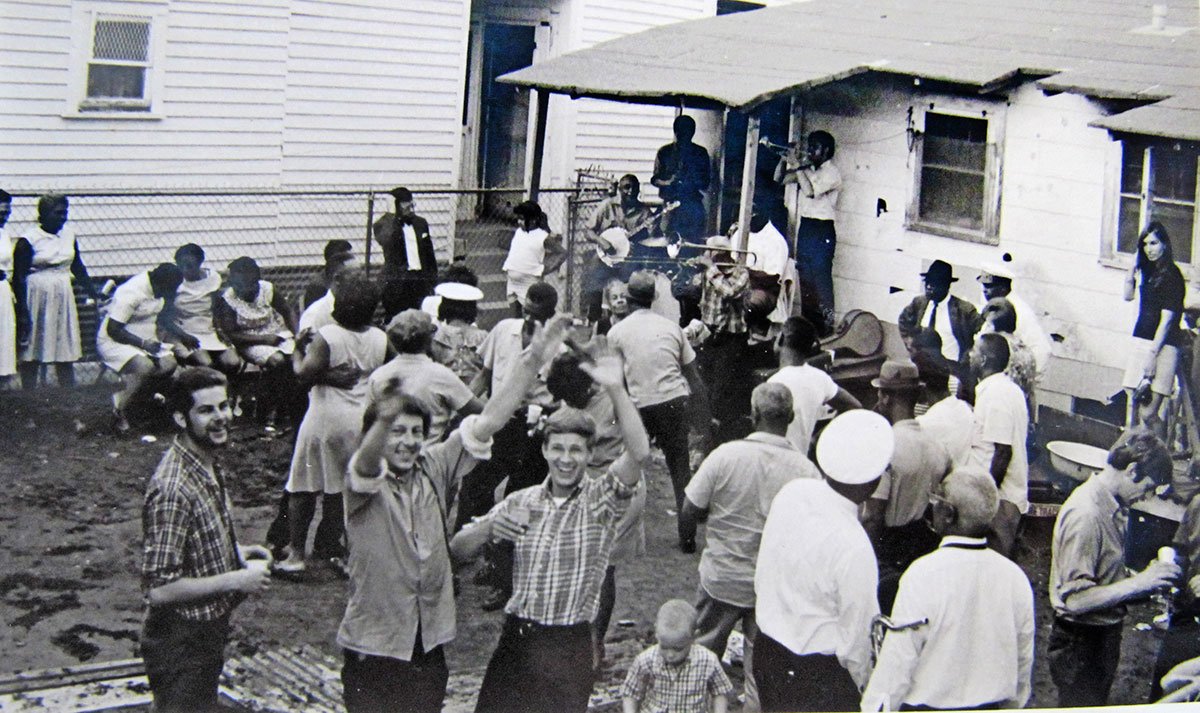
On Saturday night May 18, 1968, Harold "Duke" Dejan, saxophonist and Olympia Brass Band leader (and great grandfather of Big Chief Bo Dollis, Jr.) hosted a party for the visiting Brits in his girlfriend's back yard. Gumbo, fried chicken, jazz and endless booze dazzled the visitors from across the pond. With gratitude to the Brian Turnock Archive.
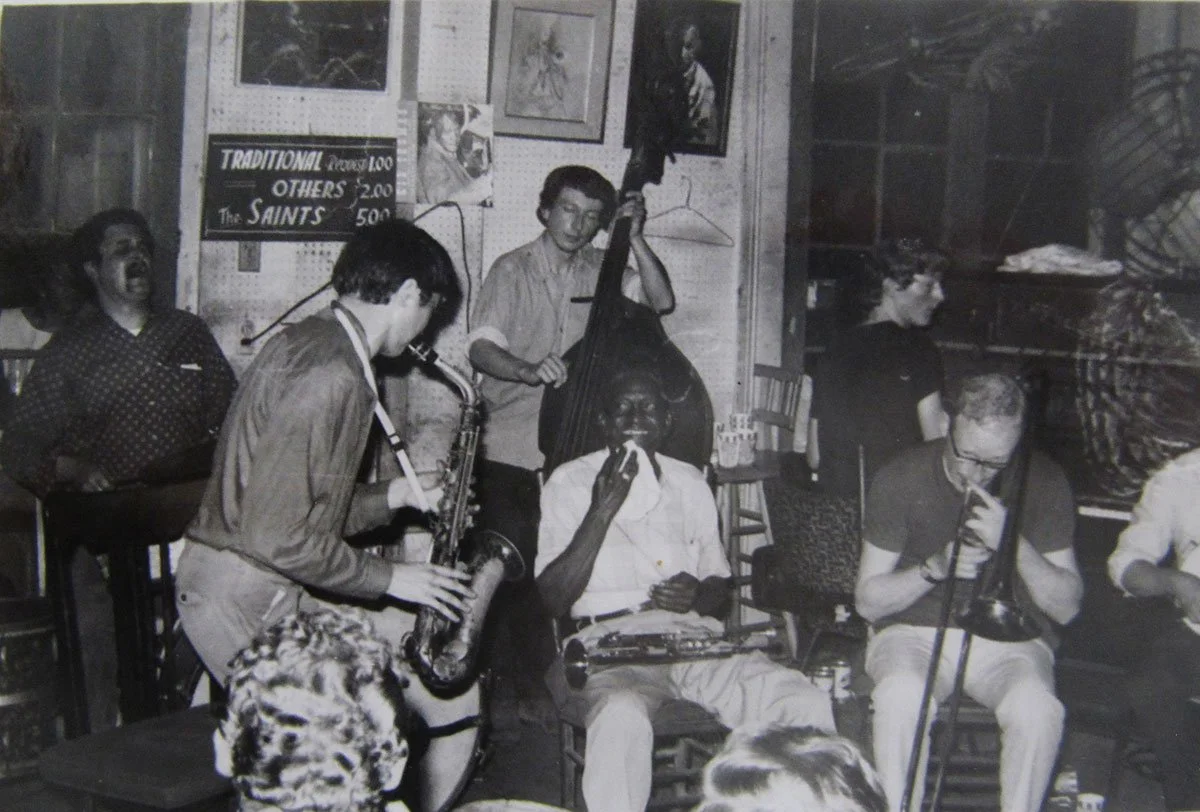
Thanks to the efforts of local alto saxophonist, Harold "Duke" Dejan, and trombonist, Louis Nelson, the six visiting Brits landed a dream gig at Preservation Hall on Thursday night, May 16, 1968. L to R: Barry Martyn, (drums) Sammy Rimington, (sax) , and Pete Dyer (trombone). They were joined by Kid Thomas for a jam session that lasted til 4am. With gratitude to the Brian Turnock Archive.
On Friday, May 17, 1968, The Barry Martyn Jazz Band took the stage as the warm-up for the headliner, Dave Brubeck. They played with instruments loaned by Werlein’s Music Store.
Peter Dyer later confessed, “I was more concerned with the few dozen local musicians listening to us, than the sold-out, 5000 people in audience.”
“It makes you cast away any doubts. This is New Orleans music at its impressive best, and made me realize how futile other jazz can be in comparison,” raved Dyer.
“As a musician, the things you notice are tones, correct tempo of numbers, and attack of notes,” he continued, “Also, an overall impression of a reserve of power, relaxation, dynamics, and of course, a great feeling and meaningfulness in their music.”
Martyn bassist Brian Turnock recently explained to French Quarter Journal why the band’s performance was remembered for decades – for the wrong reasons. They were forced to break with the hallowed Dixieland dress code, which required they wear white shirts.
Since theirs had been stolen, the Chamber’s Festival Jazz Committee chair, Joe Gemilli (proprietor of Joe Gemelli’s Distinctive Men’s Wear), offered to help on short notice. Unfortunately, he only had one in-stock set of matching shirts in their sizes: in a garish maroon.
Brian Turnock told FQJ he still has his.
Later in the evening, Dave Brubeck performed and was the only festival musician to record their set. The recording of the 1968 performance in New Orleans was only released in vinyl, but part of his extraordinary set can be found on Youtube.
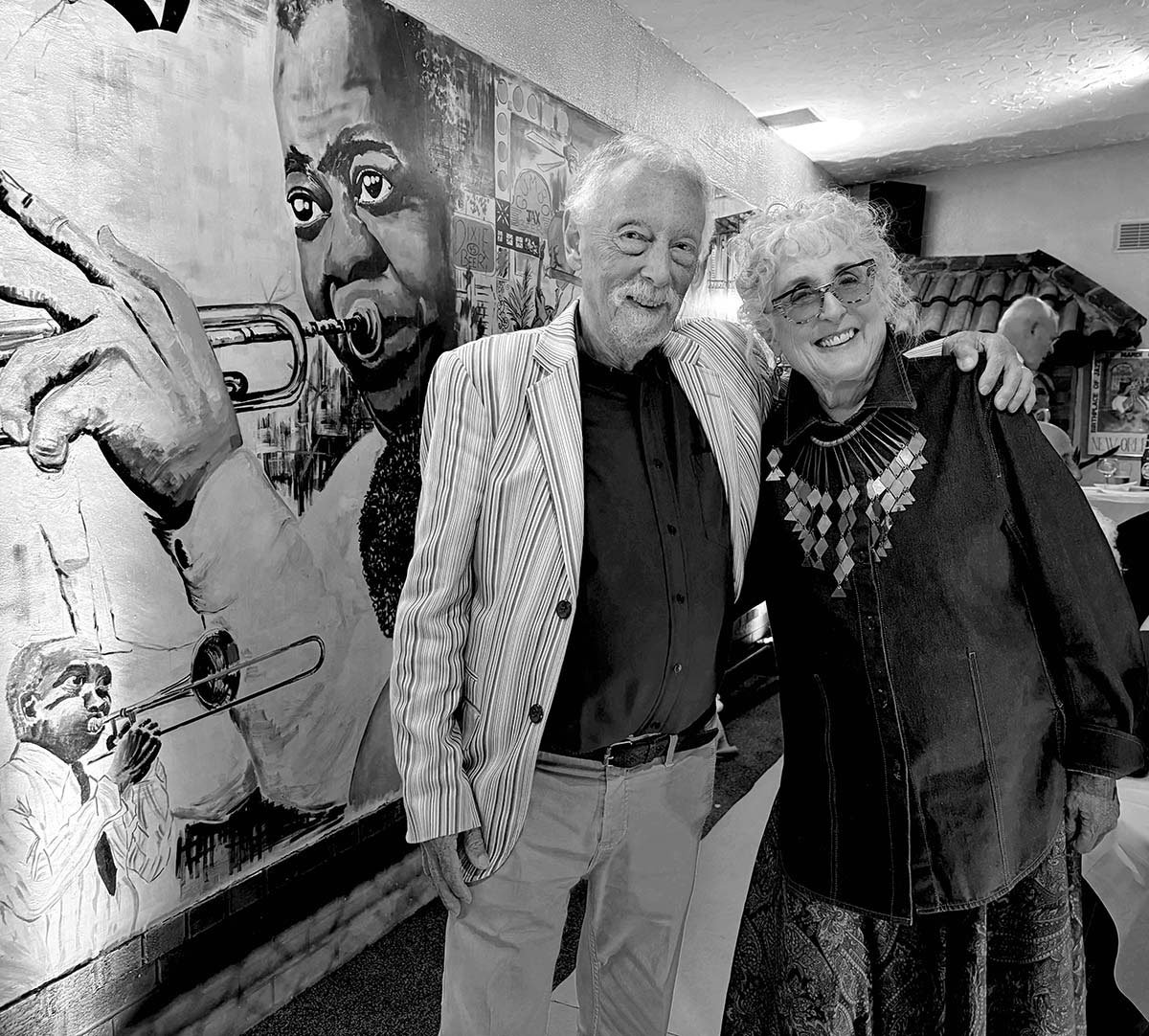
Bassist Brian Turnock with FQJ writer, Bethany Ewald Bultman, in front of the New Orleans jazz mural at the Camberly home of Barry and Chris Pryce in Surrey, England, 2025. Photograph by Kathy Edegran
“Jazz tells me more about America than any American can realize. It bespeaks vitality, strength, social mobility: it’s a free music with its own discipline, but not an imposed, inhibited discipline.” Willis Conover, 1968 International Jazz Festival producer. (New Orleans States Item, May 10, 1969)
Another musician who documented the heady experience is Joseph P. Muranyi, clarinetist for Armstrong (1967-1971), who recorded an audio diary during his tour. Armstrong scholar, Ricky Riccardi, recently transcribed his account of their visit to New Orleans for French Quarter Journal.
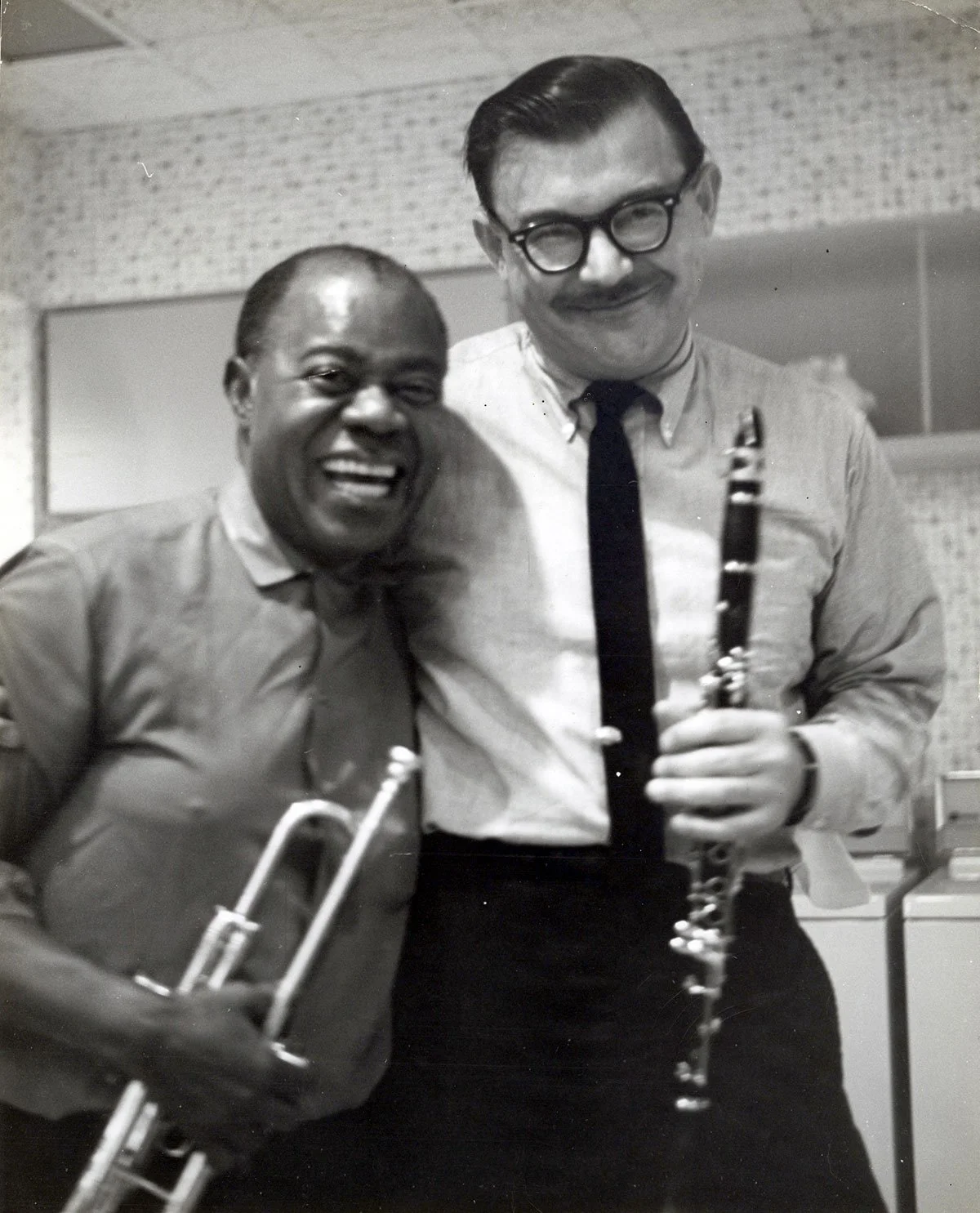
The close bond between Pops and Joe sustained them thru months of touring. Joe Muranyi's poignant documentation of Armstrong's 1968 visit, the last time he ever performed in this home town, brings the event to life. The Hungarian-born clarinetist, Joseph P. “Ma Rainey” Murayni, was a fixture on the post-war New York Dixieland circuit where he played with Wingy Manone and Danny Barker, before joining Louis Armstrong’s All Stars (1967-1971.). Photograph: Jack Bradley, with permission of the Louis Armstrong House Museum
In one segment of the diary, Joe Muranyi recalled his backstage encounter with legendary trumpet player Ernest “Kid Punch” Miller.
As they were talking, trumpeter “Wingy” Manone walked in. Kid Punch confided, "We played together at Italian Hall (1020 Esplanade) in the early 1900s, but I don't think he remembers me."
After Miller left, Muranyi went over to speak to Manone (Joseph Matthews “Wingy” Manone). He’d grown up in the French Quarter’s Sicilian community. Manone earned fame in California and Las Vegas as a bandleader, vocalist and session musician on Benny Goodman records and in 1940, with Bing Crosby in the film Rhythm on the River. After 30 years, he’d returned to New Orleans to perform in the Jazz Fest.
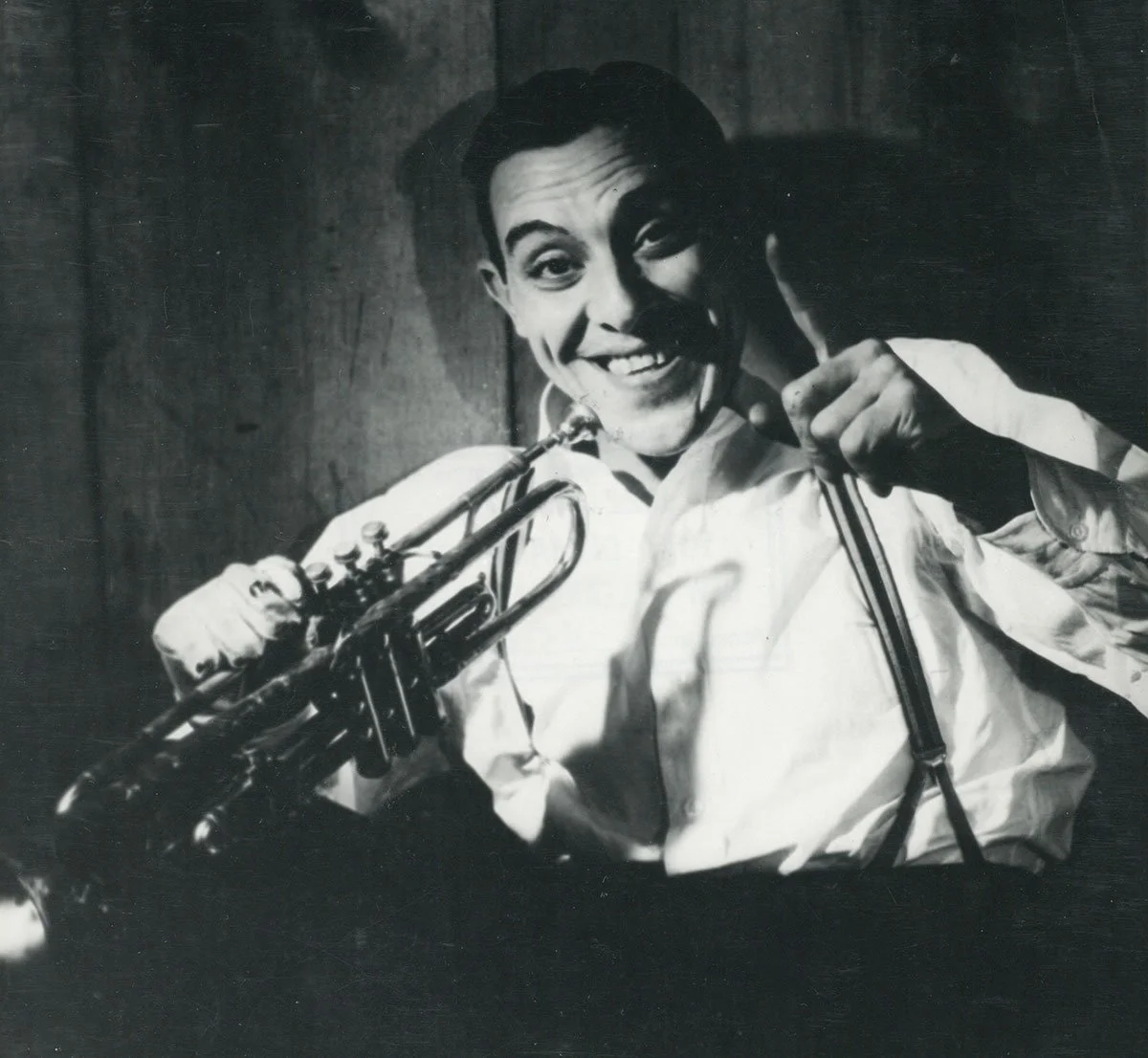
Using a prosthetist so naturally, few suspected that hot jazz trumpeter, Wingy Manone, didn’t have two hands. When he was ten his right arm was severed in a street car accident. With permission of the New Orleans Jazz Museum Archive.
As the two musicians chatted, Manone said, “Hey, wasn’t that Kid Punch? We used to play together at the Italian Hall! Bet he won’t recall me.”
Muranyi laughed very hard. Apparently, one could take a musician out of New Orleans, but in the end, they were still local cats.
“Do you know what it means to Miss New Orleans?” title of the iconic song by Eddie DeLange and Louis Alter for the 1947 film, New Orleans – sung by Billie Holiday with accompaniment by Armstrong.
Muryani also mentions that Pops was the guest of honor at a reception at the Royal Orleans Hotel. Danny Barker would later relate to me – with an accompanying eye roll and dramatic pause – “This was during the time few conventions wanted to come to New Orleans due to our “race mess.
“But wouldn’t you know it, the city managed to land one that same weekend. So Armstrong and Brubeck were greeted in the lobby of the Royal Orleans Hotel with a sign that read, “The New Orleans Chamber of Commerce Welcomes the National Association of Approved Morticians.”
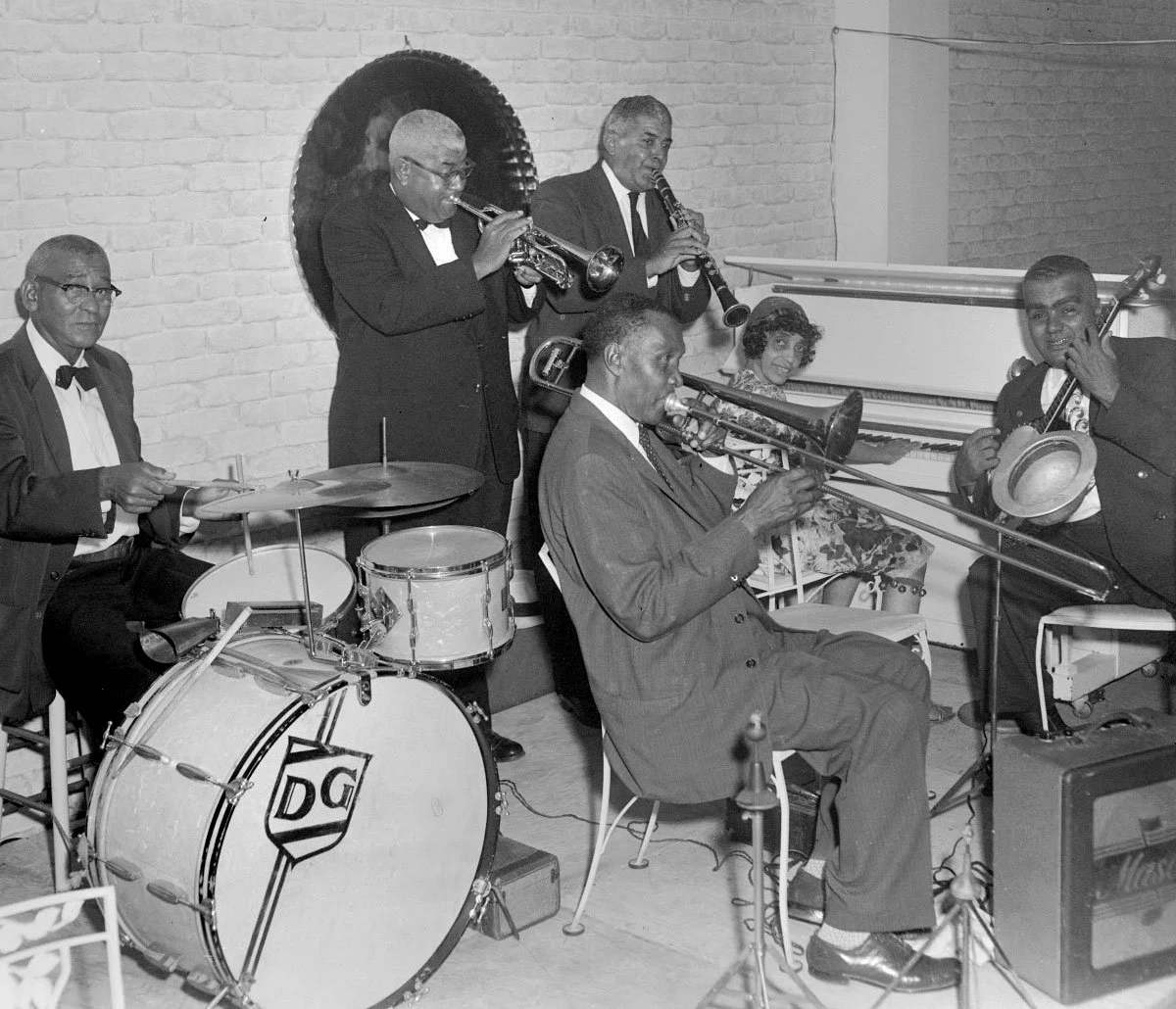
Sweet Emmet Barrett at the piano, photo by Jules Cahn, Historic New Orleans Collection, 2000.78.1.2135
Unlike Armstrong’s Halloween 1965 visit, when every moment was accounted for, he managed to slip away. He strolled over to Dixieland Hall (522 Bourbon) to sit in with his old friend, Paul Barbarin.
From there, he checked in on Sweet Emma Barrett, whom he called ‘Eyes,’ at Preservation Hall. Dodie Simmons, manager of the Hall in 1968, recently recalled that it was the only time she ever met Louis Armstrong.
Muryani never knew about Armstrong’s visit to Preservation Hall. In his account, he notes that when he and other Armstrong band members had stopped by earlier in the day, Alan Jaffe confided that Sweet Emma and Armstrong had “gone together” back in the 20’s. That amorous tidbit proved juicy fodder for a good ribbing once his band caught up with “Casanova Armstrong” later.
Meanwhile, Muryani hopped in a cab to the late-night supper party hosted by Armstrong’s sister, Beatrice Armstrong Collins – or as her friends and family affectionately knew her, “Mama Lucy.”
Muryani noted that Mama Lucy “resembles Pops when Pops was fat, was sitting there, looking kind of depressed that Pops hadn’t arrived.”
Armstrong’s band savored her gumbo and red beans. Then, “suddenly, like a tremor went through the room, almost – not physically but psychologically. And somebody said to Mama Lucy, ‘He's here,’ and she perked up immediately. In came Pops, wailing, just having a ball, eyes sparkling and carrying on like as if he was on stage.”
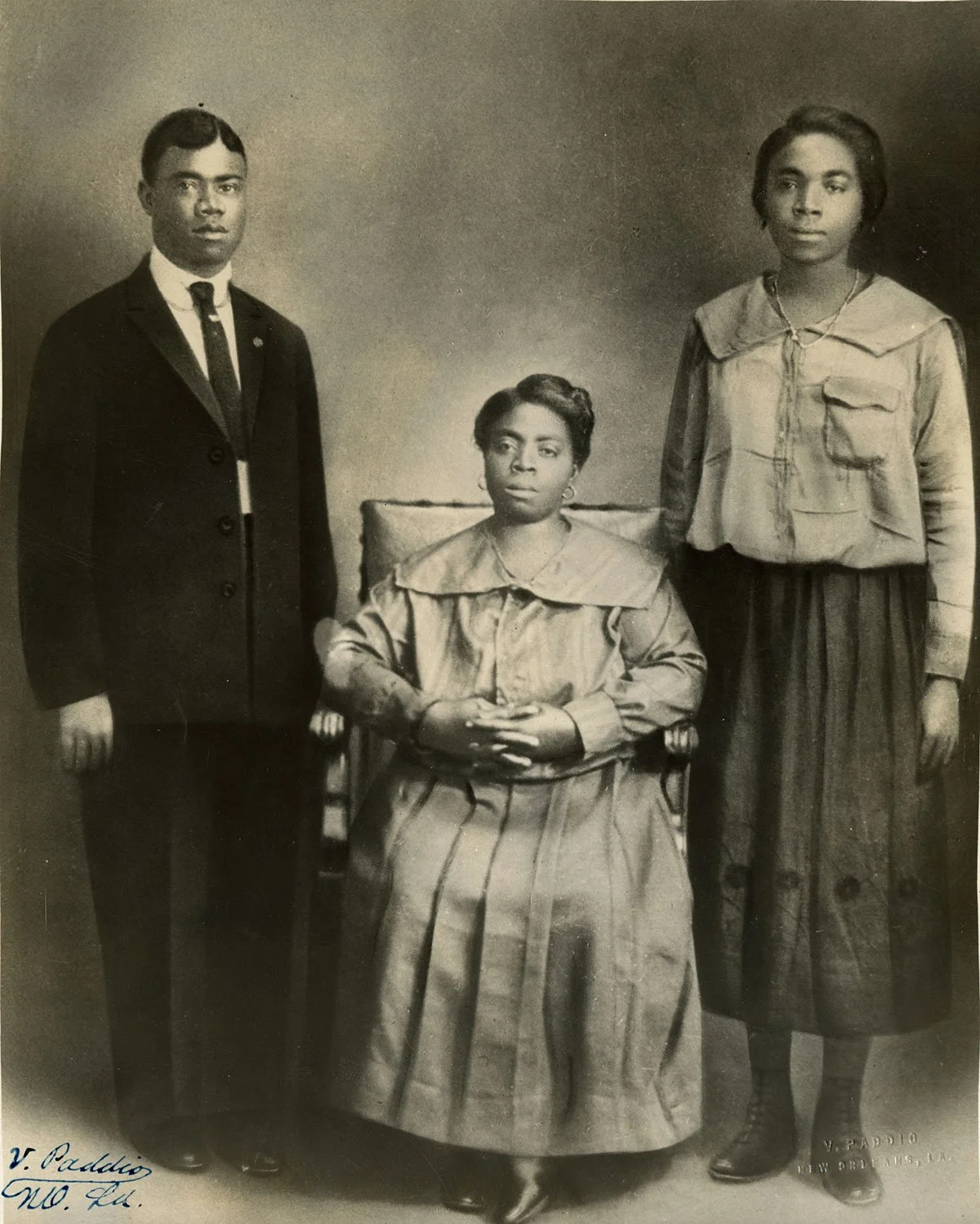
Louis Armstrong sent this photo, signed by the photographer, to the Louisiana born-drummer, from Bunkie Arthur James "Zutty" Singleton (Zutty is the nickname for cute in Creole French). The teen, Louis Armstrong, with his mother Mary Ann "Mayann" Albert, a domestic servant and launderess. His younger sister, Beatice, "Miss Lucy" Armstrong Collins. Collins died in 1987, sixteen years after her brother Louis. Photographer, Villard Paddio, circa 1920, courtesy of the Louis Armstrong House Museum and Archive
Muryani commented on the combined aroma of night-blooming jasmine blossoms and the “gage” (marijuana). “Sort of knew you were in New Orleans,” he commented.
Pops and the band stayed up all night, stealing back time for themselves before returning to the airport that would be named for him in 2001. Sunday morning, they were off to Toronto for their next gig at the Club Embassy’s Palm Grove Lounge.
Louis Armstrong never again set foot in his hometown or reunited with his fellow local musicians, all of whom bloomed on the ground where they were planted. Together, they had nurtured an art form nourished with their souls.
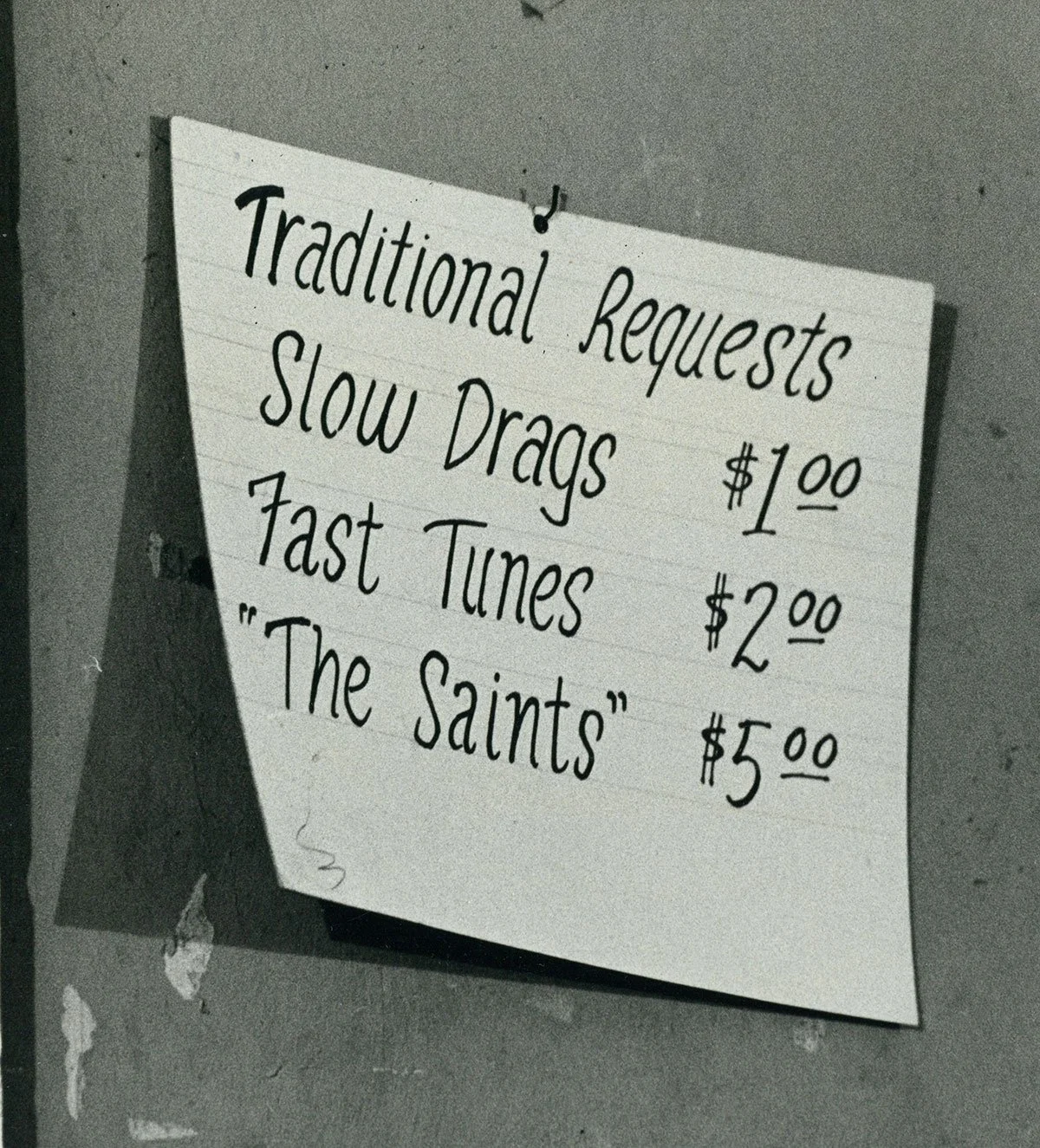
The requested song tariff posted at Dixieland Hall during the 1968 International Jazz Festival. With permission of the New Orleans Jazz Museum Archives.
***
During the months of research that went into this article, I was able to locate only one full copy of the 1968 Jazz Fest program – in the Dave Brubeck archives. Oddly enough, while Al Boletto is mentioned in the program, Barker is not. His many contributions were apparently taken for granted. The following year, festival producers regrettably sidelined Barker and the event suffered for it. One person noted that the 1969 festival’s “soul leaked like a flat tire.” George Wein began producing the fest in 1970).
Barker would be an old man before his dreams of uplifting the role of trad jazz in the city came to fruition through the many young musicians that he mentored. He considered Gregg Stafford, Herlin Riley, Leroy Jones, and Shannon Powell – along with many more – his musical sons. The Rebirth and Dirty Dozen brass bands both came about because of his influence.
Recognition came later in life as well, with many awards and honors. In 1991, the National Endowment for the Humanities presented him with a Lifetime Achievement Award as a jazz master. He and Blue Lu also possessed a gold record, given to them by Maria Muldaur after she won a Grammy with a song they had written, “Don’t You Feel My Leg.”
And today, the Danny Barker Banjo and Guitar Festival celebrates him each spring, honoring the history of the city’s jazz immortals. Appropriately, it takes place at the New Orleans Jazz Museum, which he helped bring into being.
Barker would not be happy with one continuing tradition: most local jazz musicians must still tour outside of New Orleans to make ends meet.