
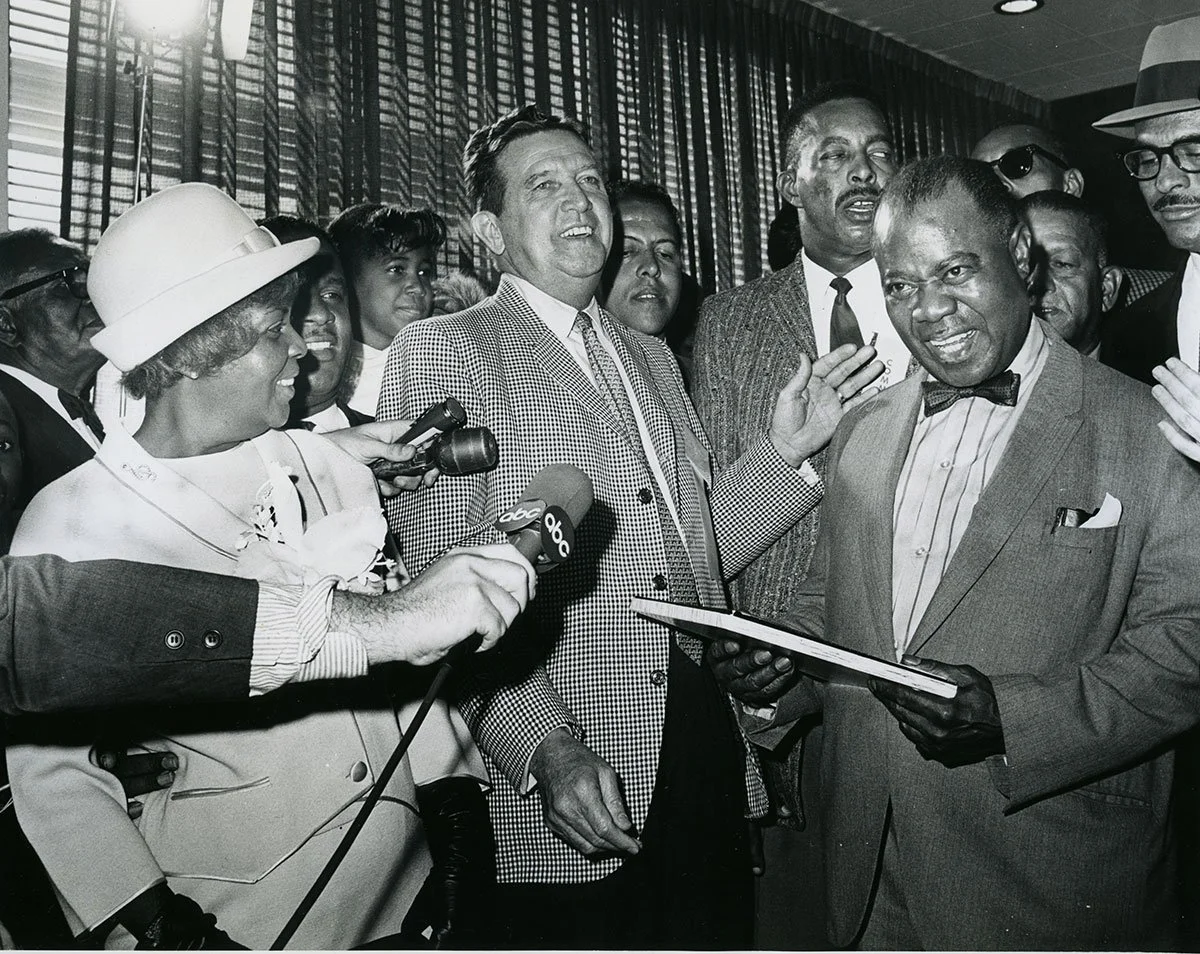
During his 1965 visit, Louis Armstrong was showered with honors at the airport that would later be named for him. Here he receives an award from the Times-Picayune. Courtesy of the Louis Armstrong House Museum in Queens, NY
March 2026Ten years after Louisiana’s Jim Crow laws led Armstrong to swear off performing in New Orleans, a determined committee from the city’s nascent jazz museum convinced him to return for a ground-breaking concert – one that helped pave the way for change.
– by Bethany Ewald Bultman

This column is underwritten in part by Lucy Burnett
Some believe that on Halloween Day, mystical forces converge on New Orleans, working magic in unforeseen ways. October 31, 1965, is a perfect example: Louis Armstrong returned to his hometown for ten hours and unlocked the power of jazz as a force of social change.
A decade before, the international king of jazz had sworn never to return to his hometown, driven away by its embedded Jim Crow laws forbidding Black and white musicians from playing together, and preventing integrated audiences from listening.
Yet, at the behest of another hometown musician, Danny Barker, and a determined committee from the city’s nascent jazz museum, Armstrong agreed to visit. And he played a ground-breaking concert that day at the Loyola Field House, one with his fully integrated band to a desegregated audience – a first for New Orleans.
Six decades later, the reverberations Armstrong began that day thread through the cultural fabric of the city where both he and jazz were born.
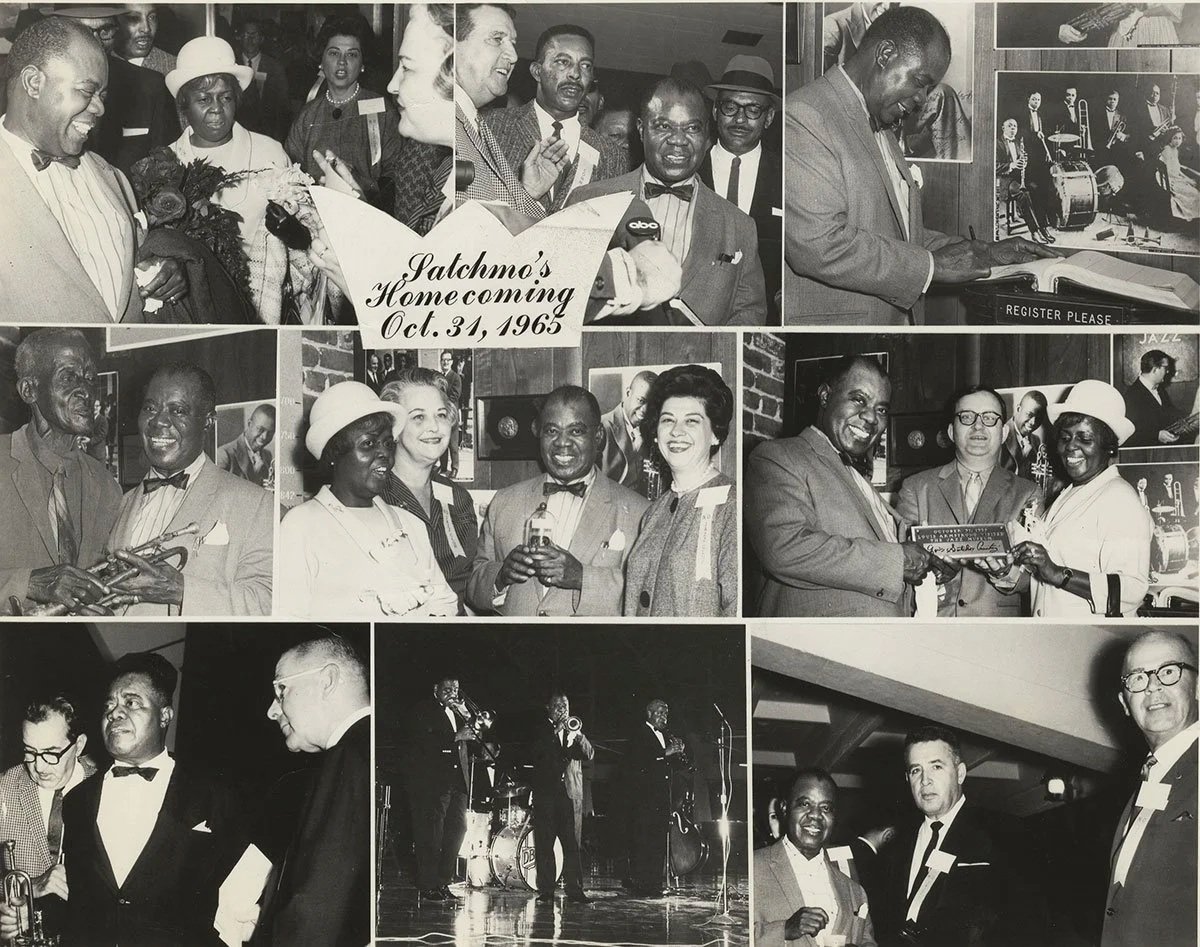
A collage of Armstrong’s homecoming on Halloween visit in 1965. Courtesy of the Louis Armstrong House Museum in Queens, NY
“For a minute there was silence and then a crescendo of happy, excited yells. “There he is! He’s coming off!” The band started the song again… and excited officials shouted, “Open up! Open up, let him through!!” And slowly out of the exit shuffled the KING, LOUIS ARMSTRONG!
- Danny Barker, “The King Comes to Town,” The Second Line (the New Orleans Jazz Club publication), November-December 1965.
Daniel Moses Barker, Grand Marshall of the Onward Brass Band, was the first friendly hometown face Lucille and Louis Armstrong glimpsed as they emerged from Delta Flight #961. Barker estimated that 900 people had come to greet the legendary musician and marveled at the crowd of all ages and nationalities that had turned out dressed in their “Sunday go to meeting clothes.”
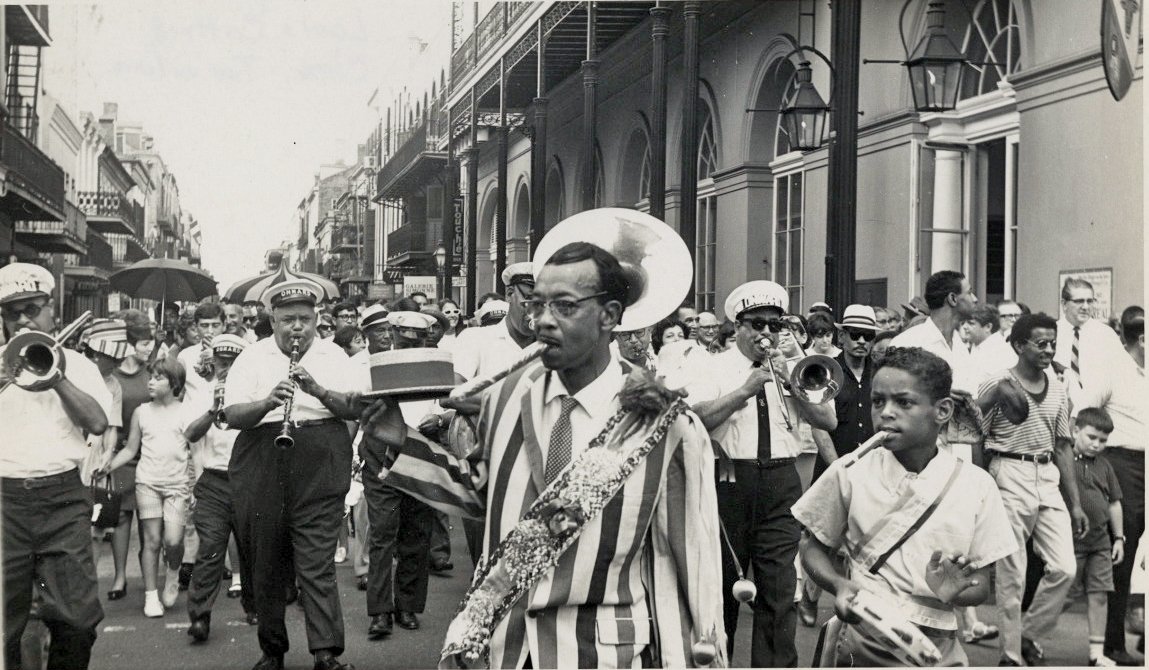
Once he returned to New Orleans in 1965, Danny Barker proudly stepped into his familial duties as the Onward Brass Band Grand Marshall. The Onward was created by his grandfather and great uncle in the 19th century and re-started by his uncle Paul Barbarin in the mid-1950s. June 30, 1968 outside of the Royal Orleans, Photographer unknown. With permission from The William Russell Jazz Collection at the Historic New Orleans Collection. Gift of the Clarisse Claiborne Grima Fund, ACC no. 92-48 L.331.2451
The Onward had played “Way Down Yonder in New Orleans” as they marched the welcoming committee to the gate and second-lined the Armstrongs toward the lobby. Armstrong was exuberant that Danny and each of the stellar jazz men second-lining him home were playing the sounds of his youth.
Accompanying Paul Barbarin and his bass drum were the President of the Colored Musicians Union, Louis Cottrell, Sr. (B flat clarinet); Jerry Green (tuba); Wendell Eugene and Clement Trevalon (trombones); Jack Willis (mellophone); Louis Barbarin (snare) and Ernie Cagnolatti, Albert “Fernandez’ Waters and Alvin Alcorn (trumpets).
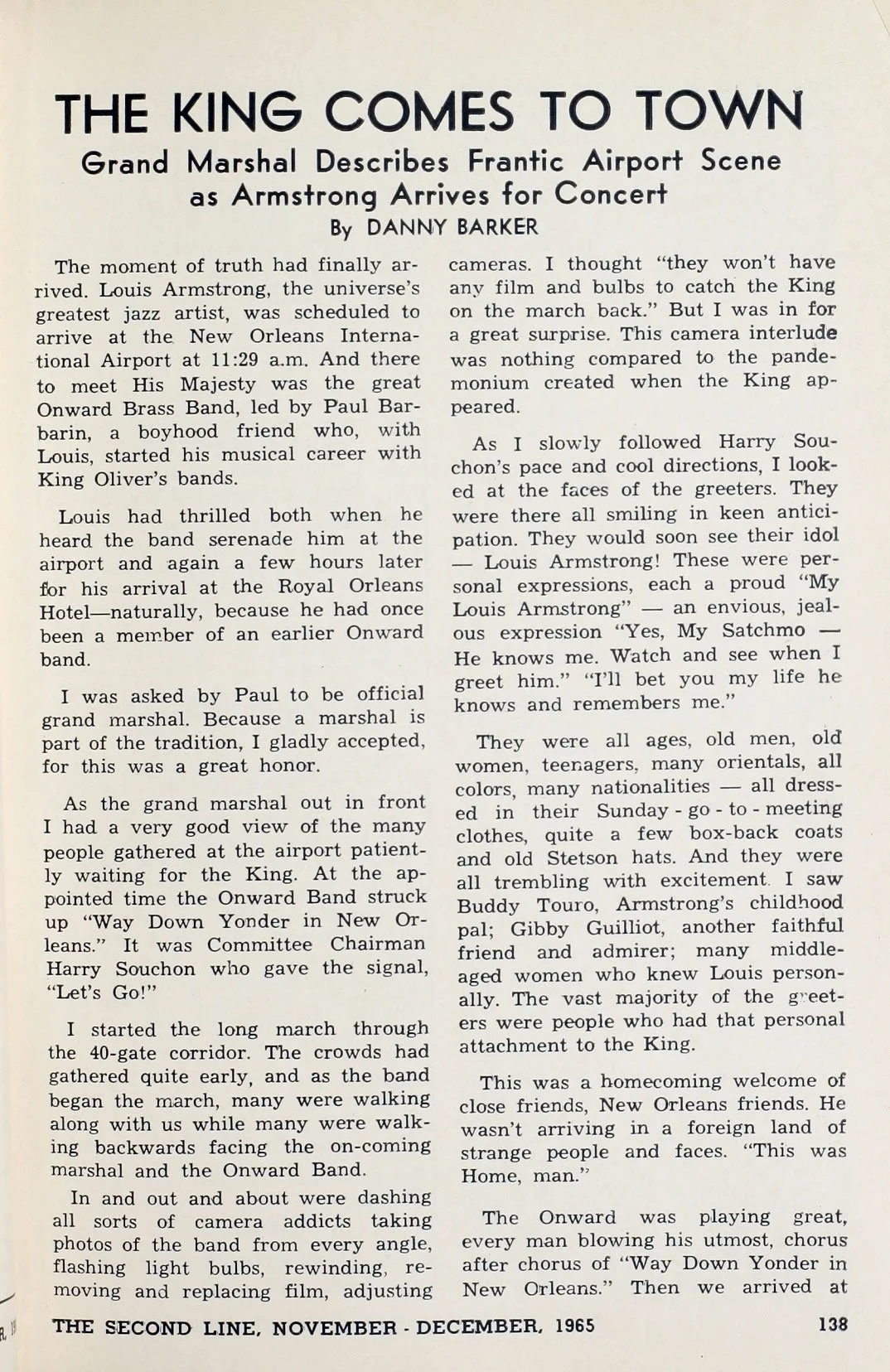
Click on image to open PDF of Barker’s full article
Leaning over to band leader Paul Barbarin (Barker’s legendary uncle), Armstrong commended him for keeping up New Orleans jazz traditions.
Writing later about Armstrong’s visit, Barker confessed to being profoundly moved:
I saw many tears dropping from eyes. I felt warm tears trickling down my face – I choked up, just couldn’t help it. It was a great, strange feeling looking at hundreds of people – all kinds from all walks of life – yelling, “Hello Louis,” “Hey, Louis.” They were waving, throwing kisses, trying to touch him…
When reporters elbowed in, “Lil Cag” Cagnolatti angled his trumpet 90 degrees above the crowd as Armstrong cheered his nimble precision. But the throngs of press encircling the visiting royalty pushed aside many of Armstrong’s waiting friends. They turned to the walls to hide their sobs.
But, an experienced grand marshal, Barker was undeterred by the press of people:
I elbowed the crowd and marched almost abreast of Armstrong. He recognized my grand marshal regalia. He shouted, “Git close, let the TV cameras catch you.” I did and smiled broadly right into the blazing lights of the many cameras. Louis pulled me close, his eyes popping, and laughingly said, “Man, you sho is sharp…”
I thought to myself, “What greatness – that’s it! He never forgets to share the spotlight… with another musician or performer, or anybody.”
“I can’t even play in my own hometown, ’cause I’ve got white cats in the band. All I’d have to do is take all colored cats down there and I could make a million bucks. But to hell with the money. If we can’t play down there like we play everywhere else we go, we don’t play. So this is what burns me up every time some damn fool says something about ‘Tomming.’”
- Louis Armstrong, 1964 Ebony
By 1965, two generations removed from slavery, Louis Armstrong was a star of stage and screen and an esteemed American cultural ambassador. Just the year before, in June 1964, he’d become the oldest recording artist to have a #1 hit: Armstrong’s “Hello Dolly” actually knocked the Beatles out of the top slot for a week.
Armstrong’s connection to New Orleans’ jazz had been forged over decades. Barker’s uncle, Paul Barbarin (b.1899), first encountered Louis Armstrong (b.1901) when the teen was a standout cornet player in the Waif’s Band.
By 1914, Armstrong was living with his father on Miro Street and Poydras. His main gig was at Spano’s Tonk (Liberty and Poydras), while Barbarin played drums a few blocks away at the notorious Tuddlem’s Tonk, across from the city jail (in the area where Armstrong was born).
Many mornings, as dawn broke over the French Quarter, teen musicians Barbarin and Armstrong joined their musical “competitors” at the Elite Club (Iberville and Burgundy). These jam sessions served up ample elbow room to soar. Each session was a revelry tempered by audacity and humidity and ambitions – and unadulterated genius.
Often Armstrong’s friends ragged the jolly-faced cornet player over his enviable ability to coax the upper ranges out of his horn. His friends teased him with nicknames: Gatemouth and Dippermouth and Satchelmouth, which some shortened to “Satchmo.”
“Listen to that cat,” the young Louis Armstrong would respond with a hearty chuckle. His fellow musicians laughed along, forging lifelong bonds transcending the snarl of Louisiana’s racist politics.
The friendship between Armstrong and Barbarin remained strong, even after the latter moved to Chicago in 1917 to work at the Armour stockyards, playing blues and jazz on the side. Barbarin’s nephew Danny continued building his own career as a musician – he’d played his first gig when he was only ten.
Barker later recalled witnessing a turning moment in Armstrong’s life in 1922. At the time, Louis Armstrong was sharpening his cornet chops with Barker’s idols, the Original Tuxedo Brass Band led by famed cornetist Oscar “Papa” Celestin.
13-year-old Danny, a huge fan of the band and Armstrong, had snuck out to catch them in a second line, watching from the porch of a neighborhood Baptist church.
When the second line stopped in front of the church, Armstrong proudly pulled out and showed his bandmates a telegram he’d just received: King Oliver, formerly of the Tuxedo, had invited Armstrong to join him in Chicago “to make feets shuffle.”
They all knew then Satchmo was headed for the big time.
A few years later, in 1924, Armstrong’s pal Paul Barbarin, already gigging in Chicago, joined ’King’ Oliver’s Dixie Syncopators. By that point, Armstrong had moved on, but still in Chicago, recorded some of Barnbarin’s compositions like “Don’t Forget to Mess Around.”
By 1929, both Armstrong and Barbarin were in New York – the latter as a member of Luis Russell’s Orchestra – a big band Armstrong fronted for a time in late 1929 and into early 1930. Henry “Red” Allen also joined them in the band, and Allen and his wife, Pearly May, shared an apartment on 136th Street in Harlem with Barbarin and his wife, Onelia.
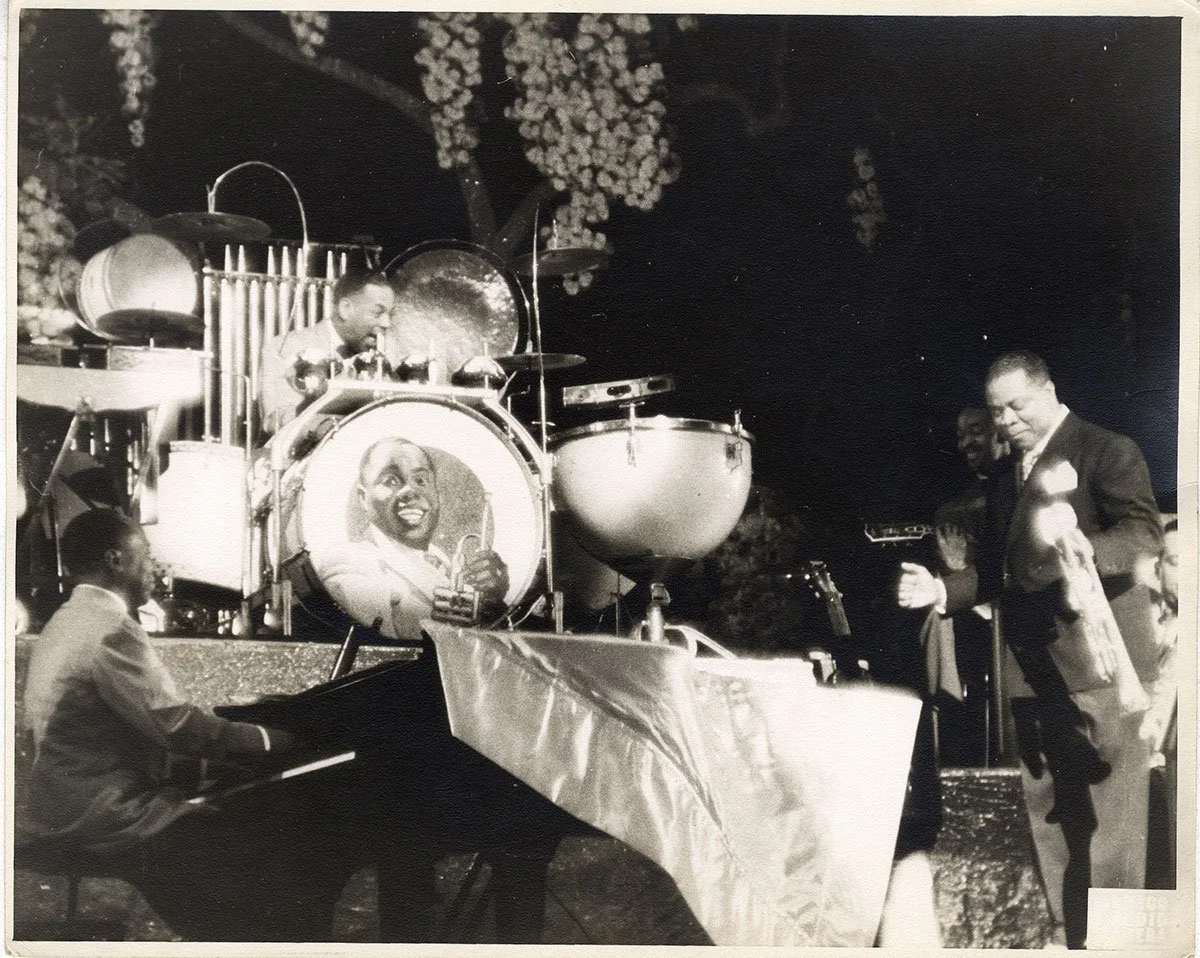
Luis Russell at the piano, Armstrong at the Mic and Paul Barbarin at the drums. Courtesy of the Louis Armstrong House Museum in Queens, NY.
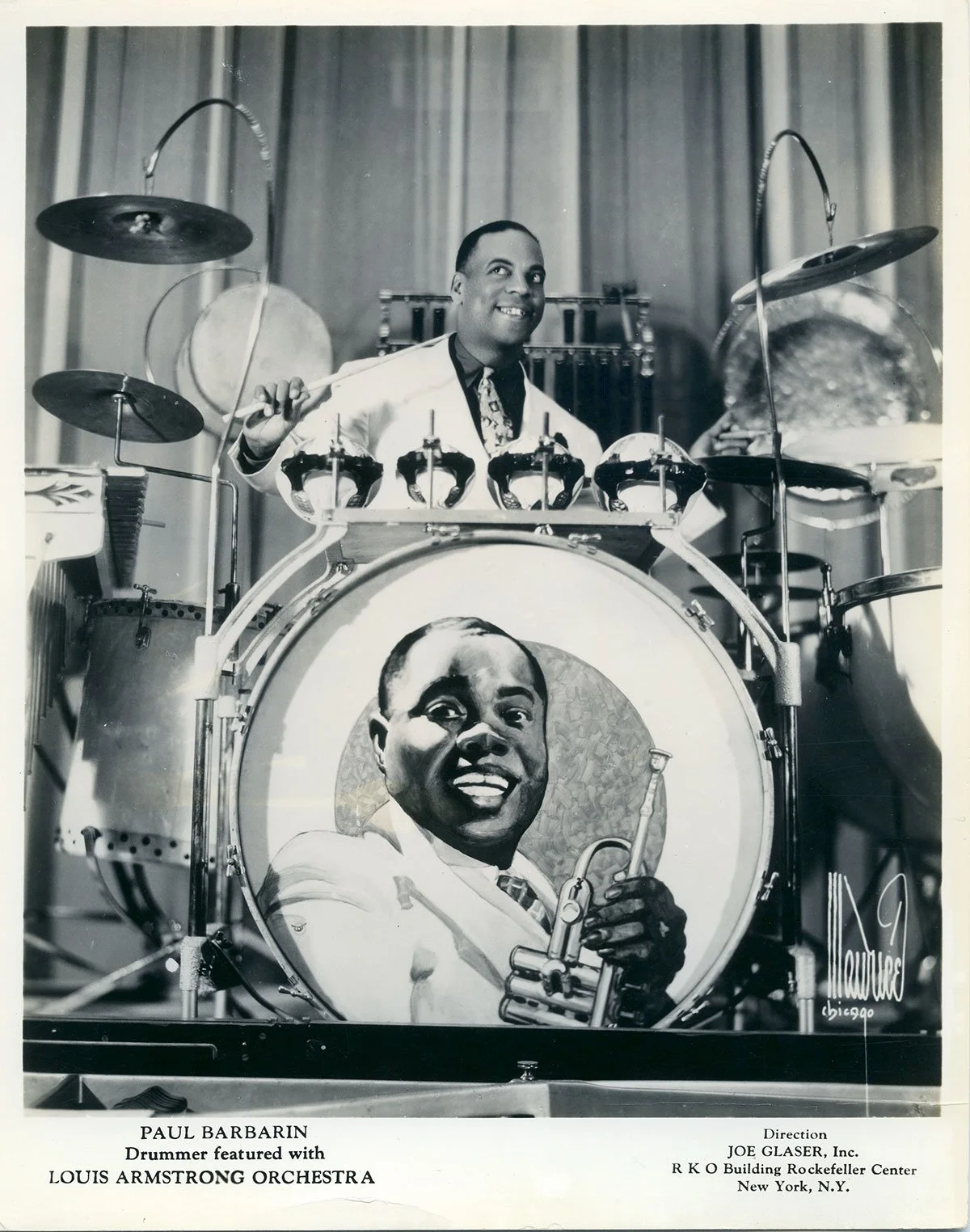
An official publicity photo of Paul Barbarin, the drummer in the Louis Armstrong Orchestra in the 1930s. Courtesy of the Louis Armstrong House Museum in Queens, NY.
In 1930, at the beginning of the Great Depression, Danny Barker, 21, and his 16-year-old wife, Louisa Dupont, also fled racism in New Orleans. The honeymooning Barkers moved in with the Barbarins and the Allens.
This gave the young couple a front-row seat for the Harlem Jazz Renaissance. The apartment became an epicenter of New Orleans culture – Ms. Onelia’s gumbo and Ms. Pearly May’s chicken and red beans served up hometown flavors for Armstrong and his bandmates.

From 1947 - 1948, Danny Barker played in the house band for Rudi Blesh ‘s radio series “This is Jazz.” During Armstrong’s appearance on April 26, 1947, he introduced Barker (far right) “as one of those Creole Cats.” Photo courtesy of Armstrong House Museum
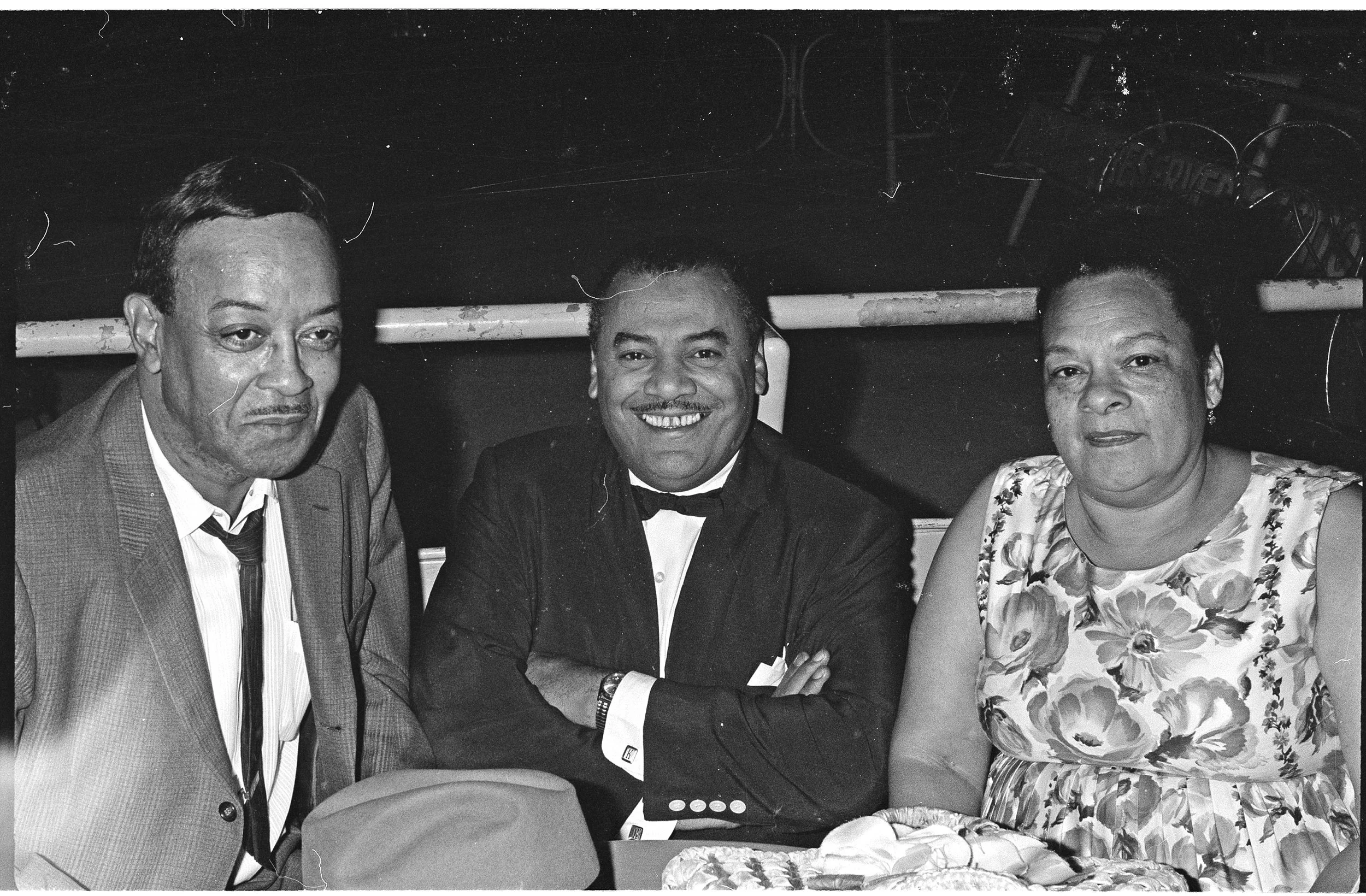
Armstrong All-Stars’ pianist Billy Kyle hanging out after the Louis Armstrong concert with Danny and Blue Lu Barker at Freedomland amusement park in the Bronx, 1964. Courtesy of the Louis Armstrong House Museum in Queens, NY.
Meanwhile, Barker continued to hone his skills and forged his own musical success in Cab Calloway’s big band (1939-46), anchoring the rhythm section with his distinctive guitar styling.
The Barkers’ only child, Sylvia, was born in the Bronx in 1938. In 1956, when she was 18, she and her Dad met Rene Brunner, a Swiss correspondent for a French jazz magazine, at a New York jam session. He was amazed that you could look up famous jazz musicians’ names in the New York phone directory, find their addresses, and ring their doorbells.
Danny invited him home for coffee to share his encyclopedic knowledge of the role New Orleans’ musicians played in jazz - little suspecting that within a few months, Rene and Sylvia would wed. Two years later, in 1958, Danny and Lu’s only grandchild, Larry Brunner, was born in Rochester, New York.
***
All the while, Armstrong’s career continued to rocket, and his friends marveled at the ways he could jab Jim Crow in the ribs.
For instance, according to Armstrong scholar and biographer Ricky Riccardi, “Louis loved ‘When It’s Sleepy Time Down South’ and made that his theme song for the last 40 years of his career, but there was one record from 1932 where he mumbled ‘When It’s Slavery Time Down South.’”
Riccardi writes that later, “Decca had him record ‘The Old Folks at Home’ by Stephen Foster in 1937, complete with the word ‘darkies.’ At the end, he sings in an exaggerated dialect, ‘Well lookee here, we are away from home—yeah man.’”
In 1957, Louis Armstrong made global headlines by speaking out in support of the “Little Rock Nine’s” failed attempt to desegregate Central High. He called President Eisenhower a “hypocrite” for not enforcing the Supreme Court’s ruling in Brown v Board of Education.
Many still believe that his criticism finally prompted Eisenhower to act. On September 25, 1957, the President federalized the National Guard and deployed the U.S Army’s 101st Airborne Division to escort the Black students to school.
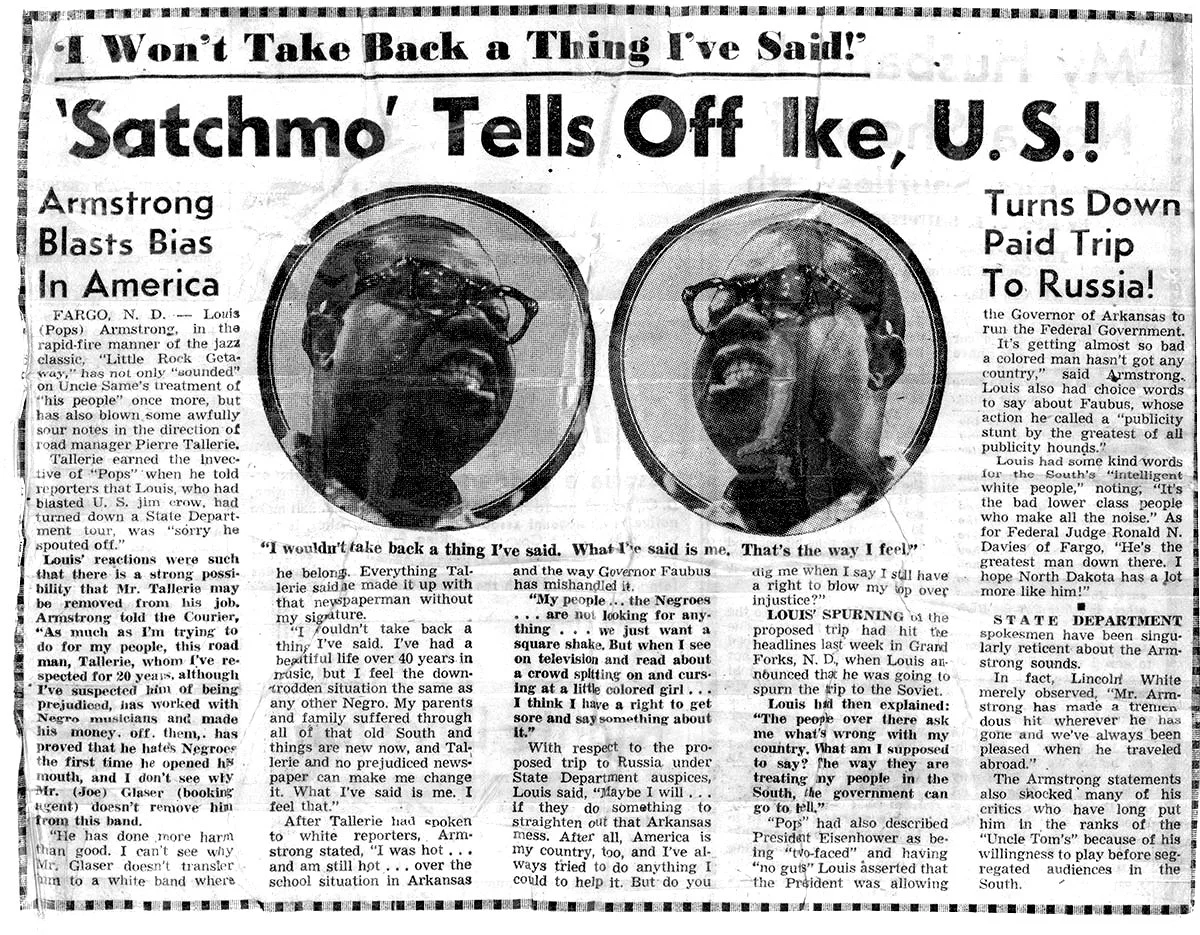
Clipping courtesy the Louis Armstrong House Museum in Queens, NY.
***
“{Black All-star AFL} players were instructed {by hotel staff} not to use the main elevator and were denied service at the hotel’s restaurant.”- Eric Smith “Brave Heroes: The Story of Earl Faison and the Boycott of the January 16, 1965 AFL All-Star Game”
Moving back to New Orleans in May 1965 after 30 years in New York, musician Danny Barker discovered that paying jazz gigs in his hometown were few. The genre of traditional jazz was out of step with the pop culture dominating the 1960s. Trad jazz was barely getting by with the support of fans nicknamed moldy figs – foreign New Orleans jazz followers.
Jim Crow played its own starring role in what seemed to be the last act of trad jazz. In 1956, bucking the trend of the nation, Louisiana doubled down on racism with a new statute. Under the guise of preventing civil unrest, Louisiana Act 579 forbade any “interracial social and athletic activities,” and “dances, social functions or entertainments” that weren’t strictly segregated.
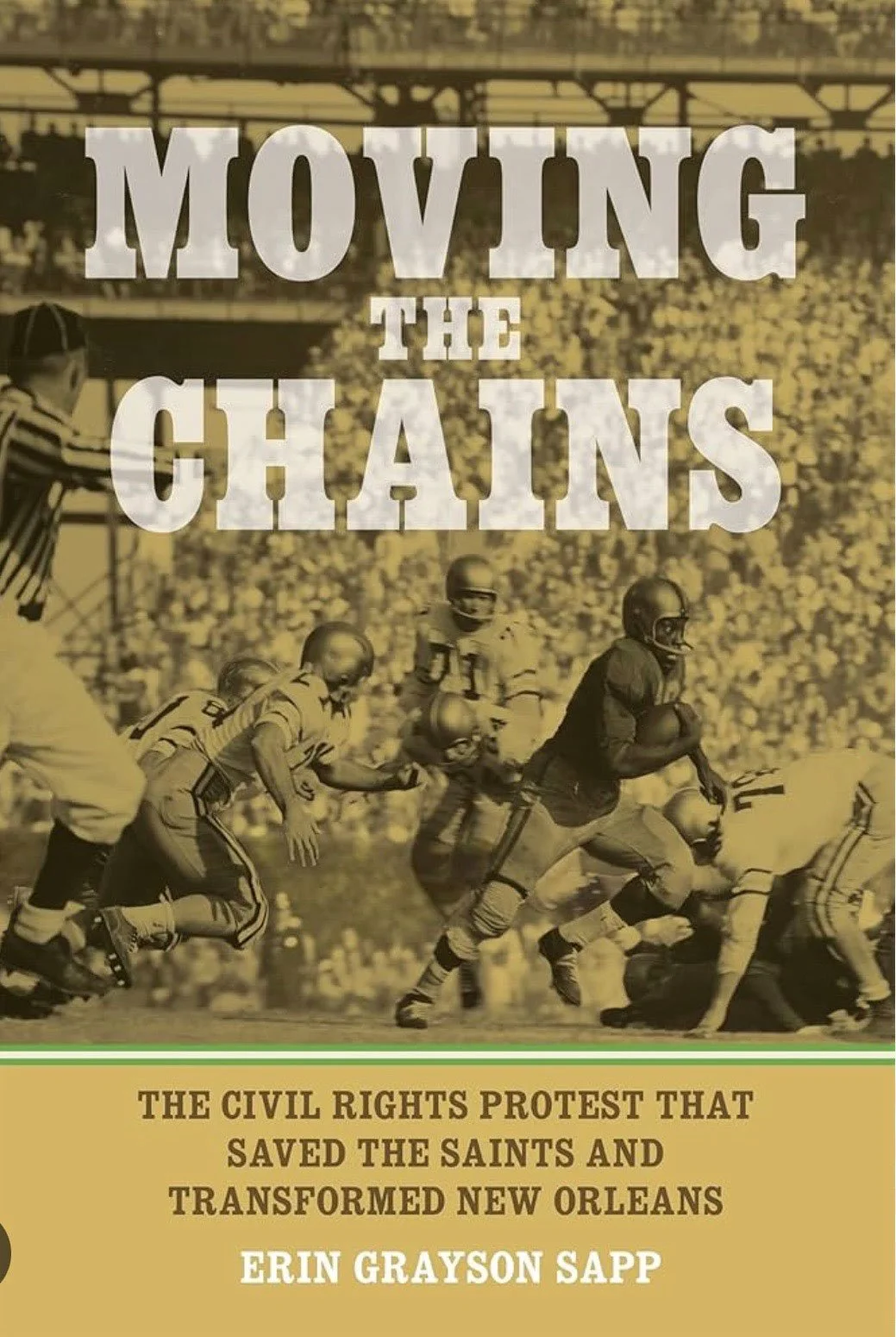
"The city was set up to believe it really had things in order and it revealed a lot of naivety on their part.”- Erin Grayson Sapp, PhD., Moving the Chains: The Civil Rights Protest that Saved the Saints and Transformed New Orleans.” LSU Press, 2022. Click on the cover to read details and order.
A federal court had declared the law unconstitutional in 1958, and the U.S. Supreme Court upheld the decision in 1959. Five years later, in 1964, the Civil Rights Act, outlawing discrimination based on race, color, religion, sex, or national origin, was passed. Yet, in 1965, New Orleans made international headlines by upholding racism as if it were part of the Ten Commandments.
An All-Star Pro game scheduled to be played in New Orleans – which was hoping to secure its own NFL franchise team – brought 21 Black AFL football players to the city. Some New Orleanians made monkey noises and hurled racist epithets at the visiting pro players as they walked on Canal Street. Taxis refused to pick them up. They weren’t allowed in the hotel restaurant.
In the final coup de grace, a bouncer pulled a gun on a group of Black players – including Louisiana native and AFL Hall of Famer Ernie “Big Cat” Ladd – as they tried to enter a Bourbon Street nightclub, one playing James Brown music. The Black players decided to boycott the game.
On January 11, 1965, Joe Foss, the AFL commissioner, made an unprecedented announcement: The players’ boycott of New Orleans prompted “the AFL family” to relocate the ABC televised All-Star game to Houston. This remains one of pro football's boldest civil rights actions.
By the spring of 1965, New Orleans was beginning to realize the boycott's repercussions. The tourist boom projected to result from hosting the All-Star game was a bust. Conventions were cancelled. Consequently, local jazz musicians lost lucrative bookings.
But having just moved back to New Orleans a few months after this debacle, Barker had no intention of letting Jim Crow pick his pocket again. Not only did Barker have “a hundred cousins” in the city, but he was also close friends with the founders of the New Orleans Jazz Club, often playing with musician members during visits home through the ‘40s and ‘50s. When Barker moved back, these jazz aficionados welcomed the musician like a conquering hero.
***
The New Orleans Jazz Club, formed in 1948, had hatched the idea of the country’s first jazz museum and launched it in 1961. They were given use of two rooms in a French Quarter cottage on Dumaine Street (near Congo Square), and began collecting important artifacts, images and recordings.
What the embryonic New Orleans Jazz Museum was missing was Louis Armstrong’s boyhood home. They’d raised the funds and obtained the city permits to move it from Jane Alley to the French Quarter, adjacent to the museum. But in a stunning and sudden setback, the city willfully demolished it to make space for the new police complex.
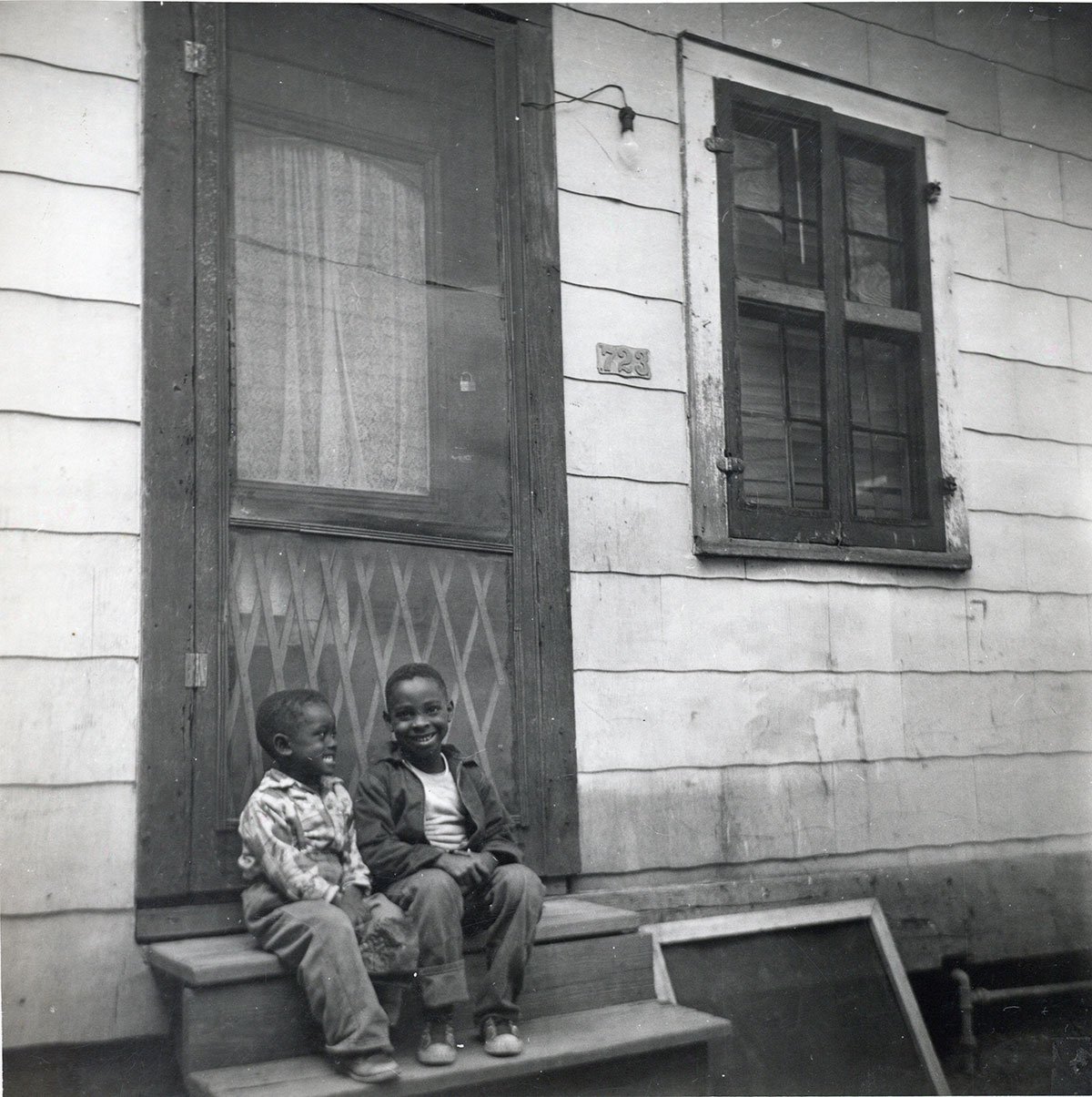
Armstrong grew up in a humble wood-frame home with his mother and sister at 723 Jane Alley. It was here in 1901 that his fifteen-year-old mother, Mary Ann “Mayann” Albert Armstrong, gave birth to him. It was located “back of town” in central city, known as the Third Ward’s “Battlefield” (Liberty and Perdido Street). It was a world apart – culturally and economically – from Creoles of color in the Seventh Ward. Photo by Edmond “Doc” Souchon, with permission of the New Orleans Jazz Museum
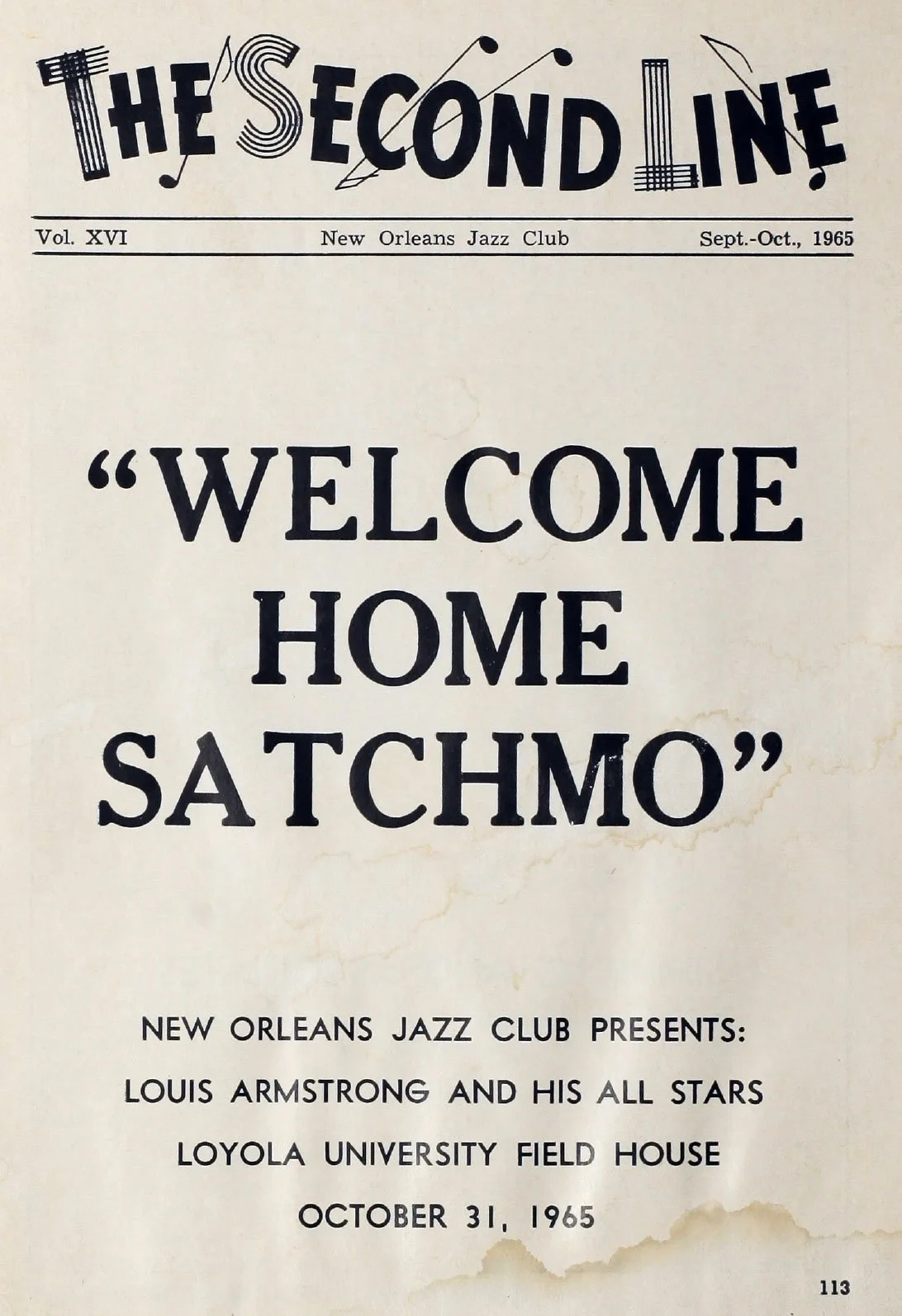
Click on the program cover to open a PDF of an article about the visit by Helen Arlt, the five time president of the New Orleans Jazz Club, Ms. Helen Arlt exuded confidence in jazz as a life-affirming cultural resource. Courtesy of Louis Armstrong House Museum, Queens, NY
The horrified Jazz Club members sent a small delegation to Memphis in February 1965 to personally apologize to “the King of Jazz.” (Listen to a short recording of their visit on Dropbox). They also issued a heartfelt invitation to visit, view the collection of jazz artifacts and perform a benefit concert to support the new museum.
Surprising many, Armstrong accepted. The date was set for October 31st.
***
For Danny Barker and the white members of the New Orleans Jazz Club Louis Armstrong Host Committee, many of whom were prominent in society circles, the preparation for this mission rivaled that of anointing a pope.
While Barker didn’t read music, he displayed Herculean abilities to persuade others to join his latest “jazz rescue mission.” With his PhD in strategy, Barker had no shame when it came to pestering folks in power to do “the right thing.”
Barker would later recall that he advised the Jazz Club host committee after Armstrong accepted the invitation. To them all, jazz was a home-grown, undeniable art form that defied boundaries of age, race, class, nationality, religion, and geography, and Barker was a hometown third-generation jazz musician. They respected his input.
Barker’s directive to the club was simple. “If jazz folks stick together, we can overcome anything!” To succeed, all they had to do was to “New Orleans the hell out of this jazz revival!”
He added with a wink, “Then we tie a ribbon around it.”
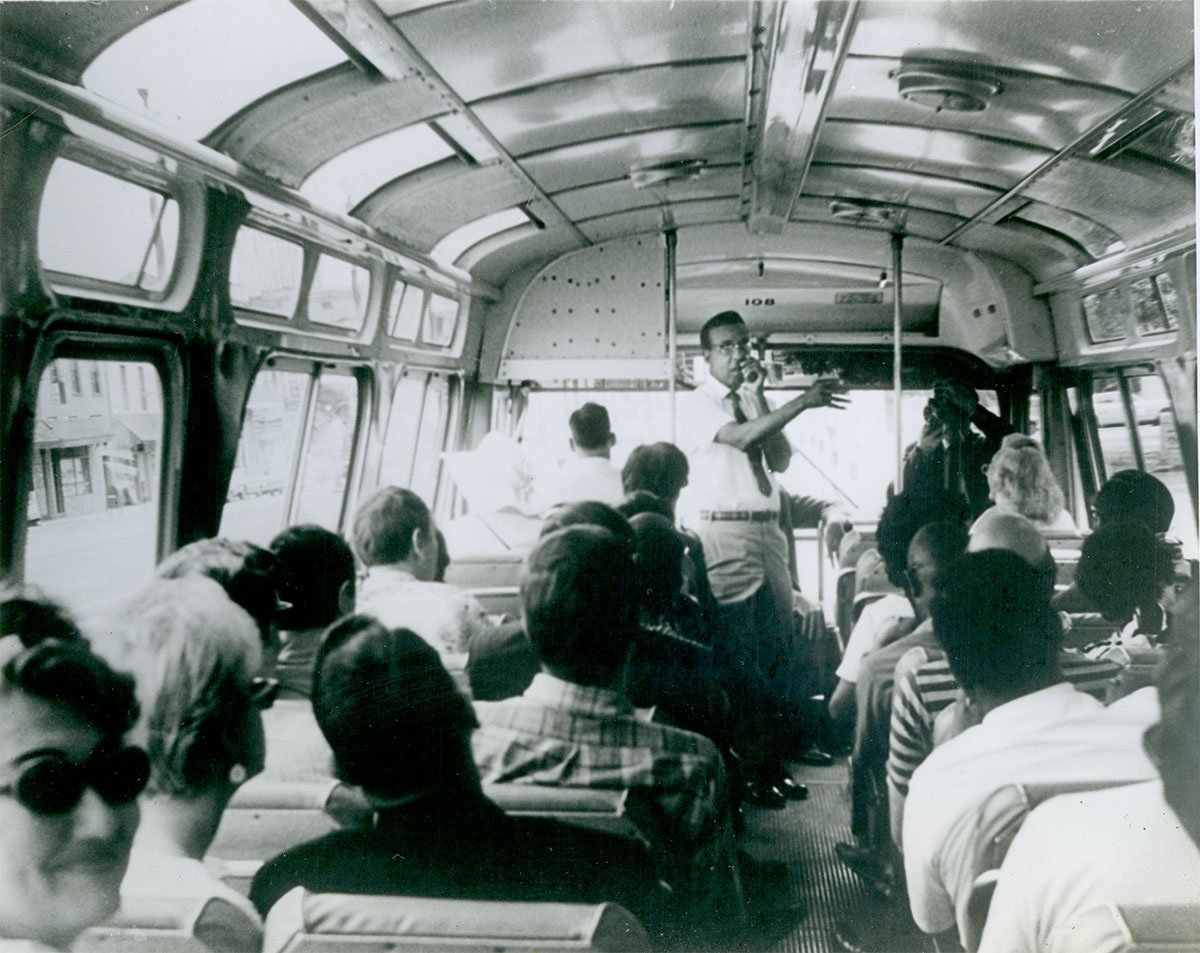
Danny Barker guiding jazz tourists to the site of Armstrong’s birth on “The Wayward Bus,” a series of tours organized by the Jazz Museum, Spring 1969. Photograph by Floyd Levin, with permission of the New Orleans Jazz Museum
At first glance, Danny Barker was an unlikely agent provocateur: the chain-smoking, slight-of-build man with a pencil-thin moustache boasted a deadpan stare worthy of John Waters. And unlike Louis Armstrong, Danny was jazz royalty. As the grandson of jazz pioneer Isidore Barbarin, jazz was his birthright.
As he grew into his role as a leader in the city’s jazz preservation movement, Danny Barker artfully juggled his gift for “making show” and his ability to play “fat danceable chords” on the guitar. Although Barker’s formal schooling ended in the 6th grade, he was a voracious reader, using his Capricorn’s powers of observation and attention to detail to absorb knowledge and chronicle the power of jazz.
Danny’s grandson Larry Brunner shed some light on his methodology. His visits to his grandparents in New Orleans and later his travels to Europe with his grandfather have provided Larry with a lifetime of memories that he has passed on to his six children and their children.
“I never saw my grandfather practice music once,” Brunner said recently. “But, when he came up to Rochester, NY to visit me when I was a kid, he’d send me out to buy six newspapers every day before I left for school.”
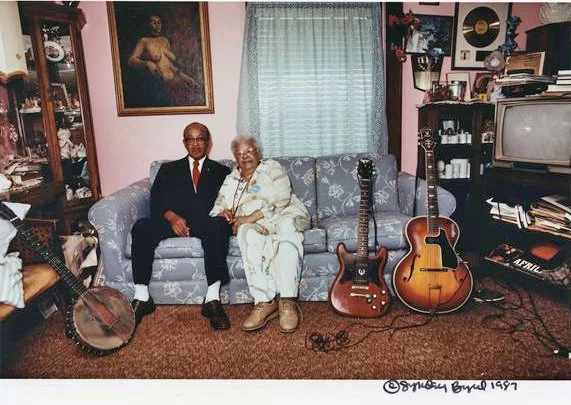
In 1974, singer Maria Muldaur and her friend in New Orleans, Lucy Burnett, drove to Sere Street to present the Barkers with the Gold Record she earned for her successful single “Don’t You Make Me High (Don’t you Feel My Leg)” from her solo album debut.(1973) Muldaur also ensured that the couple earn publishing royalties for the song they wrote and Blue Lu recorded August 11,1938. Photo by Sydney Byrd, 1987, with permission of the New Orleans Jazz Museum
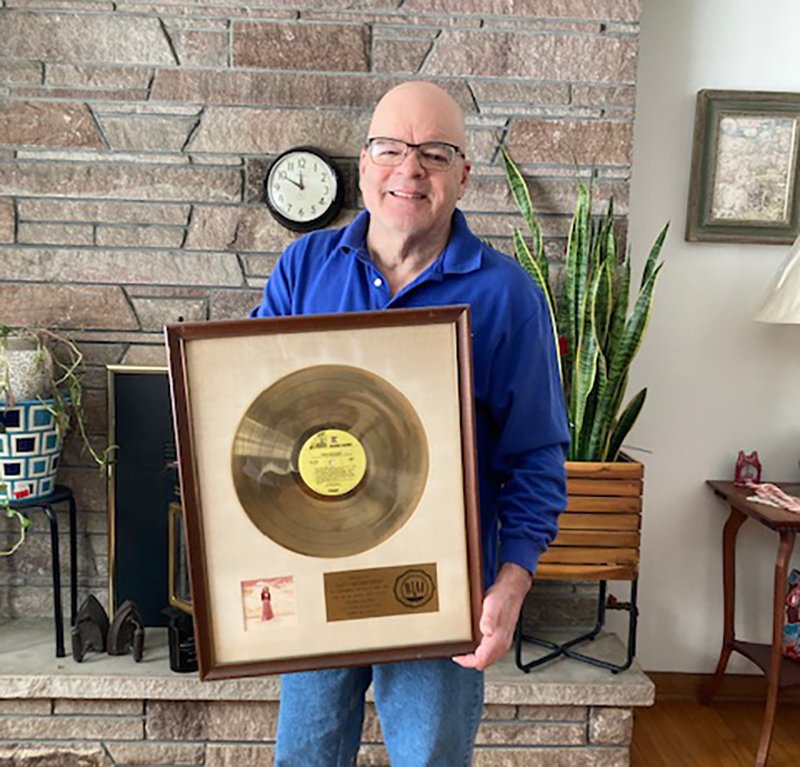
Danny Barker’s grandson, Larry Brunner, proudly displays his grandparents’ 1974 gold record at his home in Syracuse, NY. It is one of the few keepsakes he rescued from his late grandparents’ Sere St. home after Hurricane Katrina in 2005. Photo courtesy of Larry Brunner, photographer- Katie Lewis, Danny & Lu Barker’s great-granddaughter.
“His trumpet-scarred lips spread wide, his eyelids puffed with pleasure, Louis Daniel Armstrong reached for the first horn he ever blew and hugged the man who taught him how to play.”- Associated Press, November 1, 1965
The Armstrongs were escorted from the airport (later named for him) to the limousine provided by a Black funeral parlor. Their first destination was the French Quarter and the small jazz museum. It soon became apparent that the two motorcycle cops were inadequate to organize the hundreds of cars that were playing “chicken” along the Airline Hwy as folks competed for a better glimpse of the Armstrongs.
Louis Armstrong’s visit to the humble jazz museum exceeded Barker’s and the host committee’s wildest aspirations. Dozens of reporters from Saginaw to Daytona and Utica to Pasadena documented “the King of Jazz’s” visit to the world’s first jazz museum.”
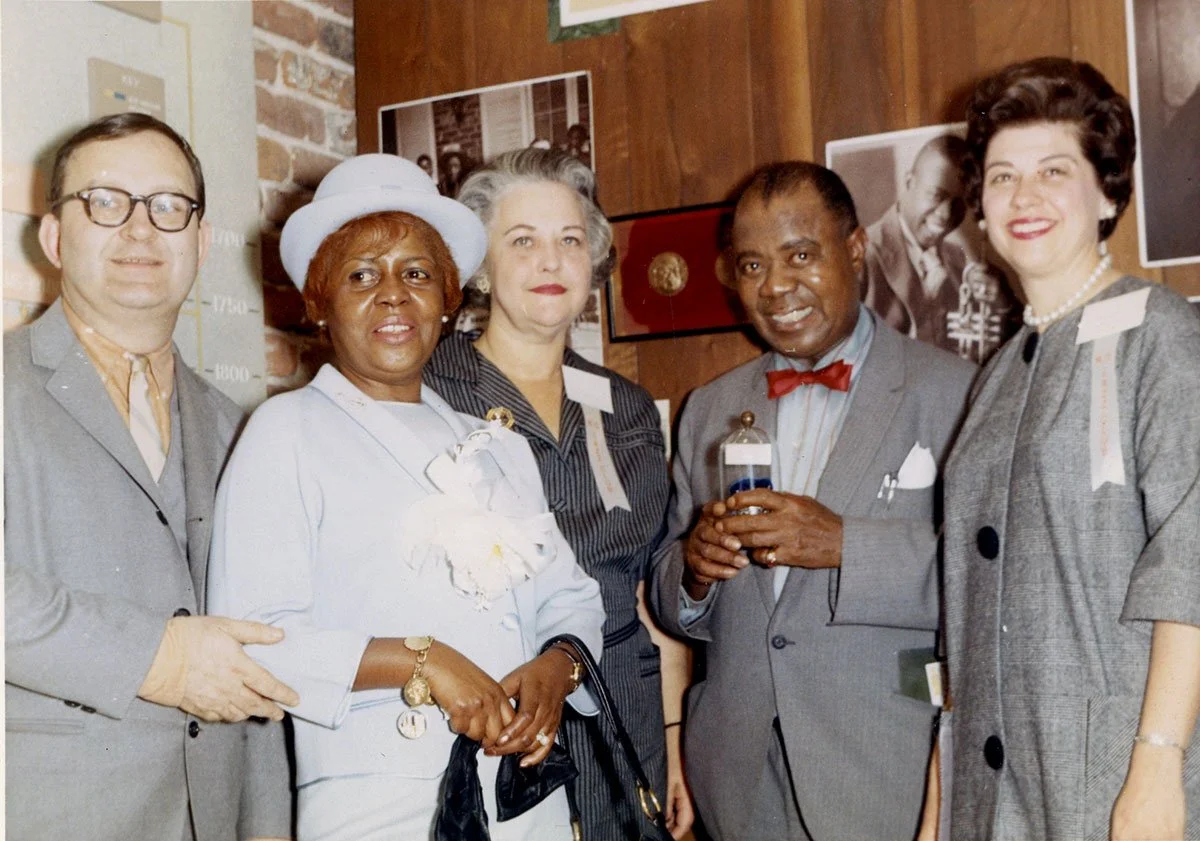
Jazz Museum Director, Clay Watson; Lucille Armstrong; Myra Menville, Jazz Club board member; Louis Armstrong and Helen Arlt, President of the Jazz Club. With permission from the Louisiana State Museum/New Orleans Jazz Museum Jazz Club Collection
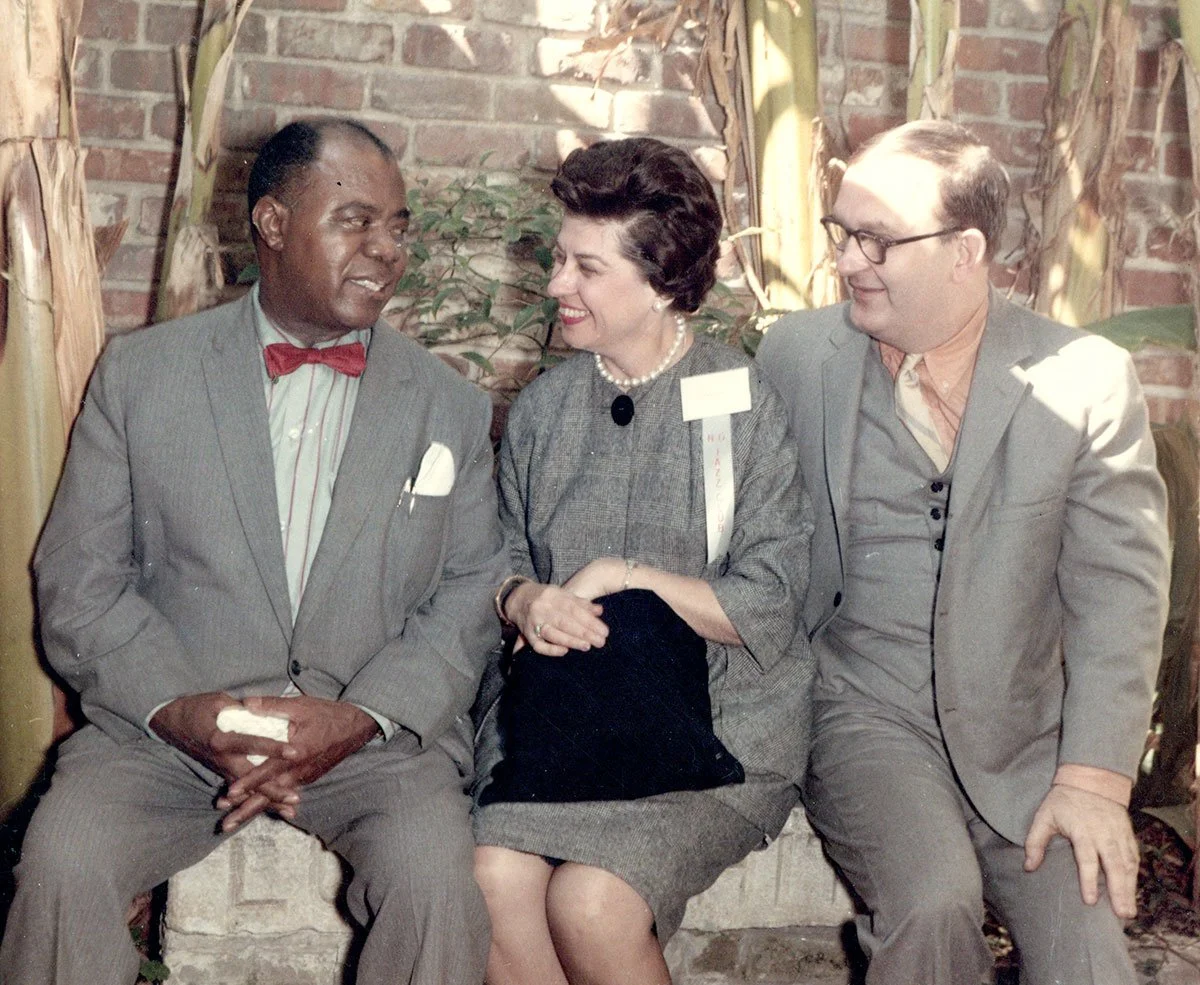
Louis Armstrong with Helen Arlt, president of the Jazz Museum five times, and Jazz Museum curator, Clay Watson, With permission of the New Orleans Jazz Museum
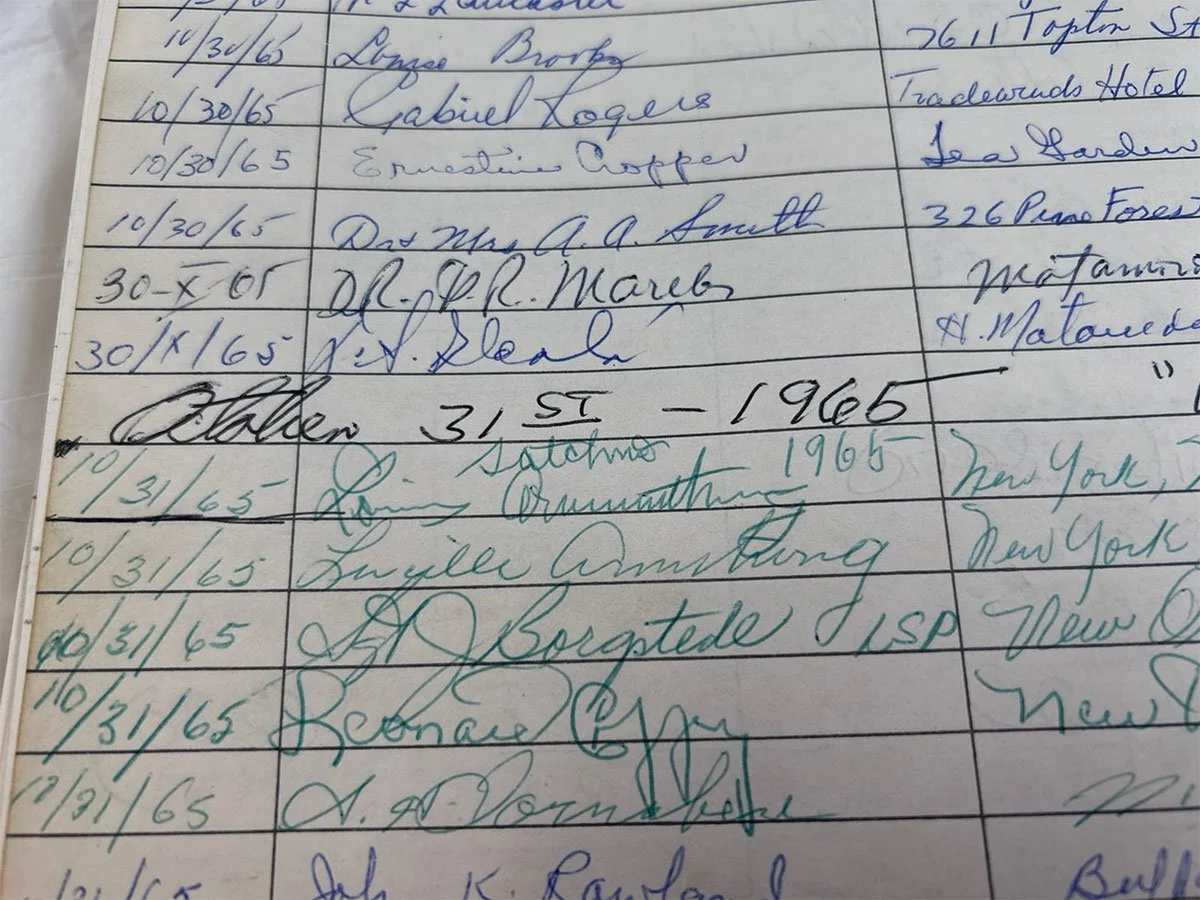
Armstrong’s signature on the guest register of the Jazz Museum, one of the thousands of artifacts at the New Orleans Jazz Museum, Photo by David Kunian, with permission the New Orleans Jazz Museum
One thing outside of the committee’s control was the New Orleans weather. Summer lingered. The air inside the overcrowded space was so hot it had teeth. In all the excitement, no one remembered to switch on the sweltering museum’s two window units.
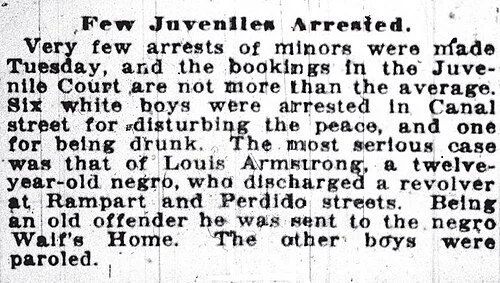
The Times-Democrat, January 2, 1913
Surrounded by his Rosetta Stone of instruments and artifacts, the 65-year-old Armstrong told reporters about how “jazzing up New Year’s Eve” by firing his stepfather’s pistol got him shipped off to the Colored Waif’s Home in January 1913.
Oblivious to the cameras, the sixty-five-year-old Armstrong fondled the dented cornet he was reunited with at the jazz museum. As a 12-year-old, to improve his embouchure, he’d carved notches in its non-detachable mouthpiece.
As Armstrong introduced 87-year-old Peter Davis, his first band master, to the press, he said, “When this man was teaching me to play do, re, mi, fa, so, la, ti, do, I had no idea it would end this way.”
Davis regaled them with his stories of little Louie, saying the child was so busy playing and dancing, he never had time for a frown. Davis stressed to reporters that Armstrong was the only musician he knew who could blow a High C.
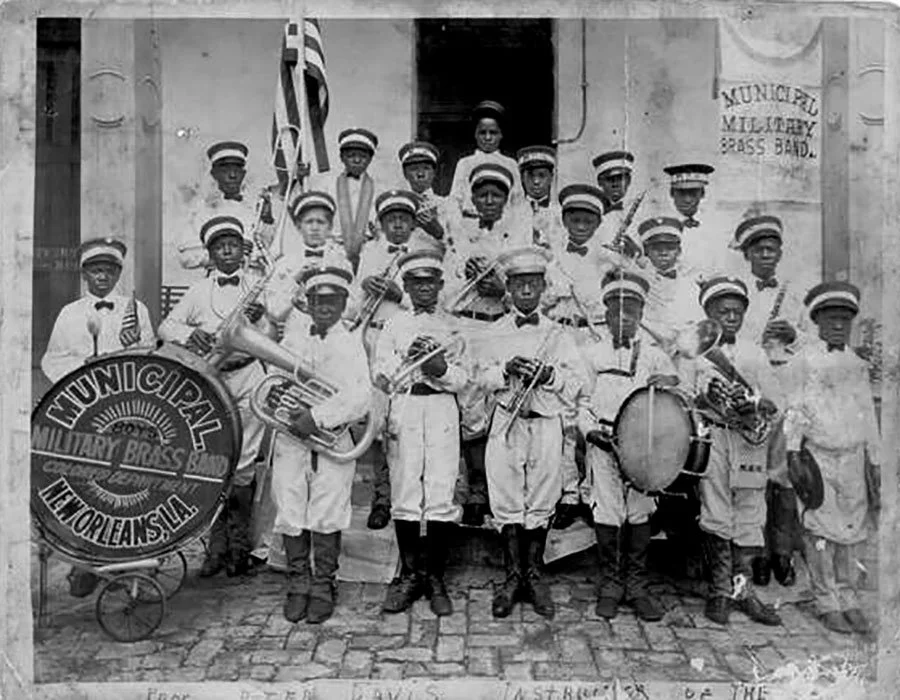
The Municipal Boys Home Military Brass Band (1920) under the direction of Peter Davis, Armstrong’s band master 1913-14. With permission from the New Orleans Jazz Museum

Peter Davis and Louis Armstrong at the Jazz Museum, October 31, 1965, with permission of the New Orleans Jazz Museum
“The voice resembles gravel scratching the sidewalk. The grin is wide and innocent. The lips are scarred and cracked and blue, yet when he blows the horn and fondles the notes, the tone is clean and bare.”- “ For the Benefit of Jazz: Louis Armstrong,” New York Times, November 1, 1965.
The benefit concert took place at Loyola University’s Field House. At 3:30 pm, Armstrong and his integrated band performed for their first fully integrated audience in New Orleans. Present were 50 boys from the Milne Boys’ Home (formerly called the Waif’s Home), local Black and white bourgeoisie dressed to the nines, the press and many musicians.
Armstrong was celebrating his 50th anniversary as a performer. The sixty-five year old performer’s artful “ba- ba-do-de-day” scatting often substituted for his trumpet playing. Earlier in the year, he’d undergone major dental surgery, impacting his ability to blow his horn. In between numbers, he could be seen backstage rubbing a special potent of witch hazel, salts and oils into his lips.
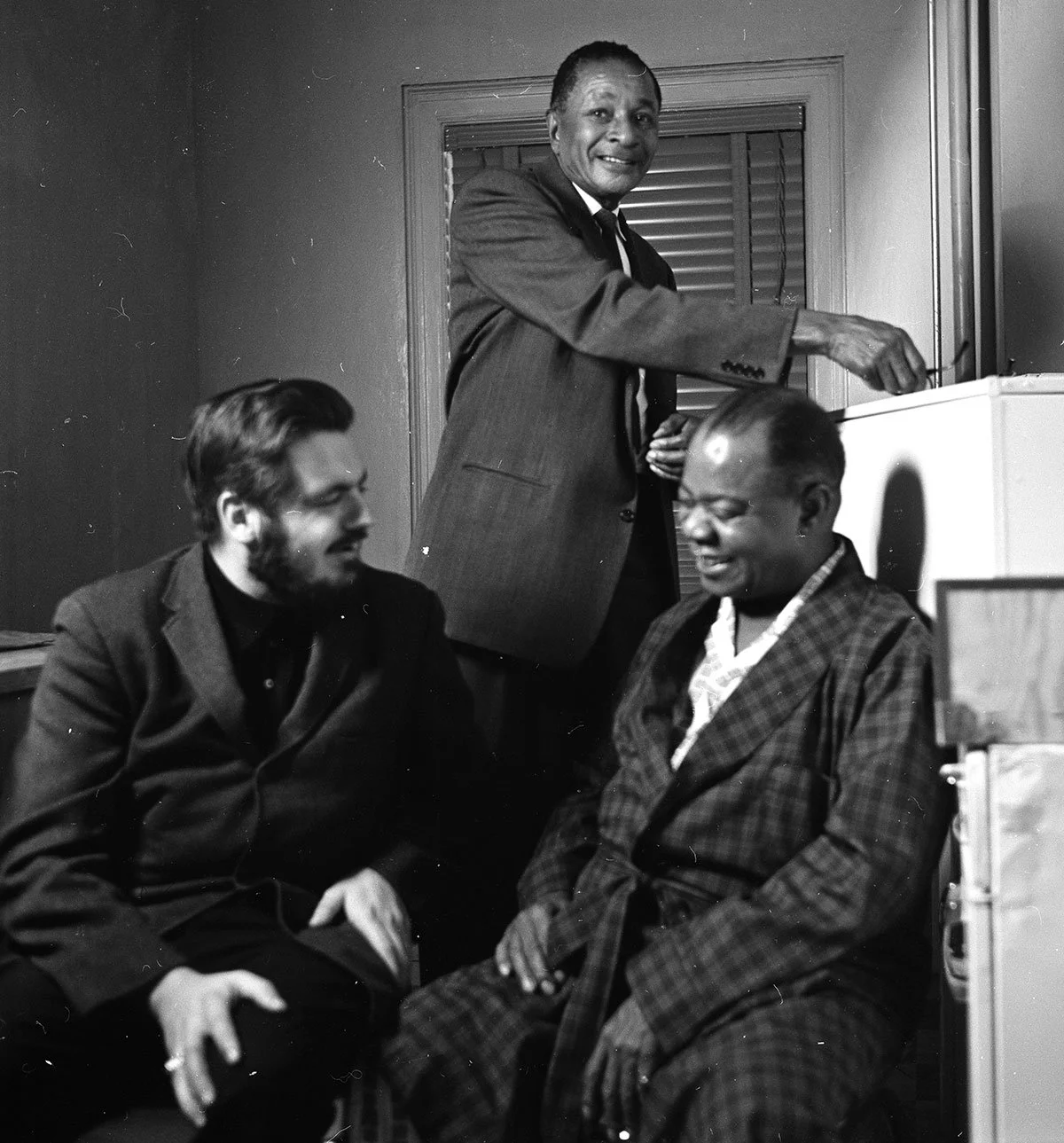
Armstrong relaxes at home between gigs with friends Jack Bradley and actor and comedy writer. Slim Thompson, in his kitchen in Corona, Queens, 1965.Courtesy of the Louis Armstrong House Museum in Queens, NY
The audience didn’t care. The crowd remained enthralled from the first note of “When It's Sleepy Town Down South” until 6 pm, when Louis Armstrong closed out the show with the song he’d topped the charts with in 1939, “When the Saints Go Marching In.”
Ten hours after the Armstrongs arrived, a VIP cart drove them to the red carpet leading to the plane back to Houston. At the top of the stairs, “the king of Jazz” looked back towards New Orleans’ neighborhoods that cradled jazz’s melodies, its myths, and the lyrical power to overcome oppression.
“Every time I close my eyes, blowing that trumpet of mine,” Louis Armstrong later said, “I look right into the heart of good ole New Orleans. It has given me something to live for.”
-Laura Townsend, “The Life of Louis Armstrong” S4E# PBS American Masters, February 17, 2021.
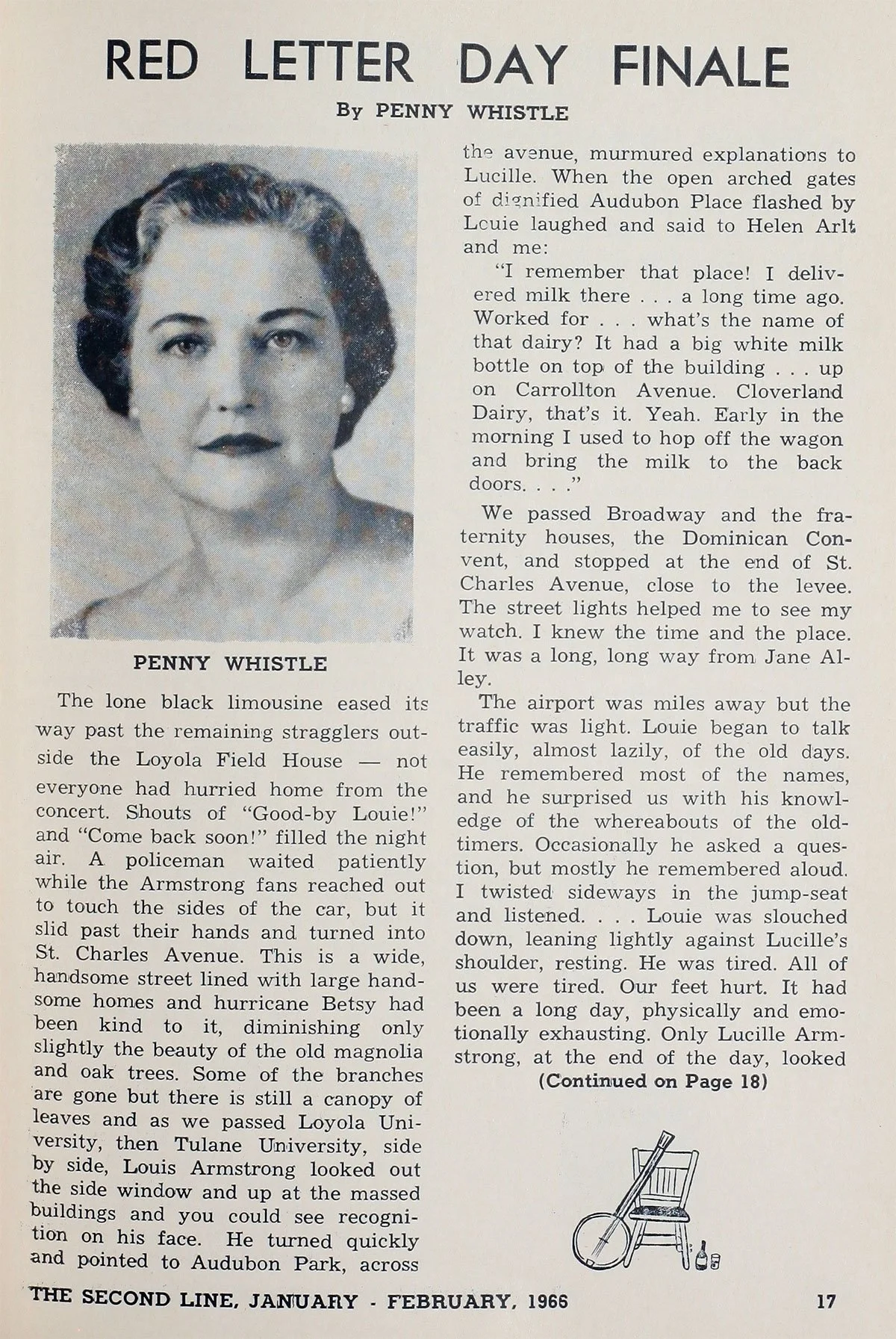
Click on the image to read a PDF of Myra Menville’s article in The Second Line, 1966. Courtesy the Louis Armstrong House Museum in Queens, NY

Many credit Danny Barker and the New Orleans Jazz Club’s “suggestions” for the proclamation since Mayor Schiro was in the hospital recovering from surgery. Courtesy of the Louis Armstrong House Museum in Queens, NY
Epilogue: Today, thanks to the worldwide attention Louis Armstrong brought to the fledgling jazz museum, the New Orleans Jazz Museum contains the most extensive New Orleans jazz collection in the world. As part of its vibrant programming, each March, it hosts the annual Danny Barker Banjo & Guitar Festival.
Part 3: Louis Armstrong and Danny Barker re-unite in 1968 for the city’s first International Jazz fest.
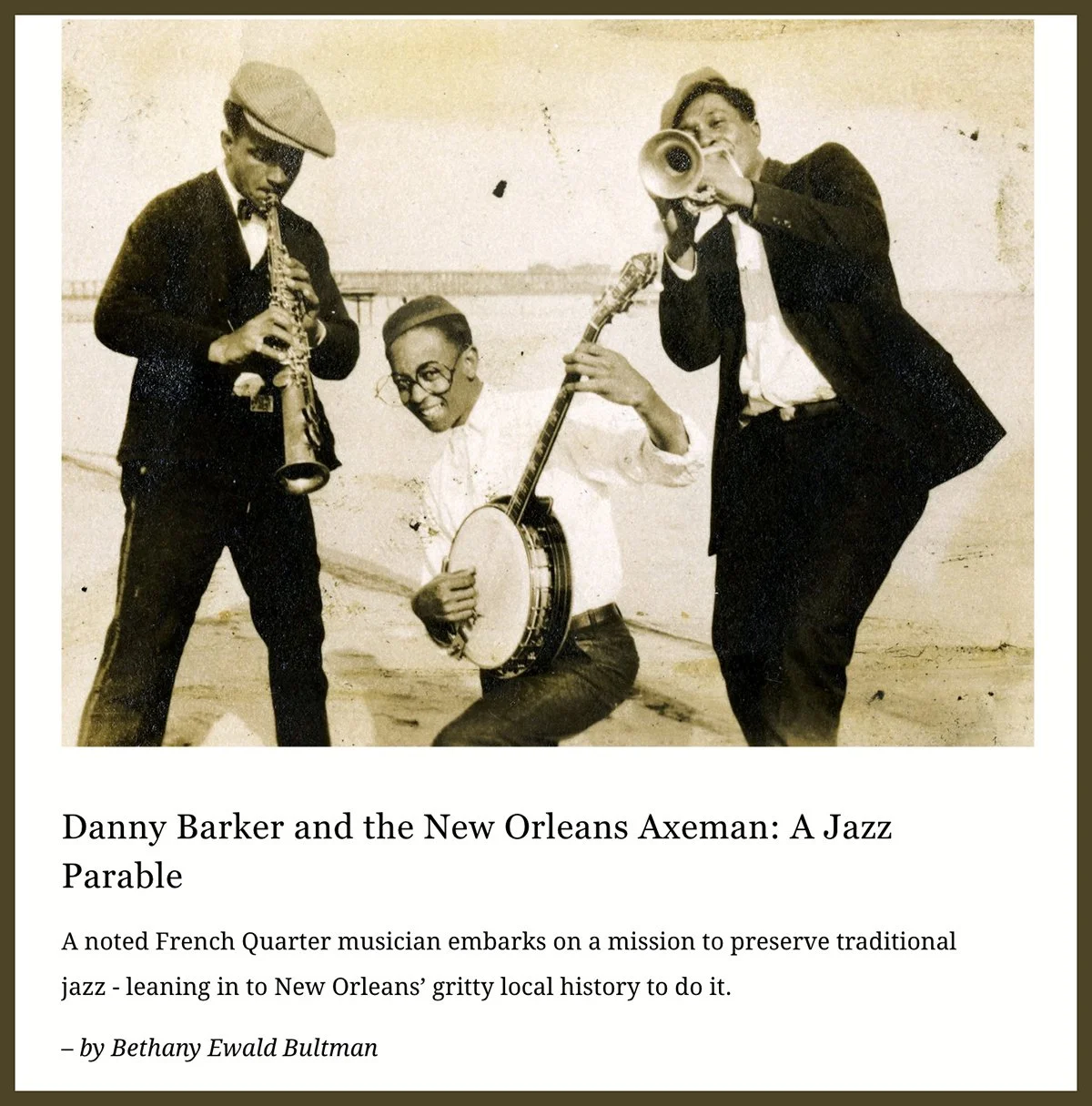
Click on the image for Part One of this Danny Barker Jazz Series.