
The Forgotten Mexican Roots of New Orleans Jazz

Detail from a panoramic shot of a Mexican band with New Orleans Shriners, 1920. Click on the image to access the high resolution file. A Mexican Band at Shriners' Mosque, November 11, 1920. Photo by Charles L. Franck, Charles L. Franck Studio Collection at The Historic New Orleans Collection
October 2026A Mexican Cavalry band performing for the 1884 - 1885 World’s Exposition in New Orleans created a sensation, but their influence can still be heard in our music today.
– by Baylee Badawy
From the late 1800s through the 1930s, visiting bands from Mexico often played in New Orleans, with many of their members befriending and performing with local musicians.
Some of these Mexican musicians even settled in the city, performing and teaching their craft. They had a significant impact on the development of ragtime and early jazz music in New Orleans, introducing new instrument combinations, rhythms and styles.
The Eighth Cavalry Mexican Band
From December 16, 1884, until June 1, 1885, the World’s Industrial and Cotton Centennial Exposition covered the grounds of what today is Audubon Park in New Orleans with massive wooden structures and elaborate displays from countries across the globe.[i] The Mexican display at the exhibition was much larger than those of other South American countries represented.[ii]

This column is underwritten in part by Lucy Burnett
The Exposition technically opened two weeks late, but by that time, the Eighth Cavalry Mexican Military Band – which had arrived on time for the originally planned opening day – had already become one of the event’s marquee attractions, performing multiple times to large New Orleans audiences.
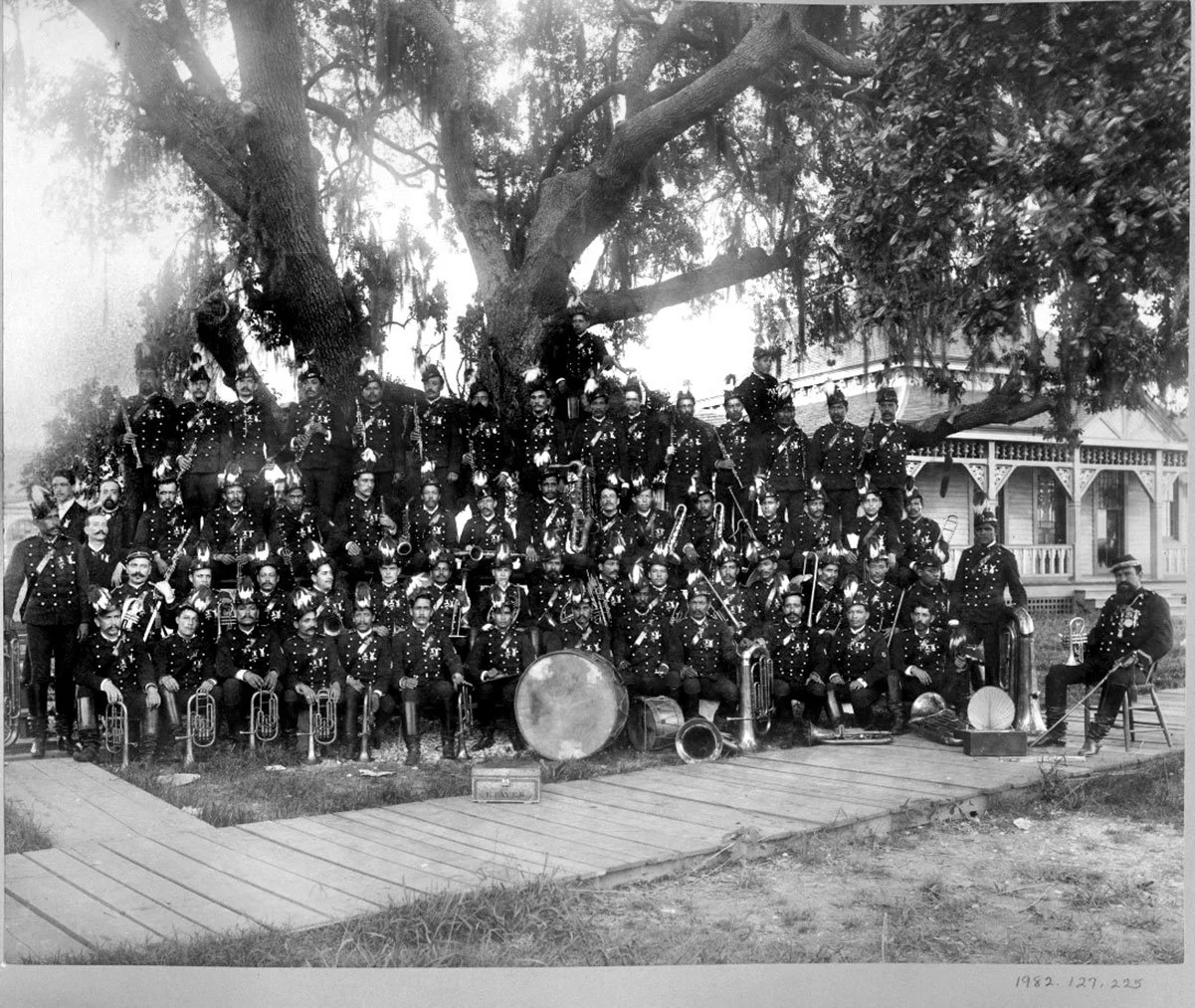
Eighth Regiment Band, Mexican Cavalry, at the World's Industrial and Cotton Centennial Exposition, 1884-85; Encarnación Payén, director (seated, far right). The Historic New Orleans Collection
In a pre-opening performance review, the Daily Picayune praised the band’s music, stating: “If the [band’s] harmonies were full and perfect, the melodious solos were equally delightful. When a platoon of flutes rendered a solo it was like a grove filled with the nightingales fluting their love music. One seldom hears music so feelingly and beautifully accented.”[iii]
The Mexican band continued to play popular New Orleans music and Mexican sounds at the Exposition throughout its six-month run.
“Some days the Mexican Band is playing twice a day. And there are some weeks where they play essentially every day,” The Historic New Orleans Collection’s historian Eric Seiferth said. “The city has fallen in love with them.”[iv]
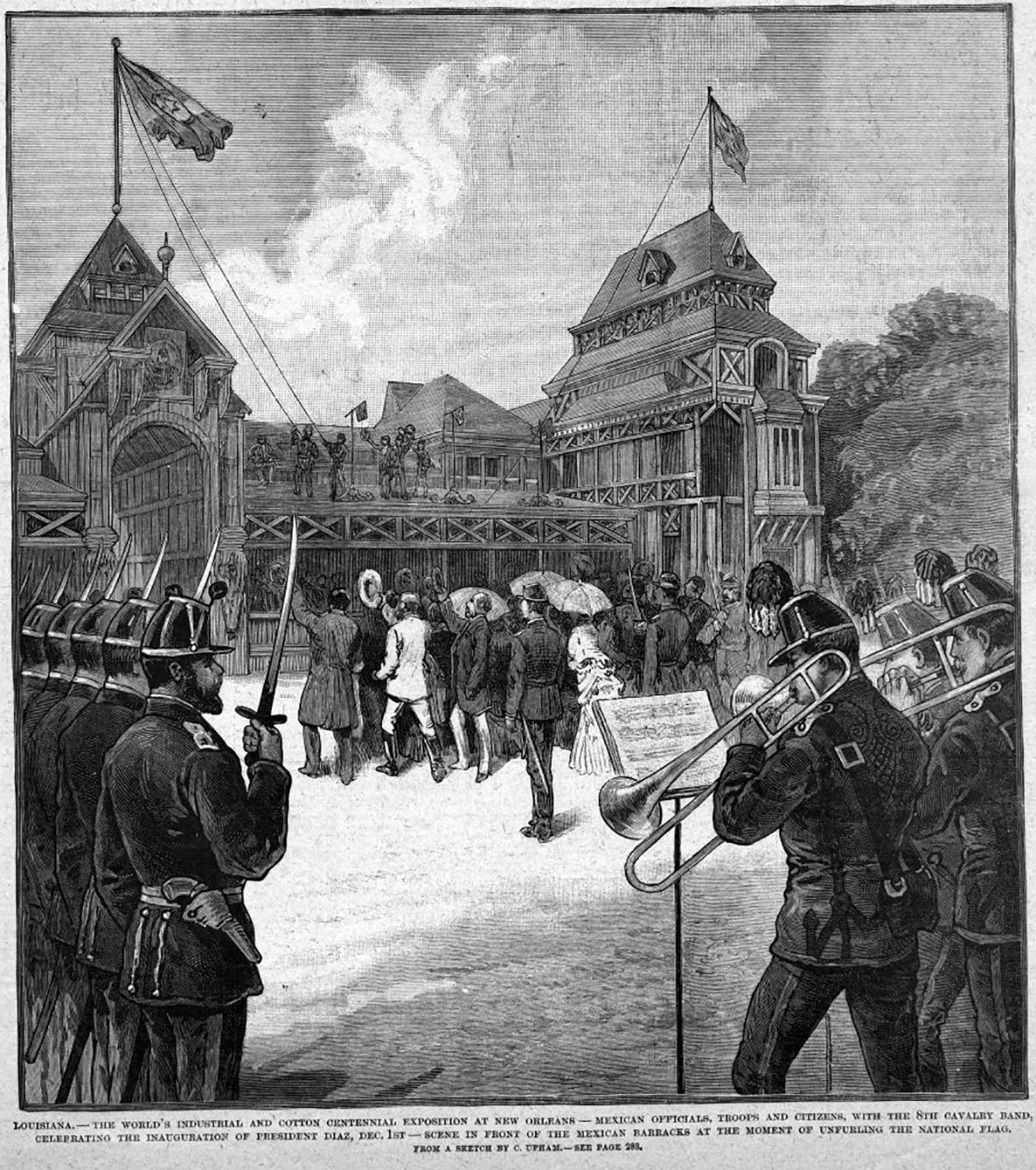
Mexican officials, troops and citizens, with the 8th Cavalry Band, celebratinng the inauguration of President Diaz, Dec. 1st, 1884, by Charles Upham. Historic New Orleans Collection
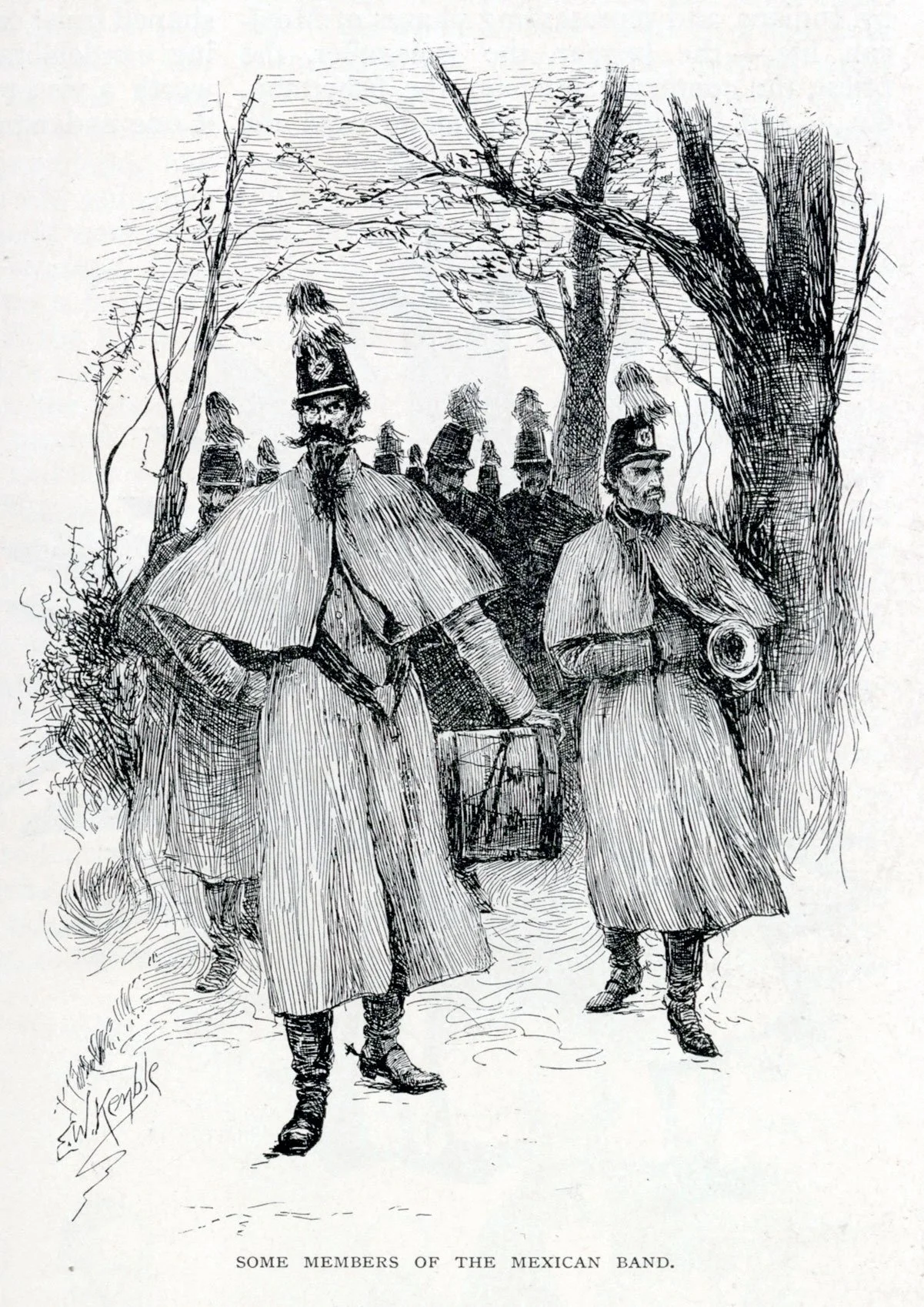
Illustration from theMarch 28, 1885, program for the Mexican Band, directed by E. Payen, Historic New Orleans Collection
Before their visit, New Orleans brass bands did not include woodwind instruments, an innovation that later shaped early jazz bands and music.[v] But this band was large – around 70-plus members – and featured a variety of instruments.
The novel woodwinds included flutes (small flute in D-flat and E-flat flutes, first and second), clarinets (small clarinet in E-flat, principal clarinets, and first and second ripianos), and oboes (first and second). The saxophone section consisted of soprano, alto, tenor, and baritone saxophones.
Brass instruments included cornets (first and second), bugles (first and second), horns (first and second), altos (E-flat first, first, second, and third), trumpets (first and second), and trombones (first and fourth).
Fagottos (bassoons) included first and second players. A bass section included a B-flat bassoon, ophicleide, counter bass, and string bass. The percussion section featured timpani, bass drum, and snare drum.[vi]
The large size of this group and the diverse instruments of the Eighth Cavalry Mexican Band were highly influential.

A Mexican band with New Orleans Shriners, 1920. Click on the image to access the high resolution file. A Mexican Band at Shriners' Mosque, November 11, 1920. Photo by Charles L. Franck, Charles L. Franck Studio Collection at The Historic New Orleans Collection
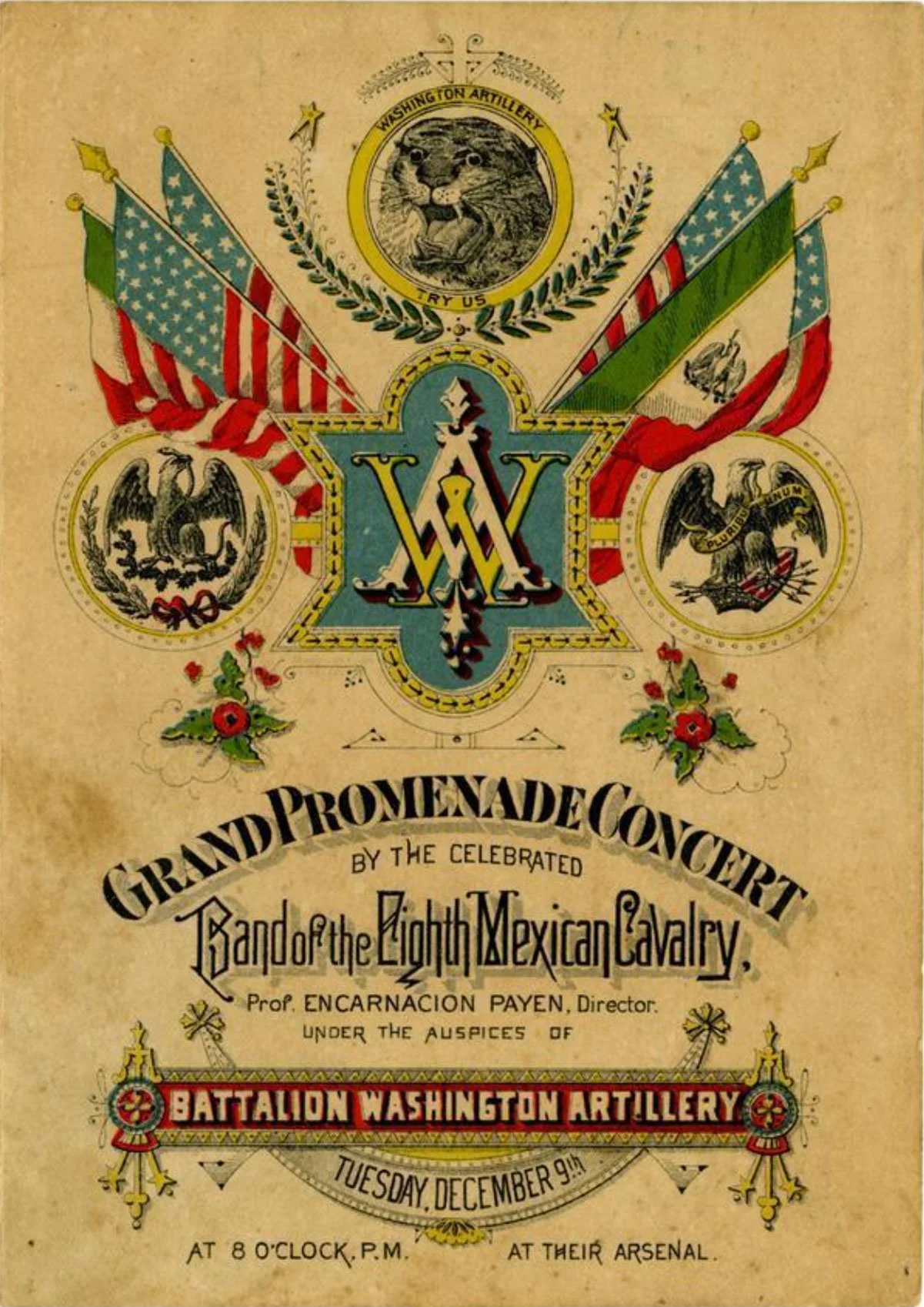
Program of the 8th Mexican Calvary Military Band performing at the Cotton Expo in 1884, New Orleans Public Library
Mexican Musicians Who Stayed
When the Eighth returned to Mexico, at least two of its members stayed behind in New Orleans, including soprano saxophonist Leonardo Vizcarra and clarinetist Florencio Ramos, "the first saxophone wizards in New Orleans who served as models for Creole musicians, both through playing and teaching.[vii] Ramos later founded the city’s musicians’ union and became an important music instructor.[viii]
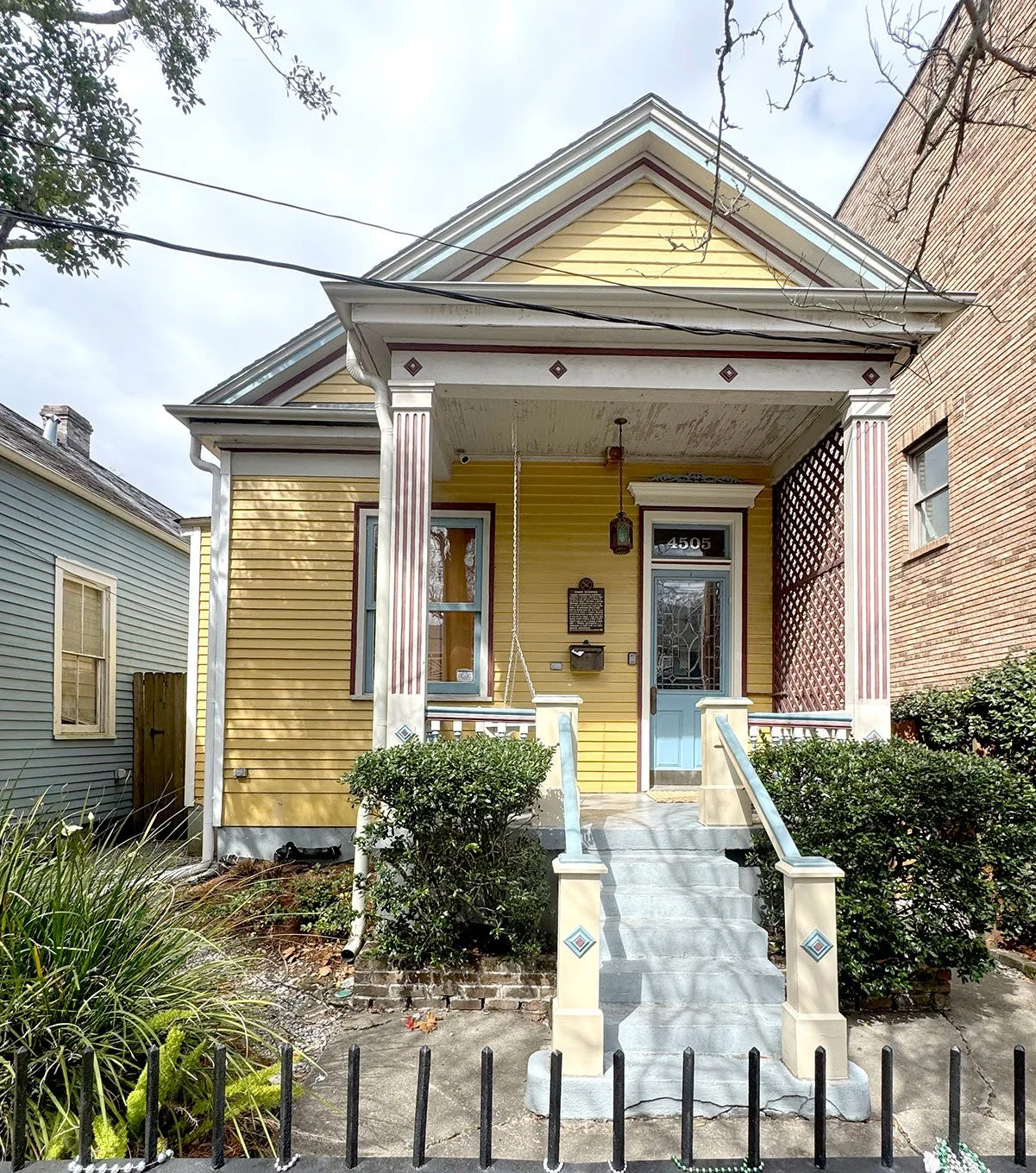
Dryades Street house wehre Florencio Ramos lived, photo by Baylee Badaway
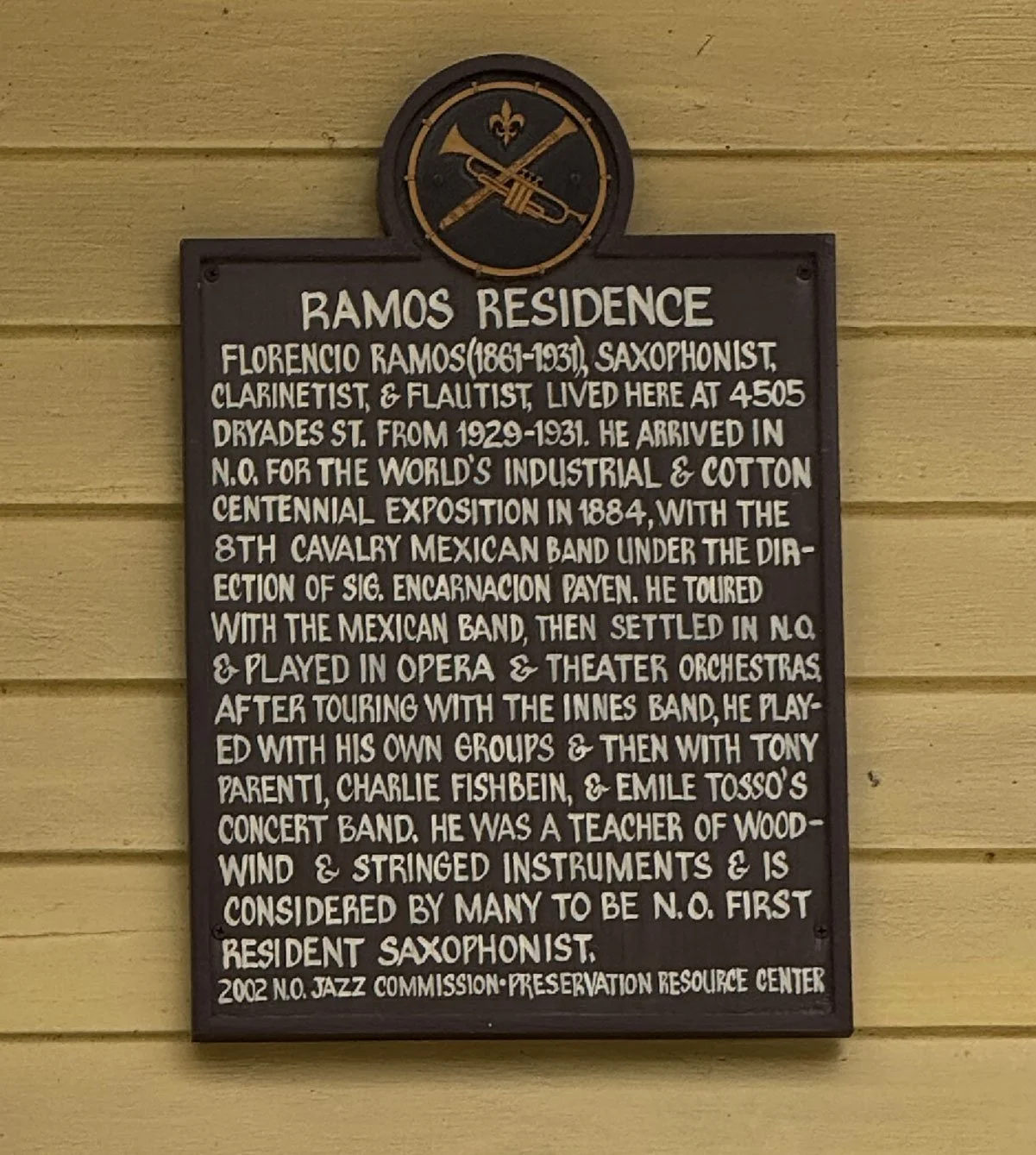
Plaque on Dryades Street house wehre Florencio Ramos lived, photo by Baylee Badaway
Junius Hart and Sheet Music Popularity
Even before the era of recorded music, the popularity of Mexican bands created a strong demand among fans to experience their music through sheet music. Mexican music proved to be so popular that local music entrepreneur Junius Hart published sixty-three piano transcriptions of such works as El Nopal, A Media Noche, and Chloé.
Eventually, Hart's advertisements for these transcriptions claimed, “Over 100,000 copies already sold.”[ix] (examples of this sheet music are currently on view at the New Orleans Jazz Museum).
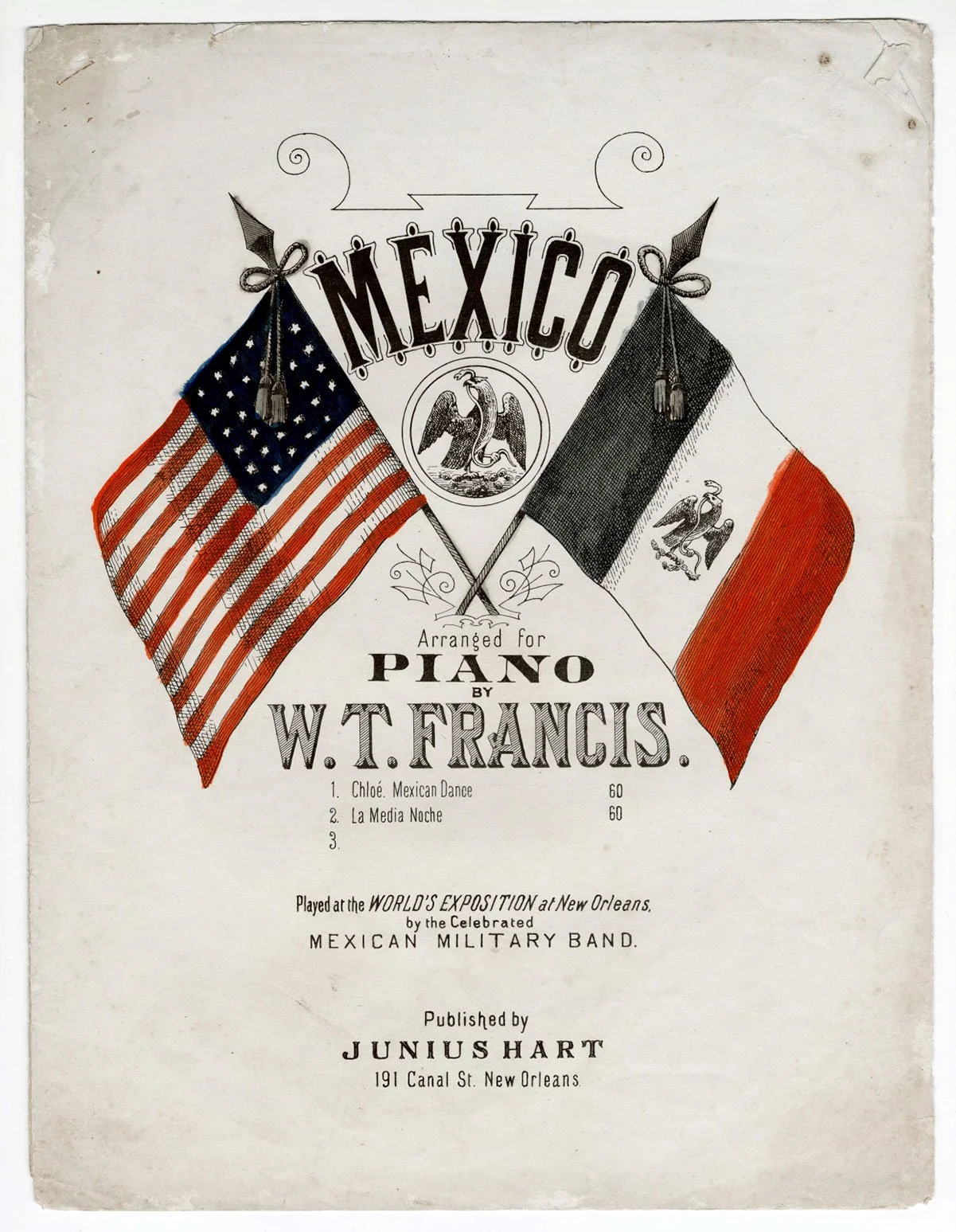
Cover for Junius Hart sheet music, Historic New Orleans Collection
Influence on Ragtime and Early Jazz Compositions
The rhythms played by the Mexican Band had a massive influence on the development of the ragtime music genre in the city, which was already about ten years ahead of the rest of the country in terms of style and syncopated rhythms.
Three-over-four syncopation is a sort of "de facto" form of syncopation in which three notes are repeated several times over a four-beat, underlying rhythm. It’s a special rhythmic variation which occurs because, as the notes are repeated, they change from upbeats to downbeats.
Since musicians play upbeats and downbeats differently, the attack and duration given to the notes tend to change, and this creates a syncopated effect. This musical style of playing is extremely common in Mexican music of the late nineteenth century.[x]
Bunk Johnson's demonstration of Buddy Bolden's playing style on a 1952 record release details this type of syncopation. The example Bunk uses is the Mexican march "Zacatecas March" (1891), with three-over-four figures thrown in as examples and embellishments.[xi] Mexican-style "three-over-four" syncopation, sometimes called "secondary rag," is included in New Orleanian Paul Sarebresole's "Roustabout Rag" (1897).
The use of this rhythmic device does not appear in ragtime from elsewhere until Charles L. Johnson's rag hit "Dill Pickles" (1906), nearly ten years later.[xii] Even later examples of three-over-four appear in and dominate early jazz compositions like "Fidgety Feet" (1919) (also known as "War Cloud") by D. J. LaRocca and Larry Shields, members of the Original Dixieland Jazz Band.
"Over the Waves" (1889) and "Zacatecas March" (1891) both contain the same chord progression as many early jazz pieces, all of which are New Orleans standards.
The list includes, but is not limited to, "Bill Bailey, Won't You Please Come Home" (1902), "Washington and Lee Swing" (1910), "Tiger Rag" (1917), "Milenburg Joys" (1923), and the more recent "Bourbon Street Parade" (1950).
In some books, it is occasionally called the "blues progression," which it is not, but it has become the traditional jazz "default" chord progression, and has Mexican roots.[xiii]
Mixed Identities of Latin and Hispanic Musicians, Creoles, etc.
Jazz historian Bruce Raeburn, the former archivist of Tulane University’s Hogan Jazz Archive, estimates that roughly 24 percent of the “first generation” of jazz musicians born before 1900 were of Latin and Hispanic origin. During this period, New Orleans musicians traveled widely, further disseminating their local inflections to a wide audience.[xiv]
During this time period, musicians from New Orleans traveled widely, further disseminating their local inflections to a wide audience.[xv]
Performers featured heavily in the local music scene included Spanish-born danzón composer Carlos Maduell, Mexican-Spanish tuba player Martin “Chink” Abraham, Mexican-American violinist Paul Dominguez, and bandleader Perlop Nunez. Other musicians included multi-instrumentalist Jimmy “Spriggs” Palao, of Castilian, Portuguese, and Catalan descent; clarinetist Alcide “Yellow” Nunez; Spanish-American cornetist Ray López; and Mexican saxophonist Leonardo Rojas Vizcarra.[xvi]
Some musicians in New Orleans, including those of Mexican descent, could impersonate a number of different ethnicities. This was particularly useful given the segregated climate of the music business in the early 20th century, and this racial and ethnic ambiguity allowed musicians to cross boundaries that determined where, with whom, and for whom they were permitted to perform.
A comparison of the membership of Laine’s Reliance Band with the Eagle and Superior bands – two other bands from the same time period – highlights how musicians of Latino heritage spanned the racial and class spectrum. They played in African American, white, and Creole bands because they had the skills and flexibility that such work required.[xvii]
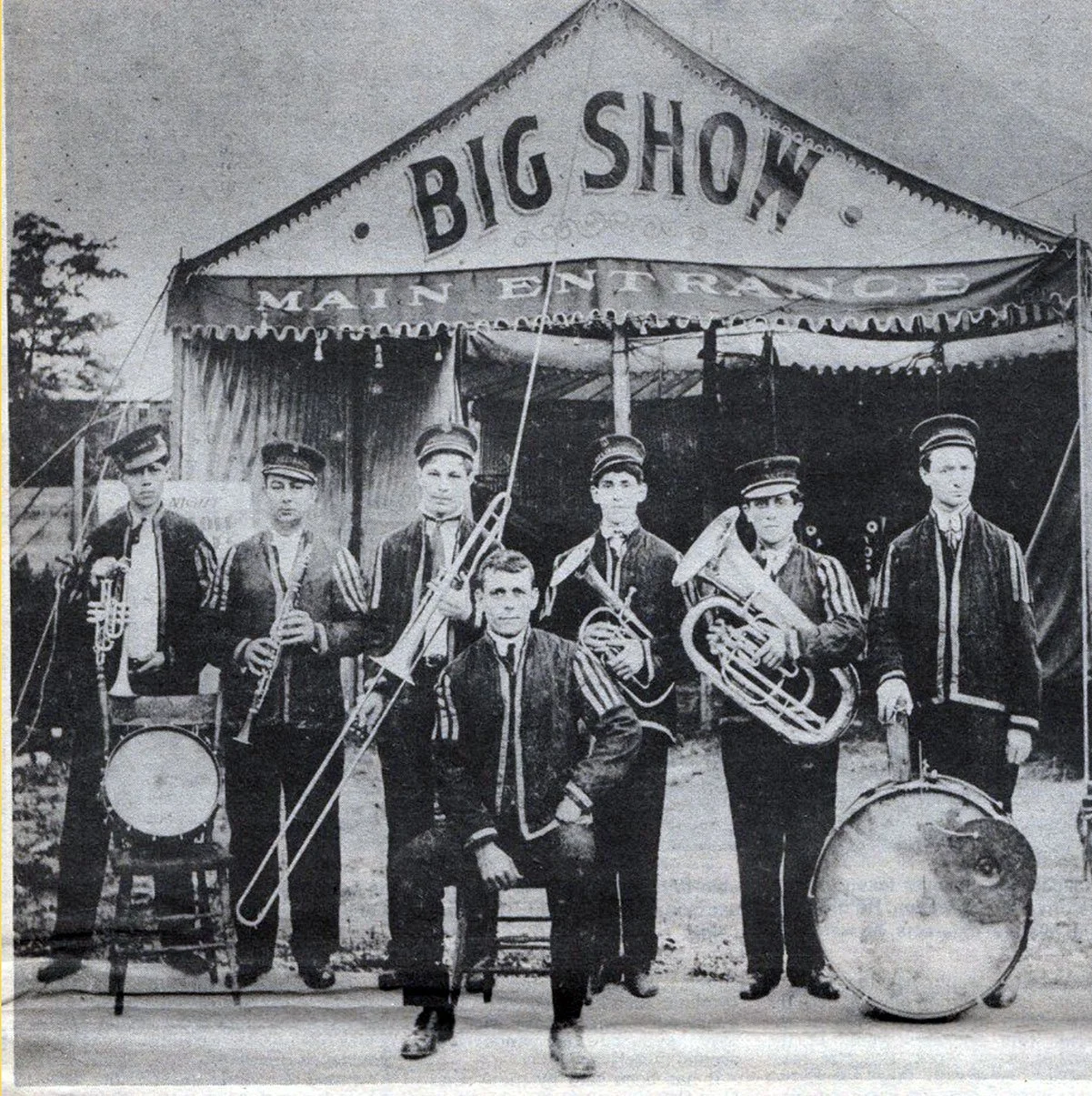
A Mexican Band at Shriners' Mosque, November 11, 1920. Photo by Charles L. Franck, Charles L. Franck Studio Collection at The Historic New Orleans Collection
During a 1960 interview, Laine picked up a photograph taken of his band during a Mardi Gras parade and identified both Vizcarra and Nunez in the lineup.[xviii] Leonardo Rojas Vizcarra appears to have played in Laine's band for about 20 years: He started with Laine around 1890 and was still playing with him at a time when the much younger Alcide "Yellow" Nunez (1884-1934) was in the band. He may have even played with Laine for the "legendary" stag party on a barge towed behind a showboat.
“Chink” Martin, of Mexican and Filipino background, gained his racist nickname when on a streetcar. His white bandleader, Jack Laine, told the conductor – perhaps to avoid looking as if he was violating segregation codes – that Martin was a “Chinaman.”[xix] Martin also played string instruments in a Mexican band and remembered the whole northeastern part of the French Quarter as being inhabited by Spaniards, Mexicans, and Puerto Ricans.[xx]
Creole and Mexican Jazz Pedagogues
An example of continued Mexican influence may be seen in the long legacy and prolific teaching of the Tio family. They were master clarinetists and pedagogues from New Orleans who were steeped in Latin and Caribbean musical influences. The elder of the family, Thomas Tio (of Spanish ancestry), fled New Orleans for Tampico, Mexico in 1859 in order to escape the declining racial environment prior to the Civil War.[xxi]
While living in Mexico, the Tios undoubtedly heard Cuban-influenced musical repertoire there, such as danzón.[xxii] Tio’s offspring, Lorenzo and Louis (“Papa Tio”) – both of whom were born in Mexico – returned to New Orleans in the 1880s.[xxiii]
Due to this migration, many assumed the Tio family immigrated from Mexico, despite being Creoles from New Orleans originally. Local musicians simply referred to the Tios as “the Mexicans.”[xxiv]
Lorenzo, Louis, and eventually Lorenzo Jr., went on to teach numerous jazz musicians, including Barney Bigard, Jimmie Noone, Omer Simeon, Darnell Howard, and Albert Nicholas.[xxv].
Clarinetist Sidney Bechet was another notable pupil of the Tio family who went on to have a massive international jazz career. Morton himself said, “Papa Tio taught us all how to play clarinet."[xxvi]
Exploring the early musical connections between New Orleans and Mexico gives us a deeper appreciation of jazz’s roots — and the Mexican and Latin American influences that helped shape it.
Citations
[i] Miki Pfeffer, “Enter the World of the World’s Fair: 1884 Cotton Centennial Exposition,” New Orleans Historical, accessed December 15, 2024, https://neworleanshistorical.org/items/show/191.
[ii] Gaye Theresa Johnson, “‘Sobre Las Olas’: A Mexican Genesis in Borderlands Jazz and the Legacy for Ethnic Studies,” Comparative American Studies An International Journal 6, no. 3 (September 2008): 225–40, https://doi.org/10.1179/147757008x330195, 229.
[iii] Dave Walker, “A Prospect.5 Exhibition Delves into the Story of the ‘Mexican Band,’” The Historic New Orleans Collection, December 15, 2021, https://www.hnoc.org/publications/first-draft/prospect5-exhibition-delves-story-%E2%80%9Cmexican-band%E2%80%9D-captivated-1884-new.
[iv] The Mexican band wowed New Orleans in 1884 - Verite News, accessed December 14, 2024, https://veritenews.org/2024/09/27/the-mexican-band-wowed-new-orleans-in-1884/.
[v] Gaye Theresa Johnson, “‘Sobre Las Olas’: A Mexican Genesis in Borderlands Jazz and the Legacy for Ethnic Studies,” Comparative American Studies An International Journal 6, no. 3 (September 2008): 225–40, https://doi.org/10.1179/147757008x330195, 229.
[vi] Dan Vernhettes, Visiting Mexican Bands (Jazz’edit, 2022), 48.
[vii] Richard J Salvucci, “No, Don Porfirio Did Not Invent Jazz, but It Doesn’t Matter Article @ All about Jazz,” All About Jazz, October 20, 2024, https://www.allaboutjazz.com/visiting-mexican-bands-1876-1955-dan-vernhettes.
[viii] Gaye Theresa Johnson, “‘Sobre Las Olas’: A Mexican Genesis in Borderlands Jazz and the Legacy for Ethnic Studies,” Comparative American Studies An International Journal 6, no. 3 (September 2008): 225–40, https://doi.org/10.1179/147757008x330195, 229.
[ix] New Orleans and the Spanish World, accessed December 14, 2024, https://www.hnoc.org/sites/default/files/file_uploads/2015LPOProgram_FINAL.pdf, 8.
[x] Jack Stewart, “THE MEXICAN BAND LEGEND: PART III,” The Jazz Archivist XX (2007), 5.
[xi] 1. Bunk Johnson – this is bunk Johnson talking, explaining to you the early days of New Orleans (1952, Red, vinyl) - discogs, accessed December 9, 2024, https://www.discogs.com/release/2853575-Bunk-Johnson-This-Is-Bunk-Johnson-Talking-Explaining-To-You-The-Early-Days-Of-New-Orleans.
[xii] Jack Stewart, “THE MEXICAN BAND LEGEND: PART III,” The Jazz Archivist XX (2007), 6.
[xiii] Jack Stewart, “THE MEXICAN BAND LEGEND: PART III,” The Jazz Archivist XX (2007), 7.
[xiv] Bruce Raeburn, Beyond the “Spanish Tinge”: Hispanics and Latinos in Early New Orleans Jazz, n.d, 15.
[xv] Christopher Washburne, Latin Jazz: The Other Jazz (New York, NY: Oxford University Press, 2020), 39.
[xvi] Alejandro L. Madrid and Robin D. Moore, Danzón: Circum-Caribbean Dialogues in Music and Dance (New York: Oxford University Press, 2014), 7-8.
[xvii] Bruce Raeburn, Beyond the “Spanish Tinge”: Hispanics and Latinos in Early New Orleans Jazz, n.d, 22-23.
[xviii] Jack Stewart, “THE MEXICAN BAND LEGEND: PART III,” The Jazz Archivist XX (2007), 8-9.
[xix] Charles Hersch, Subversive Sounds: Race and the Birth of Jazz in New Orleans (Chicago: University of Chicago Press, 2009), 106.
[xx] 1. Jack Stewart, “THE MEXICAN BAND LEGEND: MYTH, REALITY, AND MUSICAL IMPACT; A PRELIMINARY INVESTIGATION,” The Jazz Archivist VI, no. 2 (December 1991), 2.
[xxi] Bruce Raeburn, Beyond the “Spanish Tinge”: Hispanics and Latinos in Early New Orleans Jazz, n.d, 19.
[xxii] Alejandro L. Madrid and Robin D. Moore, Danzón: Circum-Caribbean Dialogues in Music and Dance (New York: Oxford University Press, 2014), 8.
[xxiii] Bruce Raeburn, Beyond the “Spanish Tinge”: Hispanics and Latinos in Early New Orleans Jazz, n.d, 19.
[xxiv] Gaye Theresa Johnson, “‘Sobre Las Olas’: A Mexican Genesis in Borderlands Jazz and the Legacy for Ethnic Studies,” Comparative American Studies An International Journal 6, no. 3 (September 2008): 225–40, https://doi.org/10.1179/147757008x330195, 226.
[xxv] Bruce Raeburn, Beyond the “Spanish Tinge”: Hispanics and Latinos in Early New Orleans Jazz, n.d, 19.
[xxvi] Gaye Theresa Johnson, “‘Sobre Las Olas’: A Mexican Genesis in Borderlands Jazz and the Legacy for Ethnic Studies,” Comparative American Studies An International Journal 6, no. 3 (September 2008): 225–40, https://doi.org/10.1179/147757008x330195, 226.