
Larger than Life: Bohemian Women of the Quarter
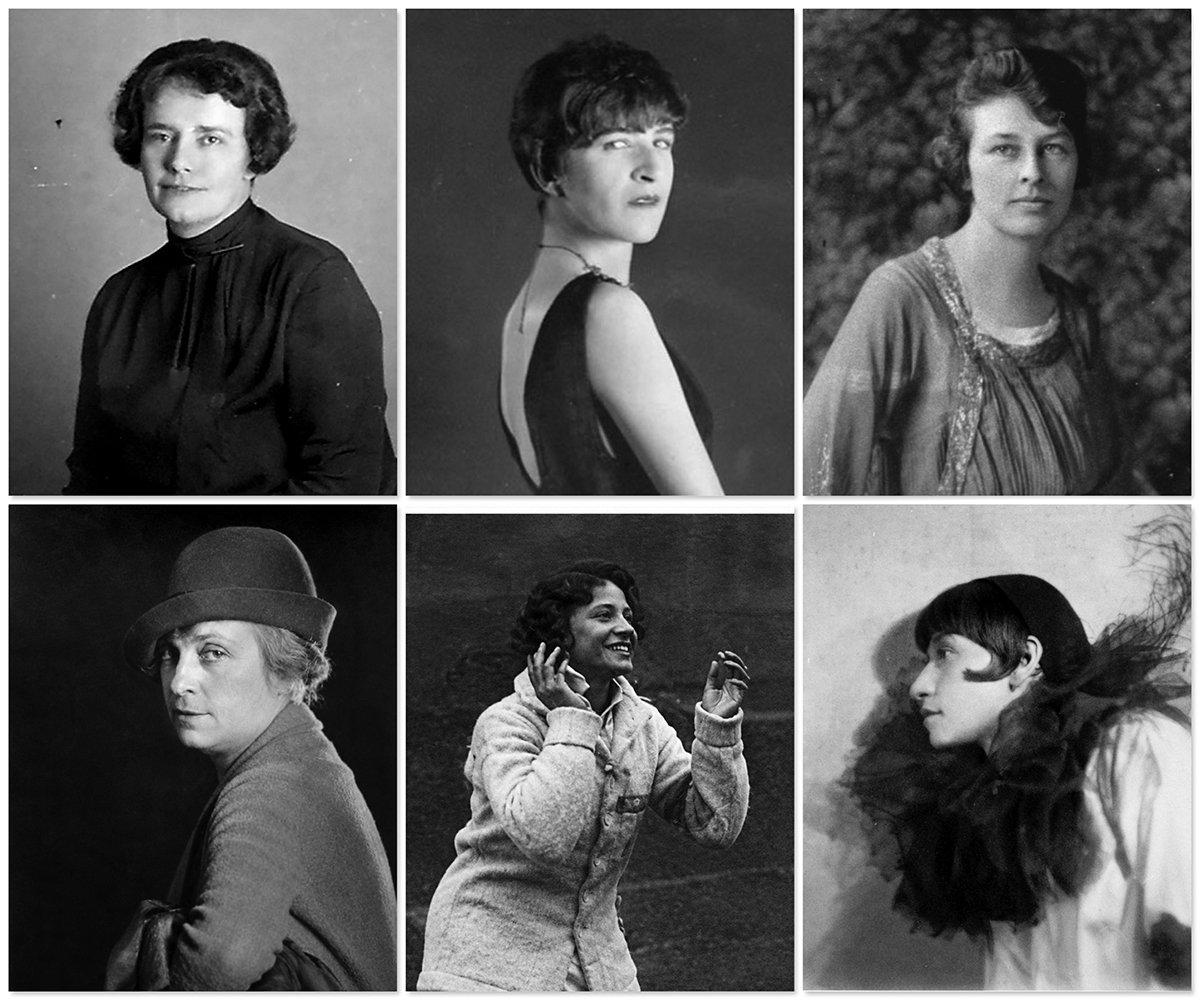
Top left, clockwise: Natalie Scott, Genevieve Pitot, Elizebeth Werlein, Louis Andrews Fischer, Marian Draper and Flo Fields. Individual photo credits and larger images below
June 2026In the Roaring ‘20s, the French Quarter became an incubator for women exercising more than their newly won right to vote.
– by John Shelton Reed

This column is underwritten in part by Karen Hinton & Howard Glaser
December of this year marks the centenary of Sherwood Anderson and Other Famous Creoles, an odd little book that The Booklover's Guide to New Orleans calls "one of the great literary curiosities in the city's history."
It was put together by William Spratling, an artist and Tulane instructor, and his apartment-mate William Faulkner, then merely an aspiring writer from Mississippi.
The book consisted of Spratling's drawings of himself, Faulkner, and forty-one of their acquaintances—"artful and crafty ones of the French Quarter," along with some uptown friends and patrons. Faulkner's introduction unmistakably parodied novelist Sherwood Anderson’s style.
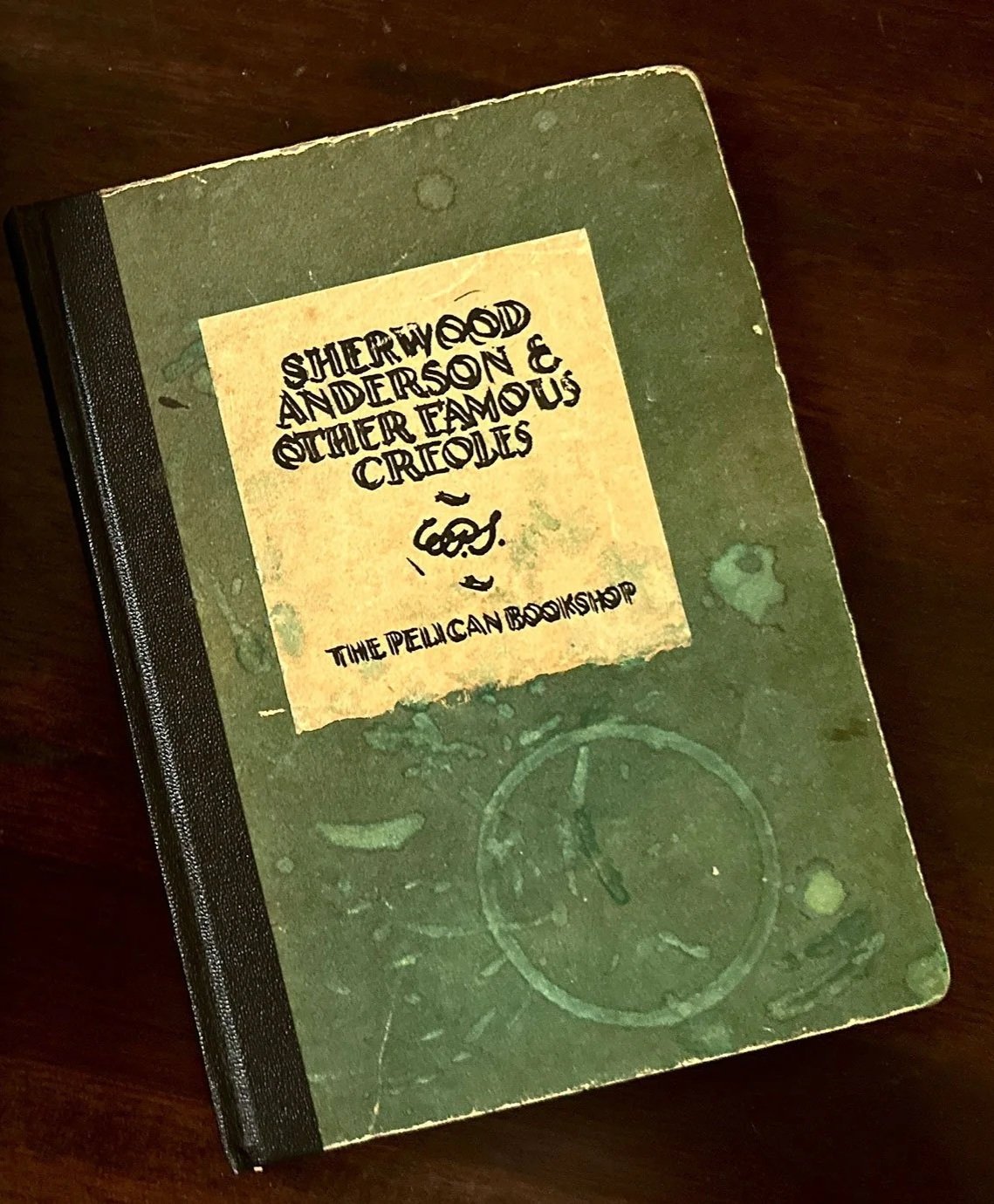
A rare original copy of Sherwood Anderson & Other Famous Creoles, by William Faulkner and William Spratling in 1926. Only a few hundred copies were printed originally, but there’s a wonderful reprint available. Click here to purchase the reprint.
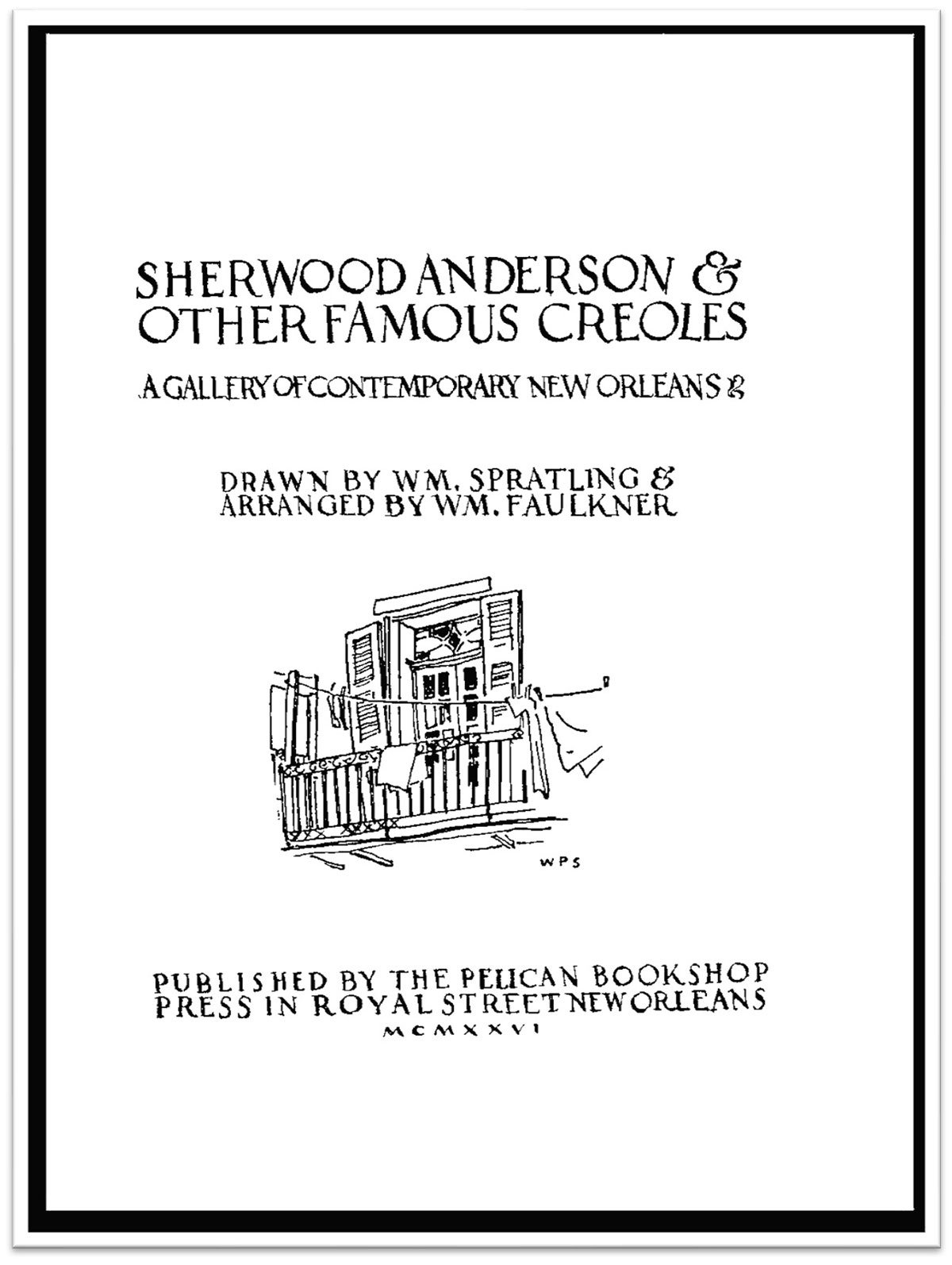
A reproduction of the book’s title page
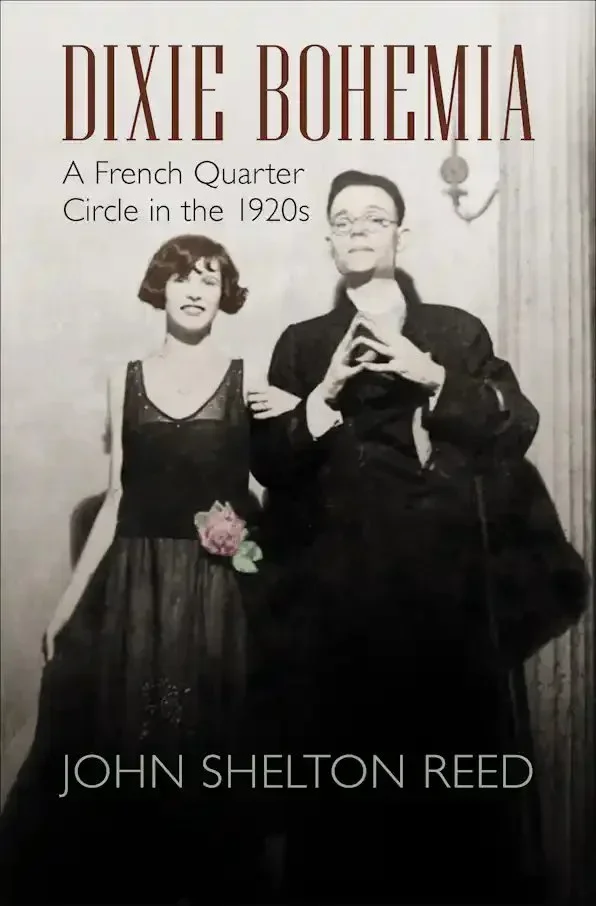
Dixie Bohemia by John Shelton Reed, profiles all 43 of the artists and friends who were included in the Faulkner and Spratling’s original book. Click here to purchase from your favorite local bookstore.
Spratling said, looking back, that the book was “a sort of mirror of our scene in New Orleans”—an introduction to a bohemian crowd of artists, writers, journalists, musicians, poseurs, and hangers-on in the French Quarter in the mid-1920s.
That, in fact, was how I used it when I explored that world for the Walter Lynwood Fleming Lectures in Southern History at LSU in 2011, later published by LSU Press as Dixie Bohemia: A French Quarter Circle in the 1920s.
Although I didn’t dwell on it there, I was struck by how fully women participated in this scene – and not merely as decoration, although Hamilton Basso did recall “a fairly dazzling collection of pretty girls [whose] part in this here twentieth century American literary renaissance will never be fully appreciated.”
Fifteen of the forty-three “Famous Creoles” were women, and several others – most notably Sherwood Anderson’s wife Elizabeth – weren’t included, but should have been.
I wrote in Dixie Bohemia that “not all or even many of the Famous Creoles and their circle did great things. With only a very few exceptions, the interest lies less in their artistic achievement than in their larger-than-life personalities and the scene they created.”
That was perhaps especially true of the women. Several led lives more adventurous, accomplished, and improbable than most of the men.
Consider five whose personalities really were larger than life:
Genevieve Pitot
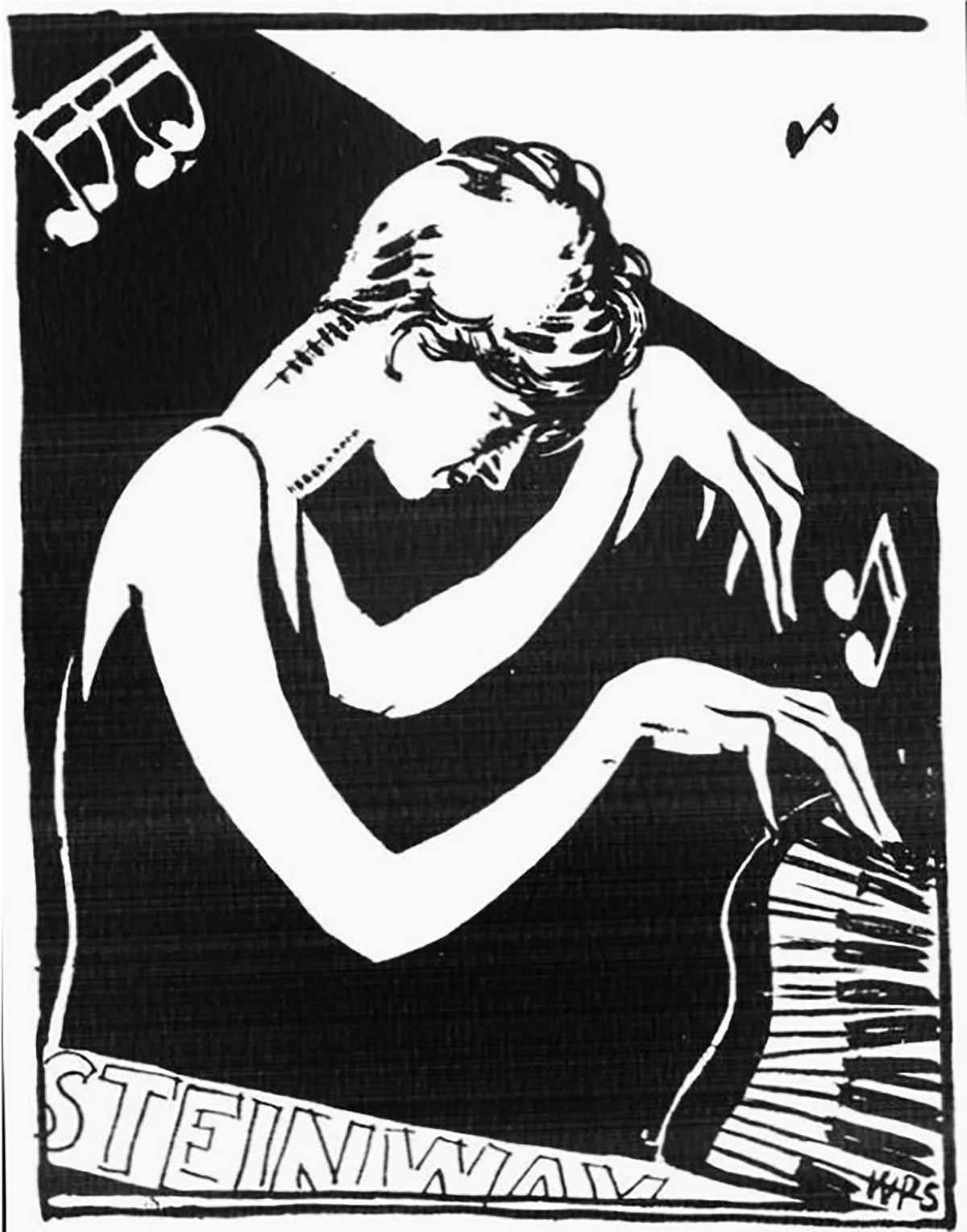
Spratlinbg’s drawing of Genevieve Pitot in the book
Genevieve “Jenny” Pitot was a real Creole, not merely a Famous one. A Pitot ancestor had been an early mayor of New Orleans, and she grew up on Esplanade in a multigenerational French-speaking household.
From an early age, she showed unusual musical talent, playing ragtime for family dances as a child and studying piano locally. At seventeen, she amused the visiting French virtuoso Alfred Cortot by playing Chopin with jazzy embellishments. Cortot urged her to study with him in Paris, and after World War I she did exactly that, spending three years there and adopting the French pronunciation of her surname.
Back in New Orleans, trying to make a living as a concert pianist, Pitot brought a touch of Parisian glamour to the French Quarter crowd. Cicero Odiorne later remembered, “Jenny, in white silk, stretched out on the divan, under the light.” Marc Antony remembered her fondly as “a fun girl of the twenties” and “crazy as could be.”
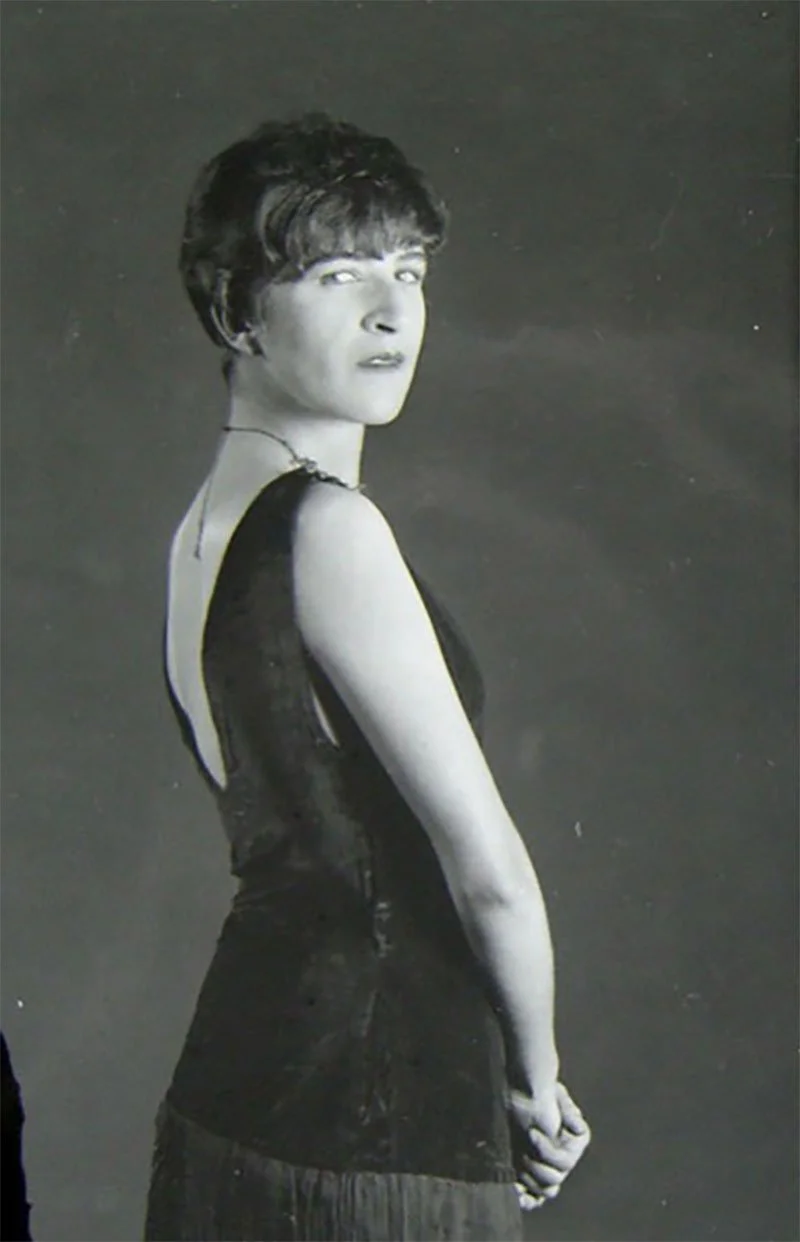
Genevive Pitot, photograph by “Pops” Whitesell, Louisiana Collection, Tulane University
And everyone remembered her Dance of the Seven Veils at Les Folies du Vieux Carré (her respectable family was not amused).
When she decided that New Orleans couldn’t support her concert career, Pitot moved to New York. There she scraped together work accompanying dancers and even modeled nude for a photographer (she didn’t tell her family).
In 1925 she talked her way into a job with the Aeolian Company, cutting player-piano rolls of sentimental “salon music.” Years later, she recalled that “they were cheap waltzes, cheap music.” Still, it paid the bills, and between 1925 and 1929 she recorded at least fifty-five piano rolls.
Pitot continued giving concerts, including a 1928 Carnegie Hall program of modern French music, but her real breakthrough came through dance. She met the avant-garde choreographer Michio Ito at a party and began accompanying his performances.
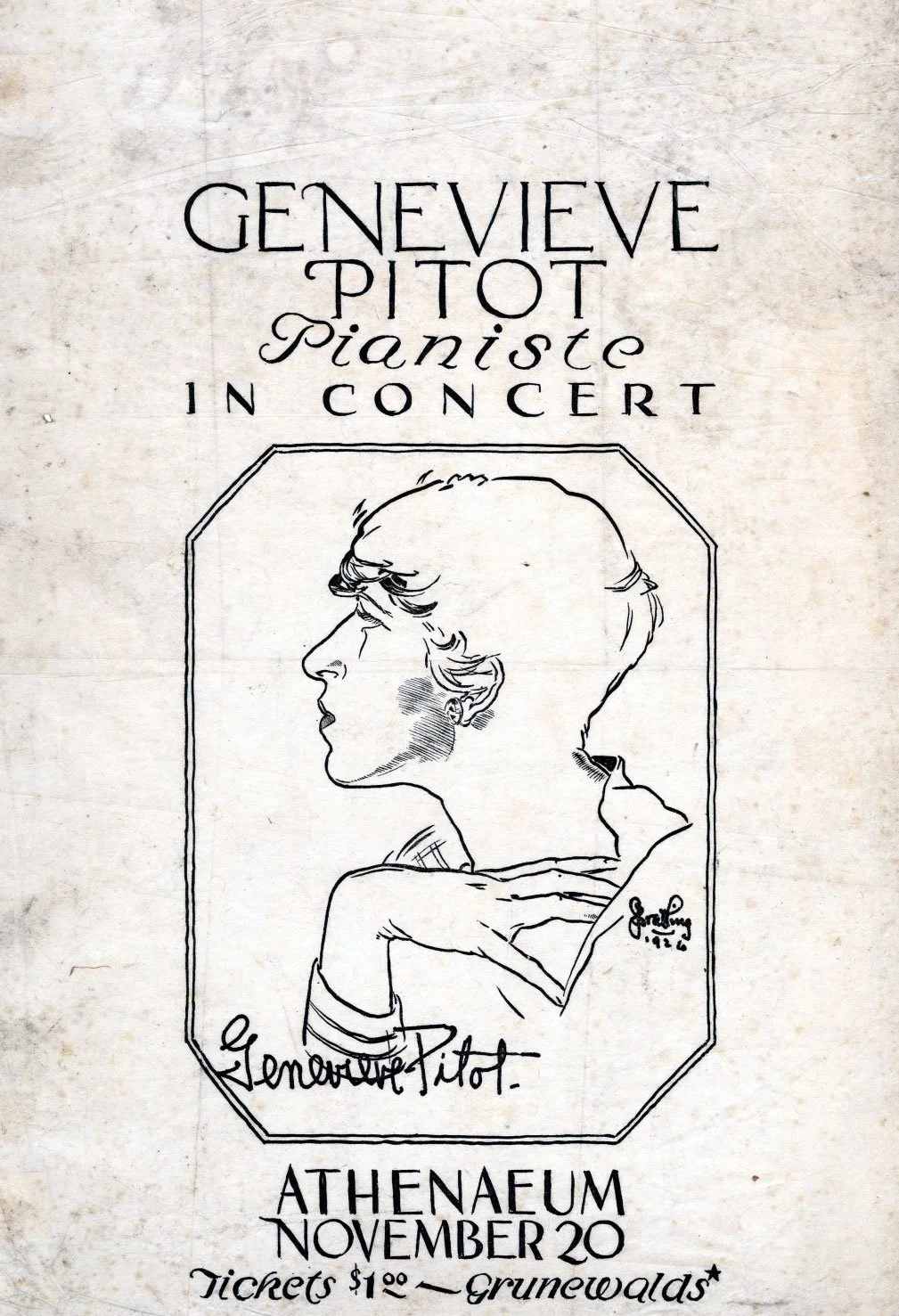
1926 flier promoting a concert, Historic New Orleans Collection, 1970.22.10
During the 1930s, she worked with Martha Graham, Agnes de Mille, José Limón, Doris Humphrey, and other major figures in modern dance. She formed a productive partnership with choreographer Helen Tamiris, composing music for many of Tamiris’s productions, including four for the WPA’s Federal Dance Project. One of those was How Long, Brethren?, based on Negro Songs of Protest; the Federal Theater Negro Chorus, offstage, sang Pitot’s semi-operatic arrangements.
During World War II, she toured state fairs playing for the fan dancer Sally Rand. After the war, she moved to Broadway, where she did dance arrangements or composed for 19 musicals, including Kiss Me Kate, Kismet, Li’l Abner, Can-Can, and Call Me Madam.
But when “Hair killed the Broadway musical,” as she put it, she returned to New Orleans, settled in, played some concerts, and had visits from player-piano enthusiasts. Things were going well when she was mugged and seriously injured.
As a nondriver, wearing a brace and running short of money, she became dependent on friends. Fortunately, she had many of them. She died in New Orleans in 1980.
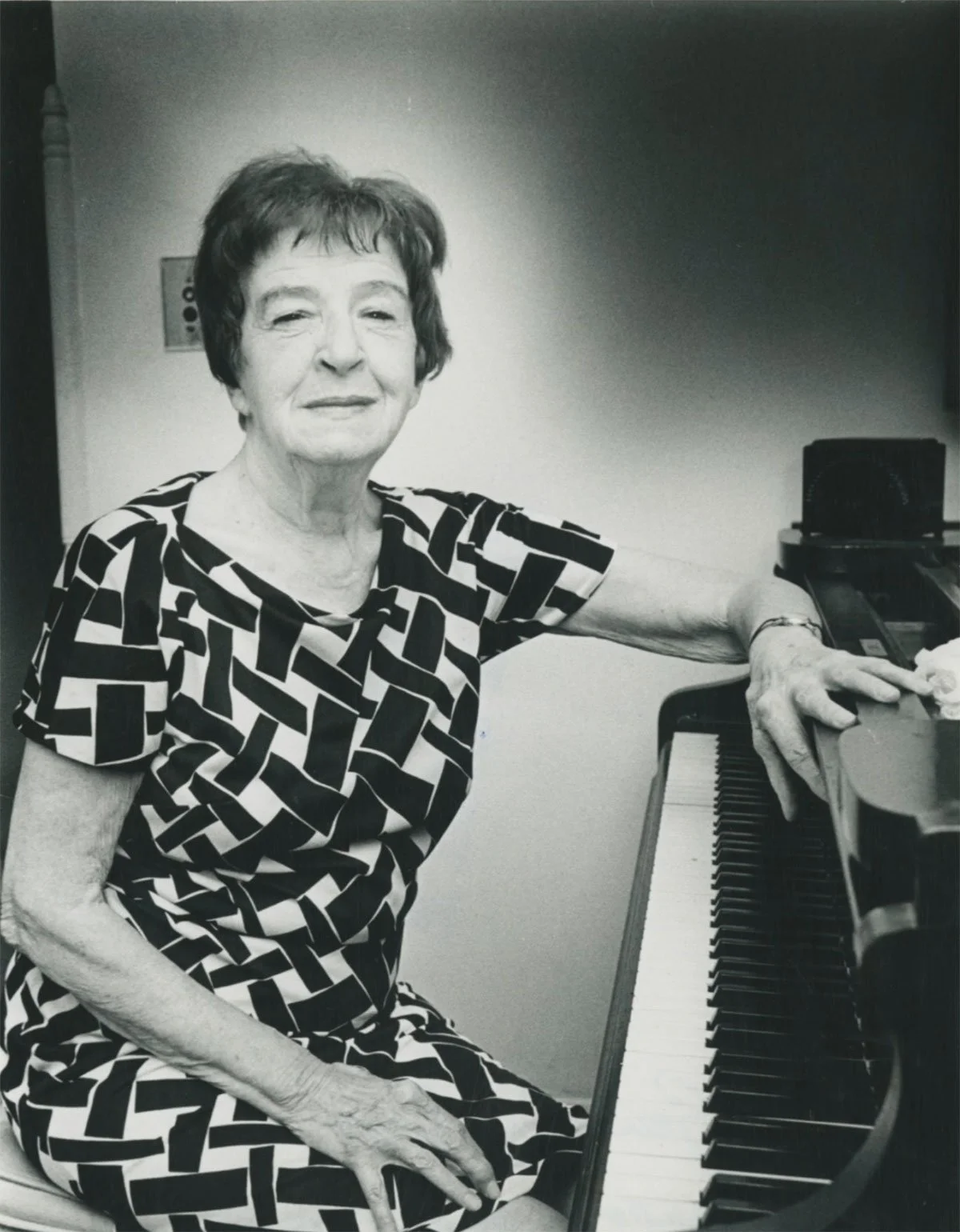
Genevieve Pitot in 1979, a year before her death, HNOC, gift of Alfred E. Lemmon
Marion Draper
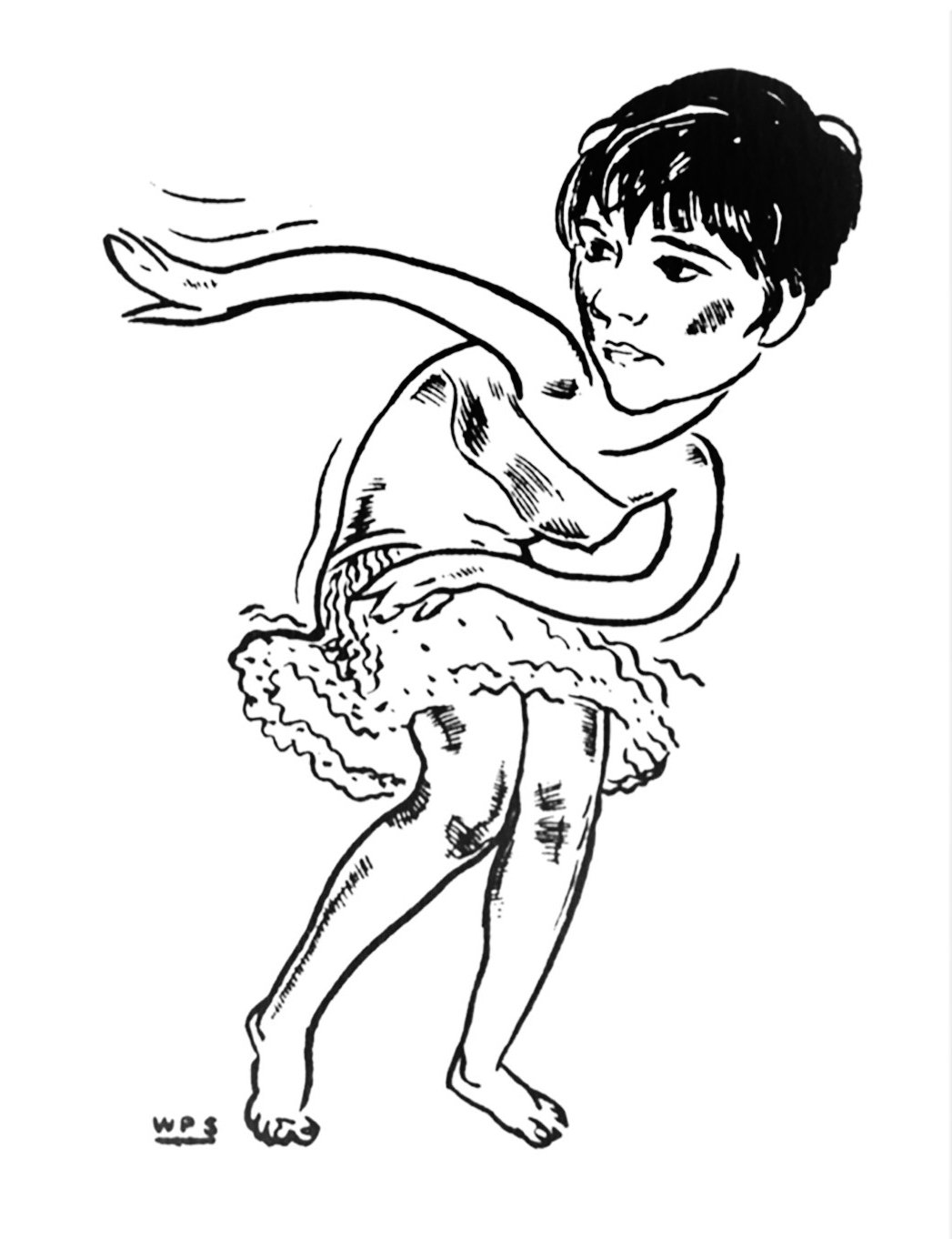
Spratling’s drawing of Marian Draper as a Famous Creole
Marian Draper was 20 in 1926, the youngest of the Famous Creoles.Three years earlier, she had been dancing in the Ziegfeld Follies, but she turned her back on Broadway and enrolled in Tulane’s architecture school. She also studied painting at the Arts and Crafts Club, and paid her way by dancing in local nightclubs.
She was a good architecture student (she won a prize as the school’s most promising sophomore), but Tulane’s yearbook put her in its “Hall of Fame” as “Tulane’s great little cheerleader.”
Female cheerleaders were rare enough at the time that when Marian led the Tulane cheers at the 1925 Northwestern game, the New York Times ran her photograph, captioned “The Girl Cheer Leader of Tulane. Miss Marian Draper.”
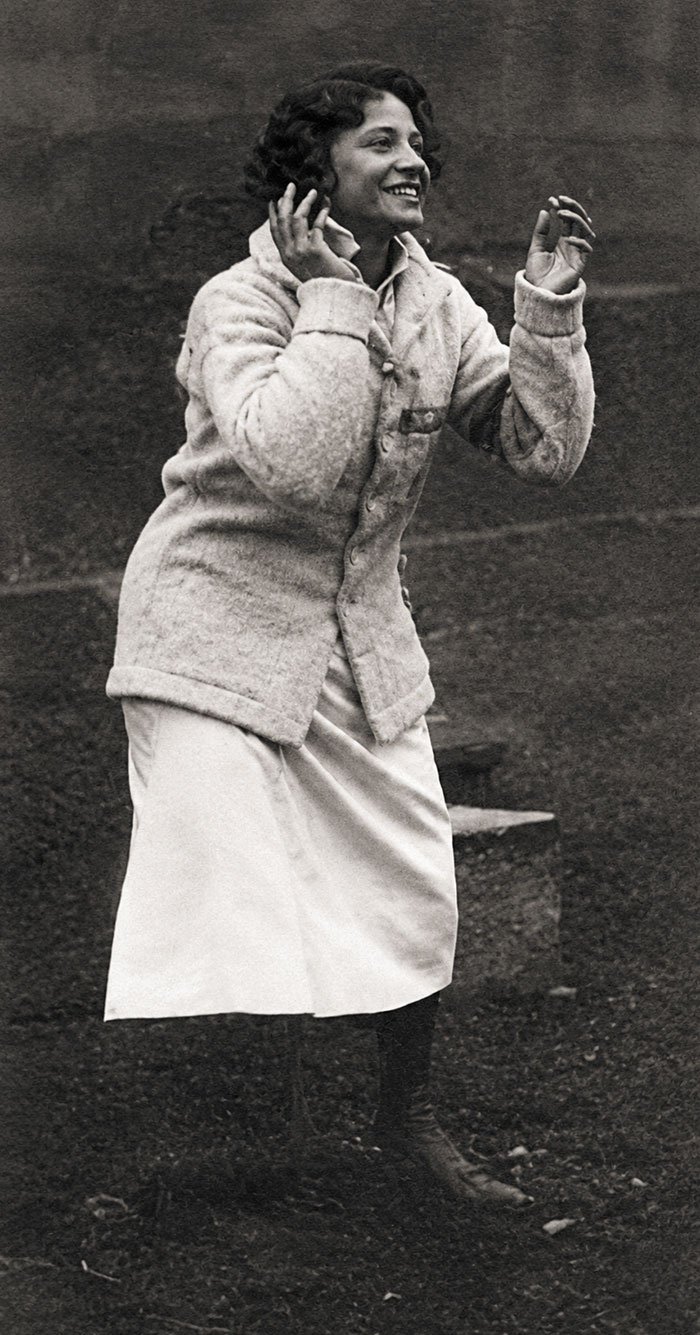
An AI restoration of a 1925 newspaper photo showing Marion as a cheerleader
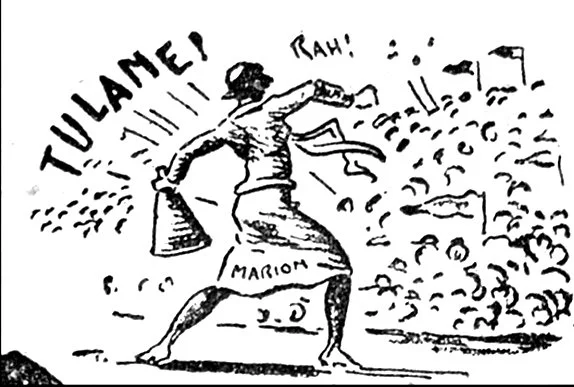
Back home, a cartoon in the Times-Picayune showed a Tulane runner eluding tacklers from Northwestern and Auburn, with a figure labeled “Marian” leading cheers in the background.
But she never finished her degree, and eventually dropped out of sight. A clubwoman trying to track down the surviving Famous Creoles in 1968 wrote the States-Item that Marian “hasn’t been seen in 40 years,” and asked if any readers knew what had become of her.
In fact, she had married a New Orleans journalist and moved to Washington, where her husband worked in the Public Affairs division of the Treasury Department. In 1940 Marian earned a bachelor’s degree in botany, of all things, from George Washington University, and she worked in the university’s botany lab for several years. When her husband retired in the 1970s, the couple moved to Savannah, where she died in 1985.
Flo Field
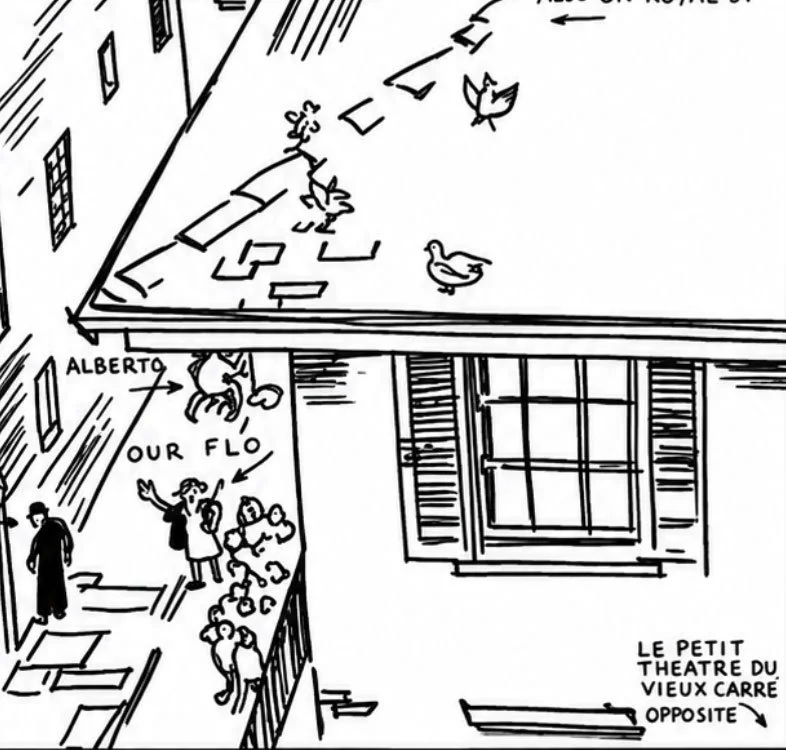
Detail of the frontispiece of Sherwood Anderson and Other Famous Creoles titled, “The Locale, Which Includes Mrs. Flo Field
Flo Field claimed to have been the first French Quarter tour guide. Her friend Lyle Saxon had talked her into it, assuring her that all she had to say was, “Oh, my God, look at that balcony!”
Her tours were enlivened with stories like one about a beautiful Creole maiden who fell in love with a mixed-race footman and threw herself from a particularly attractive balcony. She later admitted that she and Saxon “not only studied the legends, but if there were any missing, we supplied them.”
Journalism was in her blood. Her widowed mother had been a popular columnist, the first woman staffer at the Times-Picayune, and Flo grew up watching her work. In the 1890s she left school, began publishing articles, and spent years caring for her mother, who suffered from Parkinson’s disease, while continuing to write from her mother’s sickroom.
Her work attracted enough attention to earn her inclusion in a Leslie’s Weekly feature on Southern women journalists, which described her as “petite, blond, and pretty” and praised the “wit and quaint philosophy” of her writing.

An AI restoration of Flo Field’s portrait by friend “Pops” Whitesell, another of the Famous Creoles.
After her mother’s death, Field moved to Greenwich Village to pursue a literary career. Cosmopolitan published her stories, and there were rumors of a romance with O. Henry (William Sydney Porter), though he was married.
In 1905 she married someone else, but after the marriage failed, she returned to New Orleans with her maiden name and a young son named Sydney. (She sometimes intimated that his father was O. Henry).
She also had an urgent need to make a living. She joined the Times-Picayune, wrote a daily column called “Eve Up to Date,” contributed stories and verse to magazines, and worked as a press agent for the Philharmonic Society. When the Double Dealer appeared, she wrote for it and served on its advisory council, though literary prestige did little to relieve her chronic financial troubles.
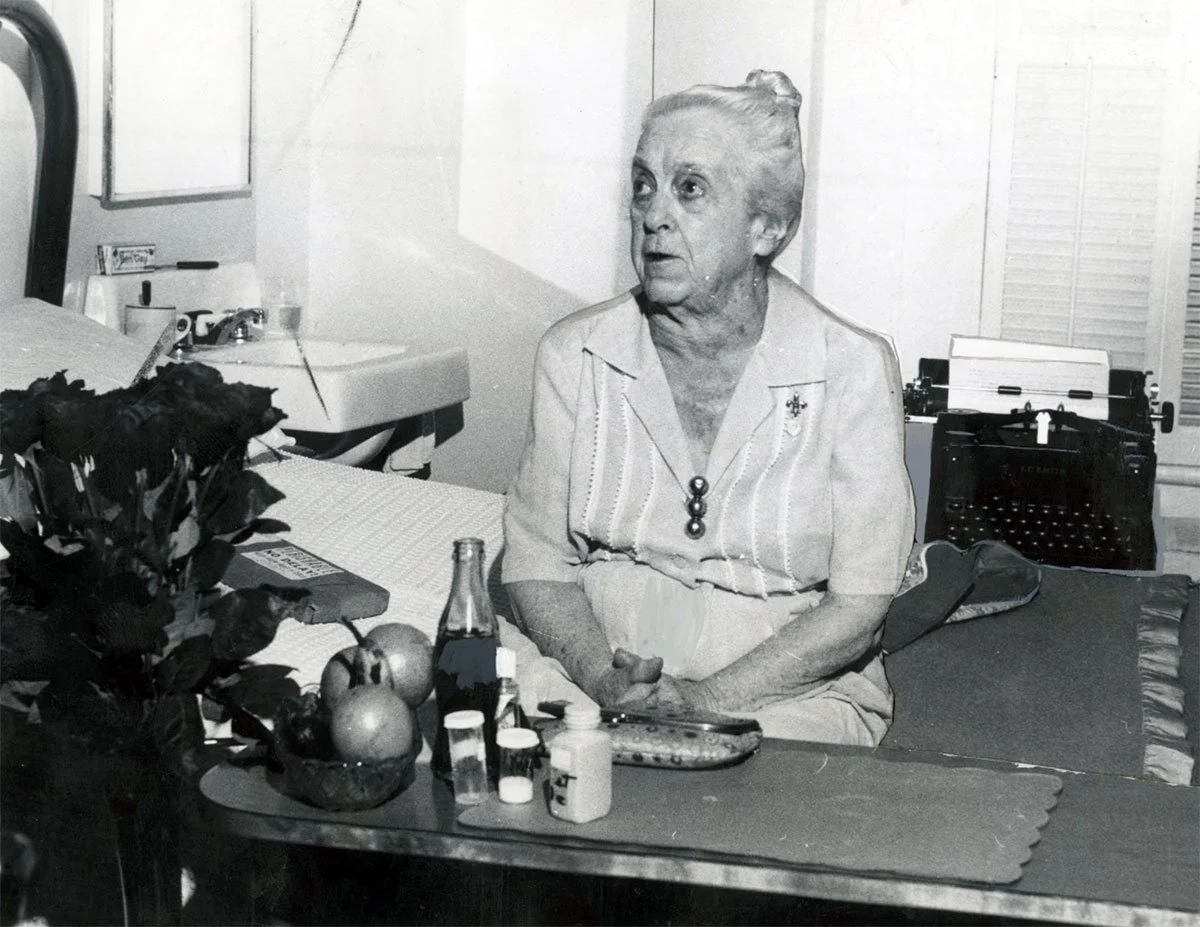
Flo Field at 93 in 1969, a few years before her death at 96, This press photo shows her apparently in a hospital bed or nursing home, with a bouquet of roses and a typewriter at her bedside. Historic New Orleans Collection, gift of John H. Lawrence, 2018.0557.1
She rented the slave quarters behind the old Morphy house on Royal Street for ten dollars a month, and became inseparable friends with Saxon and George Favrot: eating 35-cent suppers at a small restaurant in the Quarter, swinging down Royal Street at night singing La Bohème, and talking for hours on her gallery while swatting mosquitoes. In 1927 her play A la Creole premiered at Le Petit Theatre, with several Famous Creoles involved in the production.
Field spent the rest of her life writing (like this 1930 New York Times Magazine story about the City Park golf course), guiding tours, promoting preservation, and worrying about money. She led visitors ranging from Bertrand Russell to Fiorello LaGuardia through the Quarter, worked at the New Orleans Pharmacy Museum, and in the 1960s was named the city’s “official historian” by Mayor Victor Schiro.
She died shortly after her ninety-sixth birthday party, where she drank champagne and delivered a ten-minute speech. For an epitaph, she would have been content with what she once told an interviewer: “I never had any sense except a sense of humor.”
Elizebeth Werlein
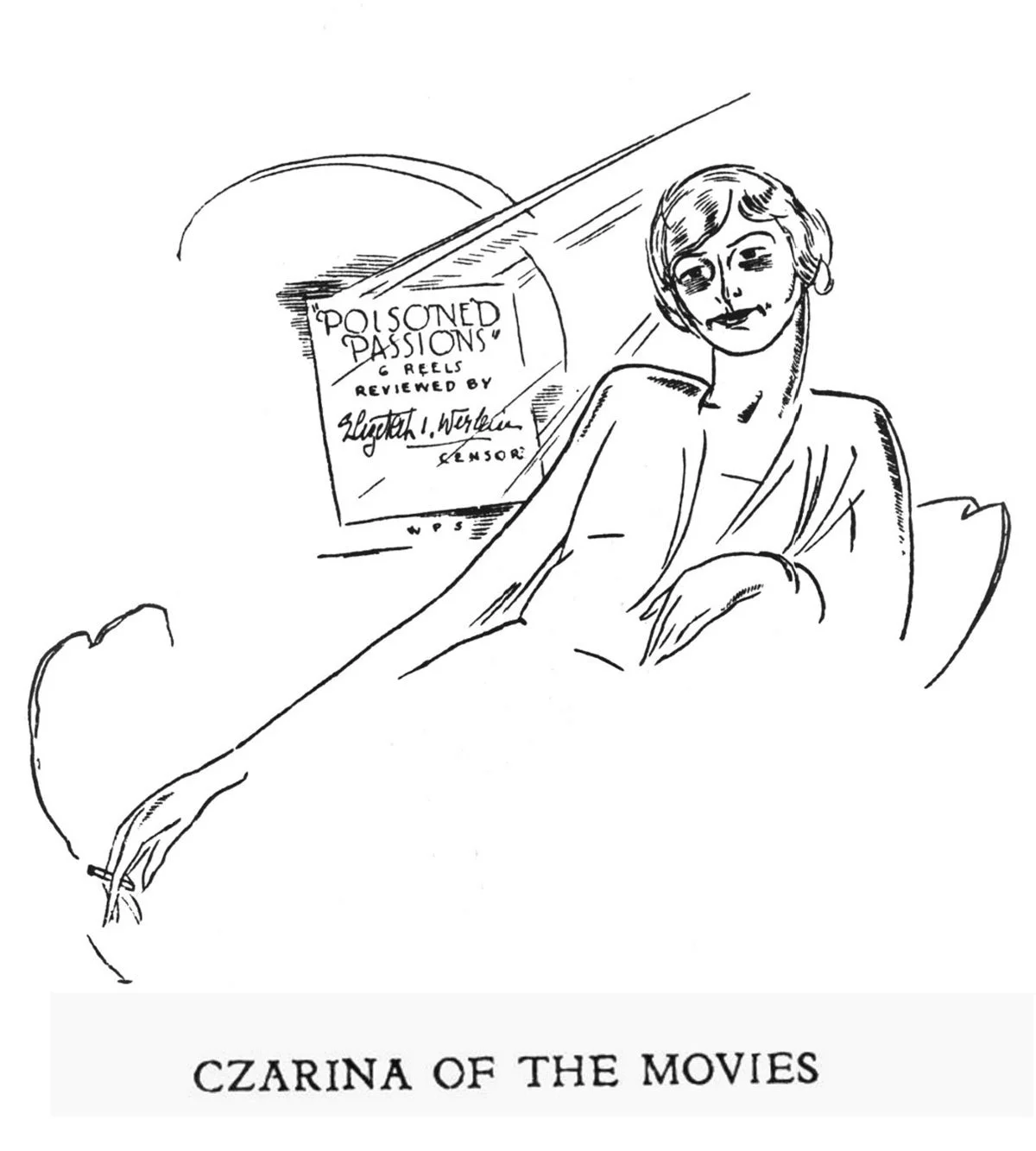
Spratling’s portrait of Elizebeth Werlein in the book
Elizebeth [sic] Werlein was described as “six feet tall, blonde, and cultural.”The daughter of a Union army veteran who owned a dynamite factory in Michigan, she went to Paris at fifteen to become an opera singer.
That dream was soon abandoned, but she stayed overseas for eight years, took up Theosophy, hunted in Russia and Africa, met royalty, ballooned around Europe, and took her first airplane flight. (She later got her pilot’s license—one of the first women to do so).
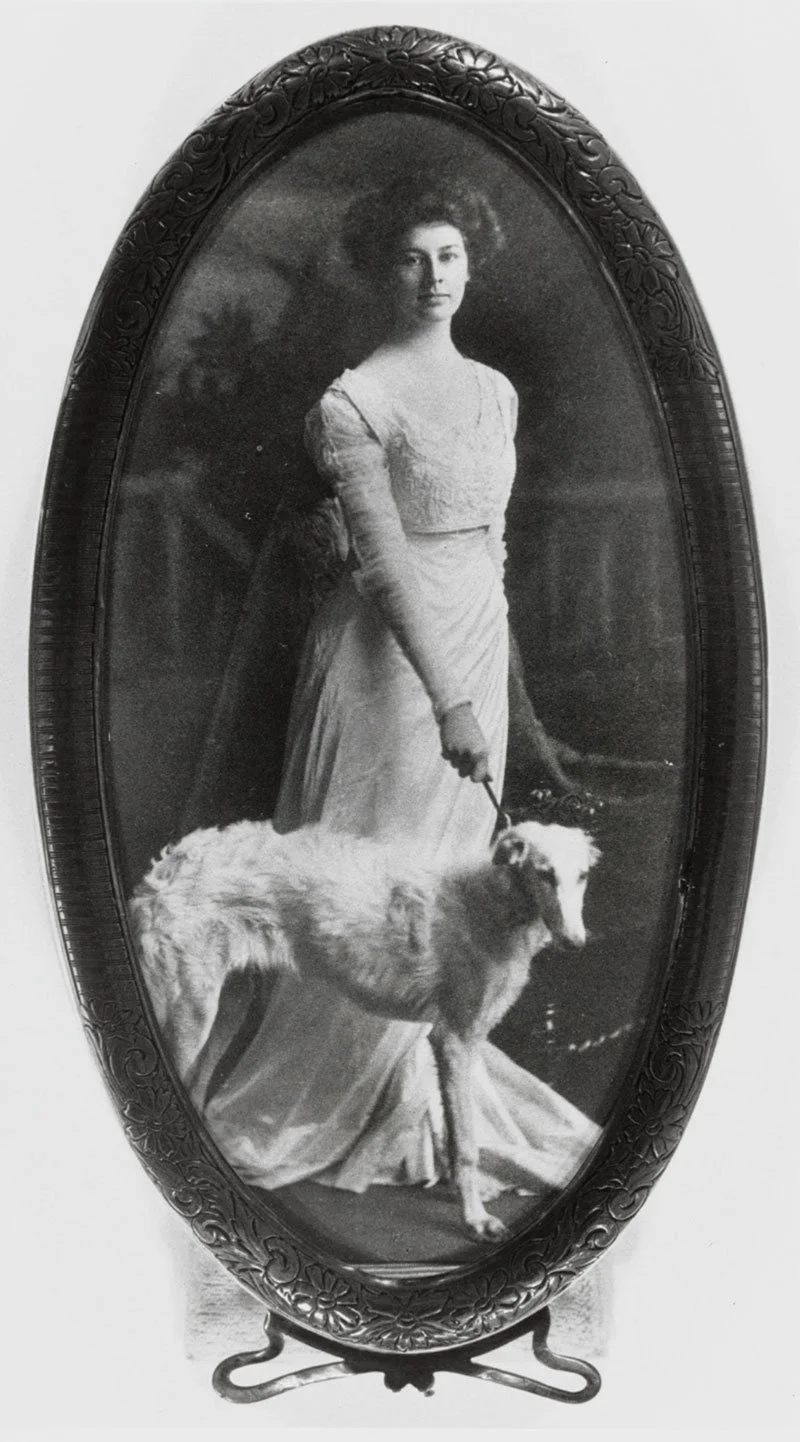
Elizebeth Werlein in 1910. Historic New Orleans Collection, original provided for copying by Lorraine Werlein Moore, 1994.14.1
While visiting New Orleans, she met and married Philip Werlein, of the Canal Street music store family, and threw herself into civic activism with characteristic energy. She hired a sewing instructor so she could teach in a settlement school, raised money for a kindergarten to serve a poor white neighborhood, helped organize the Philharmonic Society and generously supported the symphony orchestra.
She also wrote for newspapers and magazines, and worked tirelessly for the Louisiana Woman Suffrage Party. Her emancipation was evidenced by the ever-present cigarette that Spratling drew in her hand. (One rival suffragist was scandalized to see her not merely smoke in public, but blow smoke through her nose.)
In 1916 she published The Wrought Iron Railings of Le Vieux Carré New Orleans, calling for stronger efforts to preserve “the sacred confines of the old quarter.”
Philip’s death left her with four young children, but she didn’t slow down. During World War I she served on countless committees and campaigns, and after the Nineteenth Amendment passed she became the first president of the Louisiana League of Women Voters.
In 1919 she founded the Quartier Club, which brought society women to the lower Pontalba building for luncheons, dinner dances, and edifying lectures.
Bad investments in German marks wiped out most of her savings, forcing her to take a job as a censor for the Saenger theater chain. In 1926 she bought a house on St. Ann Street and began to restore it.
Ten years later, she moved in, then founded the Vieux Carré Property Owners Association and became its first president, pressing the Vieux Carré Commission to use its powers to protect historic buildings. In 1942 the American Institute of Architects made her an honorary member in recognition of her preservation work.
Her cigarette habit finally caught up with her, and she died in 1946.
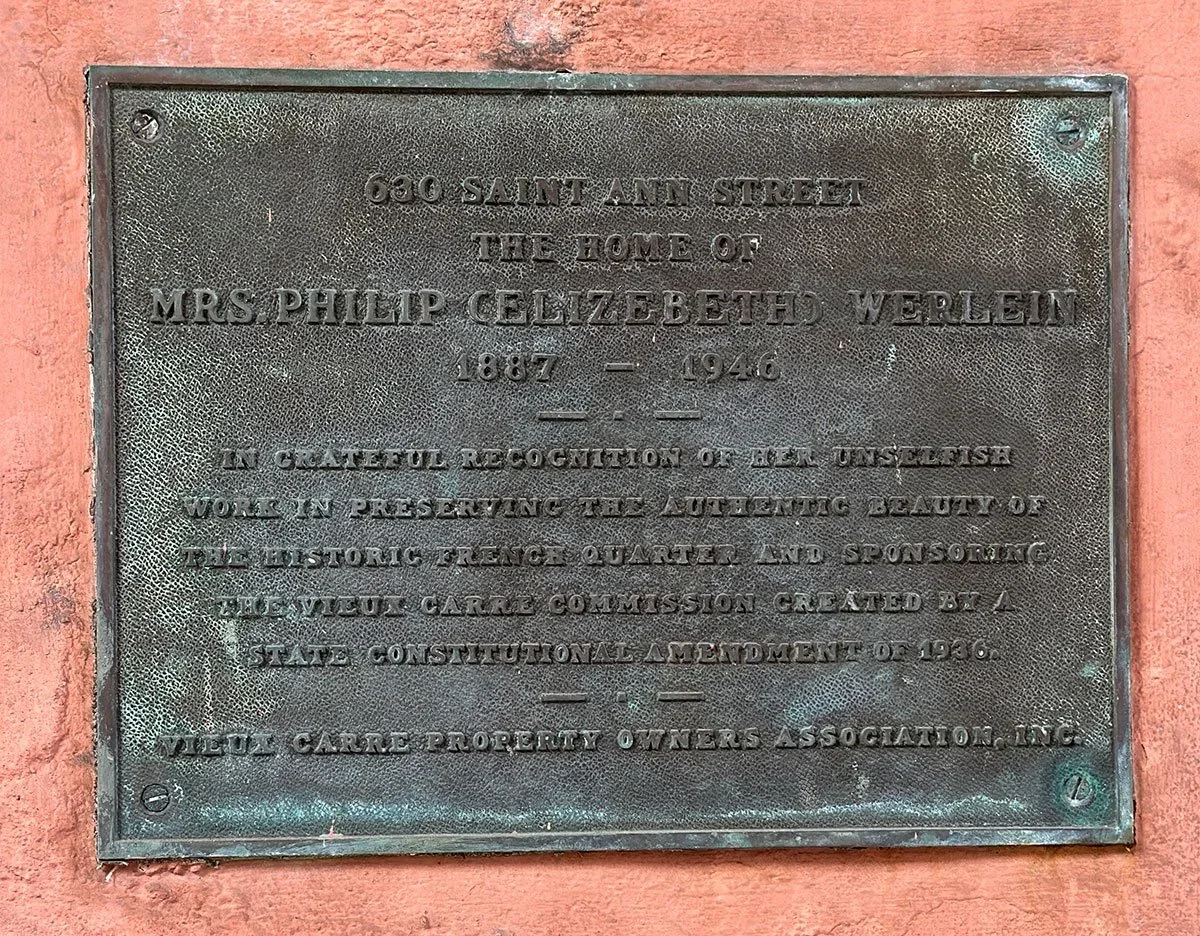
The plaque on Elizabeth Werlein’s house, 630-632 St. Ann, between Royal Street and Jackson Square.
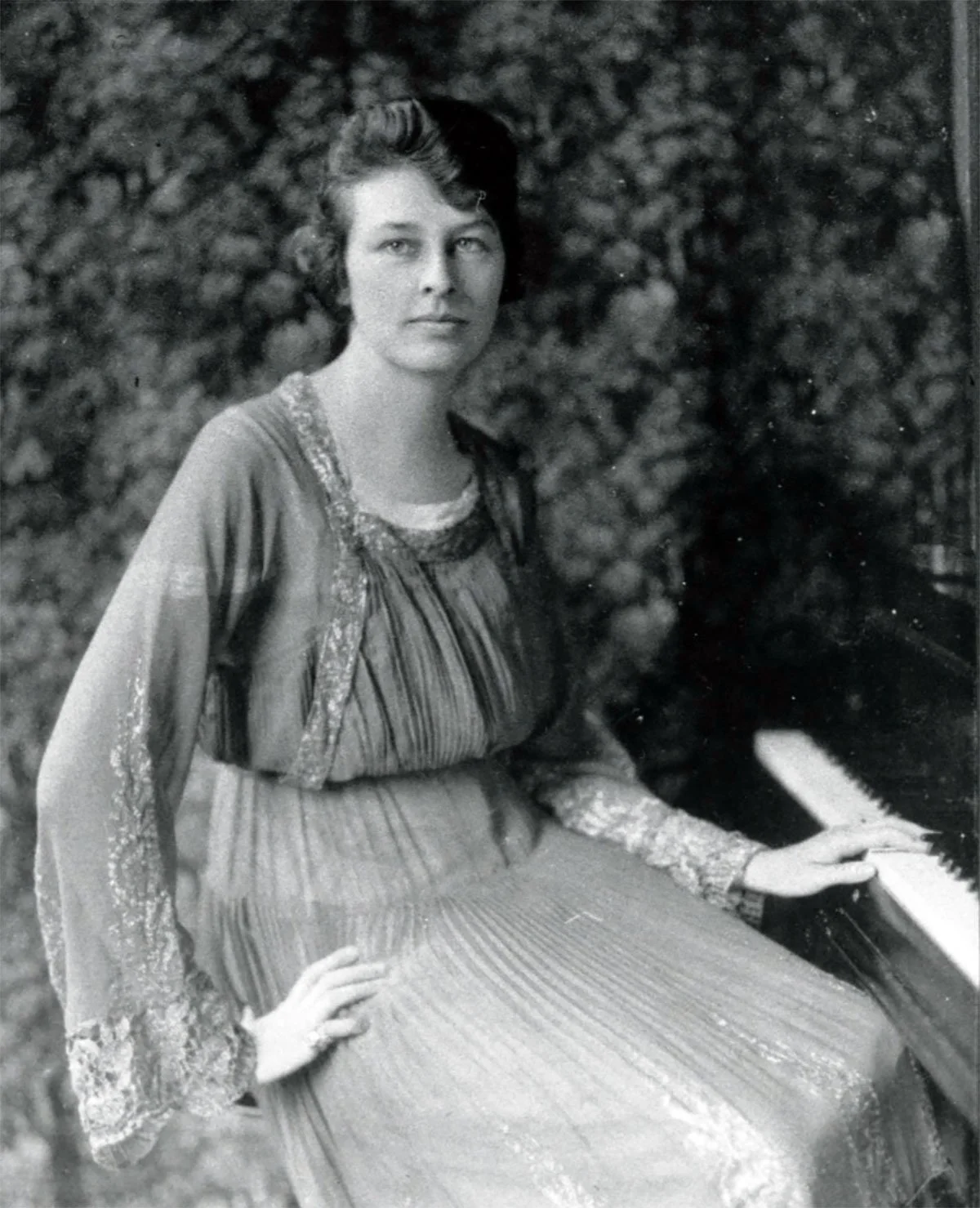
Portrait of Elizabeth Werlein in the 1920s, photographer unknown, Historic New Orleans Collection, original provided for copying by Lorraine Werlein Moore, 1994.14.2
Natalie Scott
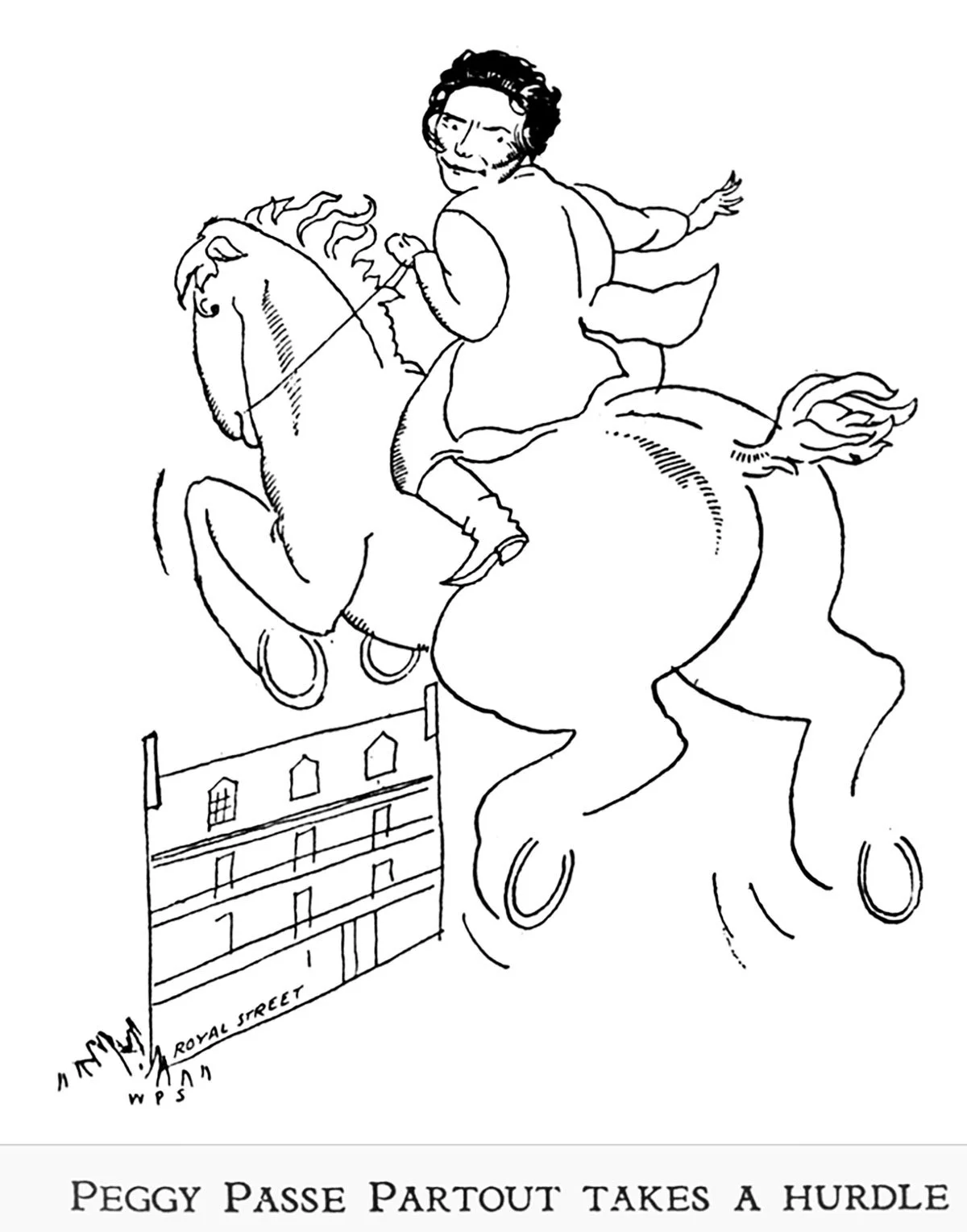
Spratling’s portrait of Natalie Scott in the book
Natalie Scott was portrayed by Spratling as “Peggy Passe Partout” on horseback, leaping over a Royal Street building. This alludes to her States newspaper column, her passion for riding (she helped found the New Orleans Equestrian Club and was repeatedly city champion), and the Court of Two Sisters, one of her French Quarter properties.
Scott was near the center of the Quarter’s bohemian world. In 1921 she and fellow journalist John McClure bought a building in Orleans Alley (now Pirate’s Alley), announcing plans to turn it into artists’ studios.
They lived there themselves, and when Spratling arrived in New Orleans the next year, he moved in, too. Later, he and Faulkner moved to a garret in another of Scott’s properties, on St. Peter Street; downstairs, Famous Creoles Marc and Lucille Antony lived above their ground-floor shop.
In another St. Peter Street property, a Creole cottage, her tenants included Famous Creoles Oliver La Farge and Sam Gilmore. After she acquired the Court of Two Sisters, a tenant opened a tearoom downstairs.
Scott seemed to turn up everywhere in the cultural life of 1920s New Orleans. She helped establish Le Petit Théâtre, wrote and acted in plays there, and performed skits for the Junior League Review and at the country club.
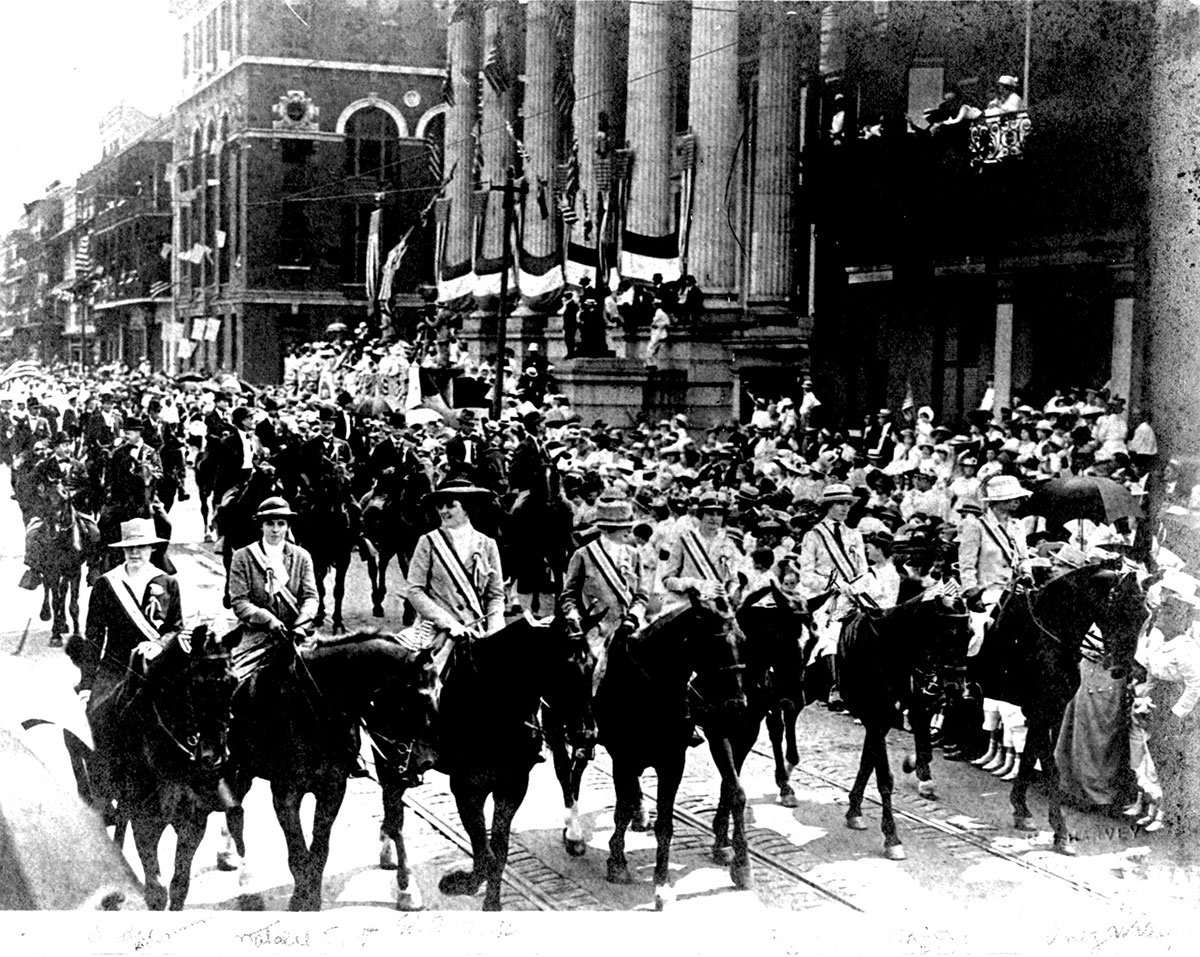
A Preparedness Parade, between 1917 - 1918, Natalie Scott is second from left. Historic New Orleans Collection, gift of Mrs. Edmund B. Richardson, 1993.71.79
She worked unpaid on the Double Dealer and invested enough money in it to become its fourth-largest backer. Her States column mixed society chatter with occasional hard news; Sherwood Anderson called her “the best newspaperwoman in America.”
She also collaborated with Spratling on Old Plantation Houses in Louisiana (1927) and wrote Grand Zombi, a drama based on the life of Marie Laveau that won a national playwriting contest and was staged at Le Petit Théâtre. Throughout the decade, she traveled extensively in Europe and Mexico, often sending dispatches home for publication in the States.
Scott’s background made her accomplishments all the more remarkable. Raised in New Orleans, the daughter of a railroad contractor, she attended Newcomb College on scholarship, graduated with honors, taught there, and earned a master’s degree from Tulane.
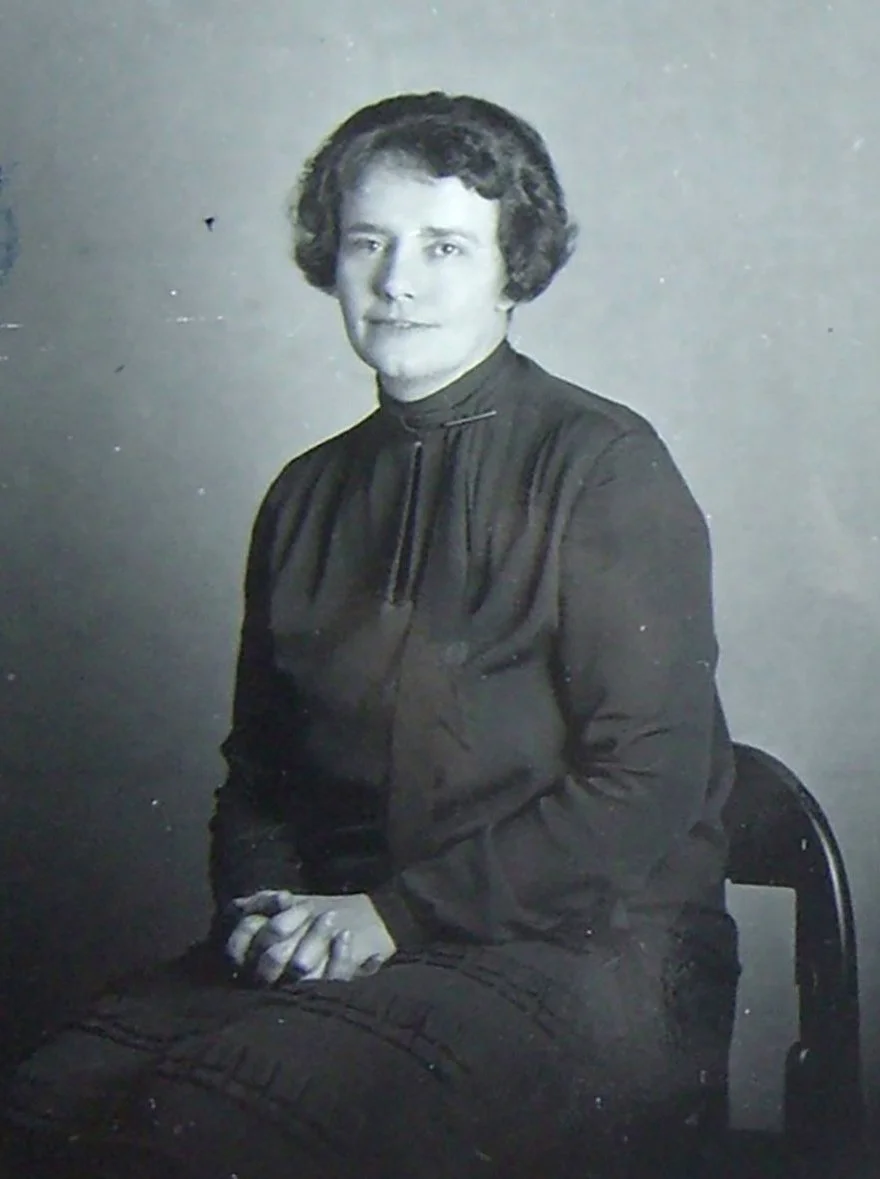
“Pops” Whitesell portrait of Natalie Scott, date unknown. Louisiana Research Collection, Tulane University
Fluent in several languages, she appeared destined for a scholarly career until World War I intervened. Serving with the Red Cross in France, she rescued wounded soldiers during a bombing raid and became the only American woman awarded the Croix de Guerre. Natalie Scott, in other words, was famous before she became a Famous Creole.
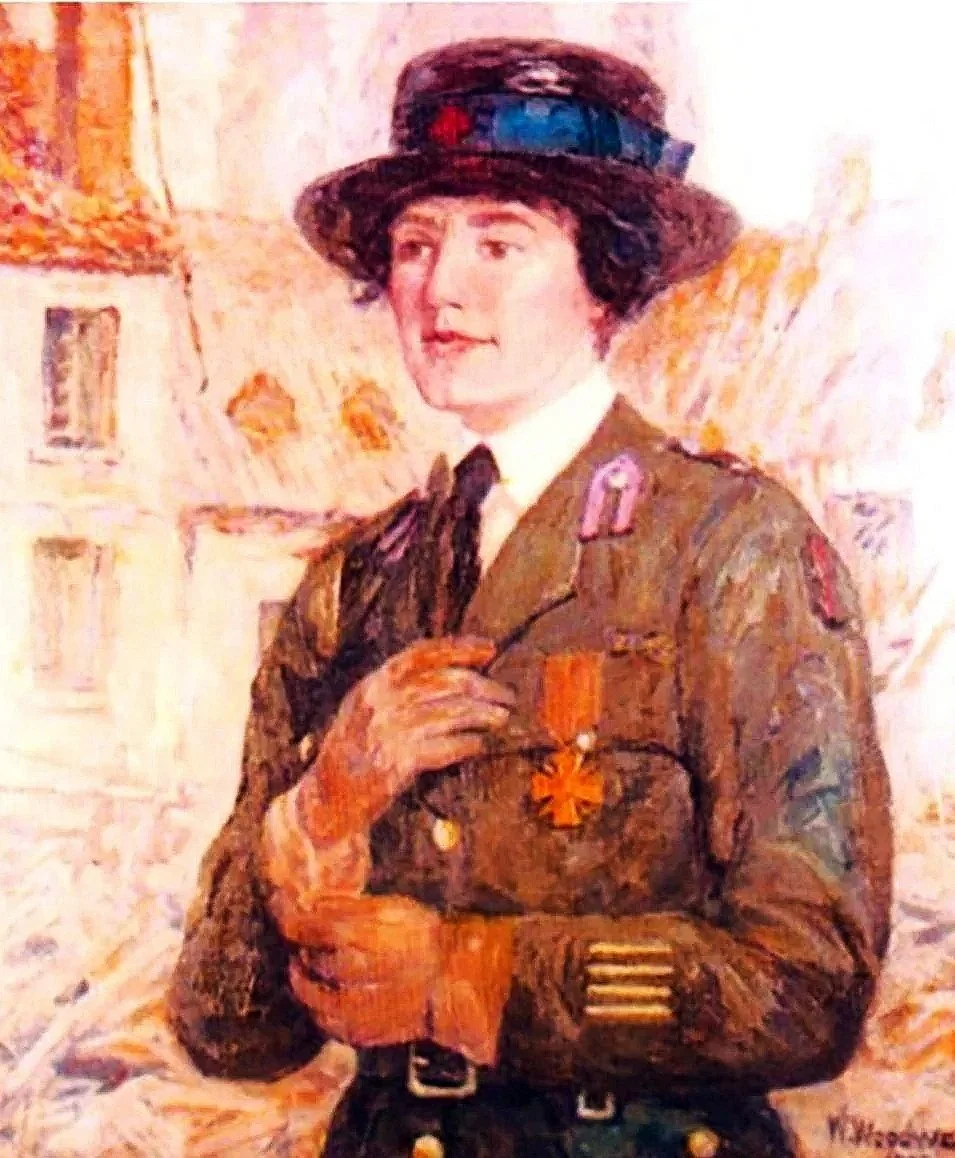
Portrait of Natalie Scott in uniform, courtesy John Shelton Reed
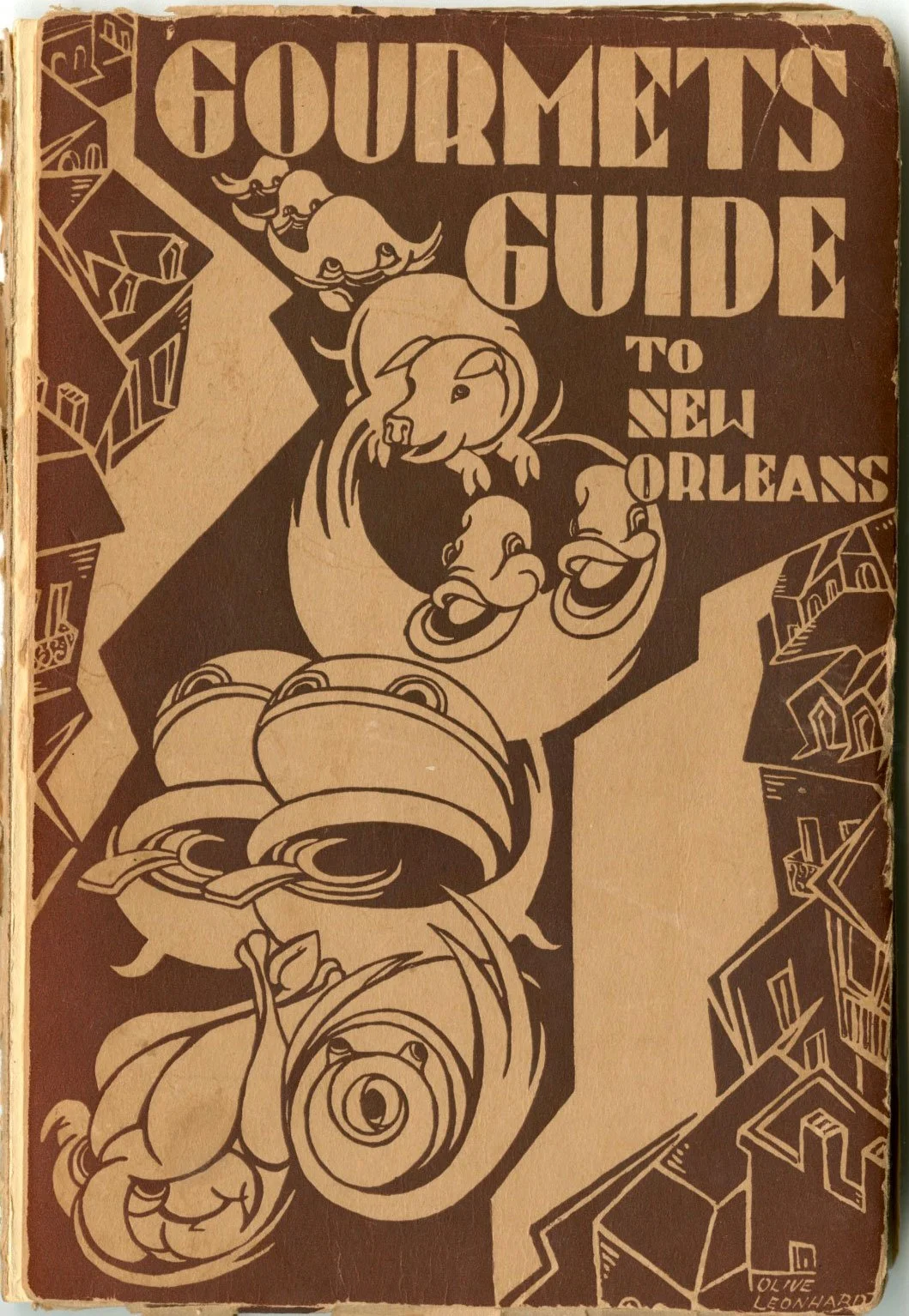
Cover of The Gourment’s Guide to New Orleans, Historic New Orleans Collection, gift of Mr. Floyd M. Zula, 2000-36-RL
By the late 1920s, however, her ties to New Orleans had begun to loosen. Her immediate family had died, her circle was dispersing, and in 1928 she left the States and moved uptown. She published a cookbook, Mirations and Miracles of Mandy, with illustrations by Spratling, and soon the two were discussing a move to Mexico. (She went to explore the country – on horseback.)
After the stock-market crash wiped out much of her savings, the idea became more attractive. In early 1930 she joined Spratling in Taxco, where she threw herself into local life: preserving historic buildings, opening a pensione for artists and writers, conducting anthropological research, and helping establish sanitation and medical services.
Most importantly, she founded a nursery school that provided education, meals, and health care for local children. She also continued to write, producing The Gourmet’s Guide to New Orleans, Your Mexican Kitchen, and Cocina to You.
World War II drew her back into Red Cross service in North Africa, Italy, France, Germany, Japan, and Korea. After the war, she returned briefly to New Orleans, then settled again in Taxco, where she died and was buried in 1957.
Elizabeth Anderson, Alberta Kinsey, Caroline Durieux and Louis Andrews Fischer
The French Quarter bohemia of the 1920s liked to imagine itself scandalous, artistic, liberated, and modern. Often enough, the women actually were. These five were the most remarkable, but there are others:
Alberta Kinsey, for instance, a Quaker spinster who was one of the few in the crowd actually to make a living by painting – in her case thousands of picturesque courtyard scenes for tourists.
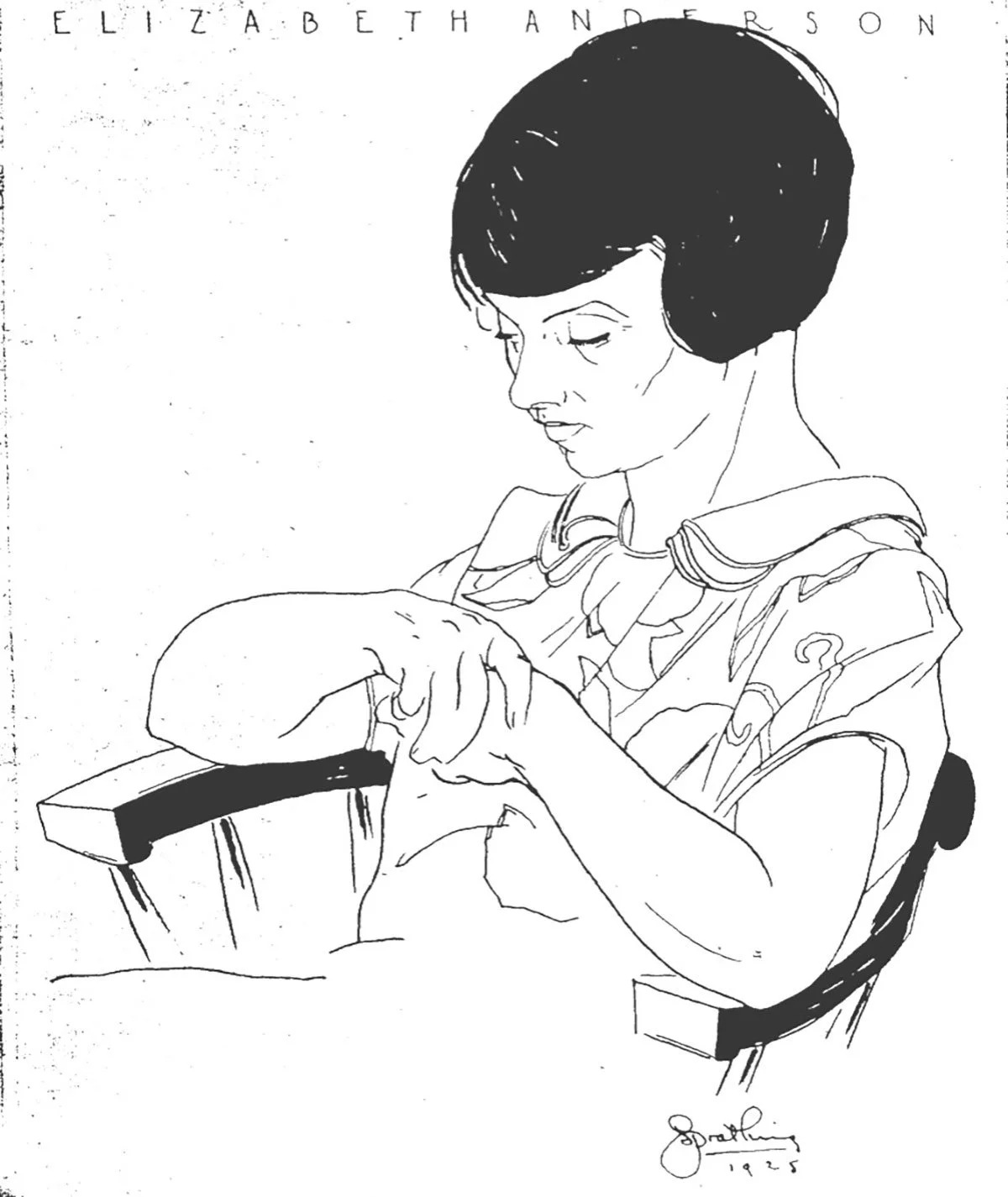
Sherwood Anderson’s wife Elizabeth wasn’t included in the book but “should have been.” Spratling’s portrait of Elizabeth Anderson, 1925.
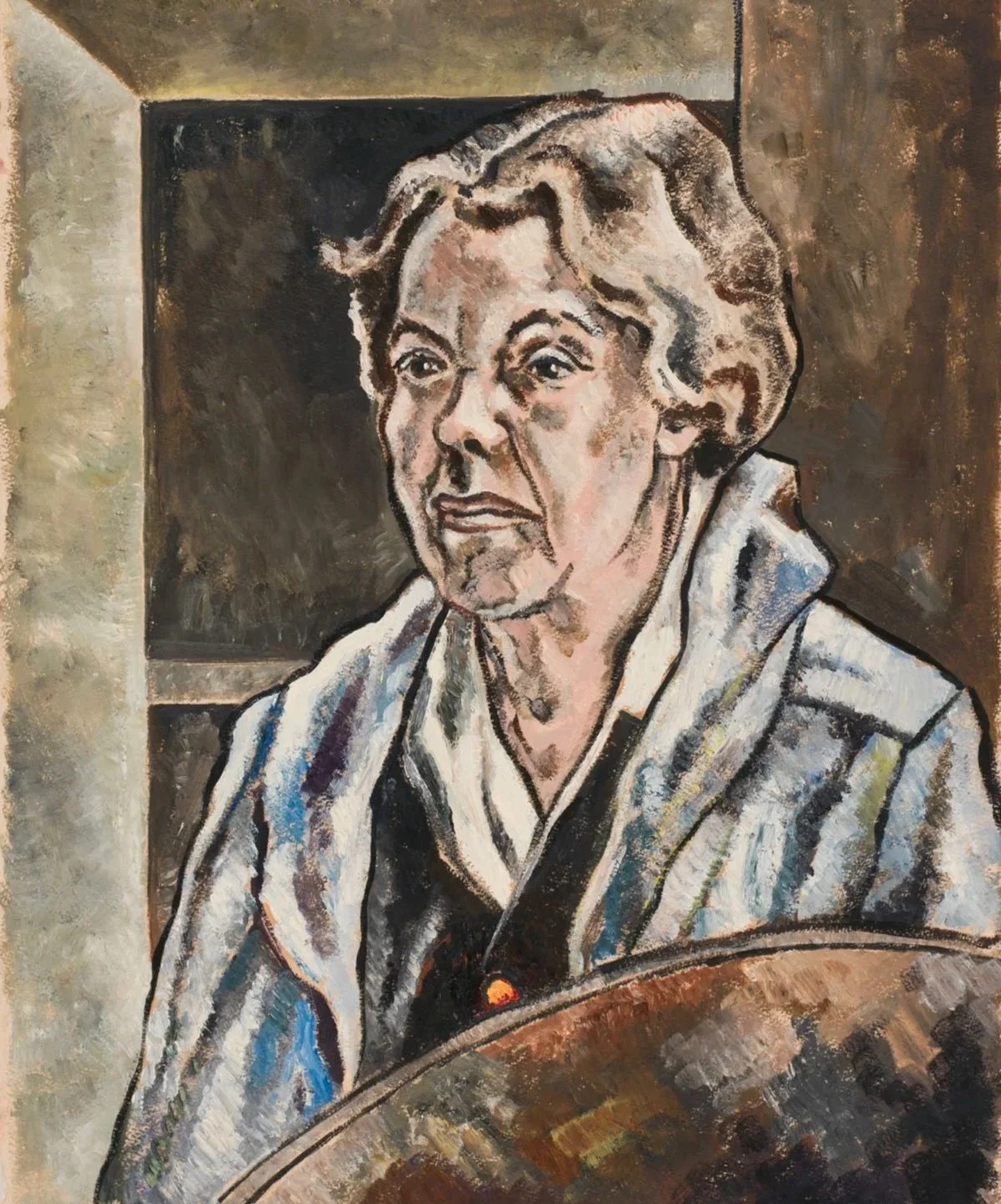
Portrait of Alberta Kinsey, 1942 or 1943, by James Lamantia. Historic New Orleans Collection, 1993.108.7
Caroline (“Carrie”) Durieux drew wicked caricatures of New Orleans life and fell in with a crowd of Mexican revolutionaries that included Diego Rivera (who painted her portrait).
Louis Andrews Fischer (named after her father), was a gender-bending Mardi Gras designer who delighted in dressing prominent New Orleans businessmen as Salome, Marie Antoinette, and Queen Victoria.
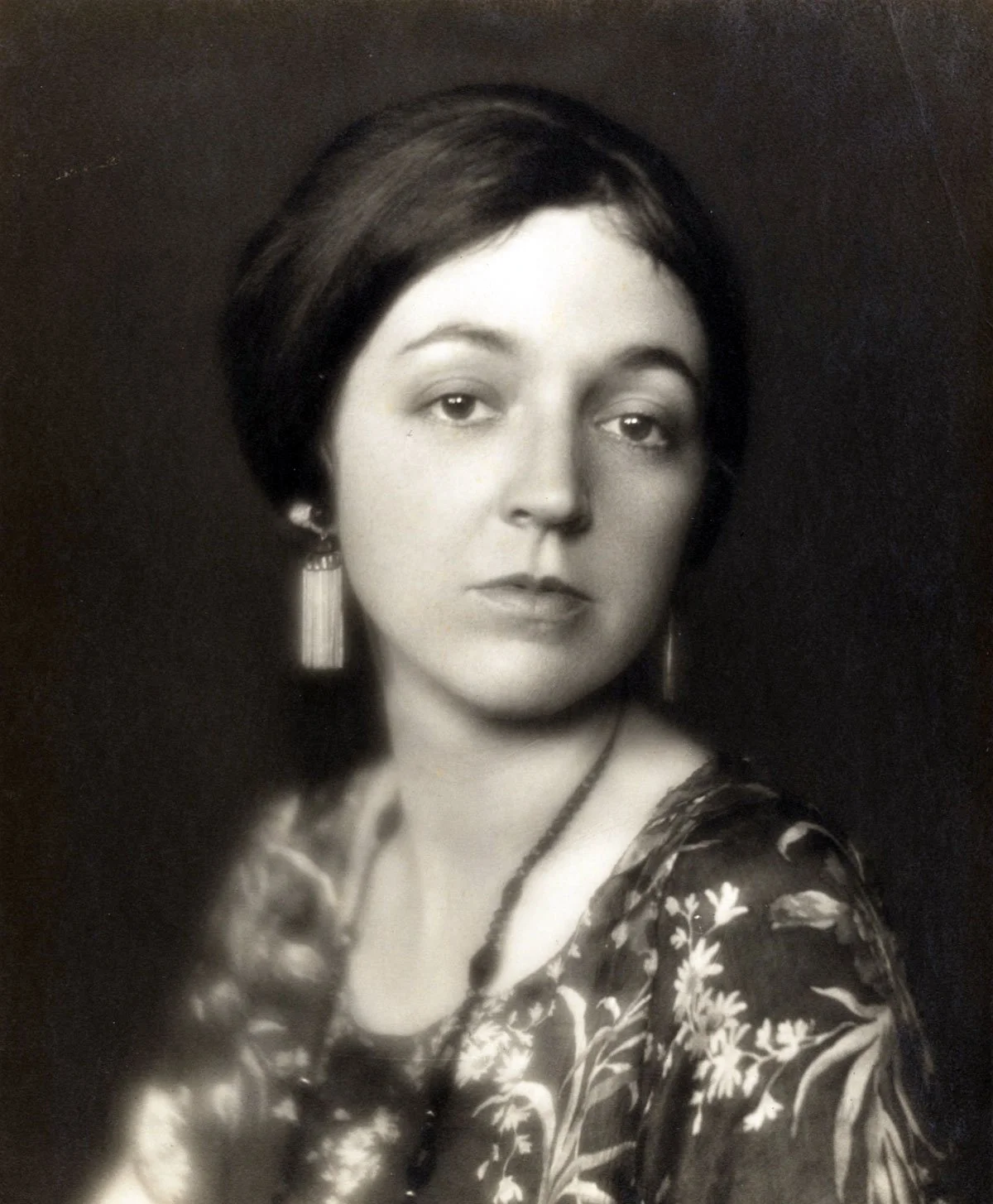
Artist Caroline Durieux in 1925, photographer unknown. Historic New Orleans Collection, gift of Mr. Joseph G. Bernard, 1992.7
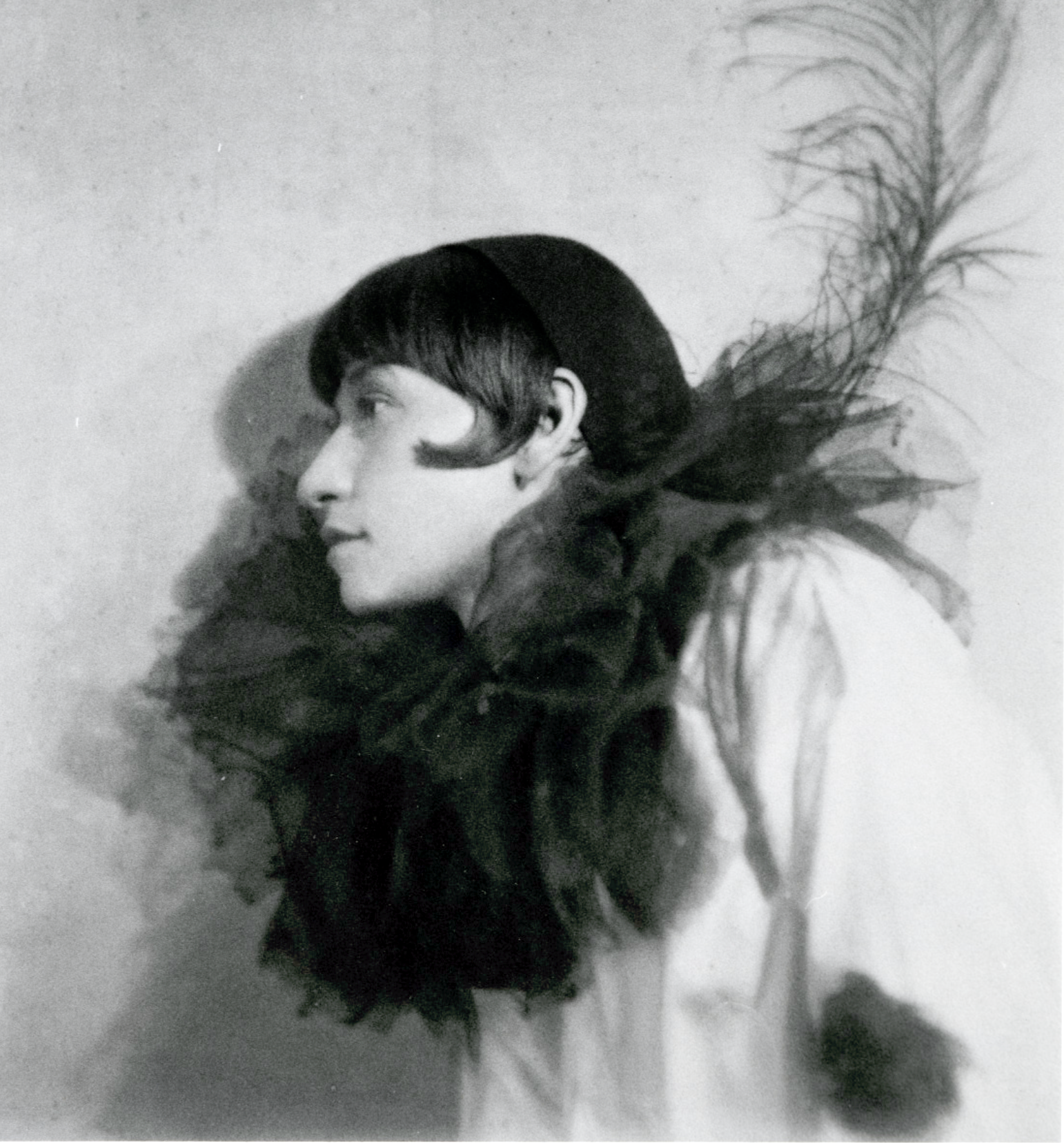
Louis Andrews Fischer, by “Pops” Whitesell, Historic New Orleans Collection, courtesy of Henri Schindler, owner of original, 1986.108
In fact, all of the women in Sherwood Anderson and Other Famous Creoles deserved to be recognized. The others were a celebrated older writer (Grace King), three promising young artists, and three active supporters and patrons of the arts.
The list of those included was limited by the fact that all of the Famous Creoles were white; in fact, all were Spratling’s friends, or at least acquaintances. And in 1926, opportunities for women were far fewer than they are today. All the more remarkable, then, that so many talented, accomplished, and simply interesting women are found in the pages of this little book.
To read more:
Judith Bonner and Thomas Bonner Jr., introduction and additional material in William Spratling and William Faulkner, Sherwood Anderson and Other Famous Creoles, facsimile edition (Pelican Publishing, 2018)
John Shelton Reed, Dixie Bohemia: A French Quarter Circle in the 1920s (Louisiana State University Press, 2012)
John Shelton Reed, "French Quarter Renaissance," in KnowLouisiana: The Digital Encyclopedia of Louisiana (www.knowlouisiana.org). Reprinted as "Bohemian Revival," in New Orleans and the World: 1718-2018 (Louisiana Endowment for the Humanities, 2017).
John W. Scott, “William Spratling and the New Orleans Renaissance,” Louisiana History 45, no. 3 (Summer 2004)