Hands-On History at the Historic New Orleans Collection
June 2026“American Revolution: The Augmented Exhibition” offers an innovative, in-depth recount of the nation’s fight for independence, shining new light on Louisiana’s contributions.
– by Doug Brantley
This column is underwritten in part by Tom and Alycia Reagan
In late May, Sail 250 lined the Mississippi riverfront with a flotilla of tall ships and naval vessels in celebration of the nation’s semiquincentennial, drawing thousands to the French Quarter over a fleeting few days for a brief peek at America’s past.
The Historic New Orleans Collection (HNOC) continues the milestone commemoration throughout the year with “American Revolution: The Augmented Exhibition.” Bringing the past into the present via modern-day technology, the free “Revolution” provides a (much, much) deeper dive into the nation’s backstory, examining its hard-won independence from Great Britain.
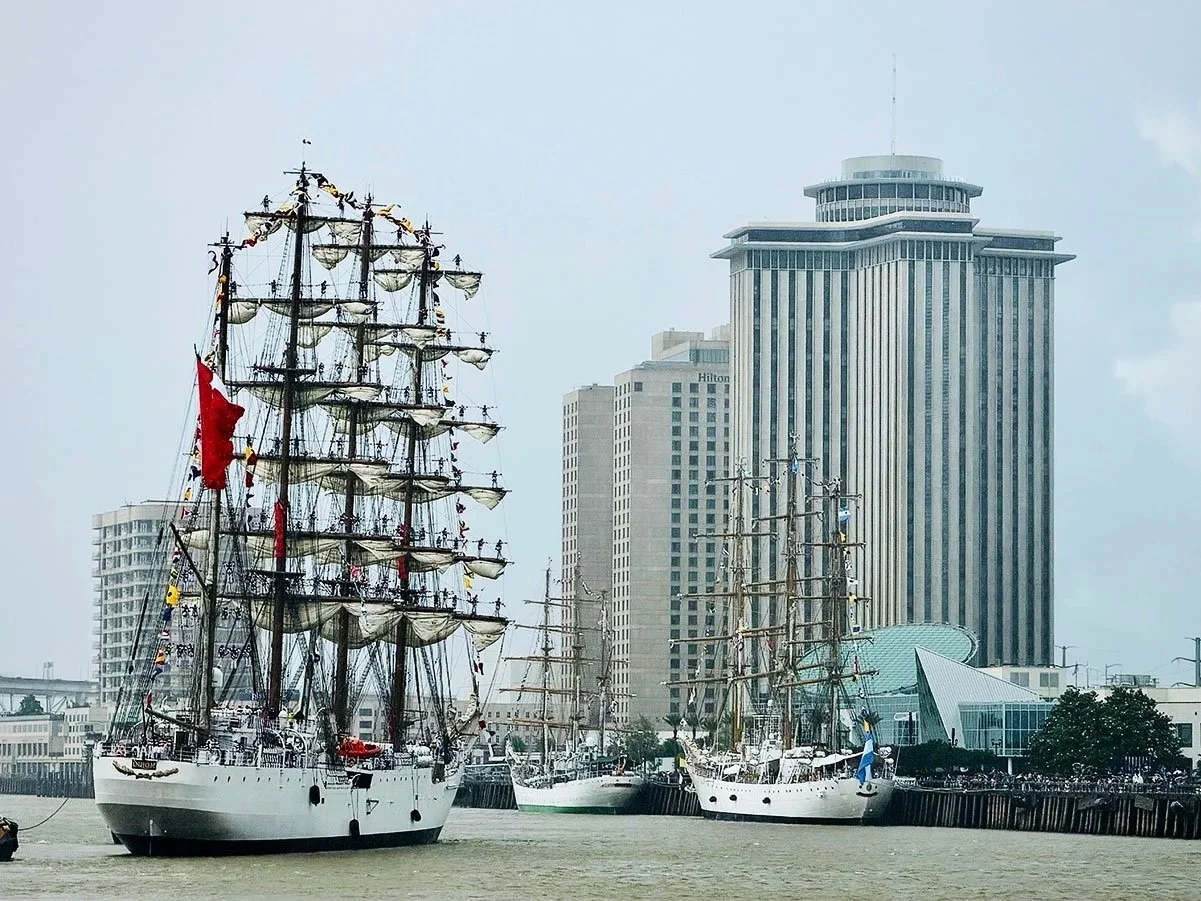
The tall ships in New Orleans, June 2026. See our photo album here.
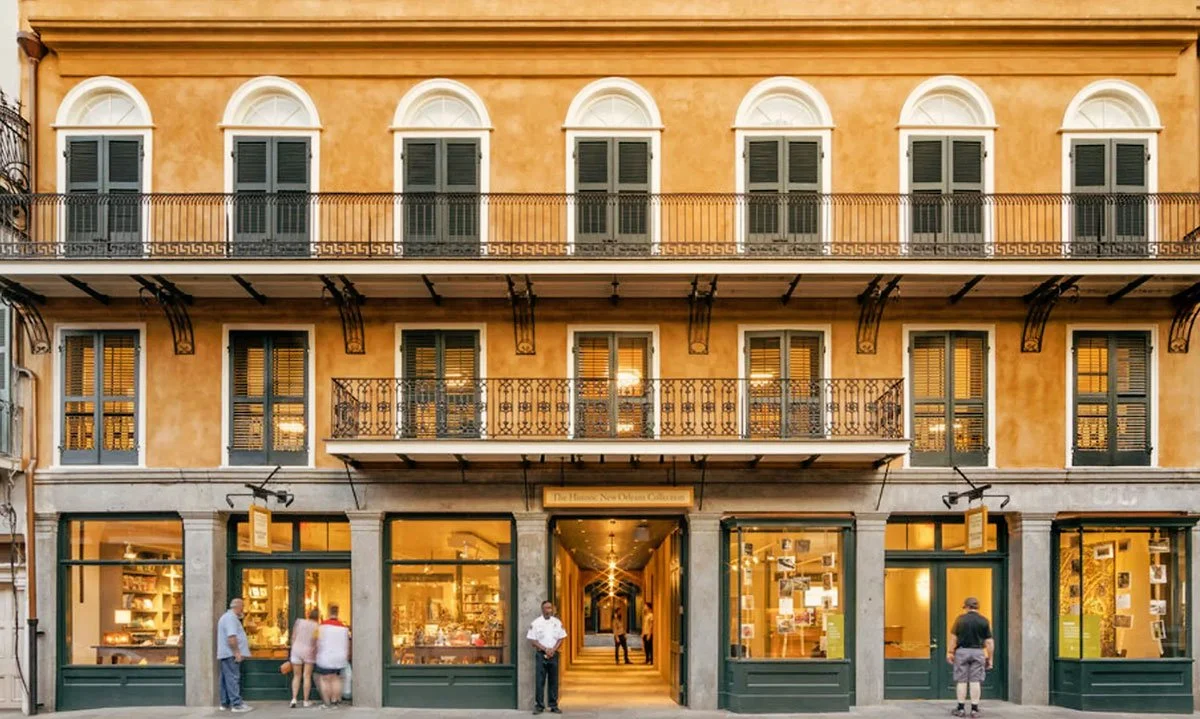
The Historic New Orleans Collection at 520 Royal Street, photo courtesy HNOC
Produced by Histovery, the innovative French firm behind the wildly popular “Notre-Dame de Paris” (the HNOC’s most-attended exhibit to date), which traced the cathedral’s long legacy, from its 12th-century construction through its 21st-century restoration, “American Revolution” is equally immersive and packed with information.
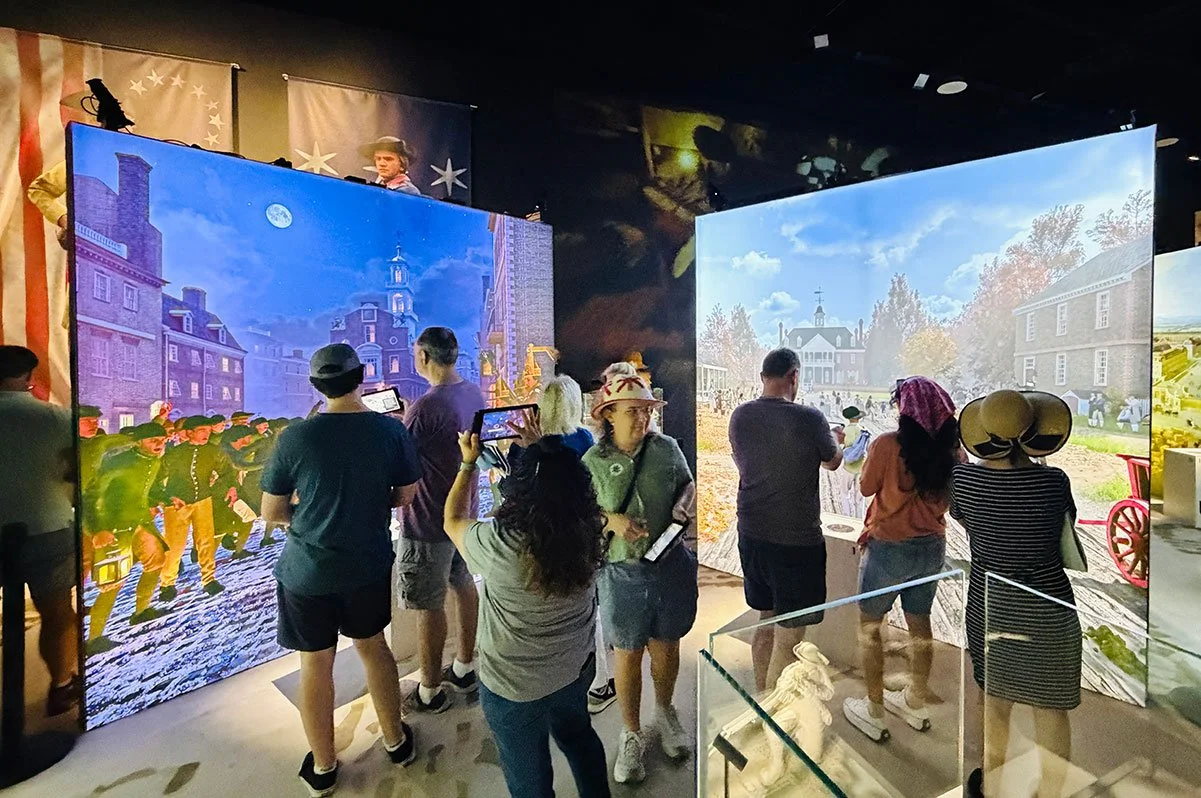
Exhibitgoers are equipped with individual HistoPads, touchscreen tablets that bring the nation-building conflict’s key moments—and players—to 3-D life, while dipping, diving and drawing viewers into the 360° simulated action.
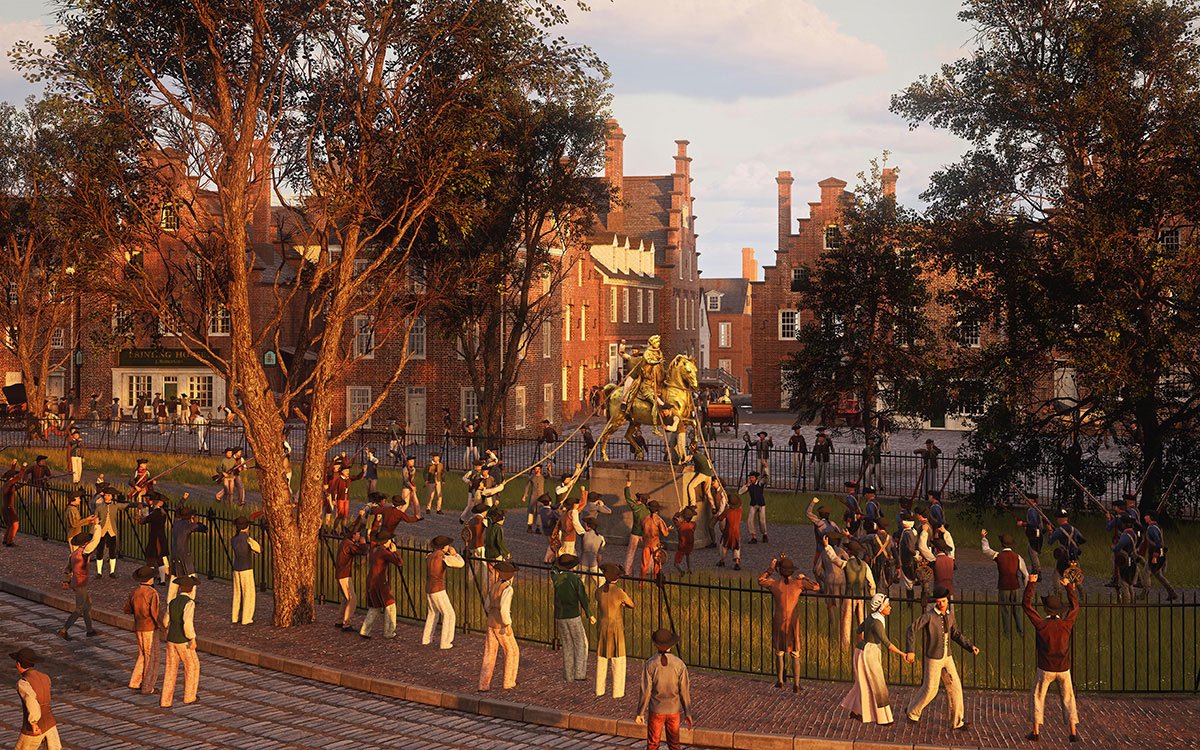
New York City, 1776, A gilded led statue of King George III was pulled down - and later melted to produce 42,000 musket balls to fight the British, courtesy Histovery
Scan QR codes at one of 20 separate stations, starting in 1765 with “Colonial Virginia” and culminating with the “Creation of a Nation” in 1789, and you’re transported to the panoramic past through animated, recreated historical scenes.
Click on a highlighted individual, item or “Learn More” prompt, and an embedded window opens, full of factoids and interesting asides, which lead to further discoveries and informative offshoots with the swipe of a finger.
Take, for example, the “Washington’s Future Collaborators” section within “Creation of a Nation.” Franklin, Hamilton, Jefferson and Madison are all given their due, along with less-ballyhooed figures, such as Nathanael Greene, Henry Knox, the Marquis de Lafayette and Edmund Randolph. In addition to detailed bios of each is an illustrated image of the respective forefather; slide over it, and their painted portrait pops up.
Other interactive elements allow guests to revisit historical sites in their present-day settings, snap (and send) selfies attired in virtual Revolutionary garb and collect “treasures” along the way. There’s a secret to accessing them: Just give it time and due diligence, and you’ll be rewarded.
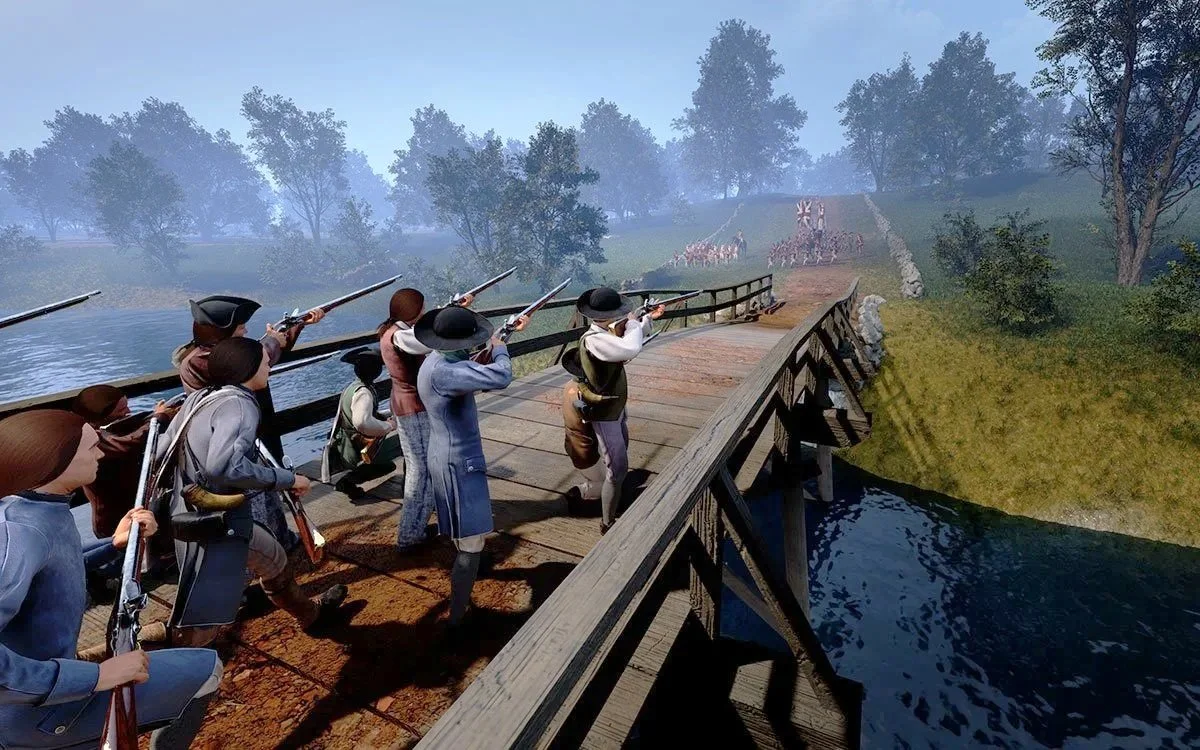
A recreation of the Concord Militia facing down the British in 1775, courtesy Histovery
Like the nation’s 250-year history itself, “Revolution” is multilayered and endlessly engrossing. One can easily devote up to a half hour at each kiosk, recapping pivotal moments in the war and navigating related rabbit holes.
Sidenote: There’s no need to stand near stations to access their content; simply scan with your HistoPad, then grab a spot at one of six seating areas positioned around the exhibit. (You can thank us later.)
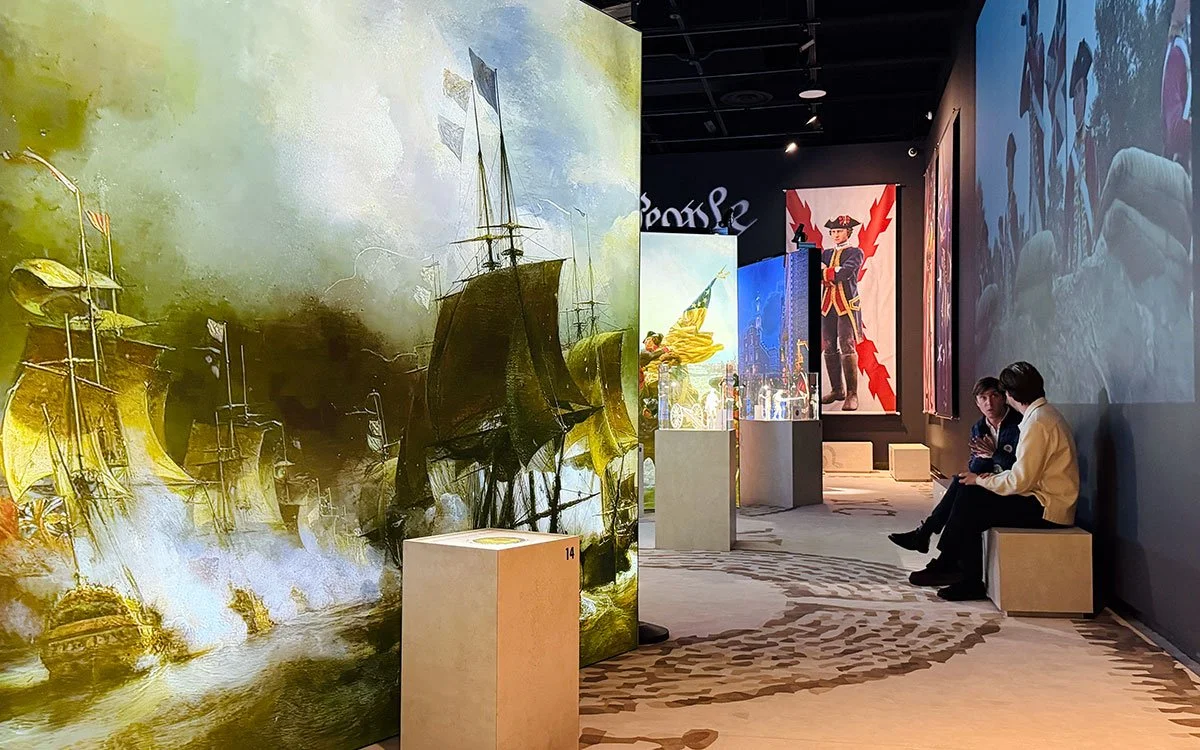
Benches throughout the exhibit make it easy to process and discuss the experience, photo by Ellis Anderson
And there is more to explore than just the Boston Tea Party and the Crossing of the Delaware.
“We think of the American Revolution as a very singular thing,” says HNOC interpreter Jacob Williams. “But it’s really a global conflict that has its tenacles in Africa, the Caribbean—not just the 13 colonies we know.”
Every Wednesday through Sunday, Williams and other guides conduct “Shortcut Talks” in the gallery’s atrium. The eye-opening, 20-minute exhibit overviews also offer insight into the oft-overshadowed contributions of Louisiana—New Orleans, in particular—in keeping British forces at bay.
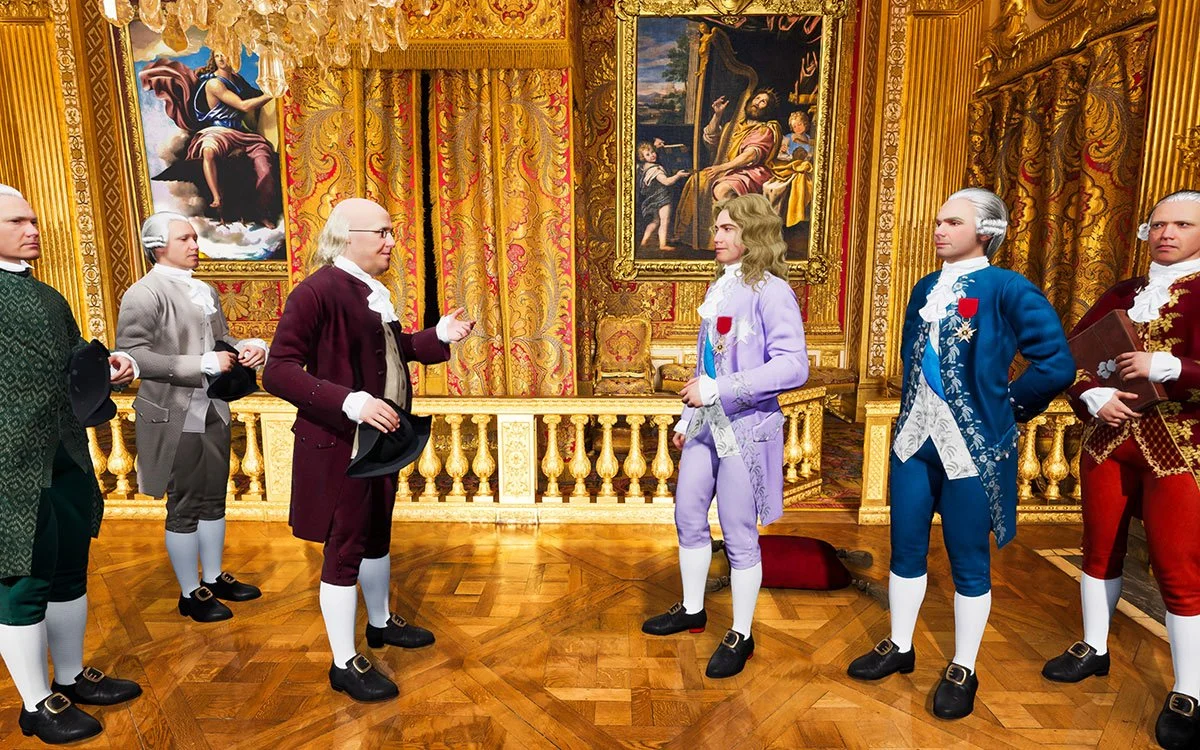
The colonies’ alliance with France played an enormous role in their ultimate victory. courtesy Histovery
The region’s role in the revolution is further explored in the 28-episode series Beyond the 13 Colonies, produced in conjunction with WWNO radio.
When initially approached by Histovery about mounting the exhibition, HNOC historians were quick to point out its heavy Eastern Seaboard slant and the lack of Gulf South inclusion. Of significant importance, they lobbied, was the game-changing coalition of Irish-born, Cuban/New Orleans economic agent Oliver Pollack and Spanish Louisiana governor Bernardo de Gálvez.
Together, Gálvez and Pollack helped form an unlikely alliance of elite French planters and everyday citizens, including Acadians, free people of color, Indigenous and enslaved people, who banded together to secure the lower Mississippi for Spain.
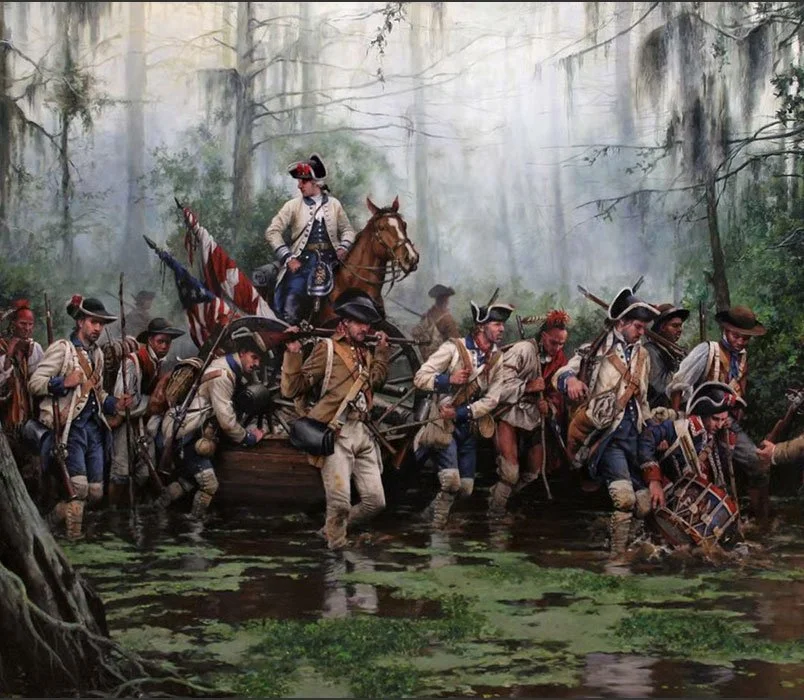
Galvez and his troops slogging through the Gulf Coast swamps. La Marcha de Gálvez, 2018, oil painting by Augusto Ferrer-Dalmau. Licensed under Creative Commons, courtesy Histovery
Taking British forts in Manchac and Baton Rouge, the multicultural militia moved on to seize control of Mobile and Pensacola, the then-British-held capital of West Florida.
“Gálvez made New Orleans a full-on supporter of the rebelling colonies,” explains Williams. “He opened up all of the Gulf Coast and brought attention away from places like Charleston and Richmond, diverting all manner of naval resources from the British.”
Gálvez would go on to aid in protecting Saint-Domingue (now Haiti) from British intrusion, allowing French ships to sail north and surround Yorktown, leading to British troops’ ultimate surrender.
A video excerpt from the “Yo solo at Pensacola” section of the exhibit
“New Orleans and Pensacola are not in the national origin story we tell ourselves when we celebrate each July, at least to most people,” Williams notes.
“But without the economic endeavors of people like Pollack, without the military endeavors of people like Gálvez and without the citizens of Louisiana, the end of the American Revolution would be different.”
Visitors will find that early omission now rectified and highlighted in detail in the nationally touring exhibit’s subsequently added “Yo solo at Pensacola” section, thanks to the HNOC’s efforts.
Think you learned everything there is to know about American independence from high school history books? Think again.
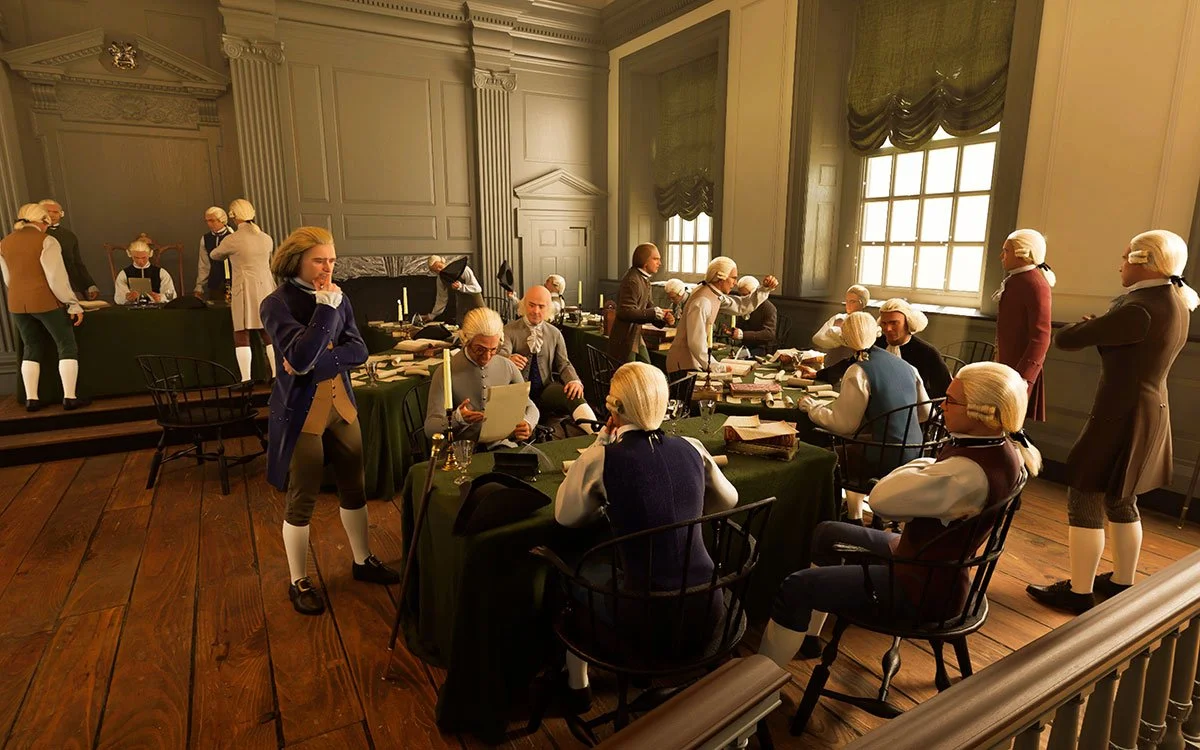
The Declaration of Independence recreation in the exhibit, courtesy Histovery