Krewe of Petronius: 65 Years of Gay Carnival Celebrations
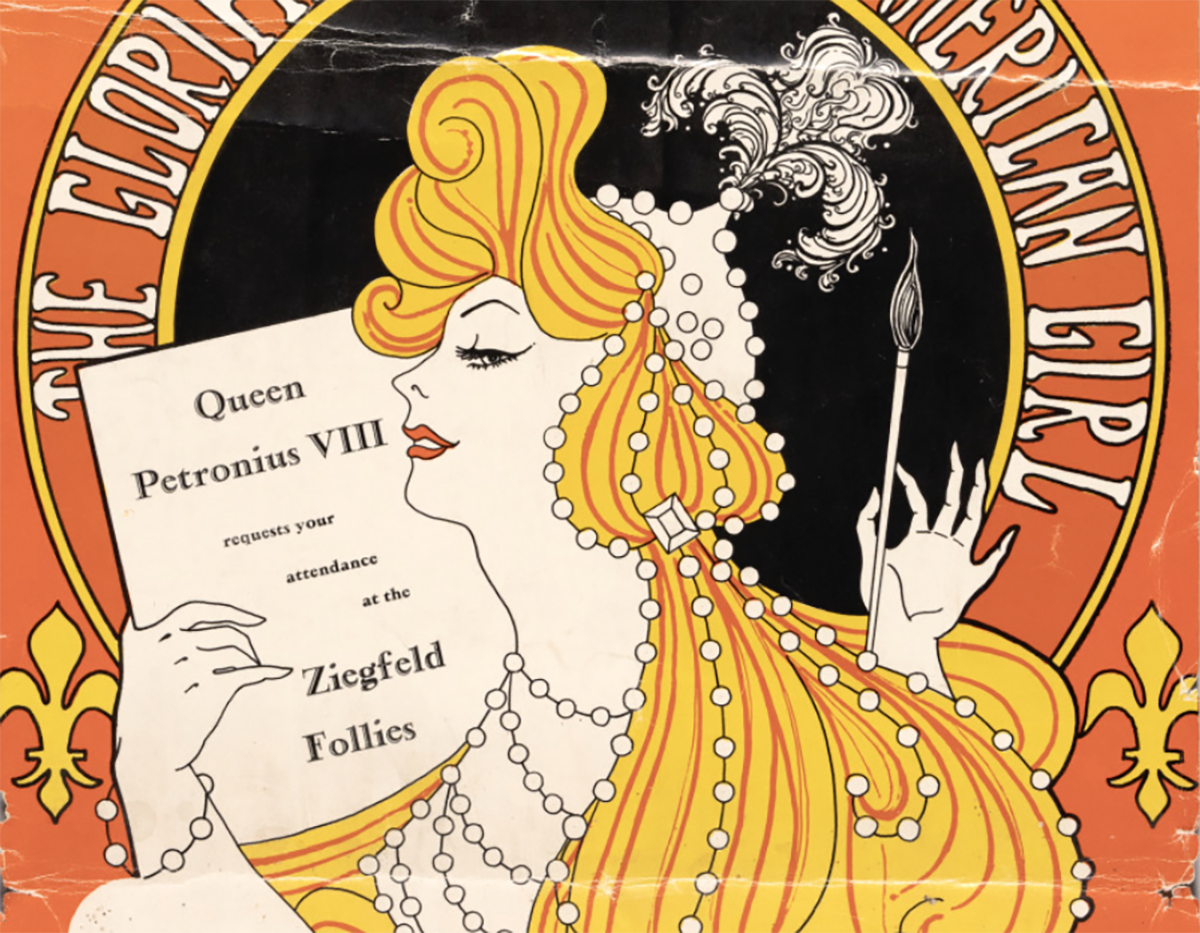
Detail from the 1969 Petronius ball invitation, held February 9, 1969. Historic New Orleans Collection, gift of Tracy Hendrix, 1980.178.184
January 2026The Grand Dame of Gay Carnival, the Krewe of Petronius has added a fabulous flamboyant flair to the city’s Mardi Gras season since 1961.
– by Frank Perez

This column is underwritten in part by the LGBT+ Archives Project of Louisiana
Gay Carnival in New Orleans began in 1949 when Bob Demmons took five out-of-town friends to lunch at Brennan’s. During the lunch – and much to his guest’s surprise – Demmons produced a bouquet of flowers and a tiara and crowned one of his friends “Queen of the lunch.”
After the meal, a carriage was waiting for the group, and they began making their way around the French Quarter tossing gladiolas to those they passed. Thus began a tradition that survives today—the Fat Monday Luncheon.
Over the last seventy-seven years, Gay Carnival in New Orleans has evolved into a unique phenomenon that attracts visitors from all over the world.
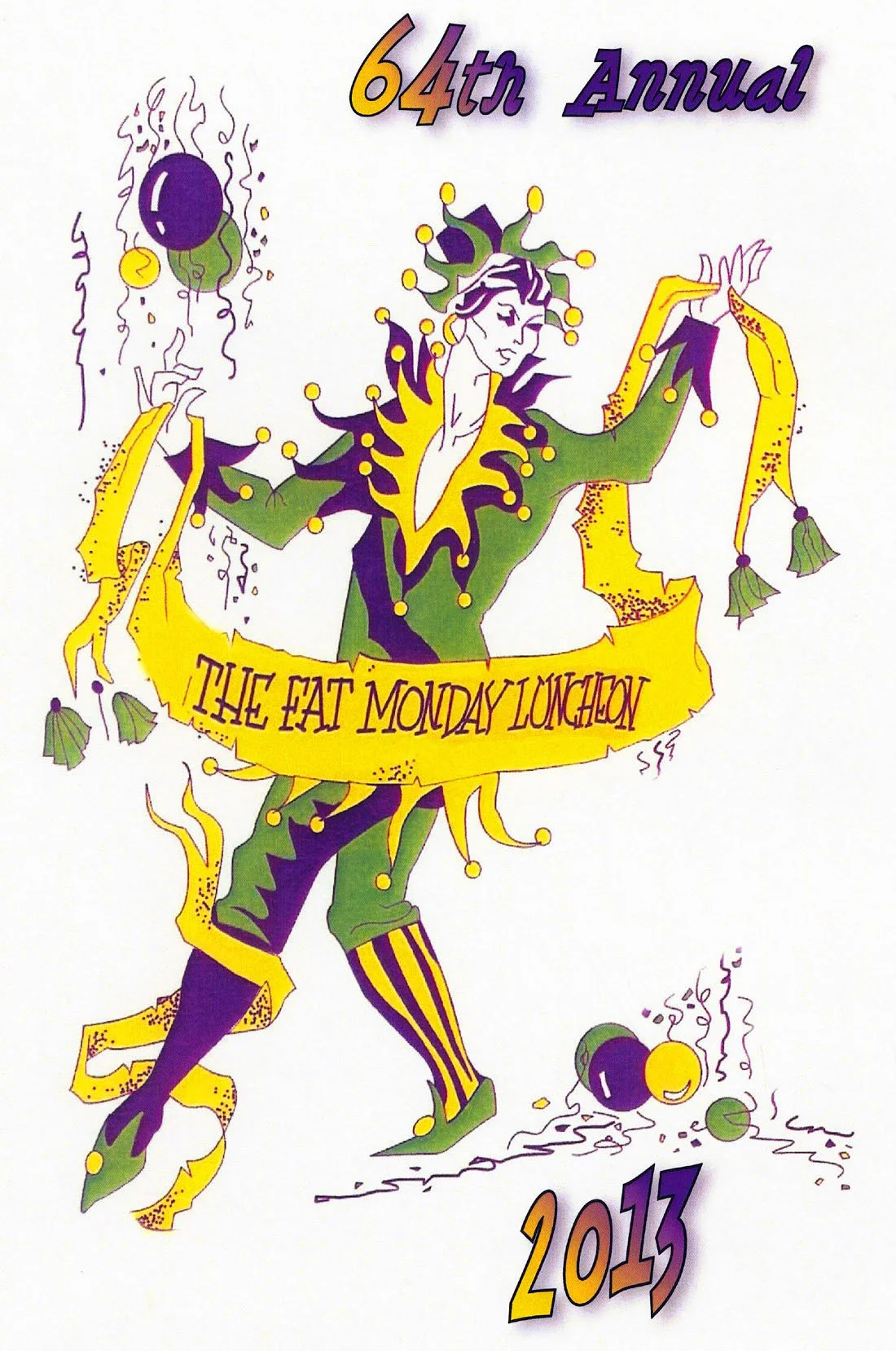
Fat Monday Luncheon 2013 invite to the 64th annual event. The luncheons began in 1949. The 2026 luncheon will be the 77th annual. Courtesy LSM 2013.014.8
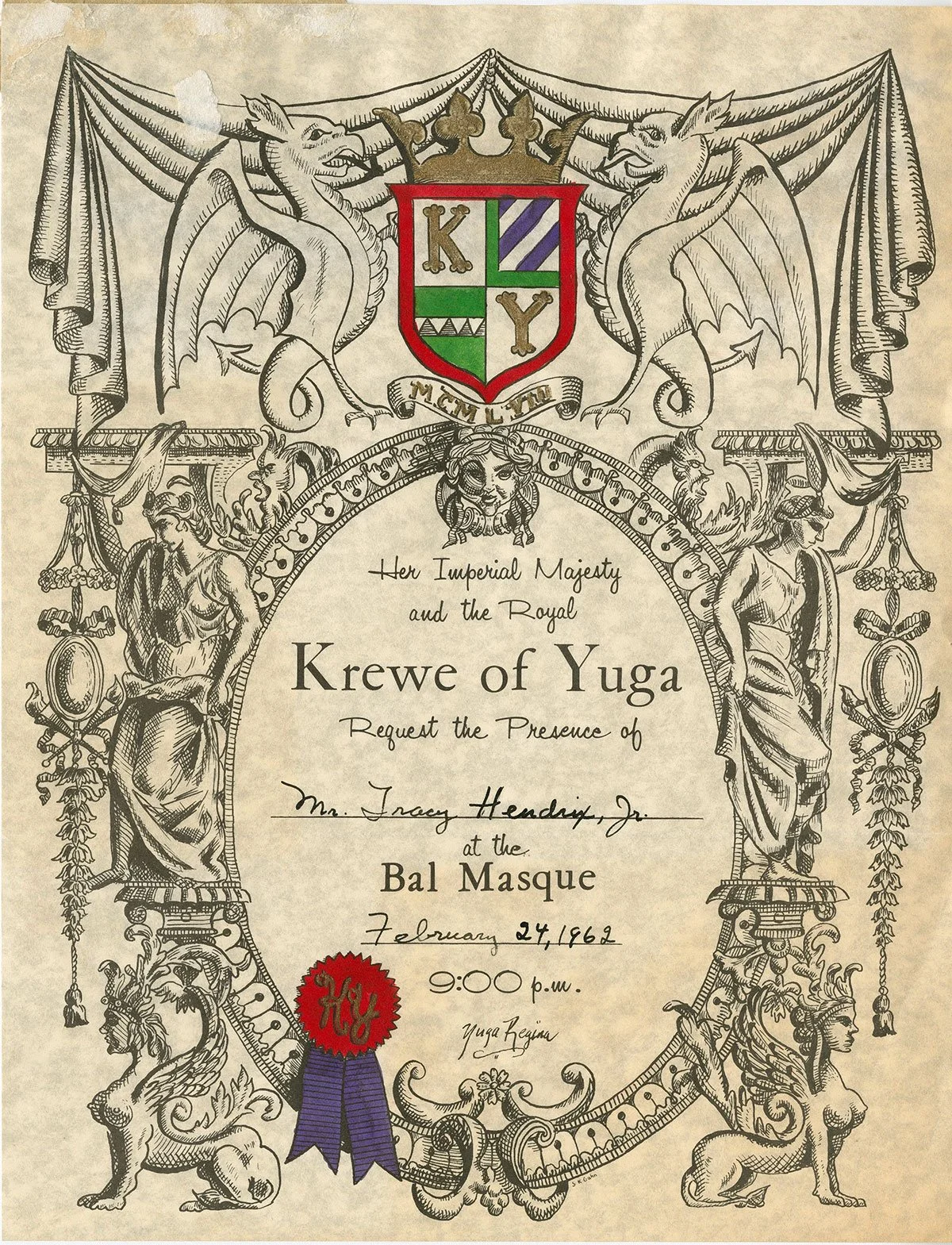
The invitation to the fateful 1962 Krewe of Yuga ball. Click here to read more about Yuga in Frank Perez’s “Dixie’s, Yuga, and Gay Carnival,” in FQJ’s archives. Historic New Orleans Collection, gift of Tracy Hendrix, 1980.178.71
The oldest surviving social organization for gay men in New Orleans, the Steamboat Club, was founded in 1953 and the first gay krewe, Yuga, was formed in 1958.
Yuga did not last long. The krewe’s fifth ball in 1962 was raided by the police and the krewe disbanded in the ensuing scandal. Fortunately, another gay krewe had formed in 1961. Today the Krewe of Petronius reigns as the oldest surviving gay krewe in New Orleans.
Petronius had been founded by some members of Yuga, particularly Elmo Avet, Bill Woolley, John Dodt, William McKenzie, Otto Stierle Jr., Carlos Rodruguez, Brad Lysholm, JoJo Landry, Don Fitzpatrick, and Joseph Barcellona.

Mardi Gras Day on Royal Street, 1956, with two of Yuga’s founders, Elmo Avet (standing, right) dressed as the Marquis de Vaudreuil and Jo Jo Landry (far right). Photographer unknown. THNOC 1982.147.2, Gift of Clay Wilson
In Unveiling the Muse, Bill Woolley recalls, “Yuga was definitely the older set, heavily influenced by the Steamboat Club, very elitist. We were younger. For God’s sake, I was only in my early twenties.
“We were all having coffee at the Bourbon House and started talking about a new krewe. We wanted to try out our own ideas, something more risque and fun. More drag and fantastic costumes.”
After the Yuga police raid, the future of Petronius was in doubt. There was discussion of disbanding the krewe, but the spark of Gay Carnival would not go out. The first few “balls” after the Yuga fiasco were more subdued affairs, really more like costume parties.
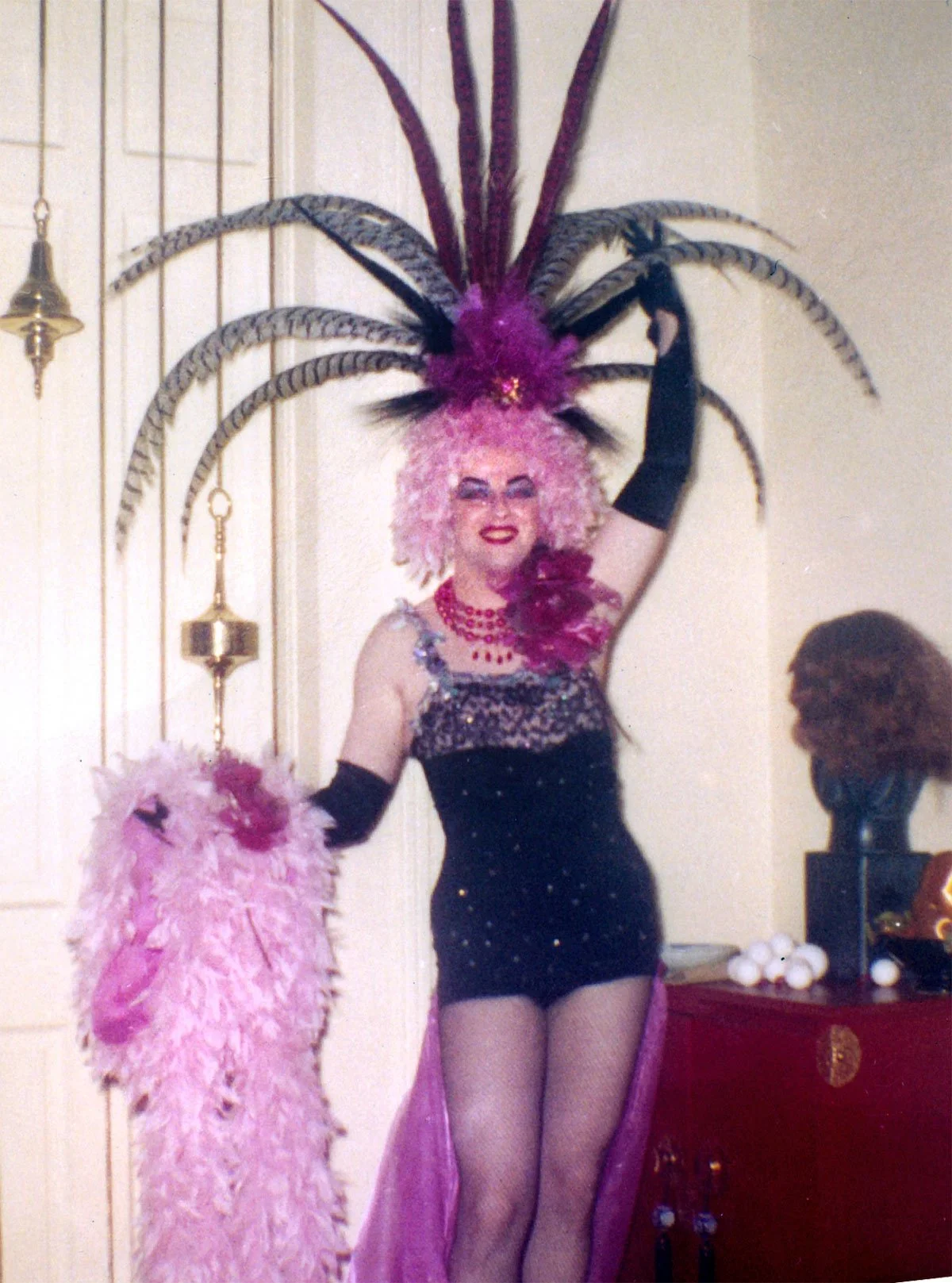
Bill Woolley as "Texas Guinan, Queen of Night Clubs," Krewe of Petronius, 1962. This is the only known original photograph from the first Petronius ball. Louisiana State Museum collection.
But that changed in 1966 when Petronius obtained a state charter as a registered Carnival krewe. The balls would now follow the traditional tableau format.
Some of the early Petronius balls were legendary. Woolley reigned as Queen of the 1965 ball, “The Wicked Bitches of History.” Other themes from the 1960s included “The Wizard of Oz” (1966), “Around the World with Auntie Mame—It’s Sheer Camp” (1967), “Shangri-La” (1968), and “Glorification of the American Girl” (1969).
Louisiana State Museum video with historic Petronius footage, including from the “Glorification of the American Girl,” in 1969. Includes footage of Jamie Greenleaf, Joseph Barcellona, Mickey Gil and more.
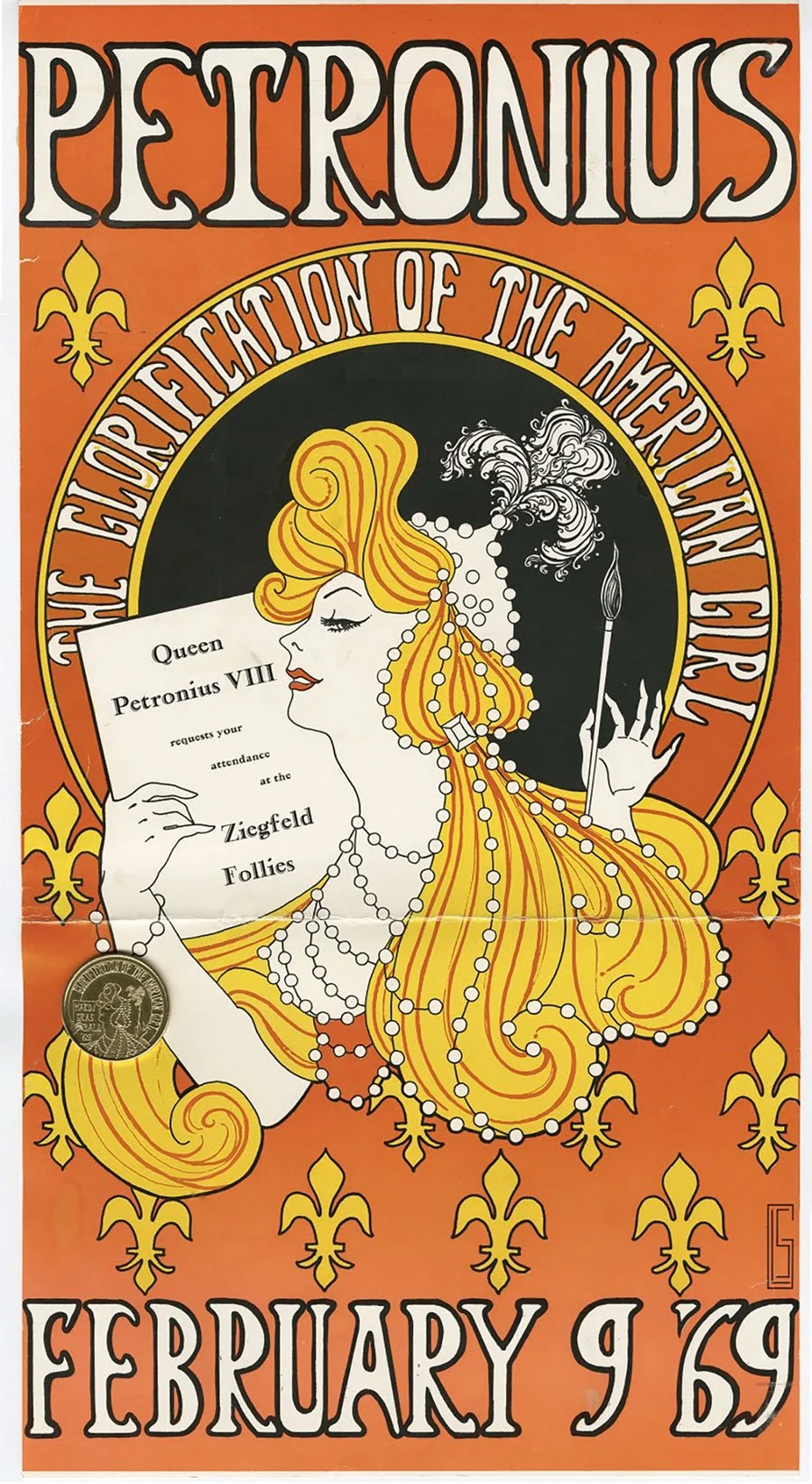
Petronius 1969 invitation, Historic New Orleans Collection, gift of Tracy Hendrix, 1980.178.184
In 1969, Jamie Greenleaf was captain and he brought to the krewe his expertise as a set and costume designer. He moved to New Orleans in 1966 with his partner Harvey Hysell, who had been a costume designer for the New York City Ballet. Hysell had grown up in New Orleans.
Greenleaf and Hysell formed a design company which was hired to design the costumes for 100th Rex parade. Despite his talent, he and Bill Wooley constantly bickered and in 1970, Greenleaf left Petronius to produce the Krewe of Olympus’s debut ball – Camelot.
Just as Petronius grew out of Yuga, other krewes grew out of (some would say broke away from) Petronius. Amon Ra was formed in 1965, Ganymede in 1967, Armeinius in 1969, and Olympus in 1970. Several other krewes were founded in the subsequent decades.
By the mid-1970s, the Krewe of Petronius was dealing with an internal power struggle. In 1976, Daniel Jones, a new member, was elected Captain. His opponent, Millard Wilson, alleged the vote was rigged and the ensuing drama turned off a number of longtime krewe members. Bill Woolley and several other members left Petronius to form the Krewe of Celestial Knights (KOCK).
By the mid-1980s, Gay Carnival faced an existential threat. The AIDS epidemic was ravaging the gay community and that included the gay krewes. By the late 1980s, several members of Petronius had succumbed to the disease and the krewe limped along, weakened and unsure of its future.
Then along came Mickey Gil and his partner George Patterson. Their energy and creativity reinvigorated Petronius and helped the krewe return to its glory days.
Gil was born in Israel and served in the Israeli Air Force. He was also a hotelier in Vienna before immigrating to the U.S., where he ran a restaurant in New York. Gil moved to New Orleans in 1982 and eventually met Patterson who worked as a set designer at the Gallery Circle Theater on Madison Street in the French Quarter. Gil and Petterson were together for twenty-nine years.
Gil fell in love with Carnival and served as the Captain of Petronius from 1987—2002, excepting 1993, when he stepped down in order to be named Queen of the “Straight from the Heart” ball. Gil’s costume as Queen was breathtaking. Patterson recalled in Unveiling the Muse:
“The fan shaped curtain rose slowly at the end of the ball to reveal Mickey as Queen Petronius XXXII, dressed in a flaming red bodysuit with its flames curving up, flying wildly all around him. Jamie had embedded hundreds of small lights in the costume to great effect. As Mickey came forward with scepter in hand, the audience went wild, with wave after wave of applause.”
Accentuating the fantastic costume were live fireworks emanating from the backpiece. Gil’s costume was designed by former Petronius captain, Jamie Greenleaf.
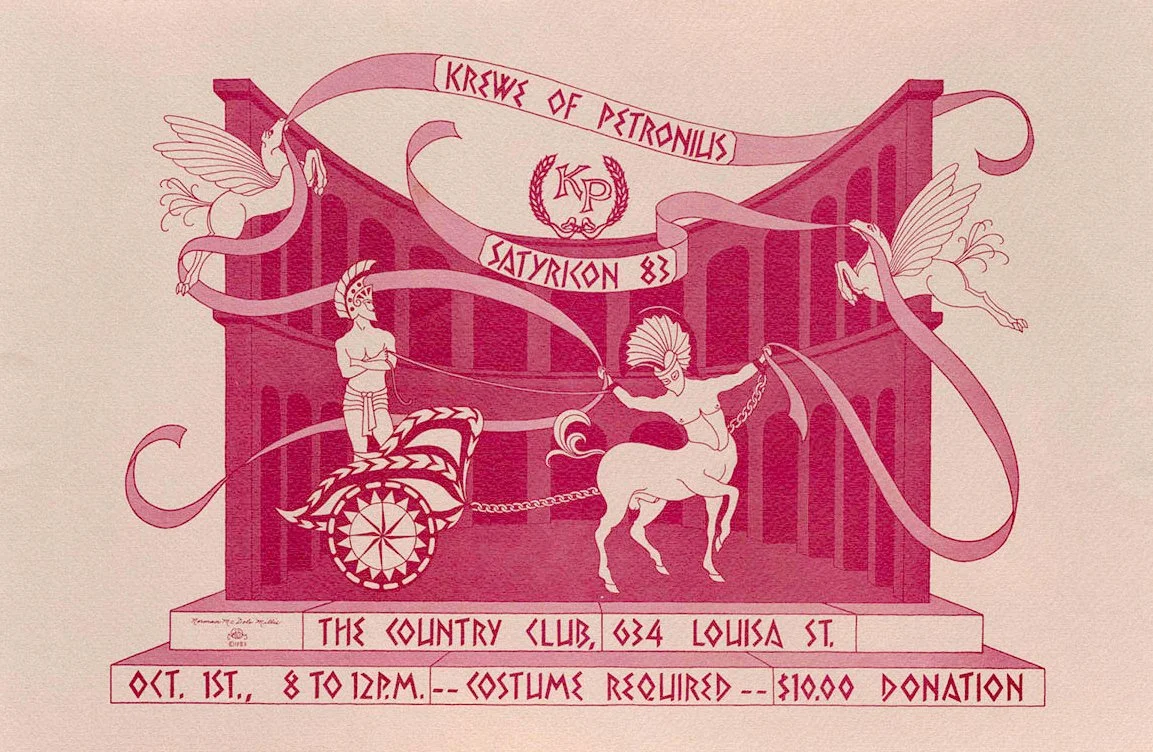
Krewe of Petronius, 1983 invitation, Historic New Orleans Collection, gift of Howard Philips Smith, 2019.0169.3
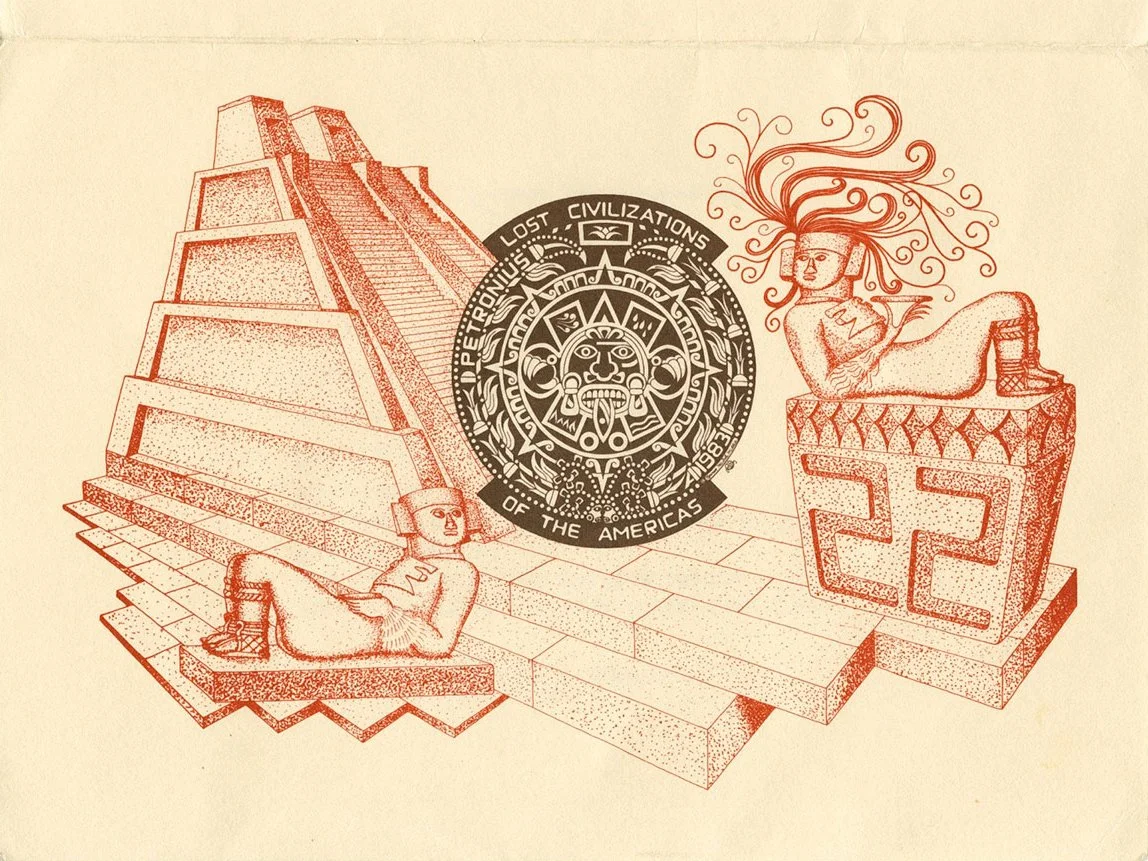
Petronius 22nd anniversary invite, Historic New Orleans Collection, 1983.109.54
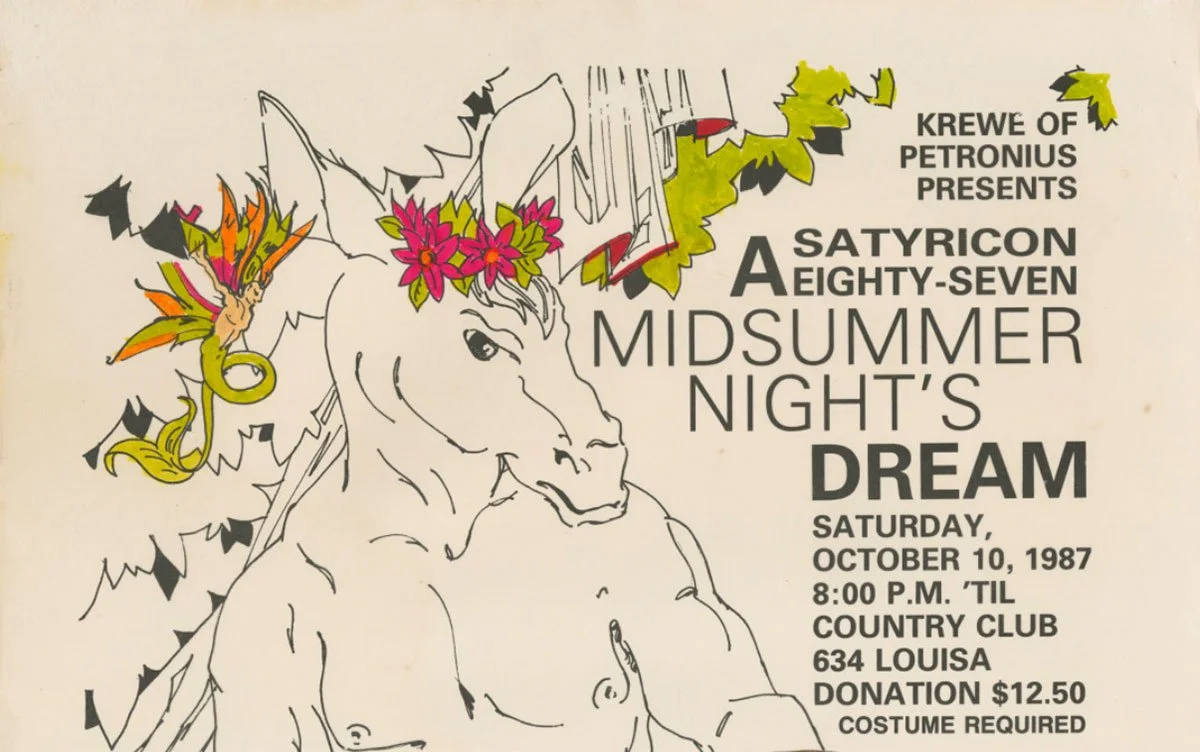
Detail from 1987 Petronius invitation, by artist R. Mullins. Historic New Orleans Collection, gift of Howard Philips Smith, 2019.0169.5
Reminiscent of Woolley’s departure from the krewe twenty-six years earlier, Gil broke away from Petronius in 2002 after a dramatic captain’s election. Gil had served as captain for thirteen years and was devastated when he lost his reelection bid to Wally McLaughlin, formerly of Armeinius.
Gil and several devotees split from Petronius and formed the Krewe of Satyricon. Gil served as captain of the krewe until his death in 2010. Satyricon folded in 2016.
Petronius is now in its sixty-fifth year and has been described as the “Grande Dame” of Gay Carnival. It will present its 2026 Ball on February 7.
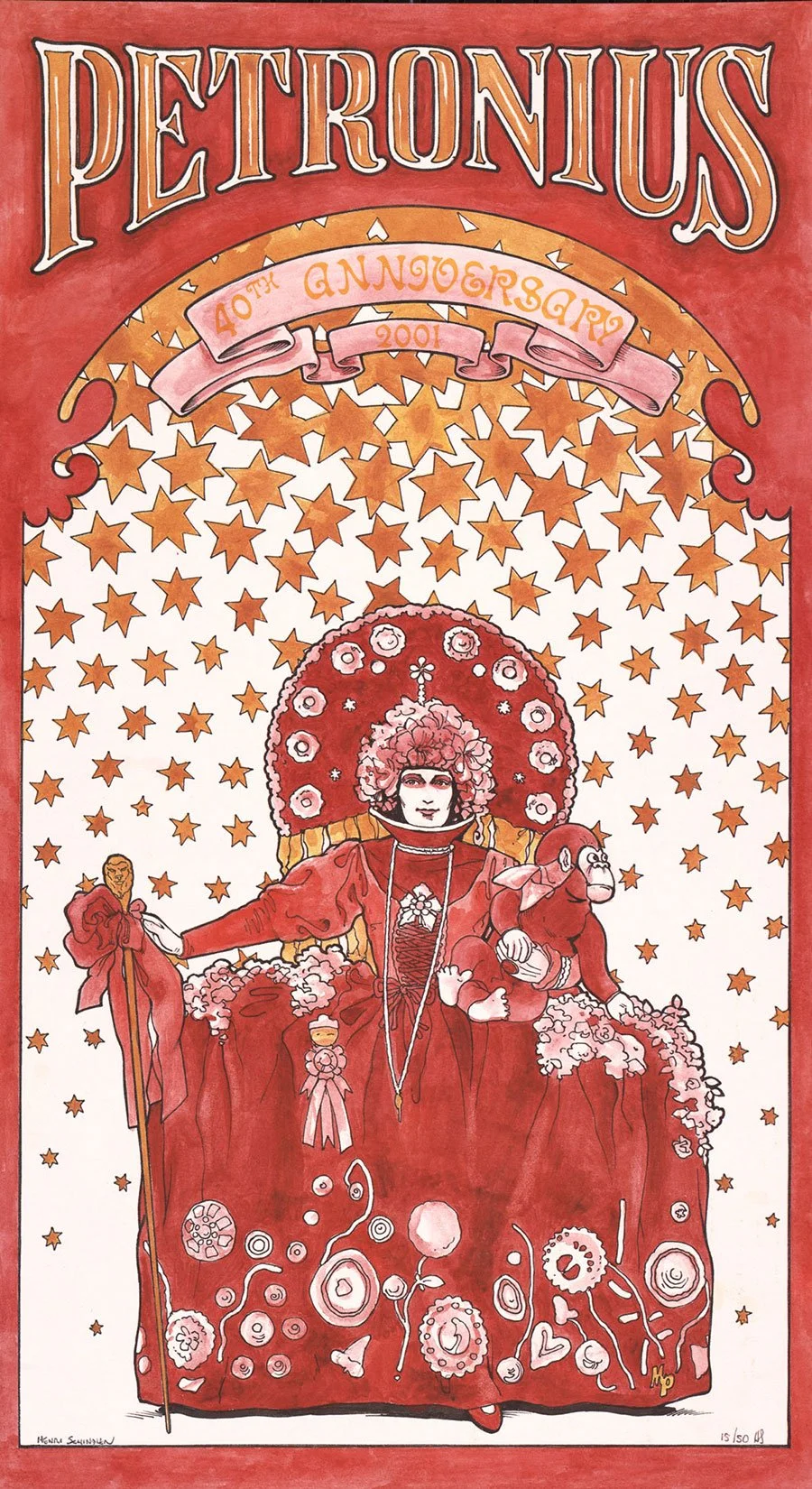
Poster from the 2001 Petronius ball. The image was based on a 1926 photograph of Elmo Avet in costume. Henri Schindler, designer. Howard Smith. Courtesy of Louisiana State Museum. Accession number 2001.105.3