Hop to It: The Historic New Orleans Collection’s Bunny Matthews Exhibit
September 2026“Bunny Matthews: His Life, Art, and Obsessions” celebrates “da real New Oyunz cultcha” and the man who chronicled it.
– by Doug Brantley
“You have to see the humor in New Orleans,” the late cartoonist and writer Bunny Matthews once told newscaster Angela Hill. “You have to have a sense of humor – or you couldn’t live here.”
For more than four decades, Matthews helped New Orleanians do just that, through his spot-on depictions of local life and the lovable – if imperfect – characters he drew from it.
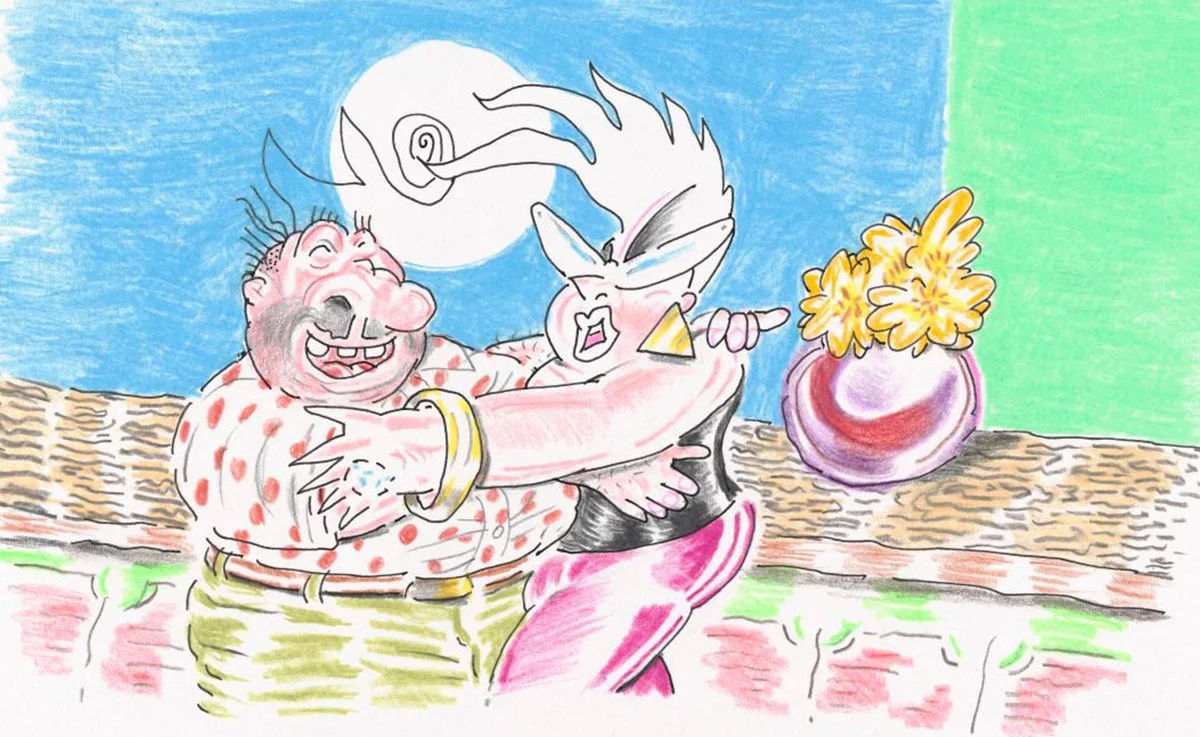
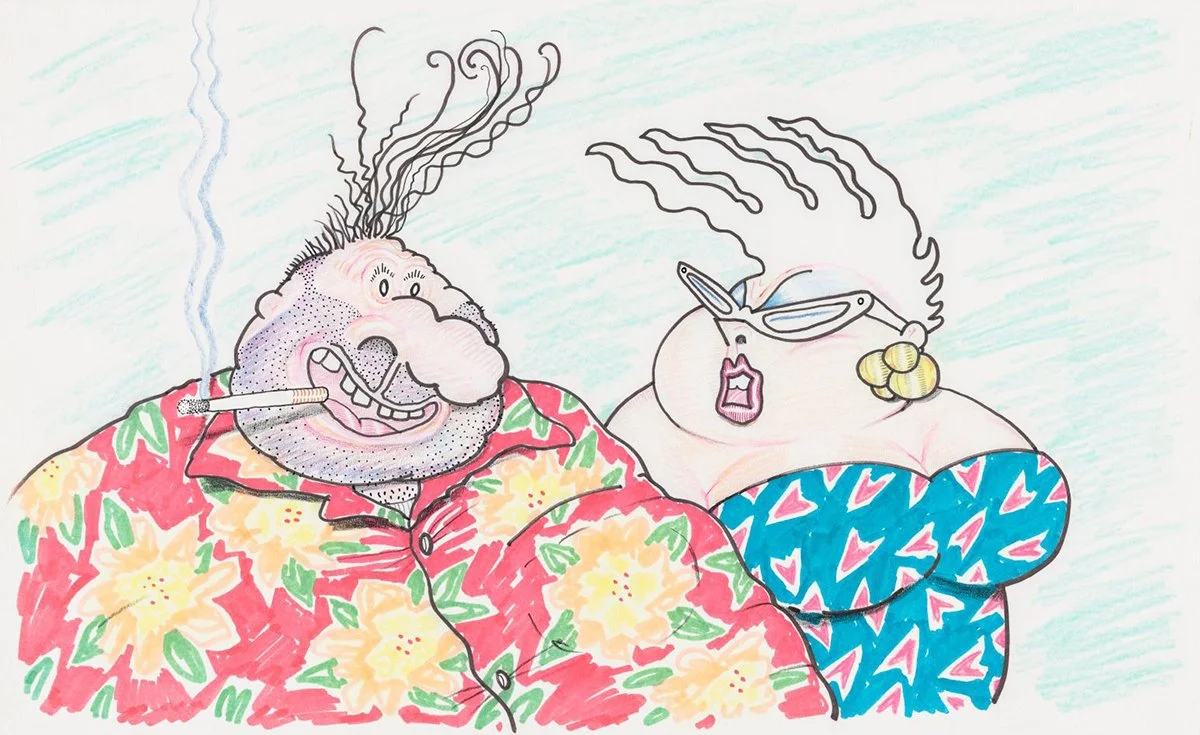
Vic and Nat’ly Broussard, Matthews’ endearing “Yat” pack, appeared in the pages the Times-Picayune from 1982 to 2000, pulling readers into their mythical “Nint’ Ward” barroom, located at what Matthews once hinted was the corner of St. Claude and Desire.
“Bunny Matthews used his cartoons to hold up a mirror that reflected both the good and the bad aspects of New Orleans,” says Emily Perkins. She’s co-curator of the Historic New Orleans Collection’s new exhibit, “Bunny Matthews: His Life, Art, and Obsessions.”
“He did not only want to celebrate New Orleans; he also wanted to critique it.”

This column is underwritten in part by Logo and name of column sponsor
Culled from more than 800 works and related ephemera the HNOC has amassed since it began collecting Matthews materials in 1979, the exhibit and eponymously titled 300-plus-page book (by Alison Fensterstock and Michael Tisserand) paint a portrait of an artist as emblematic of the city as the colorful characters he created.
Exhibitgoers will find the iconic bar brought to life in full-scale newsprint black-and-white. The interactive vignette, with working stools and a motion-sensor jukebox, encourages guests to become part of the scene and settle in for some “fresh seafood and conviviality.”
The cartoon couple had earlier incarnations in Figaro, the alternative weekly newspaper where Matthews established an early following with his “F’Sure” comic series that ran from 1976 through 1980.
But Matthews had been making people laugh—and think—long before that.
Born in 1951 in Monroe, La., one of Matthews’ favorite toys, his mother wrote in his baby book, was newspapers. And one of his favorite childhood pastimes was drawing on any and everything he could, sketching comics and creating cartoons, along with self-published books and newspapers.
Early on, the family bounced from Monroe to Shreveport to Dallas, before finally making a permanent home in Metairie, providing young Matthews with an outsider perspective on New Orleans…and an insider ear for its distinct dialects.
“I always thought that people in New Orleans talked funny,” he later recounted. “I was kind of this outsider, so I could see the humor in it and the weirdness in it.”
Matthews’ drawings were heavily informed by underground comix illustrator R. Crumb and Big Daddy Roth, whose hot-rod stylings he recreated on sweatshirts for his friends, which landed him his first paying art gig.
At age 14, he started working at a “hippie beatnik kind of place” in the French Quarter, drawing on T-shirts for $50 a week. He would spend a good chunk of that at the popular Sidney’s newsstand on Decatur Street, buying copies of underground comics books and counter-culture newspaper and music magazines, including Crawdaddy and Rolling Stone.
Those subversive influences soon began showing in the pages of East Jefferson High School’s Tom-Tom newspaper, where Matthews wrote a column during his junior year and served as cartoonist and rabble-rousing editor in his senior.
“He had gotten in trouble for running a picture of Jimmy Hendrix,” Perkins says, pointing to a 1968 parody version of the counterculture paper titled the “East Jefferson Free Press.”
“So, he put [Black Panther member] Eldridge Cleaver, who shot a police officer and went on the run in Cuba, in this one!”
During his subsequent years at LSUNO, Matthews started penning music reviews for the Driftwood student newspaper, and fell in with fellow writer Jon Newlin, who covered movies. Newlin, a few years older than Matthews, would become a lasting friend and mentor.
Matthews spent much of his free time rummaging the racks at Jim Russel Records on Magazine Street and would later work there after dropping out from LSUNO. The shop, where local legends, such as Blues great Earl King, often dropped in to visit, helped develop Matthews’ near-encyclopedic knowledge of New Orleans music.
It also exposed him to customers from all walks of life from all over the city and sharpened Matthews’ skill for capturing their unique dialects. He would put both his musical and eavesdropping talents to use at Figaro, where Newlin helped him secure a freelance gig.
“Figaro, during the mid 1970s, was engaging in cultural preservation,” notes Perkins. “The oil boom was changing the landscape of the city, with the redevelopment of Poydras and buildings being razed. So, they would do an ‘Endangered Building of the Week.’
“They also put out this glossary called ‘How to Talk Like a New Orleans Native.’ So, they were engaging in preserving the city’s accents as well.”
Matthews’ satirical “F’Sure” comic series premiered in the paper in 1976, spotlighting “actual dialogue heard on the streets of New Orleans,” and continued to run through 1980.
It was here he refined his signature stippling technique using a trademark fine-tipped No. 2 Radiograph pen—and where shades of Vic and Nat’ly first began to emerge as well.
Matthews continued his music reviews at Figaro, where he was an early advocate of Jazzfest. He was also a big promoter of the then-new Tipitina’s music club, for which he created fliers, posters and calendars, several of which are featured in the exhibit. And he championed WWOZ-FM radio, which initially operated out of Tip’s.
Over time, however, all three—which he came to view as over-commercialized and inauthentic—would fall under Matthews’ critical crosshairs.
“Though he often swung dizzyingly from booster to critic and back again,” Finsterstock and Tisserand write in the exhibit’s accompanying book, “nobody could reasonably say he didn’t know what he was talking about.”
Figaro paved the way for Matthews’ entrée into writing music reviews for the Times-Picayune on a regular basis. But his big break came in the newspaper’s “Dixie” Sunday supplement, with the debut of “Vic and Nat’ly” on January 3, 1982.
“I’ll never forget the first time I saw them,” the late Jeannette Hardy, “Dixie” section editor, recalled. “There was Vic with that greasy hair, that 5 o’clock shadow and that nasty cigarette stuck in his mouth.
“And there was Nat’ly with those pointy eyeglasses, that 1930s print dress and that mad, upswept hairdo.
“They looked like creatures spawned in the swamp and seasoned with 50 years’ worth of fried oyster, hot sauce and pickled eggs.”
In addition to looking the part, Vic and Nat’ly sounded it. Their only-in-New Orleans (and perhaps New Jersey) colloquialisms (“I’m gonna go pass my cousin’s house,” “Dawlin,” “Yeah you rite!”) resonated with readers. So much so that Matthews’ characters would continue to appear in the T-P, in some form or other, for the next 18 years.
Not that the cartoon didn’t occasionally raise readers ire, as well, with Matthews tackling such thorny and all-too-real topics as racism, hypocrisy and cultural misappropriation, however uncomfortable it might make them.
“They weren’t very well spoken,” Perkins says of the characters. “They were opinionated, rough around the edges and working class—not middle class, working class.
“I think that’s what made them so endearing to people. They were just regular New Orleanians talking about what was going on in the day.”
Even after they disappeared from the T-P’s pages, Vic and Nat’ly lived on in New Orleans.
Featured in nearly every newspaper and magazine, from Gambit to Offbeat, as well on the weekly WYES broadcast “Steppin’ Out,” for close to three decades, the fictitious couple achieved a citywide fame few real-life counterparts could match.
For instance, October 1, 1988 was proclaimed Vic and Nat’ly Day by mayor Sidney Barthelemy. They appeared in their own television show (Cox Cable), an exhibit at the World’s Fair (HNOC pavilion), a movie (Audubon Zoo), and opera (New Orleans Opera Association), and a music review (Le Petit Theatre).
Schwegmann’s supermarket printed a million Vic and Nat’ly shopping bags for “makin groceries.” D. H Holmes department store offered a line of Vic n’ Nat’ly collectibles, from refrigerator magnets to serving trays. (HNOC visitors will likewise find Vic and Nat’ly-themed magnets, mugs, prints and more available in its gift shop.)
There were Vic and Nat’ly ad campaigns for Barg’s root beer and, famously, the Leidenheimer Baking Company, which continues today and earned Matthews free French bread for life. The one commission that seemed a natural fit but never materialized: the coveted, official Jazzfest poster.
Matthews’ career continued to grow and evolve as well. In 1989, he moved across Lake Pontchartrain to Abita Springs, where his “Tammany Toon” series ran in the T-P’s Northshore edition. There, he also taught art and cartooning to middle schoolers and became the first ranger on the Tammany Trace nature trail.
There were shows at the prestigious Arthur Rodger Gallery, where he was repped; a 1996 Contemporary Arts Center retrospective; and, in 1999, Matthews was named associate editor of Offbeat, where he stayed until Hurricane Katrina hit in 2005.
Aside from a few post-college years spent in Providence, RI, a Neville Brothers New York concert he covered for Figaro, a couple of visits to Jamaica (where he interviewed Bob Marley) and occasional trips to Texas and along the Gulf Coast, Matthews, for better or worse, rarely left Louisiana.
Stricken with the onset of brain cancer while week-ending in the French Quarter in 2015, Matthews stayed true to his art, writings and himself – while remaining both a fierce defender and unapologetic critic of Crescent City “cultcha” – up until his death in June 2021.
“He was totally obsessed with the idea of authenticity,” says Perkins, “who was ‘real New Orleans’ and what it was that made a real New Orleans a ‘real New Orleans.’”
In the Dixie’s final installment of “Vic and Nat’ly,” the twosome shutters their beloved bar, packs their car and sets off “on uh real vacation!” Then the car promptly gets two flats.
It doesn’t get much more real than that.