
Cover to Cover: Beautiful and Ugly Too
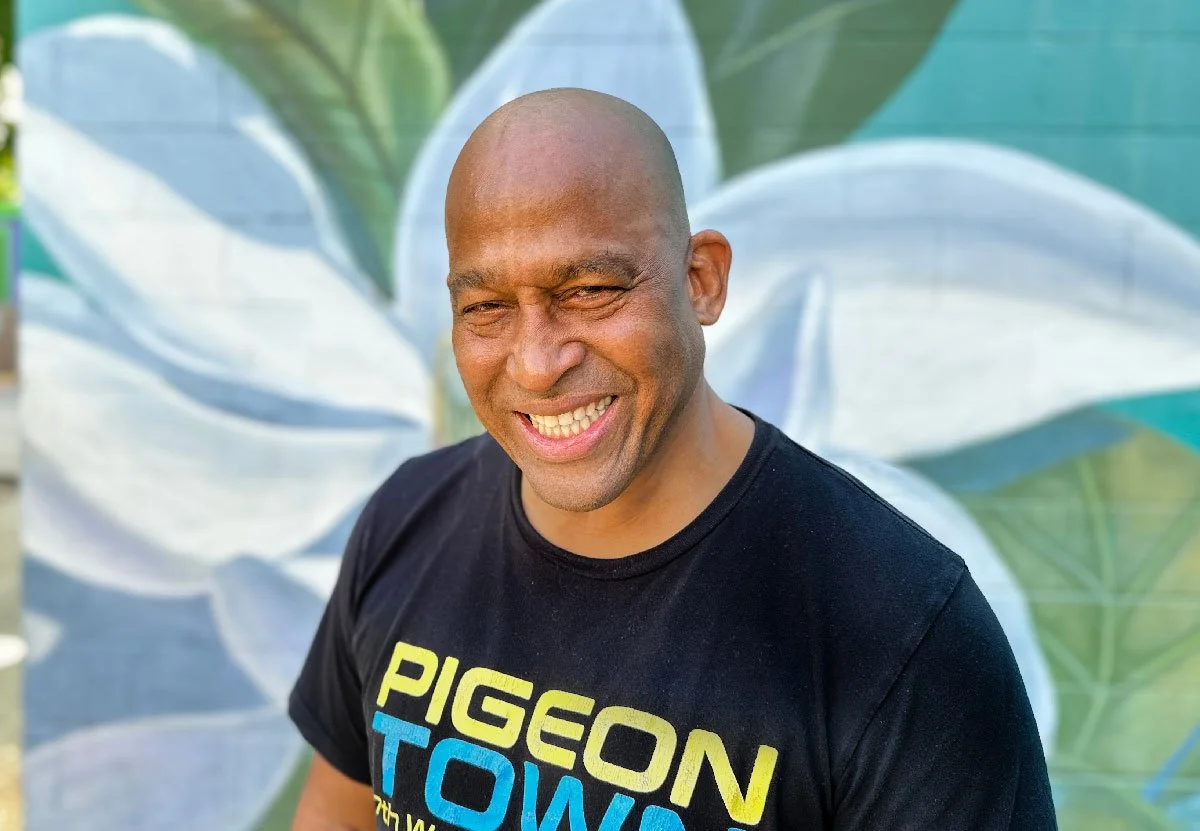
Poet and author of Beautiful and Ugly Too, Chuck Perkins, outside Café Istanbul, photo by Ellis Anderson
December 2025A debut poetry and essay collection by Chuck Perkins celebrates New Orleans in all of her “sadness, sickness, spirit and splendor.”
– by Skye Jackson

This column is underwritten in part by Karen Hinton & Howard Glaser
Chuck Perkins once said, “New Orleans is just a beautiful girl with dirty feet.” That sentiment, ironically enough, serves as the thesis of his debut poetry collection, Beautiful and Ugly Too, which was recently published by University of Louisiana at Lafayette Press.
Perkins is a poet, orator, activist and one of New Orleans’ most prominent culture bearers whose debut collection reveals and celebrates the city of New Orleans in all her sadness, sickness, spirit and splendor.
The book illuminates a world of complex juxtapositions and asks readers to confront them all at every turn, containing dazzling intricacies comprised of both poetry and memoir in essays. This work illuminates the poet’s life and existence in New Orleans as only Perkins’ can – through celebration, deeply probing examination and a lyrical interrogation of what it means to be a Black man in an inherently racist, flawed and dangerous world.
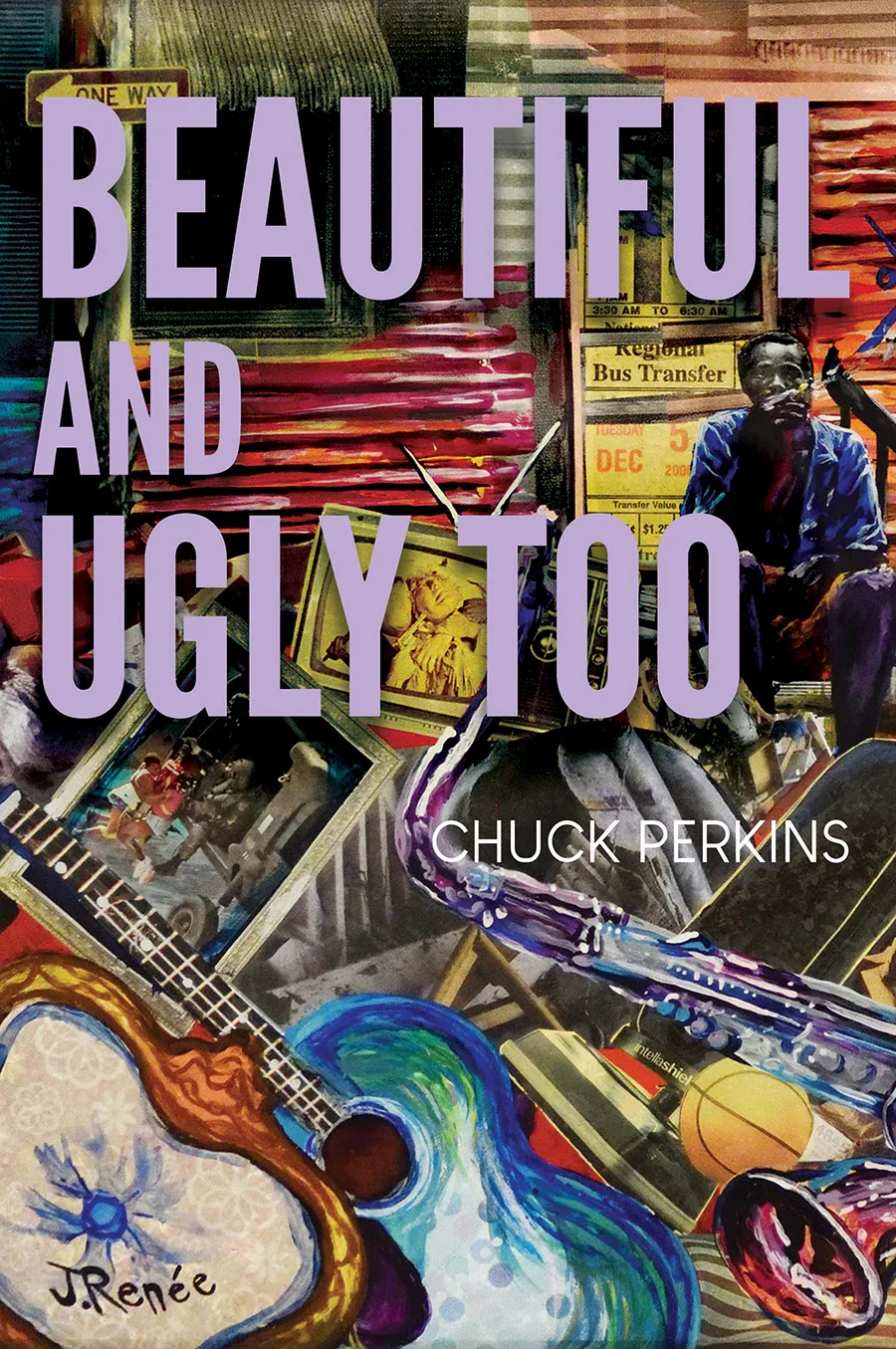
Click on the cover to find at your favorite indie bookstore.
Beautiful and Ugly Too is a collection that reflects on our current tumultuous times like a jagged and broken mirror. It demands that we examine the lengths we undertake to exist within a damaged and dark socio-political environment.
For instance, the poem “The Uncivilized” chillingly echoes our country’s current buffet of horrors – millions of people on the verge of losing SNAP benefits because of the government shutdown, all while the sitting President constructs a ballroom in the White House. Perkins writes:
[He] Lives in a gilded house by the sea.
Blood on his hands
And stink on his feet.
Hoards the food while the baby’s hungry.
Gluttony is what he be.
Perkins portrays a sinister depiction of those in power, and it is as terrifying as it is accurate. Here, we see Perkins’ ability to reveal and leave no stone unturned: exposing those in power who bow only at the altar of excess while everyday Americans suffer beneath the relentless whip of poverty and catastrophic economic disparity.
Perkins’ stylistic and poetic prowess continues to shine throughout the collection, even as he delves into taboo topics. This couldn’t be more evident than in the poem “Crack House.”
In it, the poetic speaker explores the dark and gritty underbelly of a New Orleans crack house – with inhabitants who are lost, troubled and largely forgotten by society. Readers might wonder why the narrator finds himself in such a place and what exactly he is searching for in this den of despondence and broken dreams.
Perkins skillfully paints each figure that occupies the house with the care, dexterity and dark richness of a Renaissance painting. He writes,
I cannot remember her name,
The twenty-something-year-old Black girl from the neighborhood
With the round figure and half-combed hair.
She worshipped two gods,
Equal and always separate—
Until tonight.
With a glass cylinder in her mouth,
She praised the white crystal idol of momentary bliss and eternal damnation
These sprawling lines are reminiscent of Allen Ginsberg; reflecting the relentless nature of addiction as Perkins depicts figures lost forever to the haunting pull of their inescapable vices. Perkins marries the tragic and the beautiful, using rich imagery to portray the intimate reality of an addict’s secret and personal hell.
Luckily, however, Perkins does not leave us to wallow there. Other poems and essays in the collection explore the joys of a New Orleans childhood, the layered complexities of minstrelsy and masking at Mardi Gras and pay tribute to Black legends like Fannie Lou Hamer, Danny Barker and Herman Wallace.
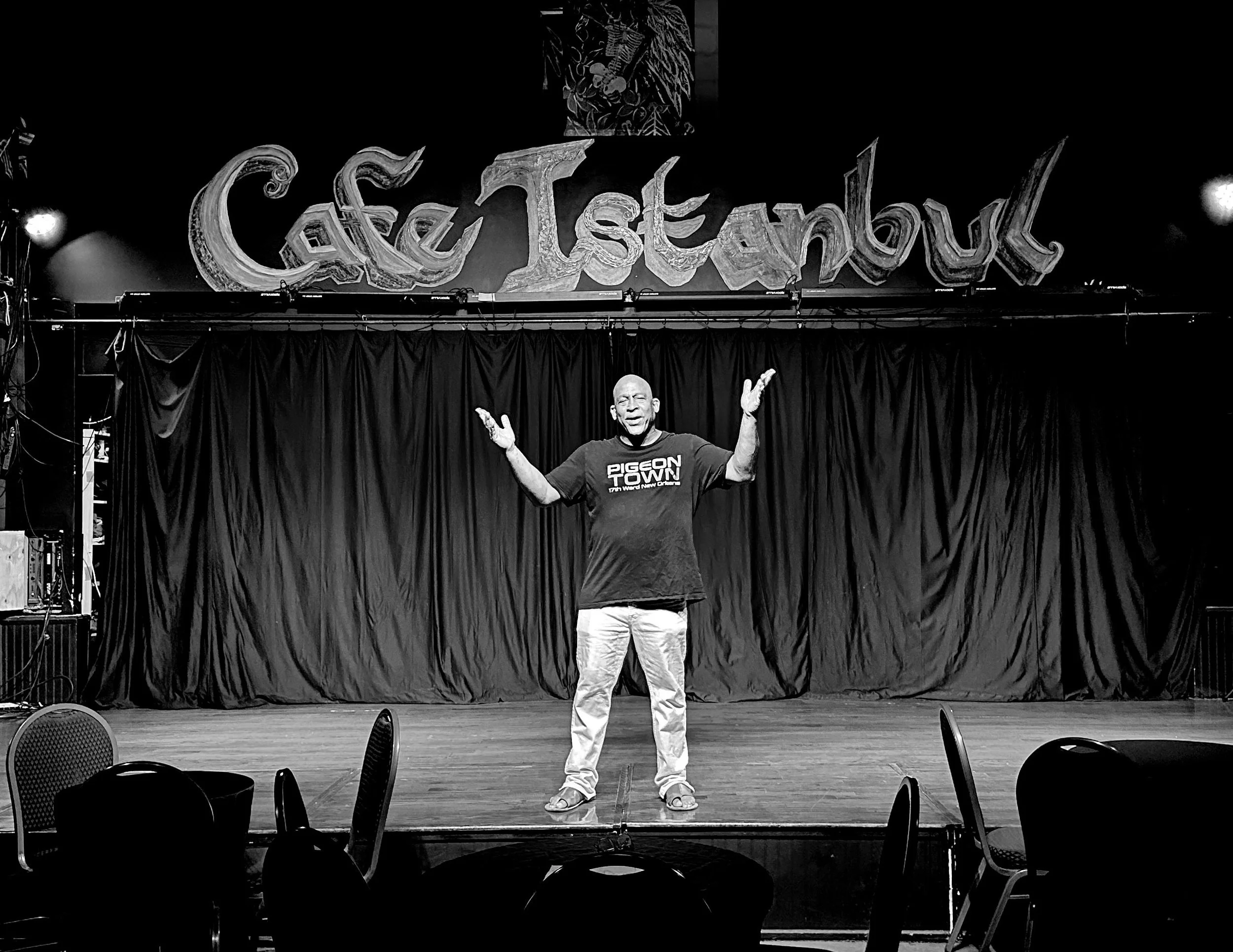
Chuck Perkins, onstage at Café Istanbul, by Ellis Anderson
Longtime fans of Perkins’ work will recognize classic and iconic poems from his extensive spoken word catalogue like “Freak of the Alchemist,” “Bucket of Questions,” “Street Names,” and “I Like Ya Flow.”
I first heard several of these poems a little over twenty years ago as a fourteen-year-old student at the New Orleans Center for Creative Arts— where Chuck Perkins was the first Black poetry teacher that I ever had. Even now, these poems continue to be staples in Perkins’ dynamic shows and performances throughout the city of New Orleans and the world.
In addition to poetry, Perkins carves out a unique path in his debut collection by including ten stunning personal essays throughout the book. One of them, entitled “Police,” reflects on the anxiety and fear that many Black people experience in America – as Perkins describes a routine traffic stop that he witnesses as a young boy.
“Regardless of how nervous this might make a kid, everything intensifies when your family is Black and big [and] White, tobacco-spitting cops approach your car in the middle of nowhere. I noticed my dad’s face turning blue every half second from the blinding lights – it made me dizzy.”
The image of Perkins’ fathers’ face “turning blue” because of the police light is a haunting one – reflecting a horrifying and inescapable reality that Black men in America face because of rampant police brutality and the ever-present specter of racism.
Perkins skillfully uses this anecdote as a vehicle to evoke another tragic figure of the past – Mark Essex, the infamous New Orleans sniper, so radicalized and traumatized by his exposure to racist treatment in the Navy that he killed nine innocent people, five police officers and wounded twelve others.
Perkins ruminates about the tragedy, which occurred when he was a young boy, commenting on the way America creates, feeds and eventually destroys individuals like this – never once taking accountability for the violence enacted daily against Black Americans.
Perkins, however, does not stop there. In the same seamless way that he addresses America’s dark history, he also reflects on the intimacies of street violence in New Orleans – taking readers on a harrowing journey, in which he and two friends get dangerous exposure to gun violence as young students on a night out partying.
Looking back on this time in his life, Perkins writes, “I accepted the fact that I would die at a young age. This is why I started celebrating my birthdays one second past midnight on August 24, and why I showed up first to all the parties and left last. I knew I didn’t have a lot of time.” Perkins’ vulnerability and willingness to write about his past light up the collection and show readers the full extent of his personal journey as a Black man in a complicated world.
Ultimately, Beautiful and Ugly Too is a staggering body of work – the poetic expression of a life well, bravely and authentically lived. The book encourages us not only to examine our current political and social landscape, but it also offers us a gorgeous and fleeting glimpse into a hallowed place that now only exists within the sacred annals of memory: the New Orleans of the past.
It is already clear that this collection will spark wonderful conversations and a thorough examination of what it means to create and live artfully in this world. Upon first read, Perkins’ poems left me with intriguing questions: What exactly is he searching for? And what does he hope to find?
But as I neared the end of the book, the answer to those questions became startingly clear: the truth. Readers will find that and more within this collection, sparkling and crackling like fireworks, on every single page.
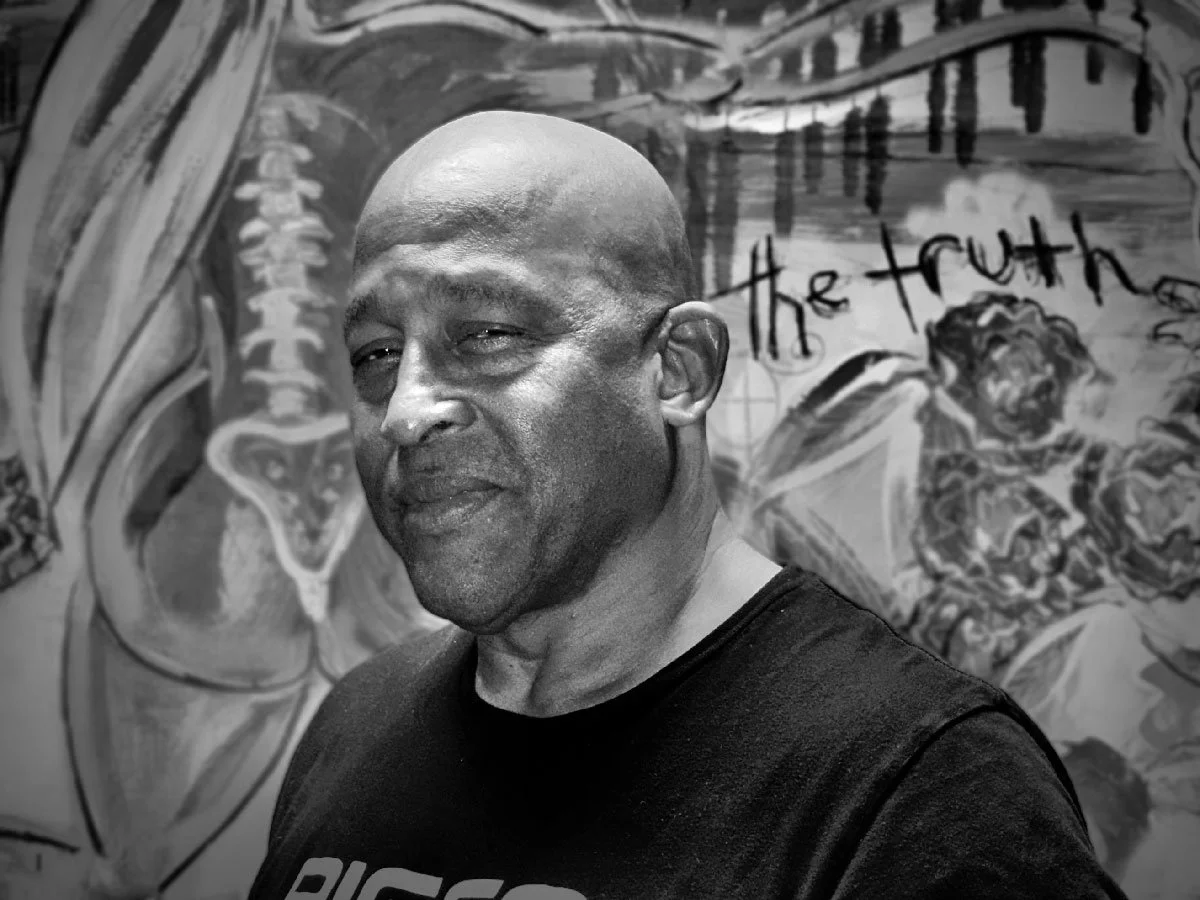
Chuck Perkins inside Café Istanbul, by Ellis Anderson
Beautiful and Ugly Too
By Chuck Perkins
University of Louisiana at Lafayette Press, 2025
Paperback, 163 pages
