
Fold Backwards
Winner of the 2026 Tennessee Williams & New Orleans Literary Festival Fiction contest.
~ by Tena Laing
CALGARY – 2021
Amy finishes a set of weighted lunges, then drops to the matted garage floor, collapses, limbs splayed, sweat running off her.
Dad’s got her practicing in singlets, to keep her in competition mode. Freaking tyrant with a rolling whiteboard, tracking workouts. Keywords for visualization in ALLCAPS. Her daily weigh ins. Everyone’s getting on with their lives, and here she is languishing like it’s Junior High.
Dad opens the side door, masked. “Hey Sumo! You done?” She glares, but he nudges the scale towards her with his boot. “Time to face the music, Ames.”
He can’t come near her. Since he lost his job in the oil patch, he’s been working in a factory, and they absolutely cannot risk her testing positive before training camp.
The invitation is taped to the top of the white board, date circled. It’s her fourth quarantine. Every day she sticks to the plan concocted by coach and delivered by Dad, she gets closer to the Team Canada Wrestling selection. The “self-governed risk mitigation protocol” is underway, and Amy’s not about to waste her overdue chance.
One year ago, she ate, slept, and breathed an Olympics within reach. For four years, she fixated on the sweet symmetry of those double two’s and zero’s that would be on all her gear and mark her moment in history. Now, that symmetrical symbol is a joke. The good fortune all bled out of it, and it’s a new year altogether. 2020ne: an extra year to maintain the intensity of training, except alone, without competition or support. Meanwhile the world could care less, and the Japanese openly oppose the games.
“Mom’s got your protein. Once you weigh in.” Amy too hungry to argue, steps on the scale. Dad doesn’t say anything, because it’s right there flashing in digital numbers. Fuck.
“Gonna start on those letters, Chubbs?”
Amy shrugs.
“It’s important.”
Amy grabs a towel and mops her stinking self. When Mom calls, she throws her winter coat on and heads out to the picnic table.
TOKYO – 2021
Meiko is blessed with a flair for origami and graceful precision. This is sadly not the case for me – her clumsy stepsister. Six years younger, six inches taller, all elbows and apologies. The volunteer coordinator had suggested simple paper cranes, fit for an elementary school child. Meiko has upgraded their expectations offering “a signature origami design for each sport.” The boss is impressed. Meiko is an artisan.
It’s an open office, with dozens of other politely dressed young people. Many can’t find proper jobs in this economy. Like us, they’re padding their resumes. The boy next to Meiko is a recent graduate too and has begun whispering things to her behind his mask. He’s not skilled at paper folding, but Meiko invites me to admire the surprising care he takes with his cuticles.
“You make the rest of us look bad,” he whispers after the boss leaves. She checks to see if he’s joking but can’t tell. He’s been assigned the job of verifying athletes’ sports and mailing addresses for welcome packages we’re creating. As he scrolls through Team Canada’s website, he tilts his screen toward her. Meiko sees the faces of the athletes.
“But they all look the same,” she says before she can stop herself, and avoids looking at me.
“Don’t they?” He doesn’t hesitate to give me the side-eye. No matter how long I live here, or how fluent I may be, I will never be Japanese.
The young faces on the screen have been caught in unmasked delight, mouths wide in celebratory smiles. Mostly dirty-blond, faces scrubbed clean of makeup, sometimes freckled, sometimes spotted with adolescent acne, they look as if they were all raised on the same prairie farm.
Meiko and the boy look at each other. She covers her mouth, already hidden behind the mask as they both giggle.
Sharpening the creases, she continues, folding, then folding backwards. Meiko winces, stunned, as blood bubbles from the corner of her perfectly painted fingernail. She’s never so inept with her valley and mountain folds. She’s given herself a deep paper cut.
The boy says, “You should sign them all in blood! After what this Olympics is taking from us.” A drop of blood plops in a perfect crimson radial across the origami swimmer she has been working on.
“Our grandchildren’s children will be paying for these Games,” he hisses the last word. “Ah, so. Meiko! Lost Child,” he says, looking at her nametag like he’s just found something. “You should be at the protest later,” he says, squinting seriously.
He doesn’t ask about my name – originally May – to which I added the ‘umi’, believing in grade school that being Mayumi would help me fit in. Nothing could help me fit in, but Meiko was my fierce protector. Umi – “You, Me,” we’d say, pointing. “Sisters.”
CALGARY
“Don’t stare,” Amy says as Mom watches her nurse one apple, sliced into slivers, and eight dipless jumbo shrimp. She’s always helped with the painful process of cutting, but it’s gotten harder.
Amy longs for spring. Eating outside in February sucks. She shivers in her damp singlet.
“The whole planet gets to pig out and gain the quarantine-fifteen. I can’t even have a single befrigged chip.” Amy’s hunger has incarnated as something with dimensions. She’s starting to wear it less carefully. She’s usually been a willing dieter. She wrestles at 68 kg and leaving too much to cut at the end is a mistake. Look at Mike Cormier in 2008. He dropped the weight but ended up in a Beijing hospital when his kidneys shut down. Missed his chance.
“Better to keep it tight than chase it off at the eleventh hour,” Mom says, reaching to brush Amy’s lank hair off her face.
“Mom! Don’t. You were just at Costco, and you’re in the hospital every day.” Amy leans away.
Mom jerks back. “I forgot. That’s all.” The sun comes out. Mom’s hair sparkles.
“You’re getting grey.”
“You’re getting mean.”
“I know.”
“Make sure you bottle it so you can use it in the ring.” Mom smiles. “I’ve decided to think of these as wisdom highlights.”
Amy rolls her eyes.
“Has Jeremy called?”
The whites of Amy’s eyes may be permanently lodged in the back of her head.
“Texted?” Mom amends. “Listen, I’ve got half an hour. Want some help with those letters?”
“Begging for money feels so…”
“Applying for grants and sponsorships isn’t begging.”
“I just wish things were normal. Not so fucked up.”
“You know I hate that word.”
Amy bites her lip and keeps her eyes straight.
“But yes,” Mom continues. “I wish things were normal too.”
TOKYO – 2011
Meiko surfaced for air, gasping. She had time for one desperate gulp before she was under again, hands and legs working frantically to keep her in precise position. Coach would remind her again after practice, of the need for graceful breaths - as if air was incidental, and fluid movements. To always be fully in synch with her team. “Watch Yuki,” she’d say. “She is your North Star. Calibrate your movements to match hers.” Then she’d smile that warm smile that made Meiko suddenly happy to be corrected, to bask in her coach’s attention. I’ve watched this video, and all the others, over and over since I was little. Heard all the stories and begged for more.
At twelve, Meiko was the youngest member of the team, but her promise had pushed her up the levels, and she was practising with the most competitive synchronized team in the league.
Her Mother and Father would be watching her compete next Saturday. Father so proud, he would even take time off. Her grandparents, O-baa-chan and O-jii-chan, too. The competition was near their home in Fukushima Prefecture. They would picnic in the family orchard afterwards.
The news comes as Meiko is packing for the competition. They had felt the quakes even in Tokyo. 40-metre waves traveling 700 kilometres per hour, 10 kilometres inland. A magnitude 9 earthquake so powerful it literally shifted the earth’s axis by 25 centimetres. Afterwards, Meiko finds herself holding her breath even when she’s not in the pool. Her hands are never still, she flutters her fingers as though moving through water. She dreams of her grandparents, hair floating around them as their fragile bodies drift, trapped. Water turns to ice and their sweet round faces like wrinkled apples, begin to crack under the pressure. Their orchard and their bodies, ravaged by the waves. She never tells her parents about these dreams, but when we become sisters, she finally shares them with me while she teaches me to swim and not drown.
CALGARY
By March, Amy hasn’t showered in so long she can’t pin down the date. Dirty, shaggy, sleeping in the garage, she feels more pet than person. She can’t escape herself.
Her phone dings. She’s still hoping it’s Jeremy, but it’s Coach, checking in. Amy’s finally eligible for a vaccine! An arrangement for listed athletes.
She’s been wrestling with the Olympics in sight since London. In Rio, she was brought along as a training partner for Betsy, her former mentor. She won’t be a spectator in Tokyo. It’s her turn this time. At least that’s what she felt months ago. It’s getting harder to care the longer this goes on.
At the top of her game, finally besting Betsy in March, 2020, on the cusp of peaking, as scheduled, she’d been jerked out of line and thrown into a brutal holding pattern, like every other elite athlete in the world.
It’s a four-year plan for a reason.
A year later she’s still waiting to find out if she’s made the Tokyo cut.
Dad’s quit working to devote himself full-time to her training.
“Hey, Sumo. What’s today’s output?”
Along with the indignities of daily weigh ins, Dad likes to grill her over her pee and poo and bring her ever more joyless meals.
“What’s that?” As if she wants to know.
“Chicken livers. And onions.”
“Ah, cardboard and spite.”
Betsy, Amy’s closest competitor and former friend, doesn’t have a mom in health care. Or an unemployed dad. She’s sleeping in her luxurious home, taking bubble baths instead of cold sponge baths in the utility sink. Envy permeates every grubby shiver and septic dump Amy endures in the garage.
Another text. Still not Jeremy. It’s Betsy, showing off her spa haircut and manicure and biting a massive cheeseburger. Amy feels her own split ends and ragged nails. Betsy’s even got the nerve to text that because she’d caught Covid last month, she now has to gain to meet her weight class. Is she for real? It’s hard to think Amy used to call her Best-y.
TOKYO – 2015
“Meiko! Come.” Mother rarely raised her voice so Meiko hurried to comply.
In the kitchen, she was shocked to see her father slumped over. He was away so often now it was hard to keep track, but this new business venture was going to make up for all the losses their family had experienced.
Meiko didn’t think anything could make up for losing O-baa-san and O-jii-san, but Father meant financially. Money was important. This house, her prestigious school and swim club, Mother’s jewelry and car. With the destruction of the family’s orchard, father had to start over and work extraordinary hours to maintain their lifestyle.
He was sweating and his swollen face called back that horrible night he’d had to identify his parents’ bodies in a temporary morgue weeks after the tsunami. The lightness leached from him then, and she only ever got glimmers of it anymore.
“Meiko, get some ice. Your father is unwell,” Mother said. She remained calm, eyes dry and wide, as she helped her husband to lie on the couch. “You need rest,” she told him, stern and gentle at the same time.
“Father, are you ill?” Meiko asked as she smoothed the cold cloth over his burning forehead.
His face melted as he reached his hand to her cheek. “My sweet Lost Child.” Meiko told me that she hadn’t the imagination to picture anything more dire than Father needing them in this way.
Yet it wasn’t the worst. There was always something much worse, and when later that week, Father hadn’t returned home, hadn’t called or texted, Mother didn’t sigh, “Ah, Meiko chan, he’s just working late again.” They both knew before they knew.
When the police from Shizuoka prefecture called to say he’d been in a fatal car accident, his heart stopped at the wheel, it was hardly even a surprise. Mother tried to insist that Meiko attend school that day, rising before dawn to pack her lunch. But Meiko was no longer a child, and she went to Shizuoka with Mother, to identify Father’s body which had been removed from the vehicle with the jaws of life.
On the train home, Mother said, “We’ll need to sell the house.”
Meiko opened her eyes.
“And find something affordable. An apartment in Sumida ward perhaps.” Meiko watched Mother involuntarily grimace. “I’ll have to go back to working at the hospital.”
“Move?”
“Yes. You’ll have to change schools.”
“My school? I can’t leave my school. My swimming team…”
For the first time ever, Mother cut her off. “That’s all over now, Meiko.”
Within the year, Meiko’s mother would become mine – the only mother I’d ever known – when she and my widowed father found each other working the night shift at the Yokosuka U.S. Naval Hospital.
CALGARY
She’s given up on Jeremy, who has essentially ghosted her. In a normal year, she’d confront him at competitions. As things stand, he’s simply fallen off the face of her iPhone. Amy’s taken to doom-scrolling news and friends’ social media. Her nights on the mat are grittier and shittier.
Dad threatens to confiscate her phone.
“What is this? A dictatorship?” she asks.
Amy washes up in the utility sink and knocks over a bottle of Jack Daniels Dad has forgotten underneath.
There’s a knock on the door. She hollers, “What?”
“Pizza.” Does Dad think that’s funny?
Another knock.
“I’m decent,” she yells.
The door opens. Someone she doesn’t recognize is holding a Domino’s box.
For a second Amy is elated, the next, enraged. “What the hell…”
Her phone dings. Betsy.
~Thought you could use a treat.
~Thanks, Betch. U know I still have kilos 2 cut.
~Oops. I forgot.
Amy can scarcely unlock her clenched jaw to bark at the delivery guy, “Throw that in the garbage. Outside.”
He looks at her. “You sure?”
“Do it now.”
He hesitates.
“Don’t come back.”
She hears the thud of the garbage bin when he finally leaves. Amy beats her head twice against the mat, then crawls to the utility sink and pulls out Dad’s JD. She’s been dry in training since Christmas but cracks the lid and drinks from the bottle.
Dad’s not due back tonight. She sips whiskey until it no longer tastes like poison.
Another ding.
~Dessert.
“No,” Amy says. She keeps saying it all the way to the door and again as she opens it and spots the box of Krispy Kreme donuts at her feet. “Fucking Betch.”
Amy picks it up, then staggers outside and scares off a lurking racoon. She lifts the lid and finds the untouched pizza box at the top. With angry tears, as furtively as her drunken, shrunken ass can manage, she carries everything into the garage.
“Coulda been worse. ‘Least I didn’t have to wrestle that raccoon,” Amy mumbles as she tears into her fourth slice. “Fuckin’ garbage pizza. Fuckin’ garbage friend.” She shoves the donuts in, each one a dagger.
TOKYO – 2021
Meiko walks past shuttered department stores, beauty salons, and restaurants. She wears a pale green cardigan that hangs off her slight frame, her muscular swimmer’s arms and torso long lost. Despite my longer legs, I trail behind, distracted by everything. Meiko is purposeful and brisk.
She pauses at a shop, adjusts her mask and enters with her elbow.
“Rashai-masai!” the masked shopkeeper calls in welcome. Meiko returns her bow, then takes a basket to examine the stationery. Her fingertips brush the surface of different samples: texture is everything. She settles on one that is neither too rough nor too pricey.
She stacks dozens of these small cards in her basket and goes to the calligraphy pens next. This time she knows exactly what she’s looking for and selects a fresh set with tiny tips.
“You have a creative project in mind?” the shopkeeper asks at the checkout.
“You could say that.”
“Invitations?”
Meiko is not made for lies. “More like the opposite.”
“Well, a personal touch is always appreciated,” the woman smiles, oblivious.
At home, while Mother prepares for the late shift, Meiko lines up the calligraphy pens and stacks the small cards beside them.
“More art?” Mother murmurs, distracted as she packs a bento box for her midnight lunch. Having returned to working with little seniority, Mother seems to draw the short straw in the scheduling, always pulling more overnights and overtime. She is still waiting for the red tape to clear on Daddy’s military pension spousal benefits, and household expenses won’t wait. But Mother has always worked, while providing a homelife, even when we were very young. Even after Daddy began to accept postings to military hospitals on bases in other countries, she continued, preferring to stay here in Japan. I was done with base-hopping and would not be taken from my new mother. Meiko says Mother never wanted to be dependent again. I think she was grateful that when Daddy didn’t survive the second wave of Covid in Spain, the Navy handled everything. “How many husbands must I bury?” she’d asked us.
The only things I’m grateful for are Mother and Meiko.
Tokyo is supposedly hosting the Games in two months yet only four percent of Japan’s population has received a single vaccine. A year ago everyone was so excited. Meiko and I had even bought the 2020 gear, the hat, the sweatshirt, the cute stuffed mascot. Now everyone is bewildered and angry.
Mother touches the top of our heads gently before leaving. After she goes, Meiko settles into her work. She consults her list then looks up the athletes online. She’s struck by a female wrestler from Canada, built like a small tank. “Can there be anything of beauty to celebrate in such a harsh and grappling sport?” she asks me. I don’t like to say, because there is something about this unattractive wrestler that, quite honestly, feels a bit too familiar to me. Meiko rarely lets herself contemplate her own dashed Olympic dreams, though her hands still flutter, and she often holds her breath. She delicately brushes the words onto the tiny cards and conscripts me to pin them to an indoor clothesline to dry. She has me check her carefully worded English message:
Dear Amy-San,
I know you have been training your whole life for this moment. Well, actually, for 2020, which is now a previous moment. In Japan, we also had important moments that we were waiting all our lives for, and they did not come to pass. Terrible things came in their place. More terrible things are coming. If there were a god, I would pray to her every day and night that you never come. If you have a human heart, I urge you not to come here to Tokyo. We are sorry, but you are not welcome. We all will regret if you come. Please take heed.
T.A.O.C (Tokyo Anti-Olympic Committee) www.taoc.jp.org
CALGARY
Amy’s grunt becomes a full-on scream as she wrestles ‘Lug’, the leather opponent Dad has fashioned from an old punching bag by adding stuffed limbs and a lolling head. Lug weighs a ton and gets slippery when Amy sweats too much, which is every time. You wouldn’t think Lug could fight back, but Dad has added an electric jolt that Lug can give off when Amy makes a stupid move. Of course, Dad administers it, but Amy has come to consider Lug her mortal enemy. Sometimes at night she considers taking the pruning shears to the thing.
“You’re frustrated. Take five,” Dad says.
“Frustrated? How about you return my fucking phone? And how the hell am I supposed to train with an inanimate object? This is bullshit. You think Betsy’s doing this?”
“That’s why you don’t have your phone – obsessing over what Betsy’s doing or not doing. You’re not a kid anymore. Stop acting like one.” He points to a corner of the mat. “And finding you unconscious in a pool of regurgitated junk food and Jack? The stink is never coming off this mat.”
“Got news for you. This mat stank long before that.”
“Ames, you could’ve drowned.”
“Now who’s being dramatic?”
“Fine. Choked.”
“Let’s talk about Lug.”
“Meaning?”
“You haven’t gone to work for months now. Unless you count aggravating me. You’re as safe as anyone. Why can’t I wrestle you?”
“Amy…” Dad shakes his head.
“What? You afraid of hurting me?” Amy mocks. “’Cause that’s not gonna happen.”
“Well,” he looks unsure.
“Wait, you’re actually worried I might beat you. Admit it!”
Dad frowns as though she’s being ridiculous. “I haven’t wrestled you since that time I made you cry. I told myself I wouldn’t do it again.”
“I was fifteen, Dad!”
He wavers, almost smiling.
“I’m probably going to regret this,” he says, but tucks his shirt in.
“Come at me, bro,” Amy taunts, channeling her teenage self and getting in ready stance.
Dad, a foot taller and fifty pounds heavier, joins her on the mat. They size each other up, circling a bit until Dad finally puts out an arm to get things started, and she surprises them both with a high inside crotch lift, knocking him flat. The look on his face is the best thing she’s seen all year. He’s so startled, she pins him before he can do more than gape.
“Sheesh, I’d have had a tougher time with Lug,” she says, brushing off her imaginary collar.
Dad groans as he rolls over and gets up. “Oof, this 55-year-old body.”
“Ok, Boomer,” Amy says. “You ready to go again? Maybe put up a bit of a fight? Gimme me just a bit of competition?”
Reluctantly, Dad centres himself on the mat. This time, as they both swat at each other, Amy tries to make a grab behind Dad’s neck. Dad unexpectedly folds backwards, collapsing to his knees with an ungodly moan. “My eye! You’ve sliced my cornea!”
Amy looks down. Instead of the regulation clean-cut-to-the-quick, her nails are jagged and filthy. Dad warned her about them yesterday. God, what she wouldn’t do to not have him be right. Again.
Dad’s crying softly now. Keening. He pukes on the mat. She needs to call 9-1-1, but Dad has confiscated her phone. He won’t carry one himself, and Mom’s at work. Shit.
“Dad! Where are your keys?”
He’s just lying there, rocking, with both hands cradling his right eye. Oh God, has she blinded him?
“You’ll have to drive,” he says finally, and she fishes around in his jacket for the keys.
“Of course.”
They’re halfway to Emergency before he speaks. “Jesus, God, girl. Who taught you to drive?” he says as she lurches to a halt.
“You.” she whispers, opening his door. When she gets her phone back, the first person she’ll text is Coach Claydon with her resignation. She is done.
TOKYO – THIRTY DAYS OUT
During lunch, Meiko marches beside the boy from the volunteer office. I follow along. Fifteen anti-Olympic organizations are protesting, and the boy’s holding three different signs. When it’s time to go back, he stays marching with the protestors instead.
As we sit back down at our desks, the building rattles with prolonged shaking. I am numb to earthquakes and most things. Meiko has experienced a thousand earthquakes, yet she is never unaware that being on the fifth floor of this ten-floor building means our floor could disappear. Outside, cars on the elevated freeway race by, even as the concrete structure sways, impossibly liquid. Meiko sits on her hands to still them. “People in Tokyo. Don’t they even remember Fukushima?” she says.
When the quaking stops, Meiko places her origami creations into the official welcome packages, sneaking in her calligraphed notes.
The mailroom attendant comes by to collect envelopes, and Meiko seems relieved to pass them off. When a supervisor requests volunteers for staging the international athletes with their uniforms in the final pre-Games push, she signs us both up. “What else do we have to do?” she says.
Meiko wonders if the boy will be reprimanded for returning late. If he returns at all.
She goes back to staring at the ungainly wrestler, imagining an ugly sport. “When I look at her, I see tires flipping and skulls cracking.” Meiko clicks a YouTube link and there she is, Amy, the Canadian wrestler, in the match where she won her berth to the Olympics. She is not, after all, clunky and clumsy. Instead, she moves with astonishing grace and power, as she takes control of her opponent. Meiko is moved. “An economy of motion…in its own way as elegant as a choreographed underwater dance,” she whispers, shaking her head as her fingers float.
I watch as Meiko heeds the flutter of her heartbeats telling her this private protest is not the path to healing her own wounds. Too late, she rushes to the mailroom.
CALGARY – TRAINING CAMP
“You have everything?” Mom asks.
“She’ll be fine, right, Ames?” Dad says.
The driver arrives. Amy stands six feet away, nodding at Dad with his bandaged eye, and Mom in her scrubs. She’s relieved Dad isn’t blind. She’s got her phone back, and she’s finally reached her fighting weight, but Amy feels empty in more than just her stomach. She spends the ride to Calgary Olympic Park double masked, guts growling, wondering how to tell Coach she’s quitting.
They’ve set up a dome. Amy goes through rapid Covid testing, then weighs in. She’s been so disciplined since the Pizza fiasco that she didn’t need a sauna suit to cut the final pounds. After testing negative, Amy’s allowed to remove her mask and enter. She looks for coach but only sees a couple walking towards her, holding hands. It’s Jeremy and Betsy - of course it is. They lock eyes, then turn around and head in the opposite direction. How had she always thought he was such a catch? And Bitsy Betsy, fresh from the spa. Neither appear to have suffered a moment of this endless extra year. It shifts for Amy then: She’s not taking my spot! Just because things are stupidly hard, this is an opportunity to step up, not give up.
A film crew is there to capture the moment when Amy reunites with an overjoyed Coach Claydon. They are there when the ref gives Betsy one minute to clip her ridiculous shellac nails before the match, and there when Amy doesn’t put a foot or hand wrong, as she controls the match, in a way that feels like coming home. They film the delicate dance as she overpowers and pins Betsy for the win.
Jeremy is chatting up the 58 kilo girls when Betsy limps away from the ring,
“We’re sending our recommendation to the COC. Once they approve, it’s official. In the meantime, here.” Coach hands Amy an envelope, postmarked, Japan.
“What’s this?”
“Just a little welcome from the Tokyo Organizing Committee,” Coach smiles. “Staging will take place there. Don’t worry, we’ll get you a Team Canada sweatshirt or something before that.”
It isn’t until Amy’s lying in the king size hotel bed after the meal which she and all the other athletes eat alone in their separate rooms, that she reaches for that envelope and pulls out two handcrafted origami sumo wrestlers, one with a blue loincloth and one with orange. She knows this game, has seen it on YouTube. She sets them across from each other on the bedside table. She slams her hand down beside them. The paper wrestlers jump but land upright. Amy brings her hand down again and again, until one of them topples – the one she thinks of as Betsy - and a tiny card slips out from inside.
Amy turns the calligraphed note over in her hands a few times. How Betsy had managed this was hard to say, but Amy smiles. Perhaps she had been a worthier opponent than Amy realized.
TOKYO – TEAM CANADA STAGING
Amy enters the warehouse with her teammates, the new friends-for-life she met on the flight over: cyclists and artistic swimmers. Apparently, synchro switched names in 2017 and she hadn’t even known. The buzz only mildly subdued due to Covid protocols. They joke that it’s the first year the Olympic organizers won’t be handing out condoms, and the bedframes in the Olympic Village are cardboard. Instead of bringing people together, these Games will work extra hard to keep them apart.
Coaches discuss schedules and time zone adjustment as athletes get outfitted with their official Team Canada uniforms – all the gear Amy’s visualized for the last five years. Smiling Japanese volunteers greet them at every step. Amy stops for her new red singlets in front of a slim volunteer who looks up in relieved recognition and greets her in English.
“Ah, Amy-san! I am so happy to see you came, after all.”
“Thank you? May-ko, is it?” Amy, surprised, reads from the nametag.
“Yes. Meiko desu.” The volunteer nods and bows.
Amy bows back clumsily. Hugging her new kit with one hand, she notices her own backwards ID lanyard.
“But, how did you know my name?” she asks.
“I remember you because…you remind me of my sister,” Meiko says, and smiling, points to another volunteer exiting the back room with more singlets – a tall, young, white woman with dark curly hair, who looks nothing at all like Amy.
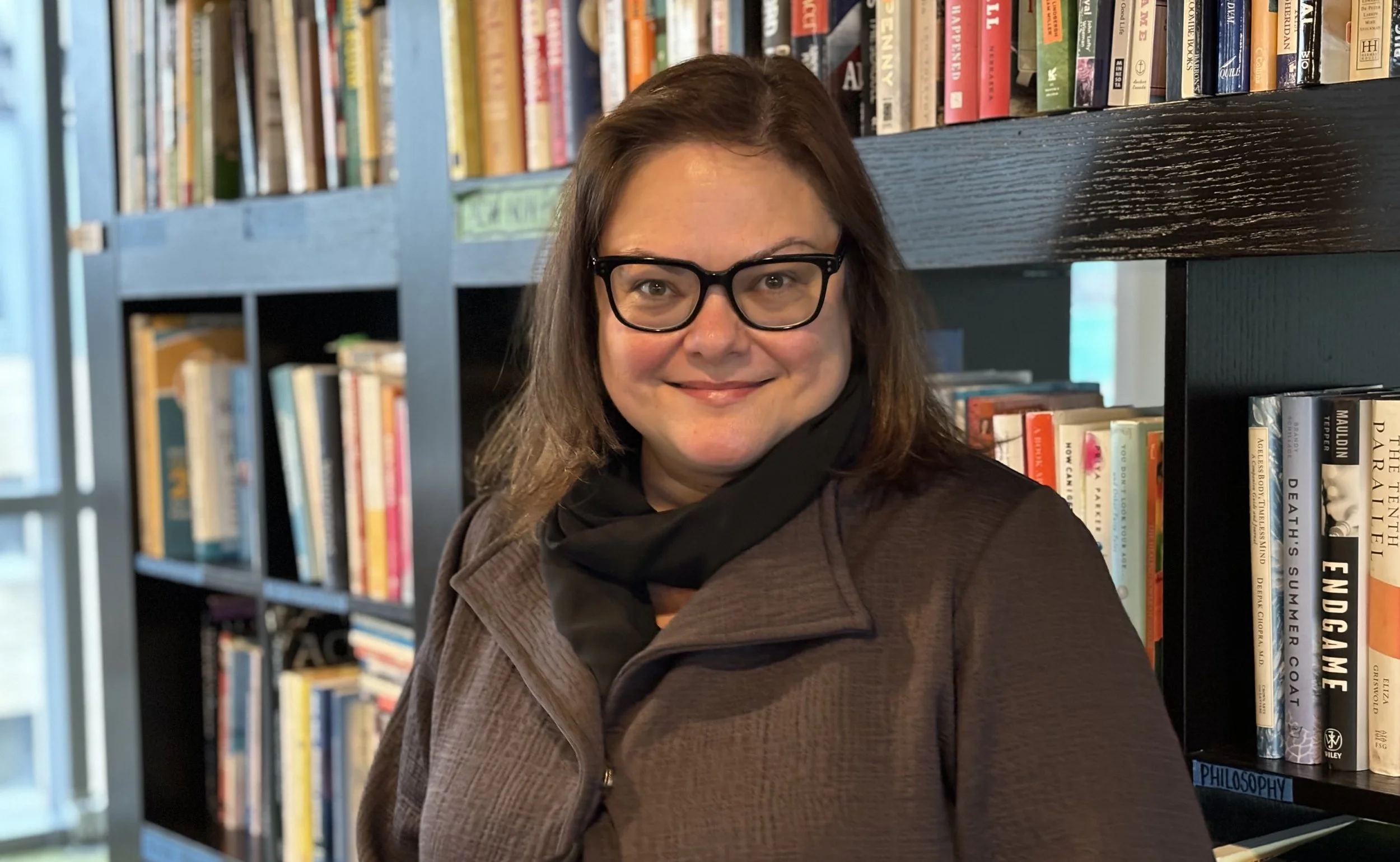
Tena Laing
Tena Laing is originally from Newfoundland, and now lives and writes in Toronto. She has also called Halifax, Quebec, Tokyo, and Calgary home. Tena won the Muskoka Novel Marathon Manuscript Contest, placed third in the Canadian Authors’ Association – Toronto National Writing Contest, and was a finalist for The Cincinnati Review Schiff Fiction Award, the Fiddlehead Fiction Prize and the Writers’ League of Texas Manuscript Contest. She was shortlisted for The Alpine Fellowship Writing Prize and the Huron County Short Story Contest and was a semi-finalist for the American Short(er) Fiction Contest. Tena holds an MFA from The University of British Columbia. Her fiction most recently appears in Horseshoe Literary Magazine, and she is currently revising her first novel, along with a collection of short stories.
Note from the judge, Ladee Hubbard
["Fold Backwards" is] a finely composed and poignant story of resiliency in the face of grief that is both intimate and sweeping in scope.