
Mike Stark: Man of Many Masks
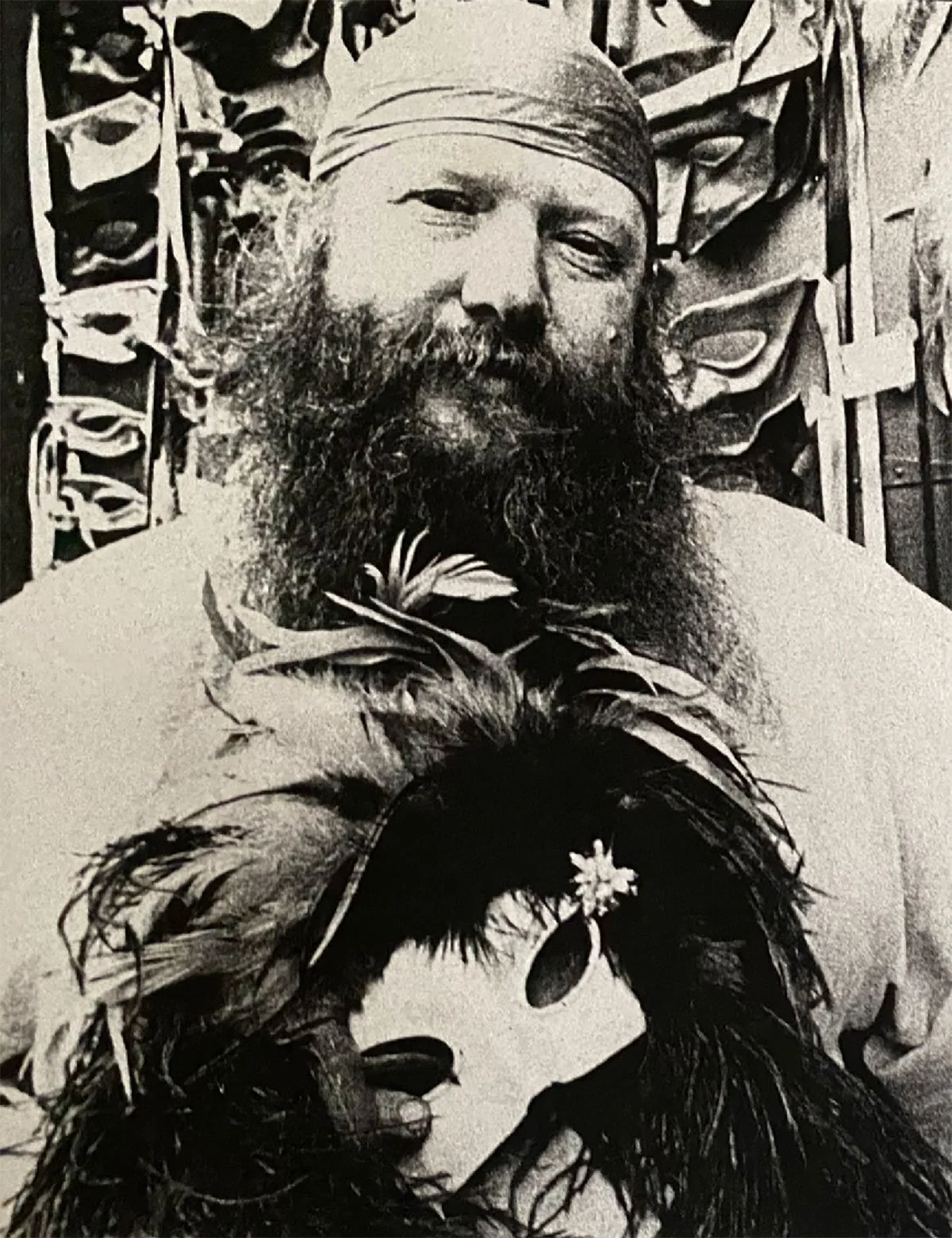
From Mike Stark’s celebration of life program, courtesy Laura Guccione
July 2026In the mid-1960s, a young Southern Baptist pastor moves to the French Quarter, becomes King of the Hippies and helps transform New Orleans mask-making into an art form.
— by Laura Guccione

This column is underwritten in part by Jeannette Bolte, PhD
I first met the late Mike Stark in the most unlikely place: Charity Hospital. My mother was one of his rehab nurses after he suffered a stroke in the early 1990s. I had just moved back to New Orleans from Los Angeles and wanted to open a store in the French Quarter. Mike owned Little Shop of Fantasy, which specialized in masks and costumes, and needed extra help, especially with bookkeeping.
That was just the beginning. Mike would become a significant part of my life, and my sister and I would find him on the fateful day of his passing, after he returned home peacefully.
Mike Stark, arguably the most renowned mask maker in New Orleans, was a defining presence in the French Quarter, beginning in the 1960s. A flamboyant figure in a neighborhood of big personalities, he stood out.
I say 'found,' but who could miss him? He was a tall, big man with a striking red beard, often wearing colorful caftans and matching caps. He knew everyone, or maybe everyone just wanted to know Mike.
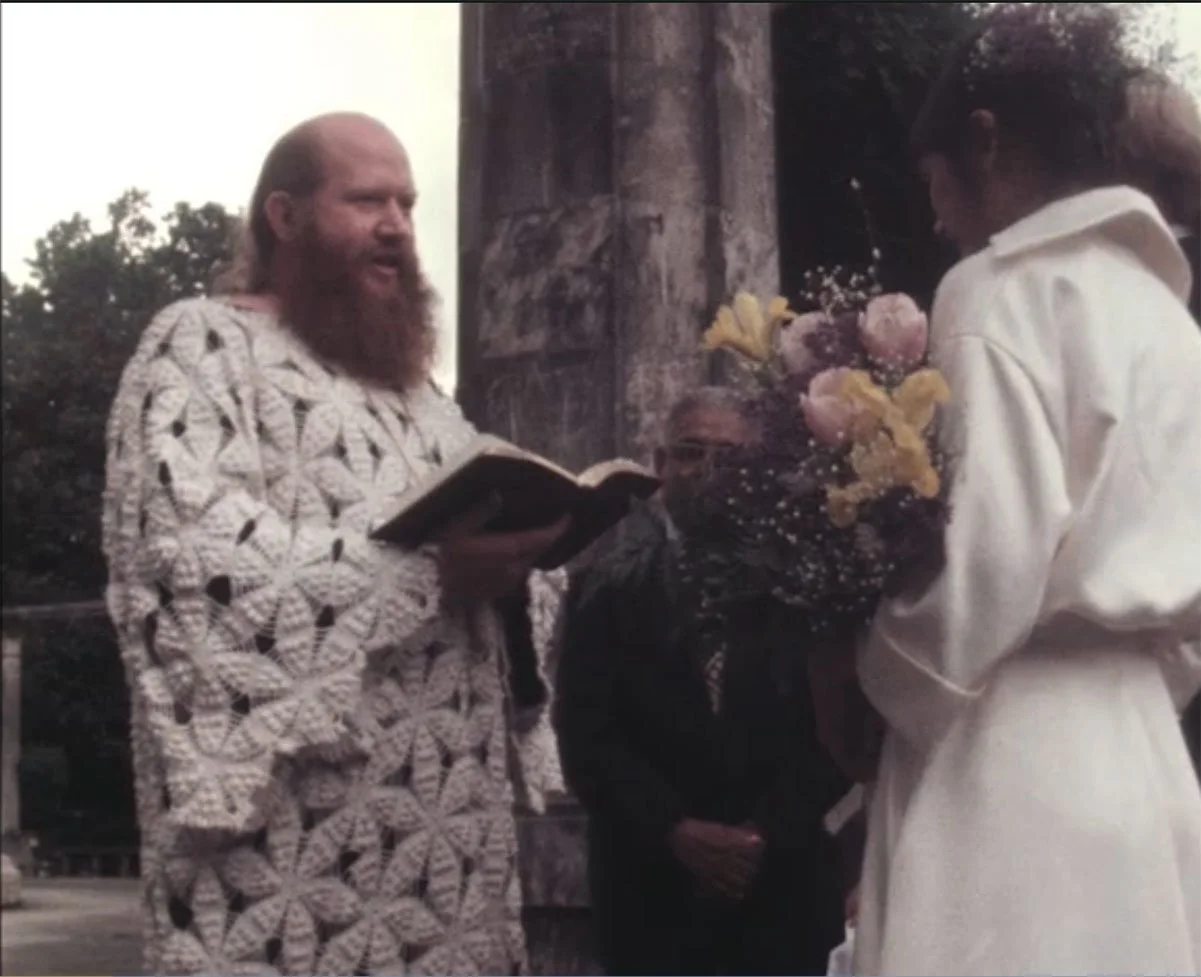
Mike Stark marrying a couple, screenshot in a video in the Historic New Orleans Collection. Click on the image to watch footage from the wedding in HNOC’s online catalog. Gift of Paul Werner
Like his fabulous feathered masks, he was a true original. He created magic and encouraged people to discover parts of themselves they never knew existed through the act of masking. He explained to customers in his shop, Little Shop of Fantasy, that the mask they chose revealed a hidden side to explore. Masks can conceal and expose simultaneously, and he knew that.
But he did more than run a shop; he was instrumental in many ventures that supported artists and helped young people – including a free clinic, a soup kitchen, and the expansion of the French Market to include the flea market. He also supported Preservation Hall and the New Orleans Jazz and Heritage Festival in their early years.
***
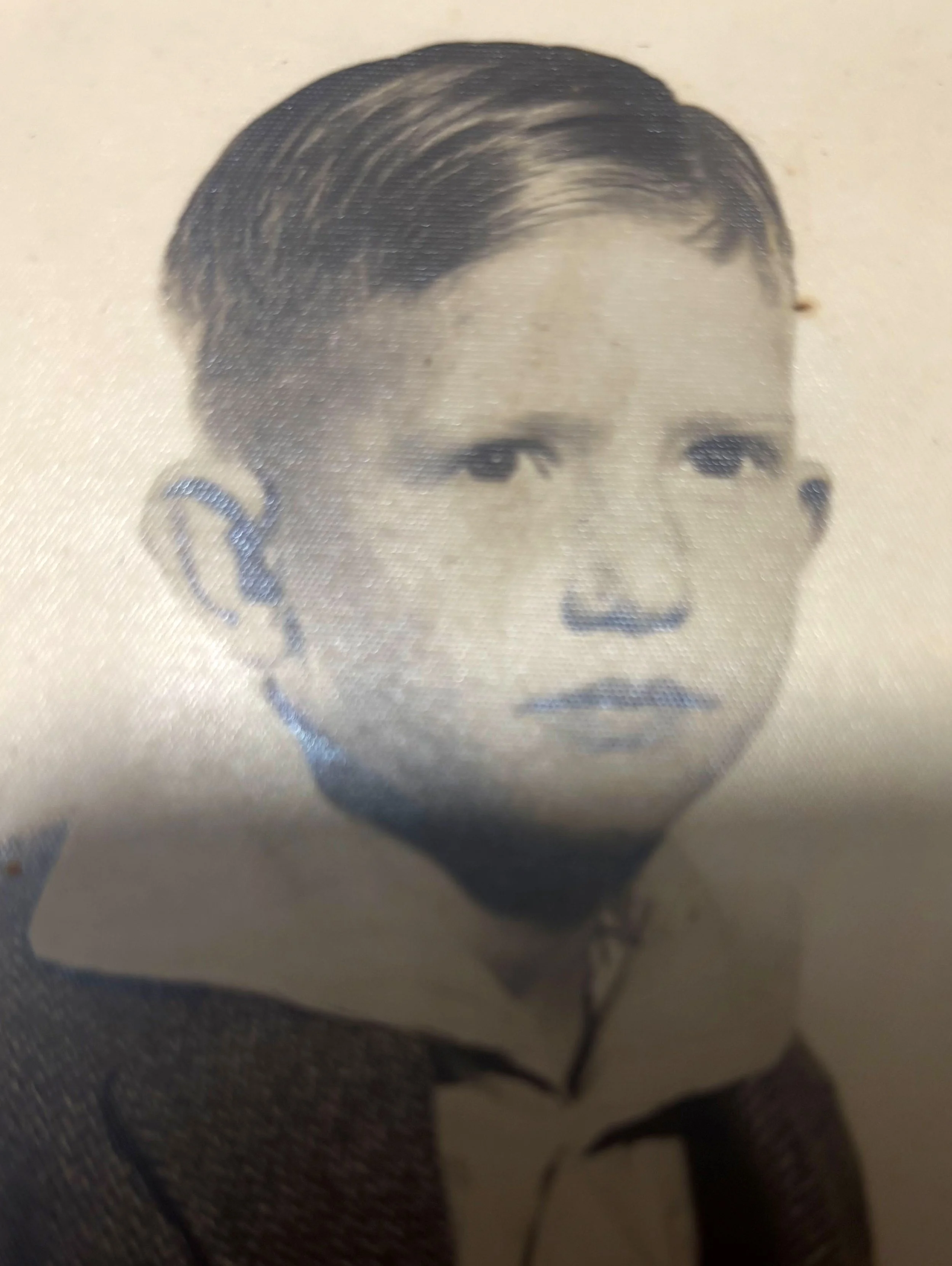
Mike Stark as a young boy, photo courtesy his sister, Judy
Stark grew up in the small East Texas town of Greenville. Always an animated speaker who used his hands to aid communication, in high school, he found a calling in interpreting for deaf members of his church community in Texas after meeting a deaf woman. At some point during his childhood, Mike briefly visited New Orleans with his father, and the trip must have left an impression. According to his sister, Judy, he returned to New Orleans in 1962, to attend a convention for the deaf at the New Orleans Baptist Theological Seminary.
New Orleans cast a spell on the young theologian, and he returned to continue his religious studies, pursuing a degree not as a pastor or a preacher, but as a seminary educational director. However, someone pointed out that it would be better for the parishioners if he were a preacher speaking as himself, rather than interpreting for someone else.
It was here that he found his voice, which he would eventually use to speak out not only for those with hearing disabilities but also for the poor, the rebellious youth, and the LGBTQ+ community. The jump from interpretation to action was easy, grounded in the true teachings of Jesus to care for the needy and the voiceless.
Mike graduated from the seminary in 1964 and for two years, interpreted services at the nearby First Baptist Church in Amite, Louisiana, while continuing to live in the French Quarter apartment he had rented during seminary. The city’s magic captured him and changed his life, allowing him to begin exploring his true self. Mike was gay, but coming from a small Texas town, he had never had the chance to express himself. New Orleans gave him that freedom.
Although he was now an ordained minister in the Southern Baptist Church, his flock was now unconventional – the hippies who descended on the French Quarter in the 1960s. The French Quarter became his church, and the hippies became his congregation, prompting local police officers to dub him “the king of the hippies.”
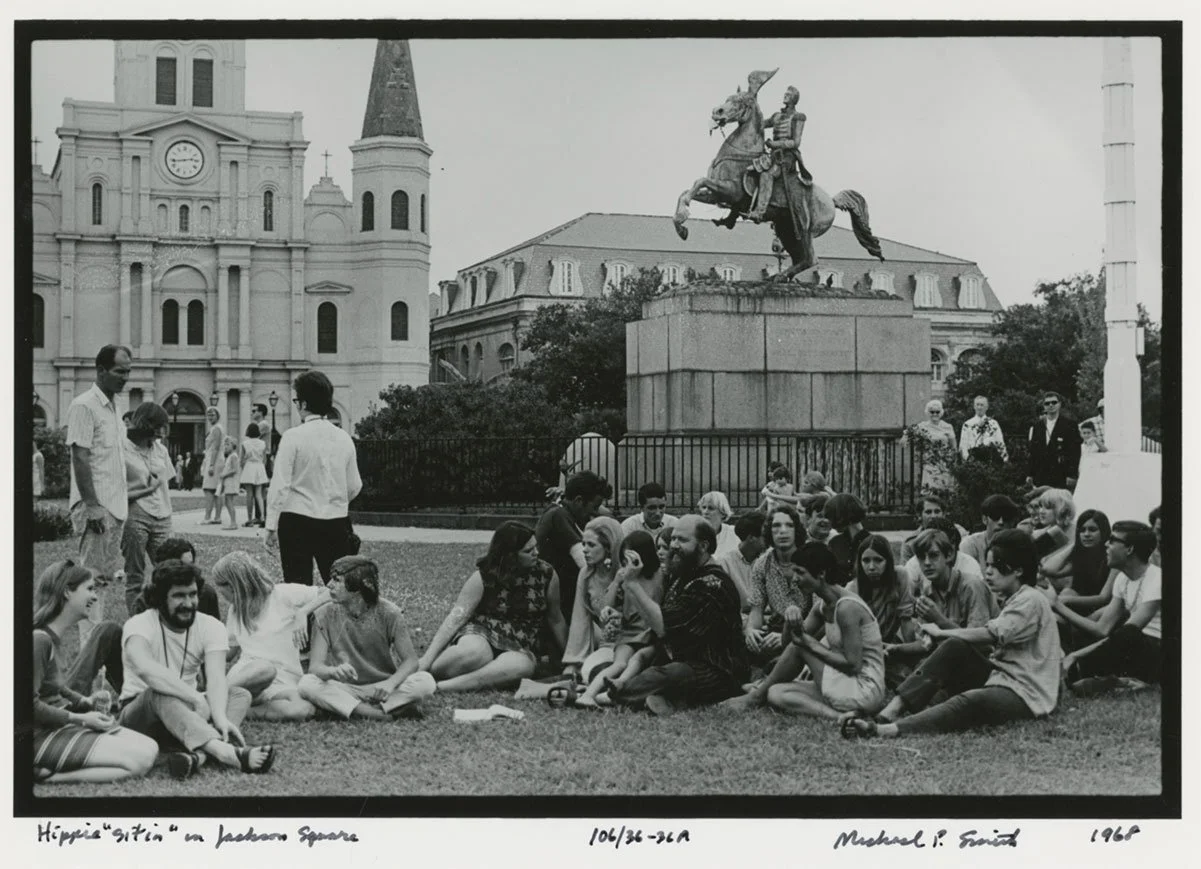
Mike Stark, center right, in this 1968 photo by Michael P. Smith, ©Historic New Orleans Collection, 2007.0103.4.950
Deeply concerned about the young people in his neighborhood, Mike opened the Health Emergency Aid Dispensary (the HEAD Clinic) on Decatur Street, which provided completely free medical services. Below the clinic, he ran a soup kitchen at the street level, living on the third floor.
The HEAD Clinic was a response to growing concern about how the “long-haired community” was treated by the “short-haired.” As Mike explained, when young people arrived in New Orleans, they often went hungry and sometimes needed medical help. He eased the burden on local officials by taking up their plight with the help of volunteers.
He also started the New Orleans Switchboard Exchange (NOSE), which provided community information; the Help Around the Neighborhood Directory (HAND), a ride-share program; helped people find places to stay; and established the ABBA Foundation, which offered free legal assistance.
Later, in 1974, he recognized the need to support the LGBTQ+ community, so he helped open the Gay Services Center in Faubourg Marigny and was also involved in the short-lived newsletter The Closet Door.
In a November 1, 1982, article in the Times-Picayune speaking about the 1960s and 70s, he said that “the French Quarter was where those who don’t fit in lived. The Bohemians were here, the Creoles were here. In a sense, it was a continuation.”
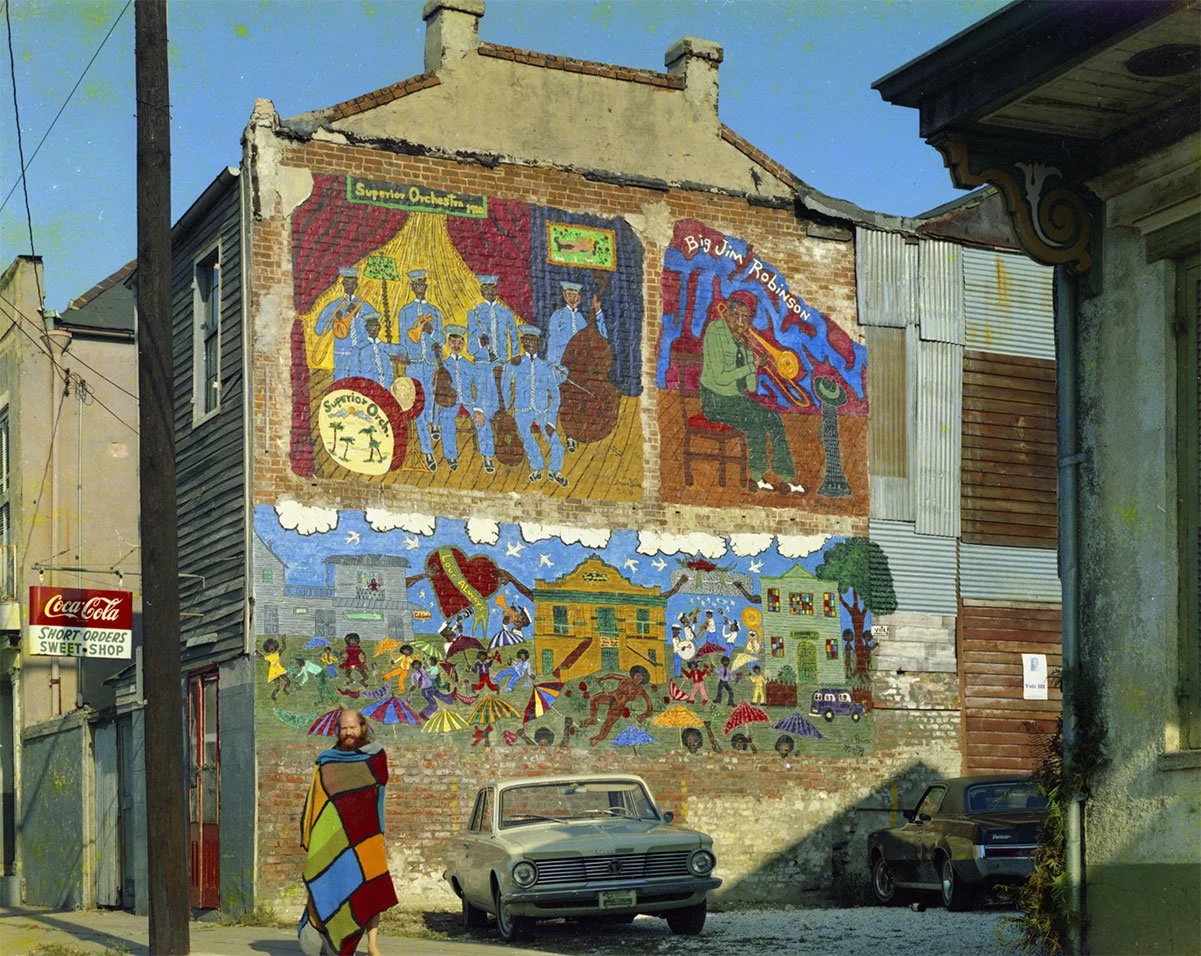
Mike Stark by a Bruce Brice wall mural located at 1127 St. Phillip Street in the Tremé. Photograph by Michael P. Smith ©Historic New Orleans Collection, 2007.0103.12.425
While living in the French Quarter, he found his second home at Preservation Hall, where he met two of his lifelong friends, Larry Borenstein and Allan Jaffe. Mike would settle in to listen to the musicians and sketch them as they played. He sold these sketches to tourists in the hall. He opened his first shop at 623 Bourbon Street, starting a business, Stark Realities, in about 1968, where he sold Mexican goods, including pre-Columbian art.
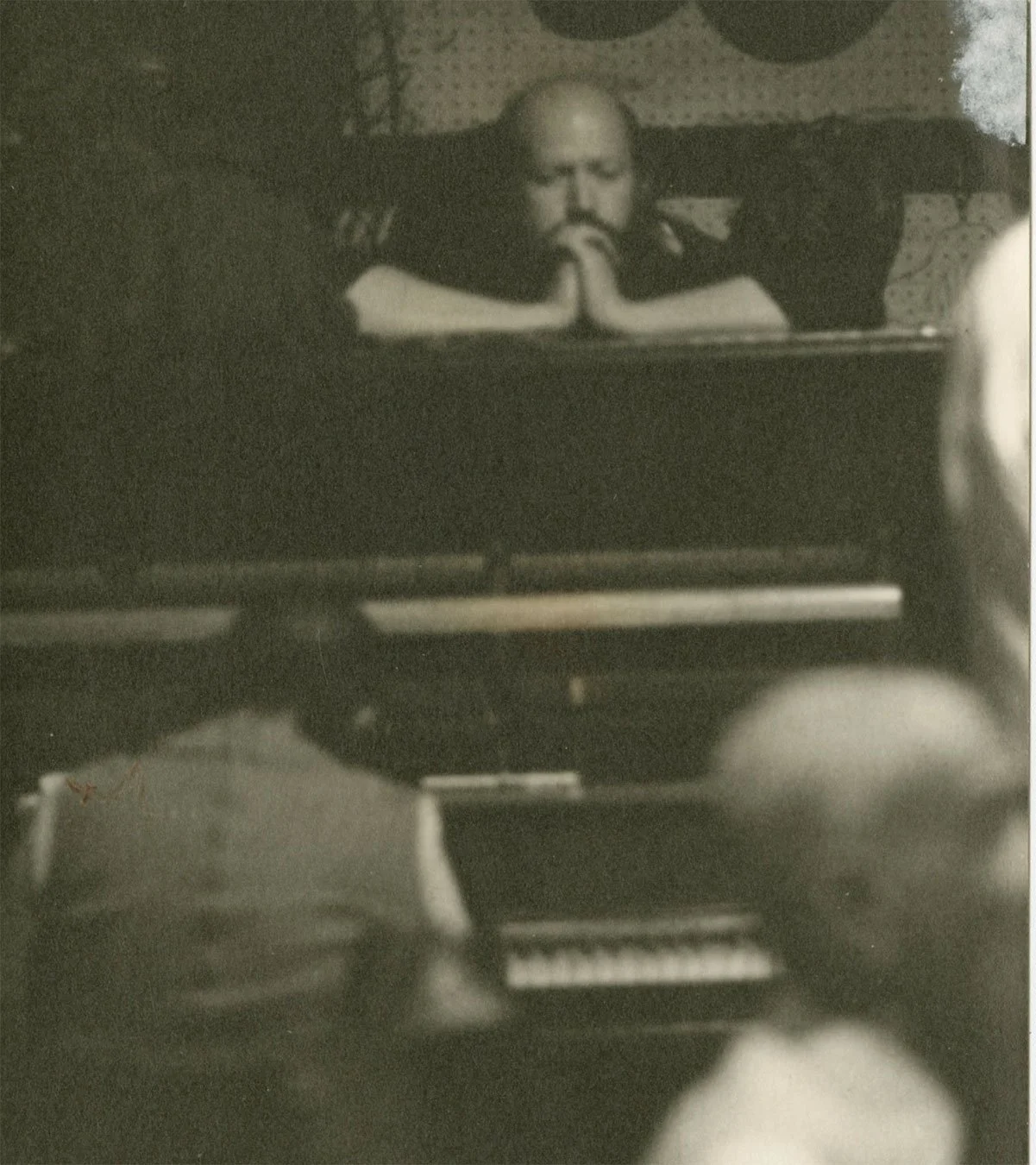
Mike Stark in Preservation Hall, The William Russell Jazz Collection at the Historic New Orleans Collection, acquisition made possible by the Clarisse Claiborne Grima Fund, MSS 520.2621
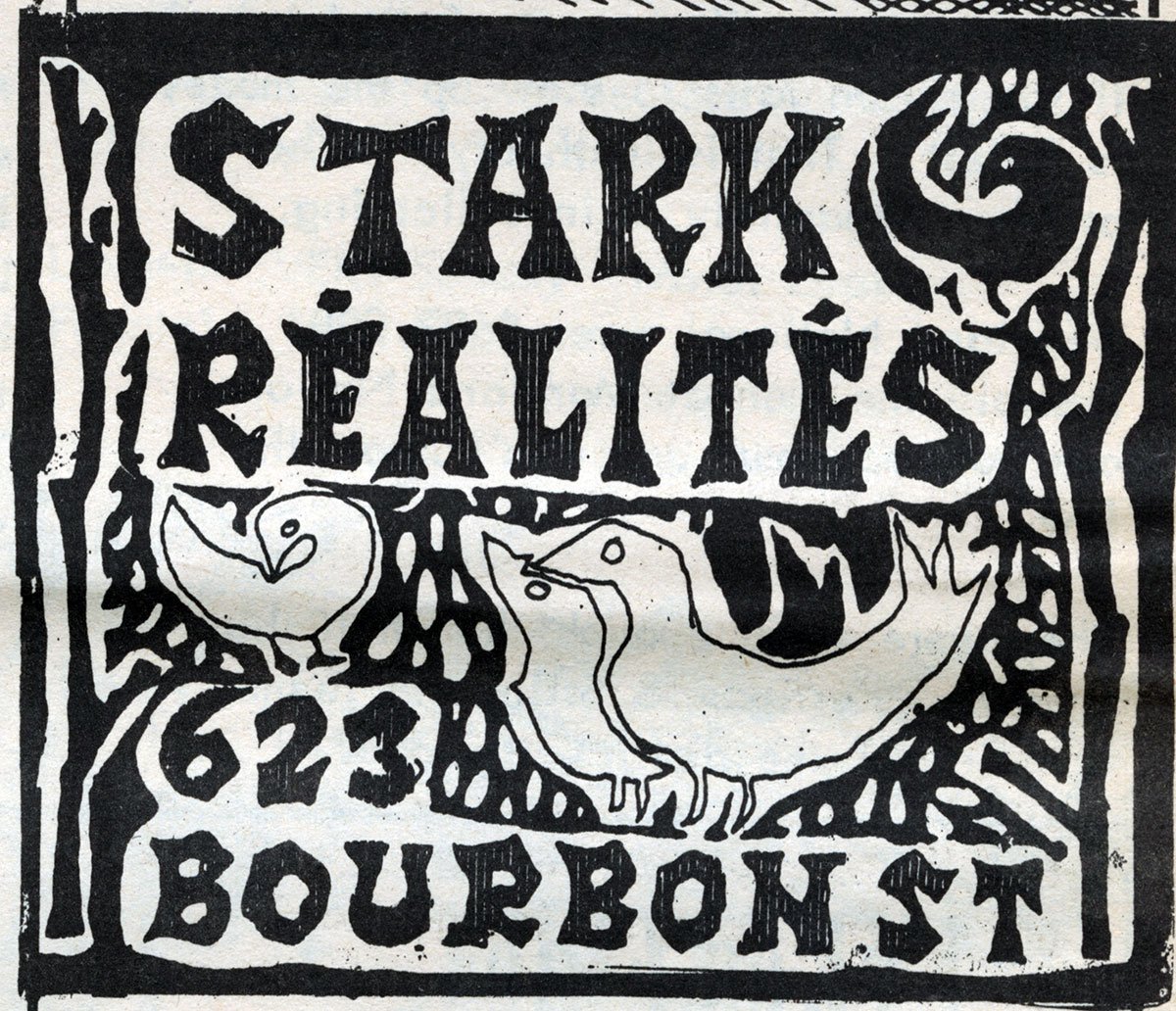
Advertisement for Stark Realities in a July 1969 issue of NOLA Express, an underground newspaper headquartered in the French Quarter.
The building was owned by Frosty Blackshears, a cousin of the esteemed US Representative and Ambassador to the Holy See under President Bill Clinton, Lindy Boggs, who would inherit it and spend her remaining years there. Mask-making would come later, when Mike met one of his dearest friends, Joanne Clevenger (later founder and owner of the iconic Upperline Restaurant).
Always looking for the next thing to keep him busy and involved in his French Quarter community, Mike set up Rent-A-Hippie Guided Tour in 1968 at 728 Toulouse Street, offering “an exciting and fresh introduction to the French Quarter with a bona fide hippie as your guide,” and promising a “personalized view of New Orleans that includes a soul food meal” at Buster Holmes’ Bar and Restaurant, the legendary eatery opened in the 1960s on the corner of Burgundy and Orleans, known for its affordable New Orleans cuisine and local flavor. A wonderful account of these tours was captured in this 1970 New York Times 1970 story, “How I Rented a Hippie and Saw New Orleans.”
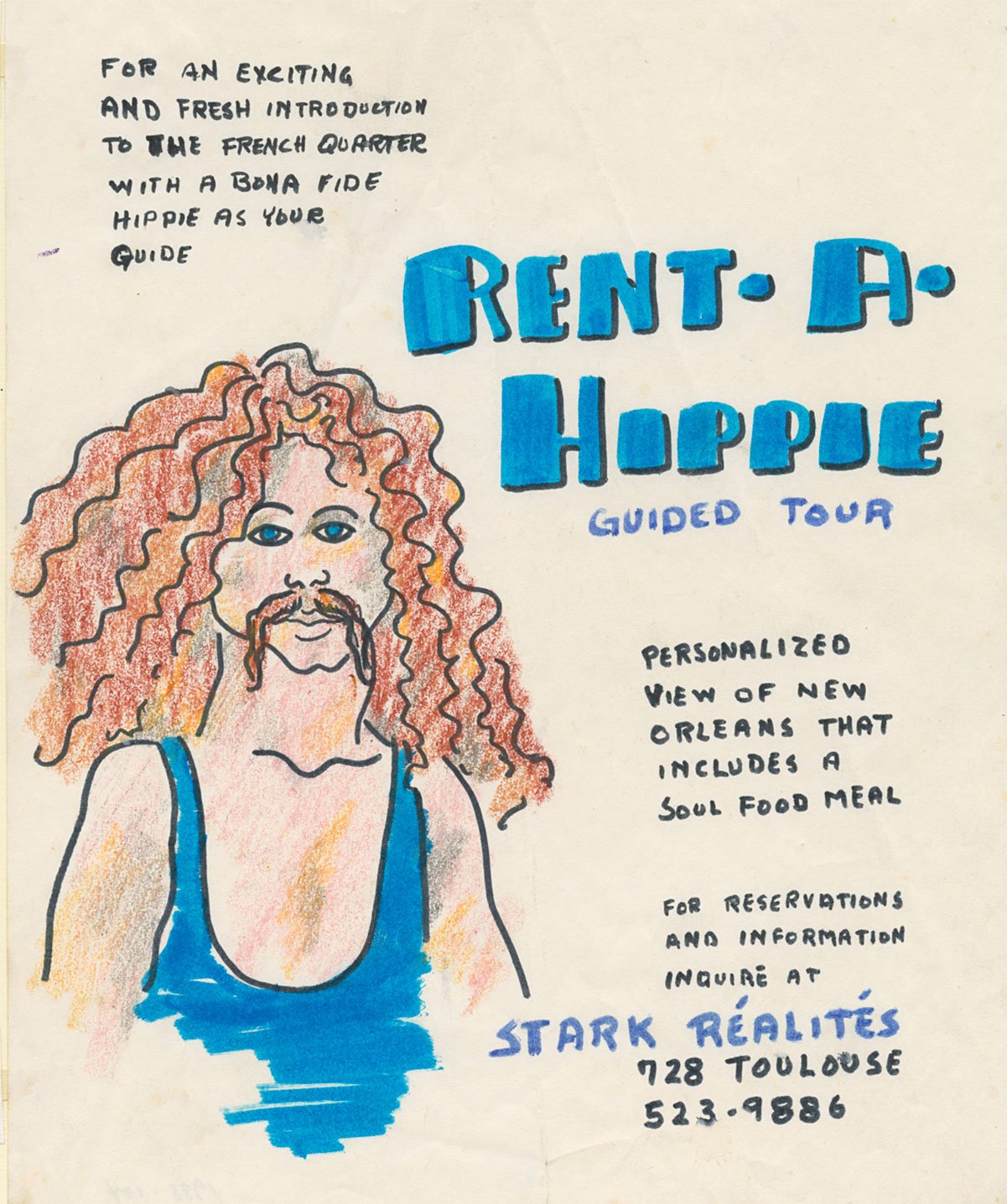
Historic New Orleans Collection, 1988.124
Throughout the late 1960s and 1970s, Mike was also involved in many creative ventures, either directly or indirectly. At Vaucresson Creole Café, a restaurant owned by Sonny Vaucresson and Larry Borenstein and a hangout for many creative types in the French Quarter, Mike met Vernel Bagneris, a waiter there who was writing One Mo’ Time, the fabulous musical set in 1920s New Orleans that became an-off Broadway sensation. Like many spots in the French Quarter at the time, Vaucresson’s was lively and encouraged the arts by displaying art and having a piano ready for impromptu concerts.
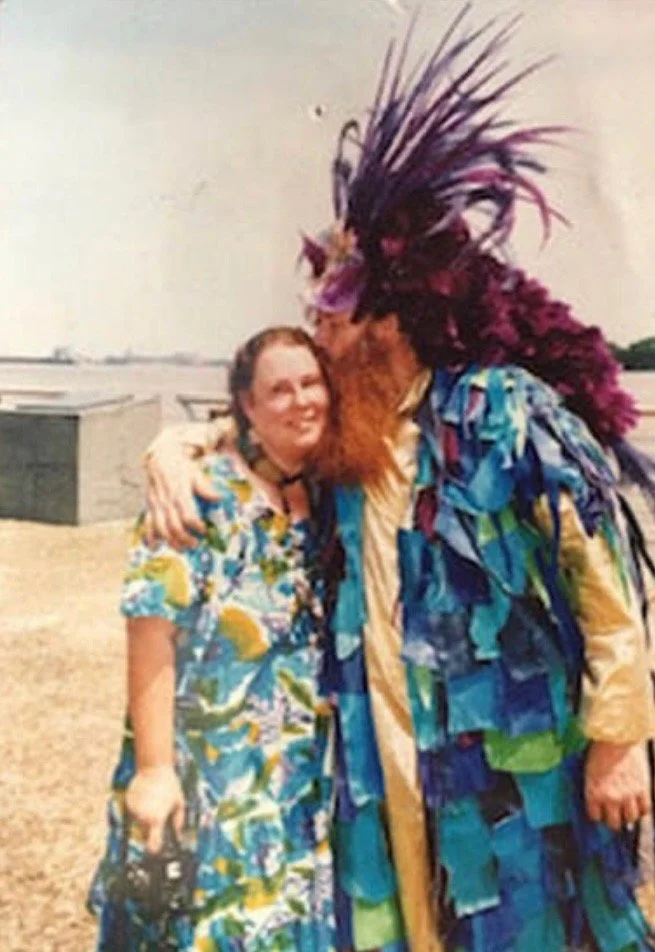
Photographer Pat Jolly with Mike Stark in one of his more “interesting” outfits, photo courtesy Pat Jolly
Mike continued his social work but found a creative outlet by becoming a mask maker and creator of magic and fun, thanks to a suggestion from his friend JoAnn Clevenger. Before opening the popular uptown restaurant Upperline, JoAnn owned a vintage clothing store called Matilda’s on Decatur Street in the French Quarter from 1972.
When a shop two doors down closed, she envisioned opening a costume shop in its place and began purchasing secondhand costumes from thrift stores around the city. Mike helped at the new shop, and as she points out, “He wore overalls in the warehouse but always wore something more interesting at the shop.”
What was missing were masks. A friend, John Fleming, worked in leather and made (and still creates) fabulously sculpted wearable masks, but Mike decided that he wanted something more outrageous to suit himself and his friends. He and JoAnn visited shops in New York City to buy feathers and fabric. A mask maker was born.
Mike created a guild to encourage more people to expand their artistic abilities by making wearable masks to celebrate the holiday New Orleans is best known for, Mardi Gras. He also founded the now-defunct Mask Market, which ran during the last few days of the Carnaval season and was sponsored by the French Market Corporation, which operated it for decades.
It was no surprise that his image appeared alongside other eccentric characters, such as Ruthie the Duck Lady and Gypsy Lou, in the beautiful painting Homage to the French Quarter by his friend, artist Noel Rockmore. Long-term friend, Rockmore, first painted Mike in 1966, when he was attending seminary, with short hair and wearing a suit, very different from the man he would become: a free spirit with long red hair and beard, always garbed in colorful caftans.
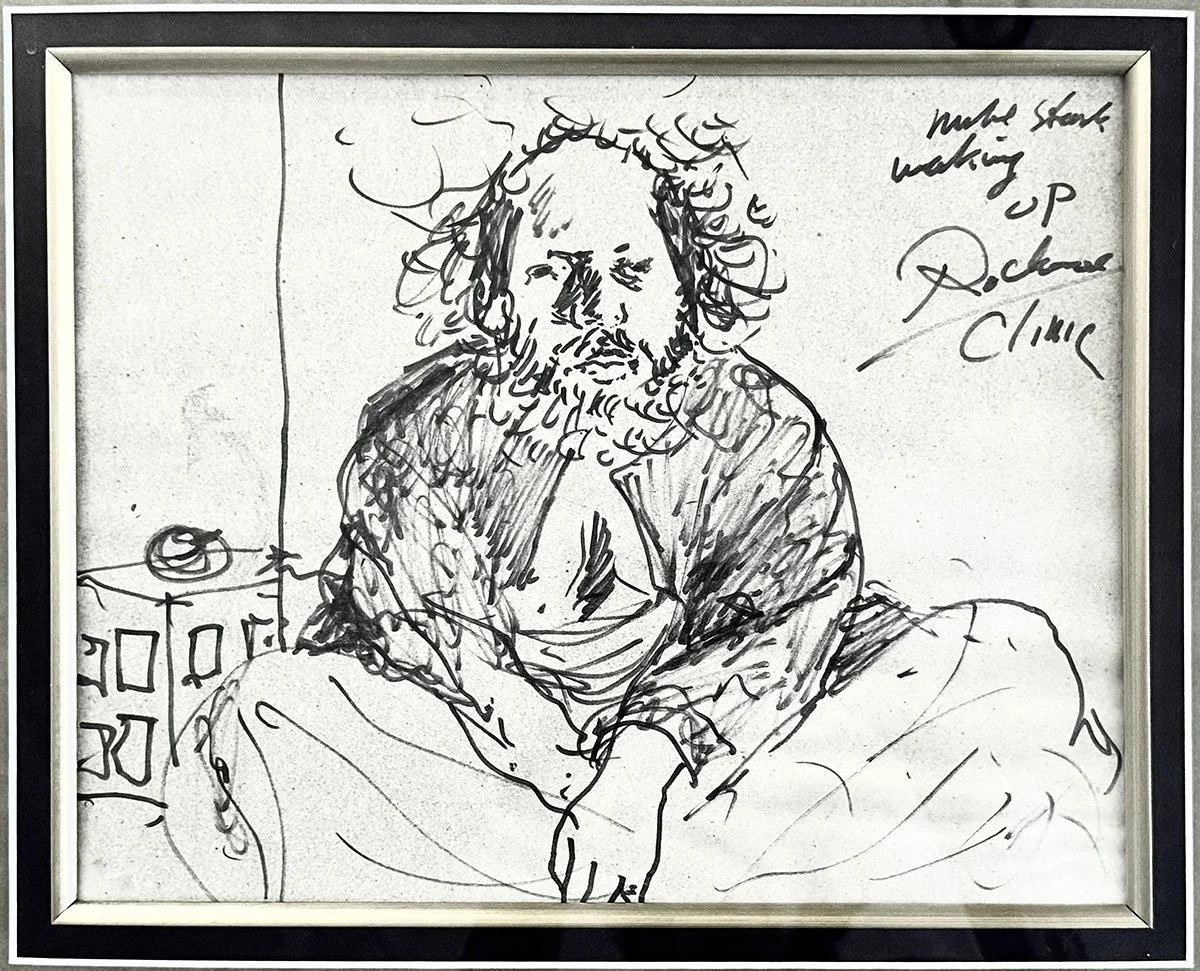
Drawing of Mike Stark by artist Noel Rockmore, date ? Collection of Joann Schmidt and Clare Pierson
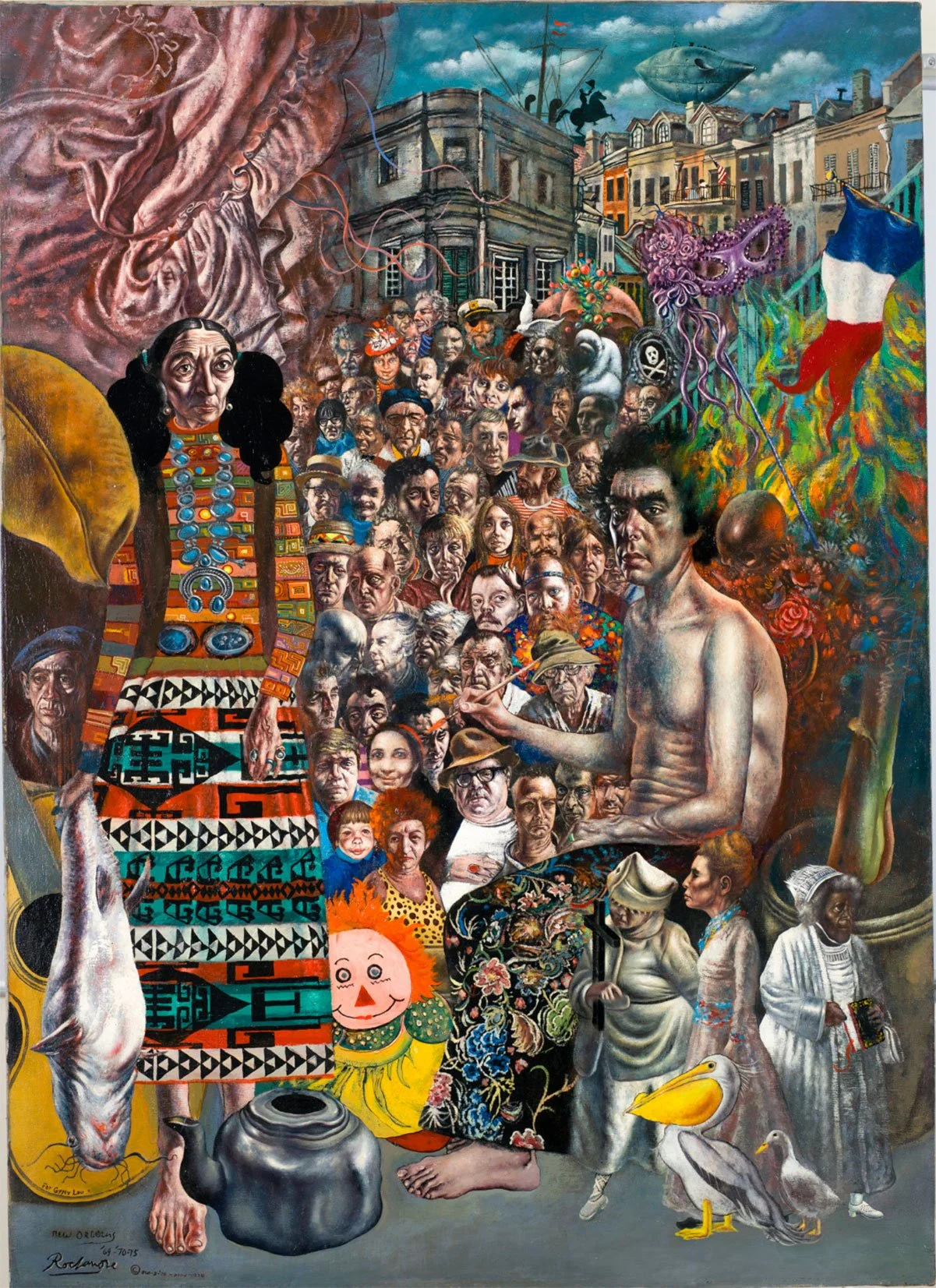
Mike Stark in this Noel Rockmore painting, adjacent to Rockmore’s self portrait. Historic New Orleans Collection, acquisition made possible by the Laussat Society
Rita Posselt, Rockmore’s girlfriend of six years, recalls that Mike asked her if he could use her massive courtyard to host a party celebrating 15 years of the Jazz and Heritage Festival. She agreed, and to her surprise, a second line wound its way through the French Quarter to the yard of her apartment owned by Alan Jaffe, ending with music and the vocals of none other than Odetta.
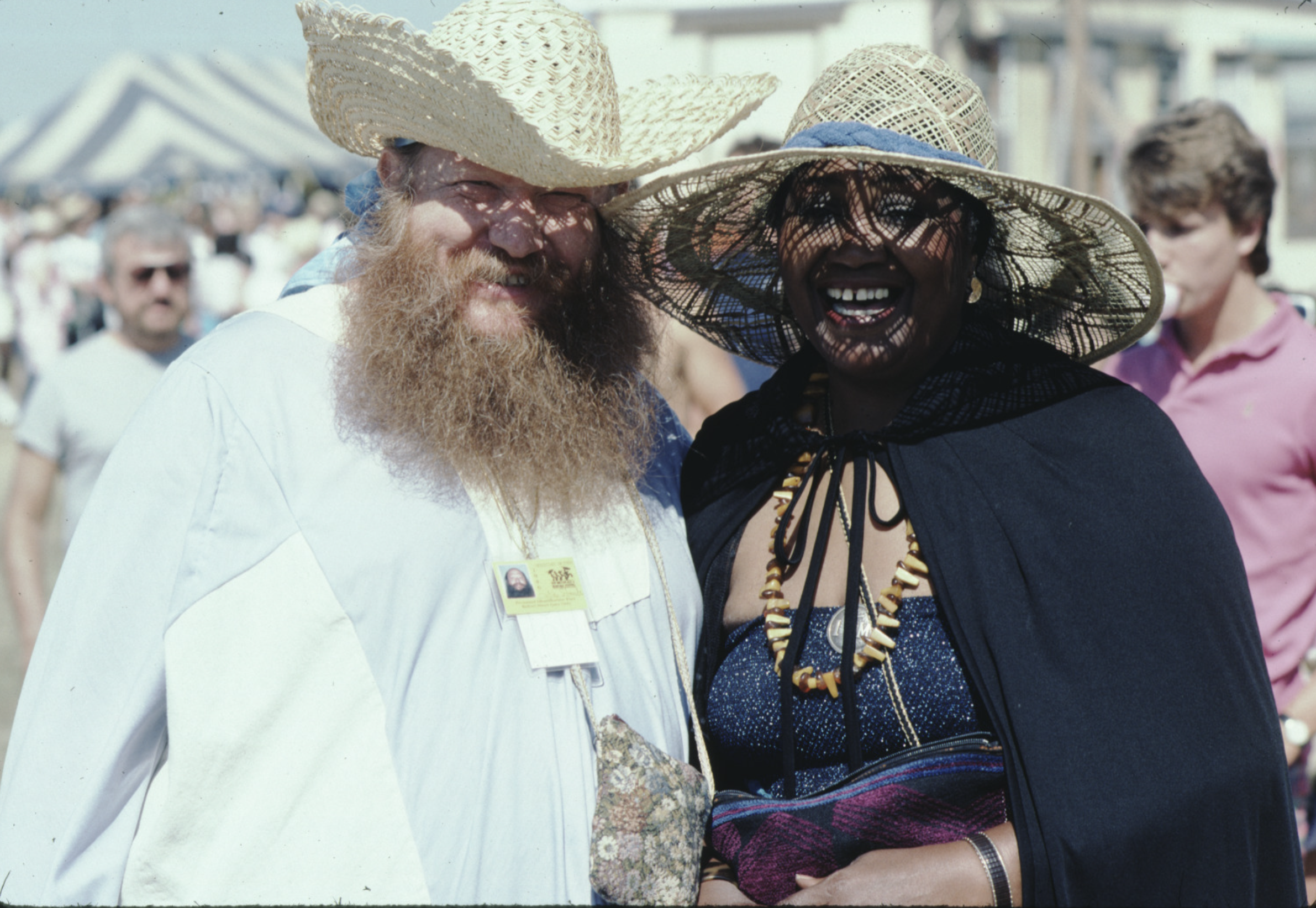
Mike Stark and Odetta, Photograph by Michael P. Smith ©Historic New Orleans Collection, 2007.0103.8.1100
Music was always important to Mike. He told people he was the reincarnation of an old gospel singer. My sister and I would tease him, saying that if he was, he hadn’t inherited the voice, because he couldn’t sing at all.
He was involved with the New Orleans Jazz and Heritage Festival from the early days, posting flyers and handing out brochures to encourage attendance. Mike chauffeured the musicians around in his Corvair. Through his service, many lifelong bonds were forged.
His address book read like a who’s who of coolness – Odetta, Dr. John, David Johannsen (Mike officiated his marriage to Kate Simon in New Orleans in 1984), Rita Cooledge, and many more local and nationally known musicians. Another close friend, B.B. St. Roman, met Mike through their mutual friend, Mac Rebennack, also known as Dr. John. Mike was the creator of much of his trademark feathered finery, a hallmark of his Night Tripper persona.
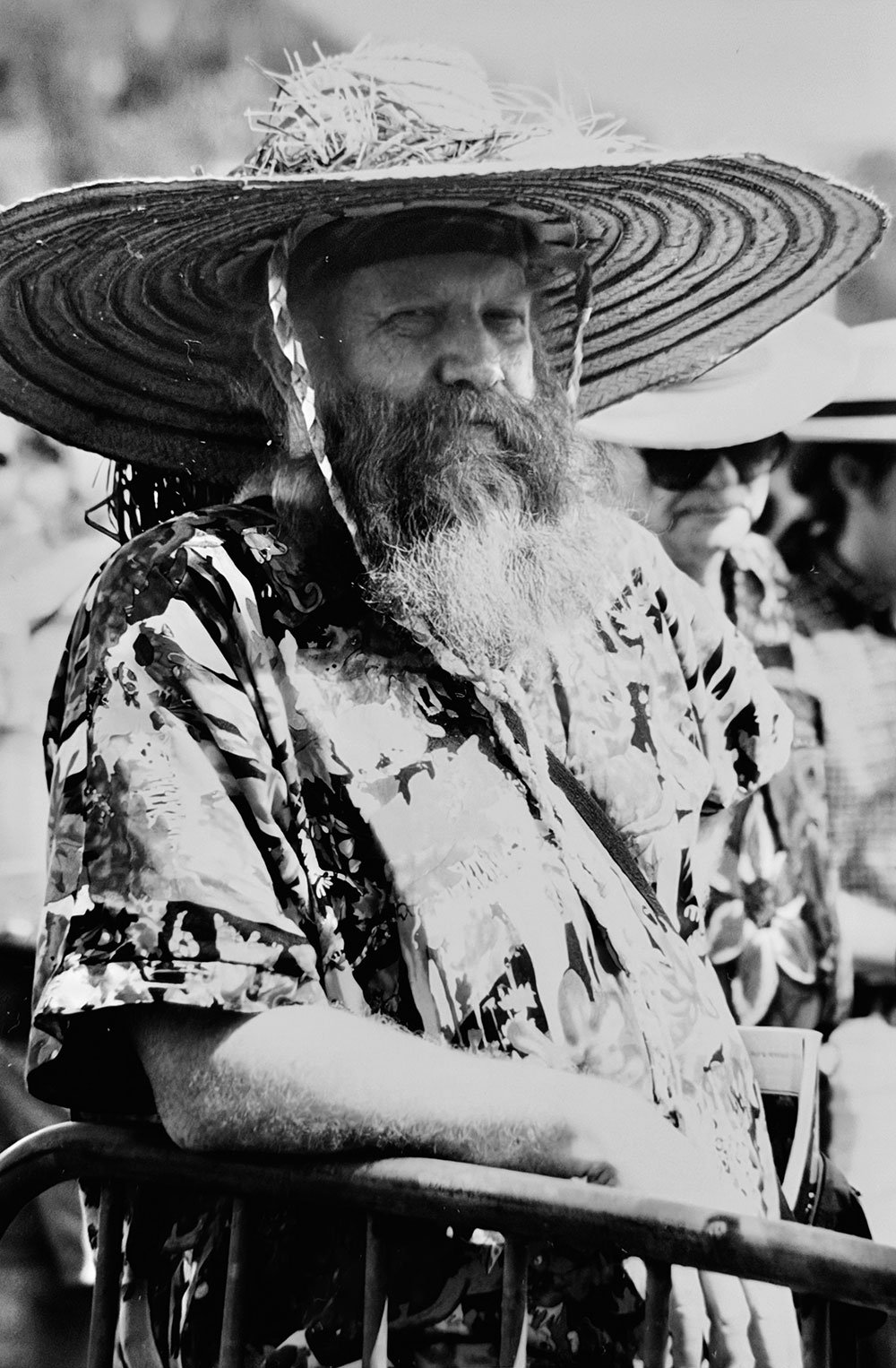
Mike Stark at Jazz Festival, year unknown. From the collection of Joann Schmidt and Clare Pierson
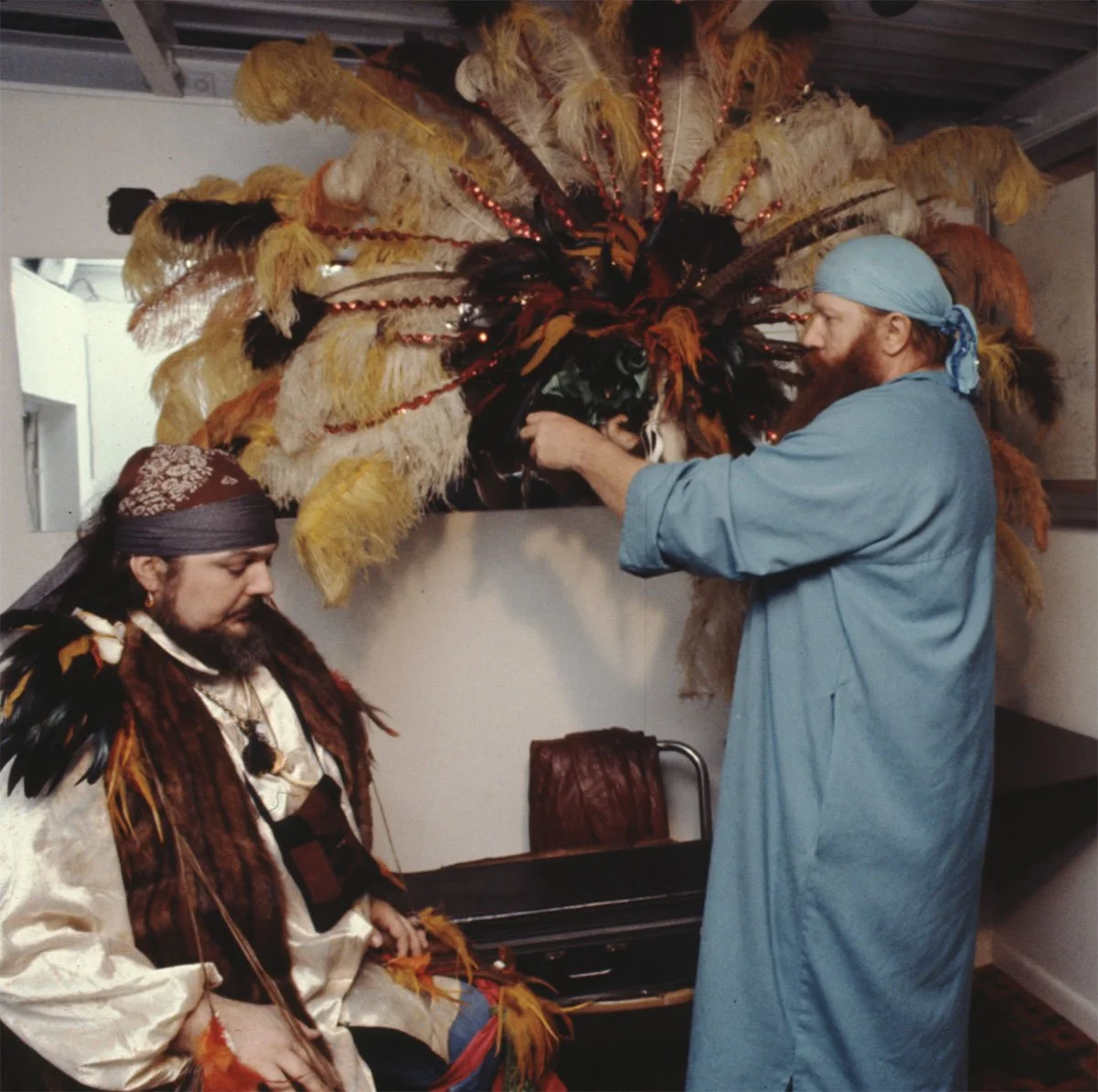
Mike Stark with a new headdress for Dr. John. Photograph by Michael P. Smith ©Historic New Orleans Collection, 2007.0103.8.763
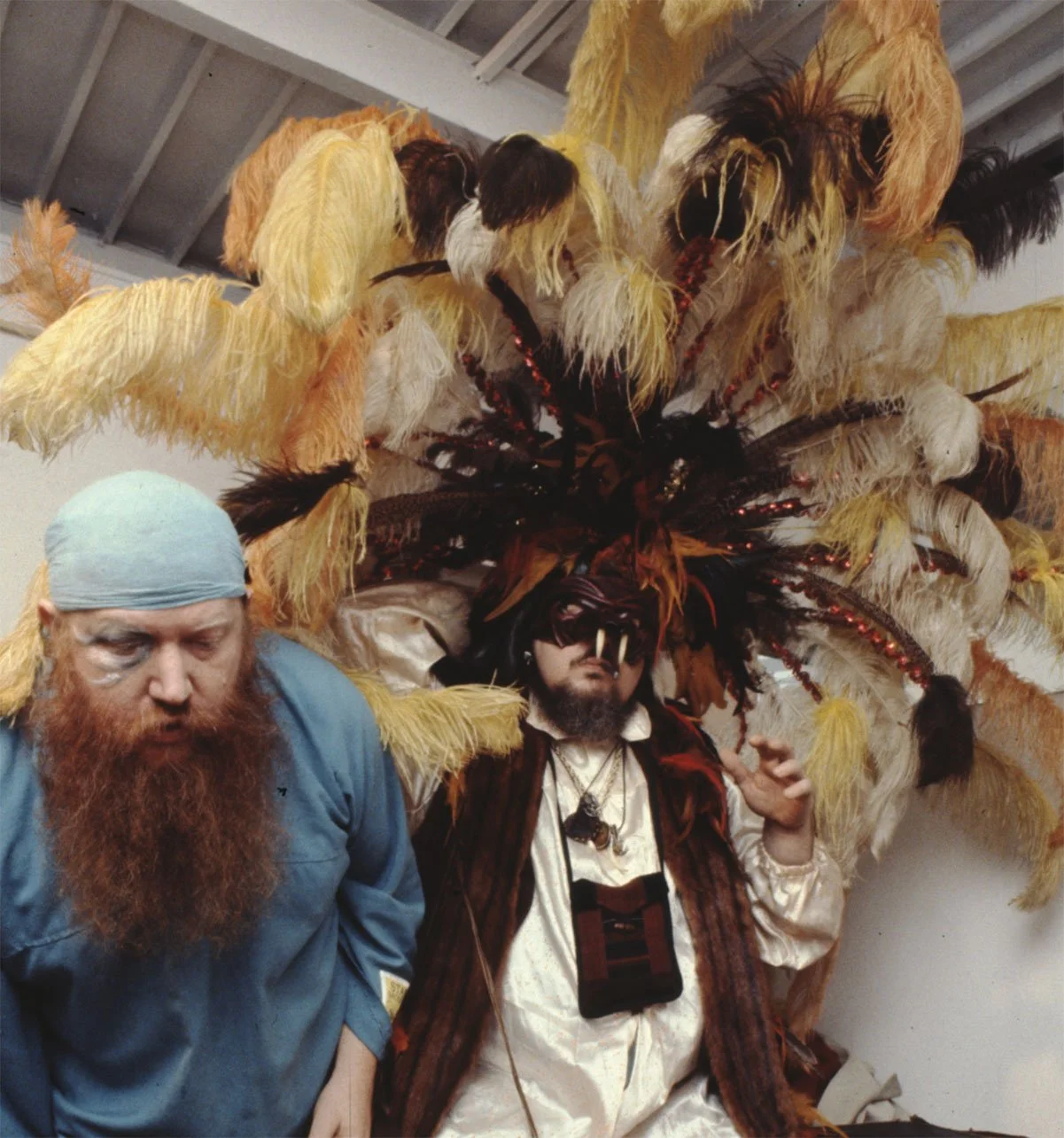
Mike Stark with a new headdress for Dr. John. Photograph by Michael P. Smith ©Historic New Orleans Collection, 2007.0103.8.764
As if he wasn’t busy enough, Mike had a vision and found time to expand the French Market – which at the time sold only produce and other food items – by adding a flea market. He saw it through, helping it grow from just a couple of stalls to the large, world-famous spot it is today. He eventually took his idea all the way to the 1984 Louisiana World Exposition, running the Exposed Flea market in an old warehouse near the fair, along with two restaurants and a coffee-roasting place.
Later in life, Mike settled into running the shop and focusing on mask-making. His masks were owned by many locals, tourists, and celebrities, including shop regulars Harry Shearer and his wife, Judith Owen; Anne Rice; Harry Anderson and his wife, Elizabeth Anderson; Sandra Bullock; and visiting luminaries such as Ringo Starr and his wife, Barbara Bach; Bonnie Raitt; Julie Smith; and countless others who appreciated the offbeat art form. But beyond the beauty of his work, these masks were made to be worn and then displayed, making them functional art.
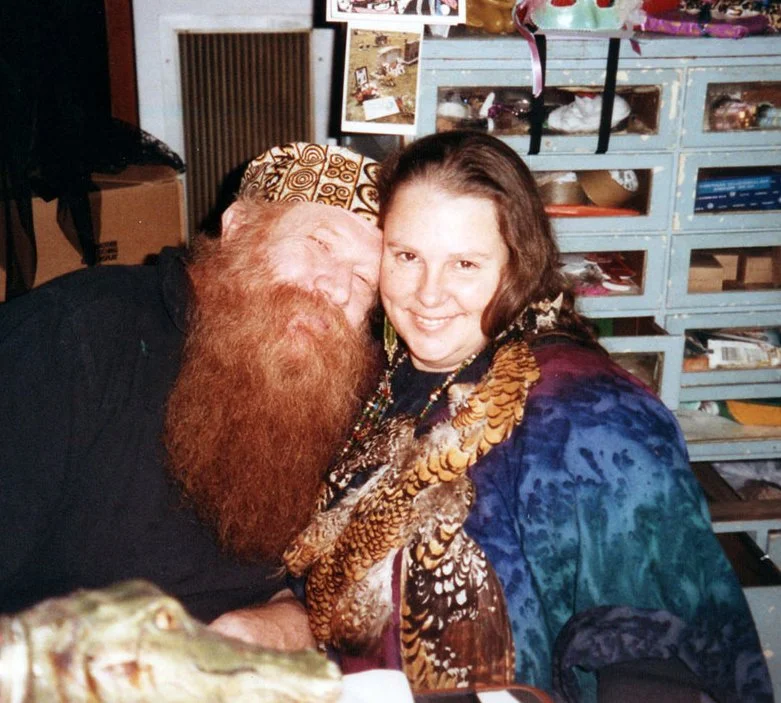
Mike Stark in his shop with photographer Pat Jolly, photo courtesy Pat Jolly
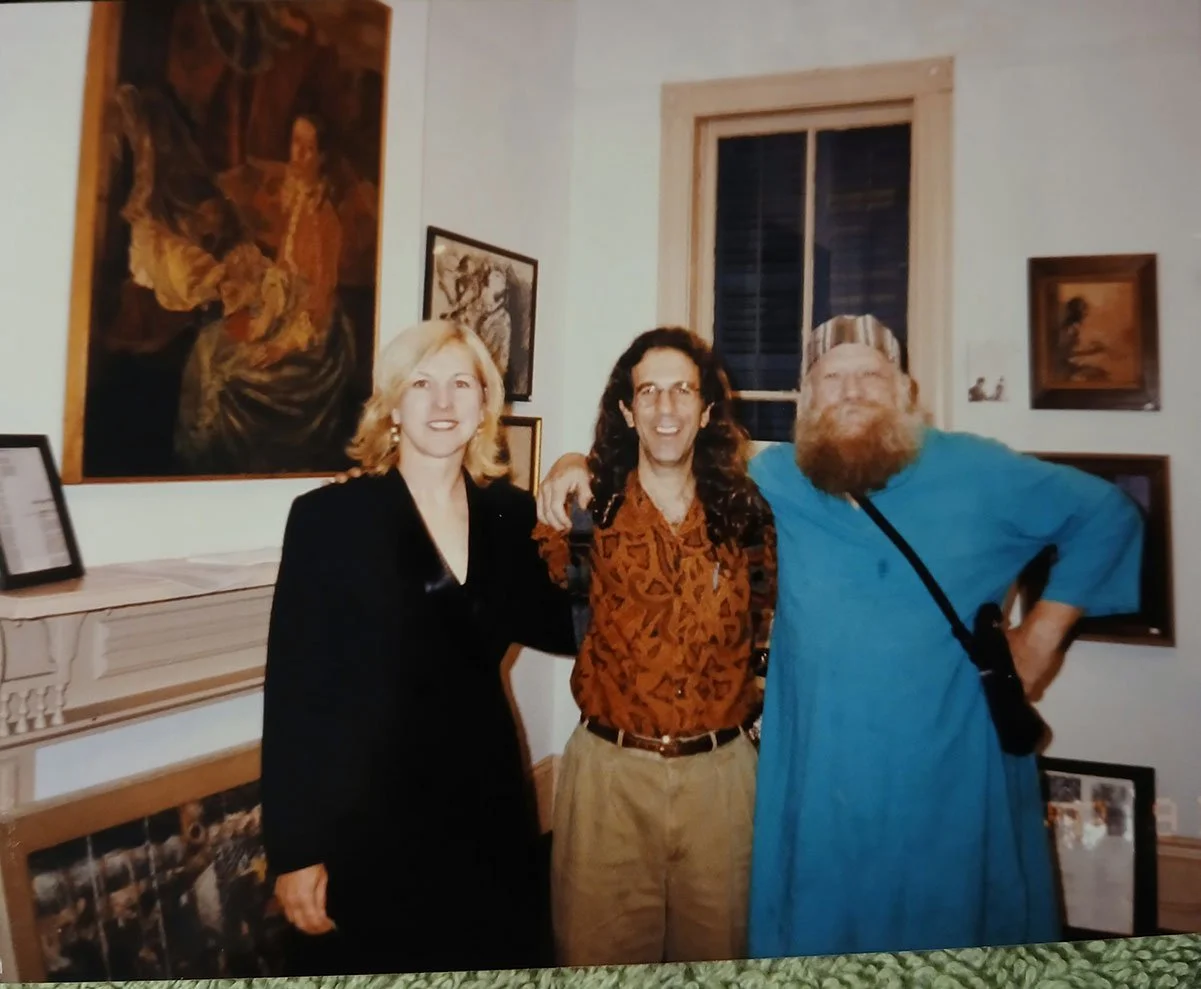
Mike Stark with friends Rita Posselt, Michael Zarrou, photo courtesy Rita
In the early 1990s, Mike had a stroke and soon after found out that the building that housed his shop at the 400 block of Decatur Street was being sold. This is when I met Mike. We found a new spot at 523 Dumaine Street, where he would make masks and entertain customers and friends alike.
Soon after, my sister Ann would take over with the day-to-day running of the shop. She and Mike became very close, and he would teach her how he made his masks and many secrets of feather work. With Ann handling the shop, Mike was free to leave the city and spend the whole month of October at Fast Buck Freddie’s, a department store in Key West, Florida, for the town’s annual Fantasy Fest. He made masks and, with the help of friends, created wonderful matching costumes, which he would bring to Key West to sell.
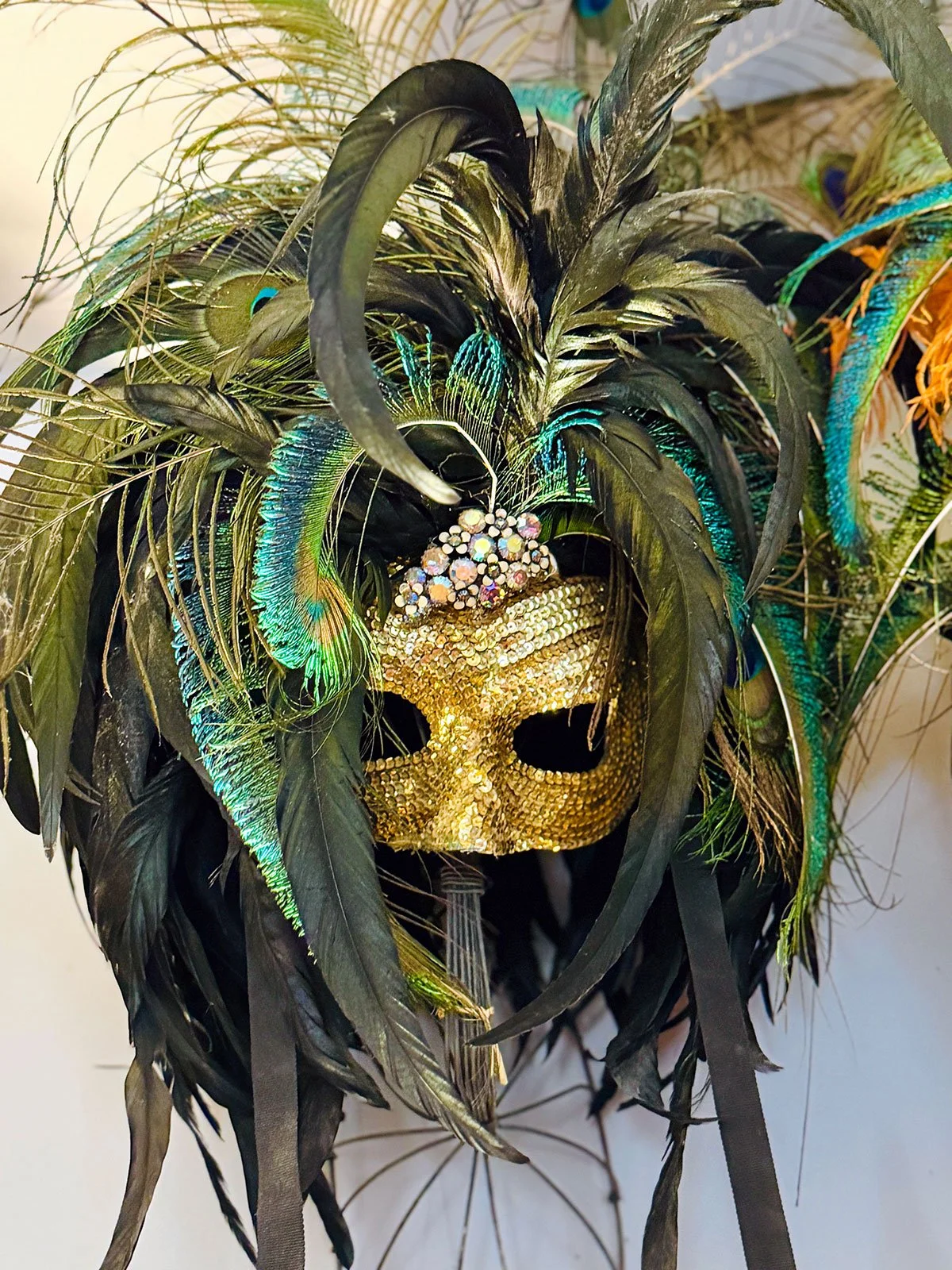
Mask by Mike Stark, collection of Joann Schmidt and Clare Pierson
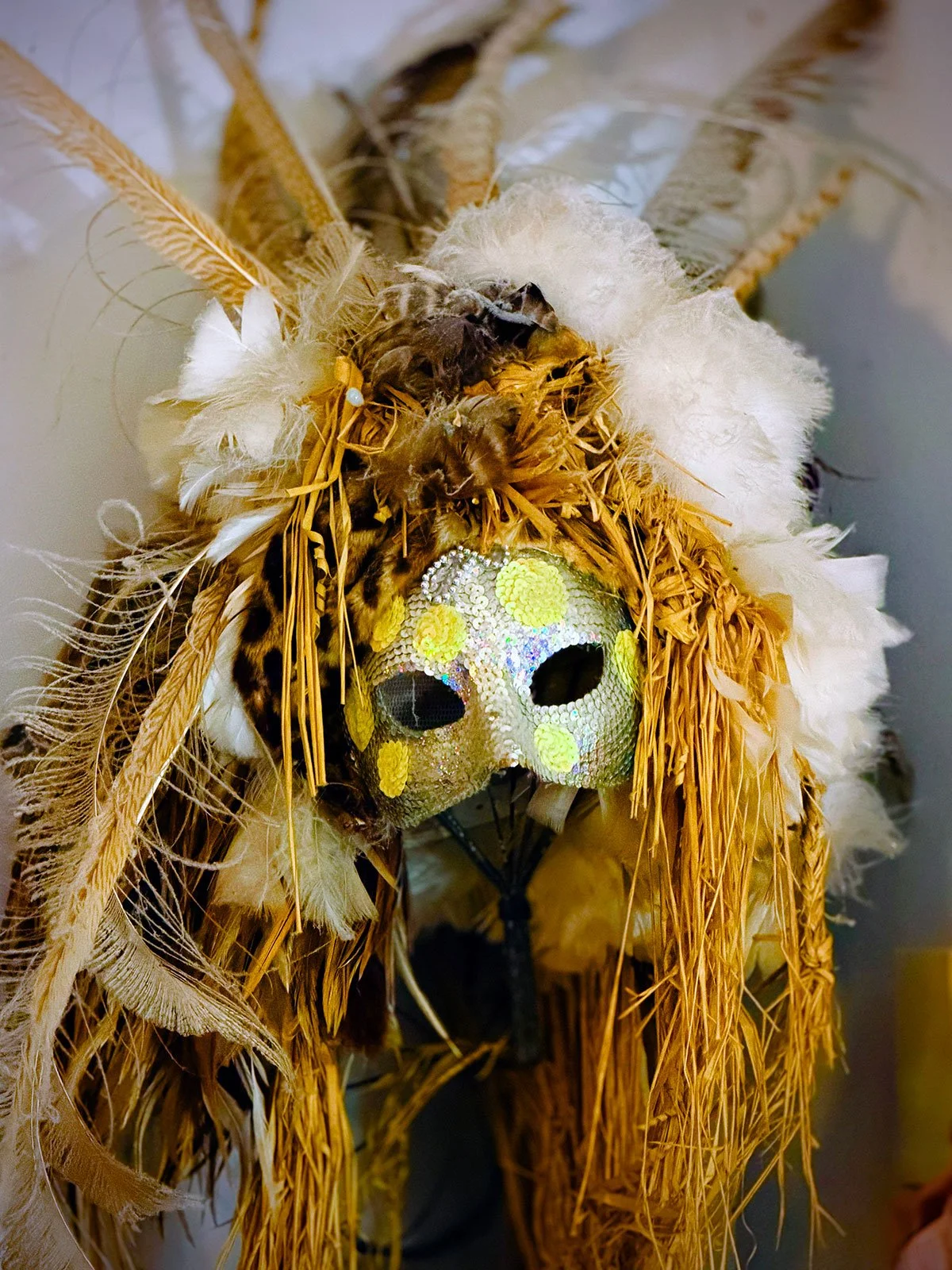
Mask by Mike Stark, collection of Joann Schmidt and Clare Pierson
Mike’s New Year’s Day parties were legendary. It is an old Southern custom to serve black-eyed peas and cabbage on New Year’s Day to ensure a year of good luck and prosperity, a tradition he honored all his life in New Orleans. Marcus Frasier recounts visiting Mike’s tiny attic apartment on Decatur Street in the early 1970s for the obligatory meal. After climbing all those stairs and emerging into the room, he was surprised to find none other than Lindy Boggs, who by now lived nearby in the house at 623 Bourbon Street.
Sacha Borenstein, Larry Borenstein’s daughter, shared Mike’s recipe for his New Year’s Day cornbread. He used a box of cornbread mix, substituted sour cream for half the milk, and added a can of Mexicorn. His black-eyed peas were also phenomenal, and Sasha explained that, in addition to the expected sausage, he added sliced apples, onions, and peppers.
Through his Jazz Fest connections, Mike met a kindred spirit, Joann Schmidt, in the early 1970s. She remained a close friend and, until he passed away, lived in the house she owned with her partner, Clare Pierson. Joann brought up an interesting point: after Mike’s stroke, he became more creative; his masks became even more glorious than before his hospital stay.
***
He died on September 17, 1998.
I will never forget this date because it was my sister Ann’s birthday. Mike told her to go out and enjoy herself and that he would open the store the following day. At around 11:30 am on September 17, we received a call from one of Mike’s old friends, who said Mike had not opened the shop or shown up for lunch.
We immediately knew something was wrong. Anyone who knew Mike knew he would not have missed a lunch date.
We made some calls and decided to check on him. We hopped in the car and drove to his house, which was just blocks away. We knocked and knocked and yelled his name, but there was no answer. We pushed on the door and then tried the doorknob, but it was locked. Ann thought she had a key, so she took out her keyring, and the first key unlocked the door. It opened, but there was an eerie silence as we made our way through the old, creaky door.
We yelled his name again, but there was silence. I opened the door to his bedroom, and there he was, at peace, in his bed. Suddenly, the white, billowy curtain danced up and swayed back down. It was as if he were waiting for us to find him, and that was his final goodbye. We yelled and cried, but he was gone.
We had no idea what to do next. Ann’s best friend, Gretchen, who worked at Jefferson Parish’s coroner’s office nearby, and we called her. She advised us to calm down and call NOPD. We did, and when they arrived, we answered all their questions.
They said they had to seal the door, so we needed to return the key. We handed the police officer what we believed was Mike’s key. He tried to slide it into the lock, but it wouldn’t go in. Ann grabbed her keys from her purse and handed him the full key ring. He tried every key on the ring, but none worked.
Somehow, we had opened the door without a key. We both remember trying the door, but it was locked. It was as if he wanted us to find him.
Mike had opened many doors for us, and the last one he opened was his own.
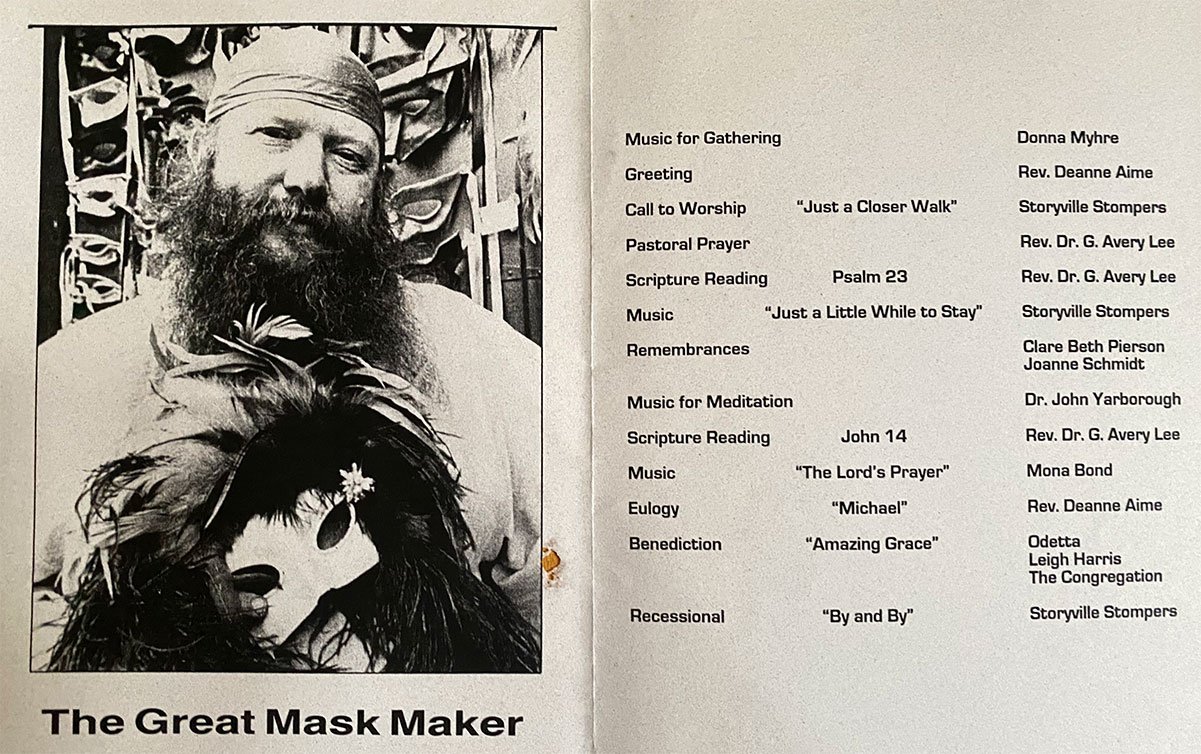
Courtesy Laura Guccione